
Track seven things to know whether your voicebot is working: containment, resolution, transfer quality, abandonment, caller satisfaction, cost per resolved call and compliance. Containment is the one everyone quotes, and it is the easiest to misread. A call can end without a human and still leave the caller with nothing they came for.
This guide is for owners and managers at small and medium Australian businesses: clinics, trades, hospitality venues, sales teams and anyone chasing overdue invoices. It explains what each KPI means, how to calculate it, what to compare it against and when a human should step in. We’re 42Voice, and we build AI voice agents for these jobs, so the examples come from the calls we see most: bookings, after-hours enquiries and payment reminders.
Table of Contents
- The short list of voicebot KPIs
- Containment rate: what it means and how to calculate it
- Why containment alone misleads
- Resolution and task completion
- Transfers, handoffs and abandonment
- Caller satisfaction
- Cost per resolved call
- Compliance as a KPI
- How to set a baseline and report over time
- How to improve containment without hurting quality
- Perspective: what we tell owners to watch
- Where 42Voice fits
- FAQ
- Book a free 15-minute demo
- Sources
The short list of voicebot KPIs
One published framework, Lewis Crook’s 2026 Enterprise Voice AI Benchmark Report, names seven dimensions: gross and net containment, autonomous resolution, end-to-end latency, cost per resolved call, integration depth, operating-model maturity and compliance posture. It is written for large deployments, so we have trimmed it for a business with one to fifty staff.
Here is the version we use with SMEs:
| KPI | The question it answers | How to measure it |
|---|---|---|
| Gross containment | How many in-scope calls did the bot finish without a human? | Calls not transferred ÷ in-scope calls |
| Net containment | How many of those stayed finished? | Subtract callers who rang back about the same thing within 7 days |
| Resolution rate | Did the caller get what they wanted? | Check the outcome in your calendar, CRM or ticket system |
| Transfer rate and quality | When the bot handed off, did it go well? | Count transfers by reason; check the human did not have to start over |
| Abandonment | Did callers hang up early? | Calls ended by the caller before any outcome ÷ total calls |
| Caller satisfaction | Did people feel looked after? | Short post-call survey or text, split by bot-handled and transferred |
| Cost per resolved call | What does a finished job cost? | All platform, phone and staff review costs ÷ resolved calls |
Add response speed (how long the bot pauses before it answers) and compliance checks, and you have a full scorecard. Most owners can start with the first five.
Containment rate: what it means and how to calculate it
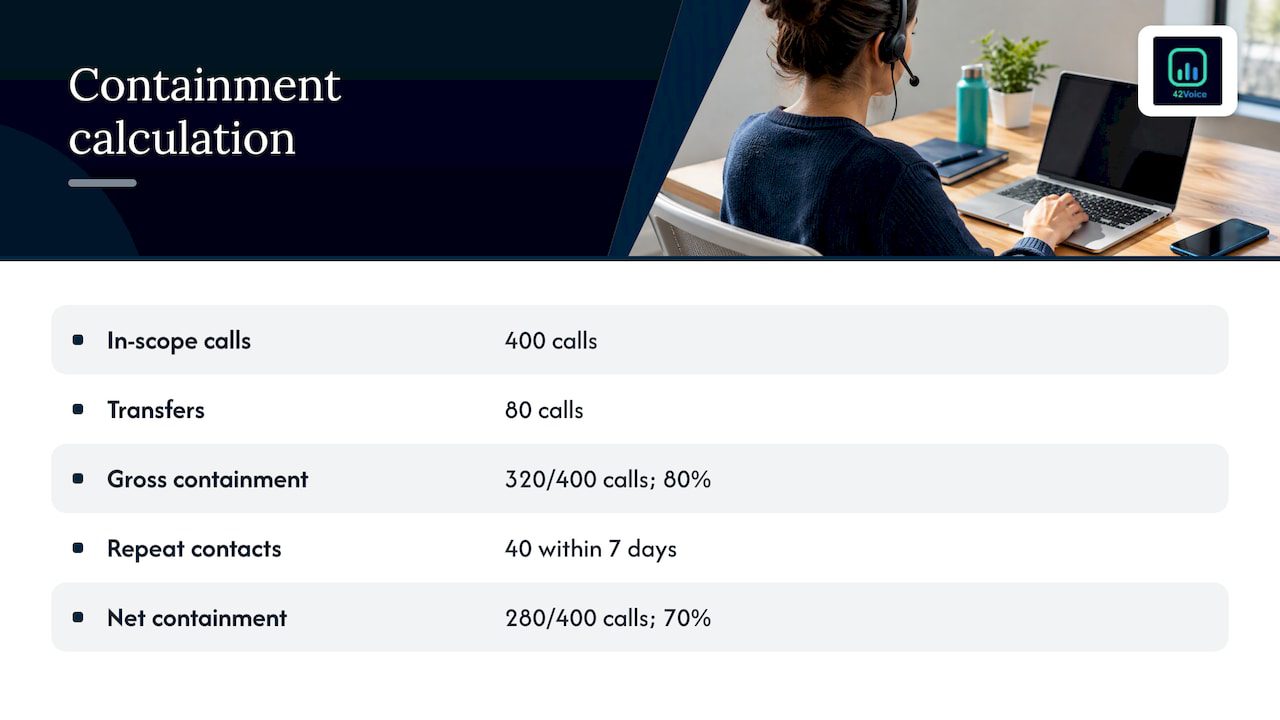
Containment is the share of calls the voicebot handles from start to finish without passing them to a person. In the Crook framework, gross containment is calls not escalated divided by in-scope calls. Net containment goes a step further and subtracts calls where the same person rang back within 7 days about the same intent.
Two details matter.
Define “in scope”. If your bot is built to book appointments and answer opening-hours questions, a call from a supplier or a caller asking for the owner by name is out of scope. Leave it out of the denominator, or your number will punish the bot for jobs it was never given.
Use net, not just gross. Say your bot handles 400 in-scope calls in a month and transfers 80. Gross containment is 80%. If 40 of the 320 contained callers ring back within a week with the same problem, net containment is 280 of 400, or 70%. The 70% is the number that reflects customer experience.
Our own voicebot customer service playbook goes deeper on the 70 to 95% range for contact-centre style work. For a small business, treat any target as a direction rather than a promise, because your mix of calls decides what is realistic.
Why containment alone misleads
A high containment figure can hide a bad experience. A bot that never offers a transfer will be “contained” on every call, including the calls where the caller gave up and hung up.
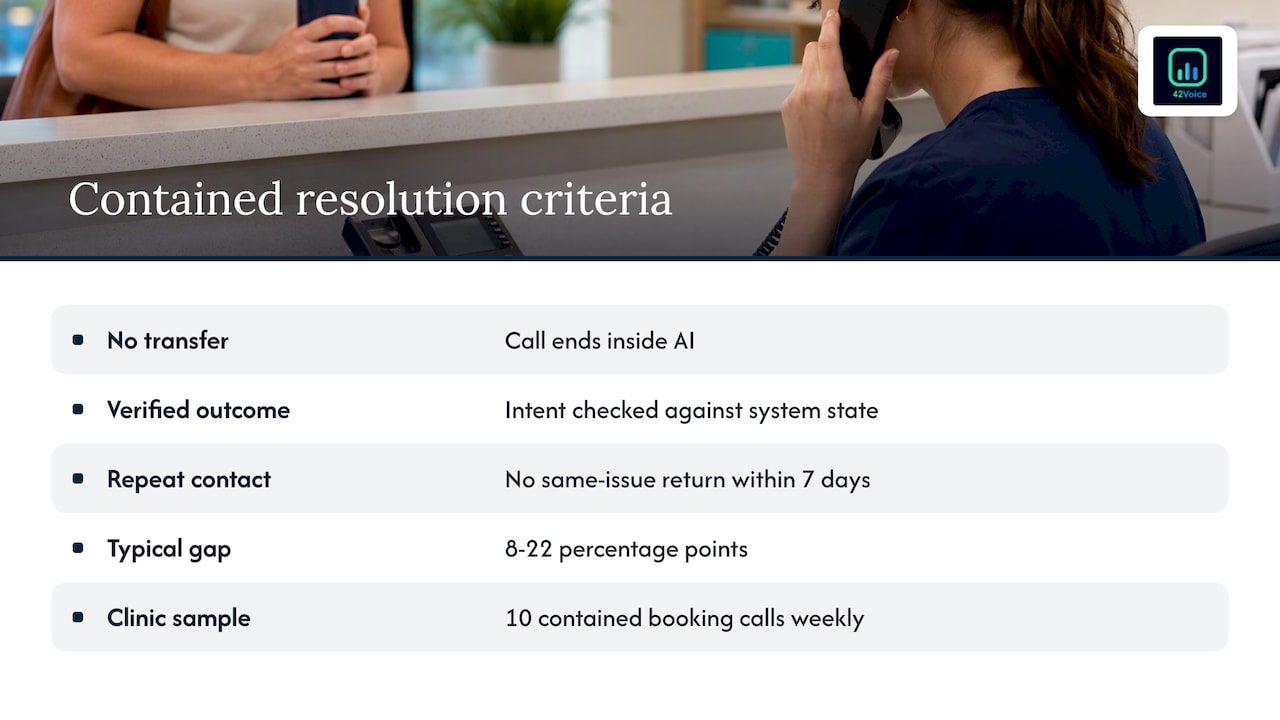
Roark’s piece on containment versus resolution argues for a stricter measure called contained resolution. It needs three things: the call ends inside the AI without a transfer, the intent is checked as resolved against system state, and the caller does not come back about the same issue within 7 days. In plain terms, did the booking land in the calendar, did the payment promise get logged, did the question get answered.
Crook’s report puts the typical gap between containment and autonomous resolution at 8 to 22 percentage points in production deployments. Treat that as a reminder to expect a gap, then measure your own.
A simple check for a clinic: pull ten “contained” booking calls each week and compare them with the diary. If the bot said “you’re booked for Thursday at 2pm” but nothing is in the calendar, that call was contained and not resolved. This is where a calendar integration earns its keep, because the bot writes the booking and you can count it. If you have a tangle of systems, our note on CRM and phone integration shows what a clean connection looks like.
A headline number also needs context. Crook argues that many benchmarks fail because they publish one figure, such as containment, without re-contact rates or call types. Pair containment with repeat contact, customer feedback and task-completion evidence. If you want help building that reporting layer, operational and governance measures beyond containment are a sensible area for a software developer to scope for you.
Resolution and task completion
Resolution rate asks one question: did the caller leave with the outcome they wanted? The cleanest way to measure it is against a system, not the transcript.
- Booking calls: is there an appointment in the calendar with the right service, time and contact details?
- After-hours enquiries: was a callback task created, and was it actioned the next morning?
- Payment reminders: was a payment, a promise to pay or a request for a human logged?
- Support calls: was the ticket closed, or did it get reopened?
Where you cannot check a system, sample transcripts. Read 20 calls a week for the first month. It is slow, and it teaches you more than any dashboard. This is also why we keep humans in the loop on quality: every agent we deploy is backed by human review, so odd calls get spotted and the script is corrected.
Transfers, handoffs and abandonment
A transfer is not a failure. For a nervous patient, an upset customer or a complex quote, a transfer is the right outcome. What you track is why transfers happen and how well they go.
Log every transfer with a reason:
- Caller asked for a person.
- Topic out of scope.
- Bot did not understand after two attempts.
- Emotional or sensitive call.
- Sales-ready lead or complex decision.
Then check the handoff quality. The person who picks up should already have the caller’s name, the reason for the call and what the bot has already said. If the caller has to repeat everything, the handoff has failed even when the transfer technically worked. Our guide to AI-to-human handoff best practices covers what to pass across.
Roark also suggests splitting satisfaction scores by contained and transferred calls. If contained calls score much worse than transferred ones, the bot may be forcing resolution on callers who needed a person. If transferred calls score worst, your handoffs are blind, with no context passed and long waits.
Abandonment is callers hanging up before they get an outcome. Watch where in the call it happens. Hang-ups in the first 10 seconds usually point to the greeting or a long pause. Hang-ups after a menu of options point to too many choices. Hang-ups during identity checks suggest the bot is asking for too much.
Caller satisfaction
Ask after the call, briefly. One question by text message works: “Did we sort out what you needed?” with yes or no, and an optional comment. Keep it short because a long survey measures patience, not satisfaction.
Compare three groups: bot-resolved calls, transferred calls and calls to your human team in the same period. You are not looking for the bot to beat people. You are looking for no big gap between what callers get after hours and what they get at 10am on a Tuesday.
Cost per resolved call
Divide the total cost of running the voicebot by the number of calls it actually resolved, not the number it answered. Include the subscription, phone charges and the staff time spent reviewing calls and handling transfers.
The Crook report gives illustrative UK figures in pounds, from £0.40 to £1.00 for a simple balance check up to £4.00 to £12.00 for disputes. Use them only to see how cost climbs with complexity, not as an Australian benchmark. Your own figure is better compared against what the same call costs you now: the staff minutes, plus the revenue lost when nobody picks up.
That second part is the one most owners miss. A tradie on a roof or a dentist mid-procedure cannot answer, and a caller who gets voicemail often rings the next business. Our piece on increasing call answer rates with human handoff looks at that side of the maths. Pricing at 42Voice is tailored to each business, so we work out your cost per resolved call with you during the demo rather than quoting a generic number.
Compliance as a KPI
Compliance belongs on the scorecard because failures are costly and avoidable. Track:
- whether the bot discloses it is an AI at the start of the call, where your policy requires it
- whether call recording notices are given
- opt-out requests honoured, and how fast
- for outbound work, whether numbers were checked against the Do Not Call Register before dialling
Outbound sales and collections have extra considerations in Australia: the Do Not Call Register, the Privacy Act and how you disclose the use of AI. We cannot give legal advice, so take your call scripts and lists to your lawyer or a compliance adviser before you go live. Our call compliance checklist is a practical starting point for the questions to ask.
How to set a baseline and report over time
You cannot tell whether a voicebot is improving anything without a before picture. Do this before launch:
- Count your current calls for two to four weeks. Total, answered, missed, after hours, and the top five reasons people call.
- Record outcomes. Bookings made, enquiries lost, callbacks needed, average time to return a missed call.
- Pick three to five KPIs. Net containment, resolution, transfer reasons, abandonment and caller satisfaction is a good set.
- Segment from day one. Report by call type (bookings, pricing questions, payments), by time of day and by language if you serve multilingual callers. An average across all calls hides the one type that is failing.
- Review weekly for the first month, then monthly. Look at trends and a handful of listened-to calls, not just percentages.
- Change one thing at a time. If you change the greeting and the booking flow together, you will not know which moved the number.
In a pilot of four to six weeks, expect containment to rise as gaps in the script are found and fixed. Our AI receptionist versus human pilot guide shows how to structure that comparison.
How to improve containment without hurting quality
A useful academic paper on conversational AI and virtual agents (an IT service desk study) points to practical levers. Applied to a business phone line, they look like this.
Audit what people actually ask. Read transcripts of calls that were transferred or abandoned and group them by intent. The biggest group of unhandled questions is where to add content. Often the bot understood perfectly; it just had no answer. A plumber’s bot that cannot say whether you service a suburb will lose calls no matter how good its speech recognition is.
Handle out-of-scope gracefully. When the caller asks for something the bot cannot do, it should say so, offer a callback or transfer, and capture the details. Looping back to the main menu is what drives people to hang up.
Pass context in every handoff. The human should see the summary and transcript. This raises satisfaction on transferred calls and shortens handle time.
Offer fewer choices at a time. Reveal options progressively. “Are you calling to book, change or cancel?” beats a list of eight services.
Fix the data behind the bot. Opening hours, service areas, fees and cancellation policies must be current. Outdated answers produce confident wrong calls, which damage trust more than a transfer does.
Do not chase 100%. Never raise containment by hiding the transfer option. Distressed callers, complex complaints, negotiations, clinical concerns and anything involving a vulnerable customer should reach a person quickly. Higher containment is only a win when resolution and satisfaction hold.
Perspective: what we tell owners to watch
Most owners ask us for one number. We give them two, resolved calls and happy callers, and then a third thing to read: the transfers.
Our stance is simple. A voice agent should take the repetitive, high-volume calls, the bookings, the opening-hours questions and the after-hours enquiries, so your people have time for the calls that need judgment, empathy or a close. That is why we measure handoff quality as seriously as containment. A well-timed handoff is the system working as designed, and a team that trusts the transfers will use the tool properly.
We also push owners to read calls. Dashboards show what happened, and recordings show why. Our human-in-the-loop review exists because scripts that look perfect on paper meet real accents, background noise and unexpected questions on day one. For help with a mixed-accent customer base, see our guide to AI voice accents for business calls.
If you are choosing a first use case, start with missed and after-hours calls. The baseline is easy to measure (calls that previously went to voicemail), the risk is low, and every answered call is a gain.
— Alston
Where 42Voice fits
If you want these KPIs without building the reporting yourself, our AI Receptionist answers calls 24/7, books into your calendar, hands complex calls to your team and gives you call transcripts and analytics to review. Agents go live in 3 to 5 days, with no lock-in contracts. See plans and pricing for Starter, Growth and Scale; pricing is tailored to your business.
If you also want to see how customers respond to follow-up messages and feedback loops, pairing containment with feedback and quality review is worth discussing with a marketing adviser who handles chatbot work.
FAQ
What is a good containment rate for a voicebot?
It depends on the call mix. A line that mostly takes bookings and simple questions will contain more than one that handles disputes or complaints. Set your target from your own baseline, measure net containment and resolution alongside it, and only call it good if satisfaction holds.
What is the difference between containment and resolution?
Containment means the call ended without a human. Resolution means the caller’s problem was actually solved, which you can confirm in a calendar, CRM or ticket system. A call can be contained and unresolved, which is why we recommend tracking both.
How do I improve voicebot containment?
Read transcripts of transferred and abandoned calls, group them by reason and add answers for the most common gaps. Then fix out-of-scope handling and keep your business information current. Do not remove the option to reach a person, because that raises the number while hurting customers.
Which voicebot KPIs should a small business start with?
Start with net containment, resolution rate, transfer reasons, abandonment and a one-question satisfaction check. Measure your call volumes for a few weeks before launch so you have a baseline to compare against.
Book a free 15-minute demo
Want to see what your own scorecard would look like? Book a free 15-minute demo and we will walk through your calls, your calendar and the KPIs that matter for your business.
Sources
- 2026 Enterprise Voice AI Benchmark Report
- Containment rate is not resolution
- Conversational AI and Virtual Agents in ServiceNow ITSM
Recommended
- AI Call Analytics for SMBs: A Practical Pilot Guide
- Containment 70–95%: Voicebot Customer Service Playbook for CX Leaders
- Decision Makers: 3 AI Voice Agent Use Cases to Pilot This Quarter
- IVR vs Voicebot: Which One Fits Your Call Flows?
This article is general information about AI voice technology and isn’t legal or compliance advice. Requirements for call recording, AI disclosure and outbound calling vary by state and use case.