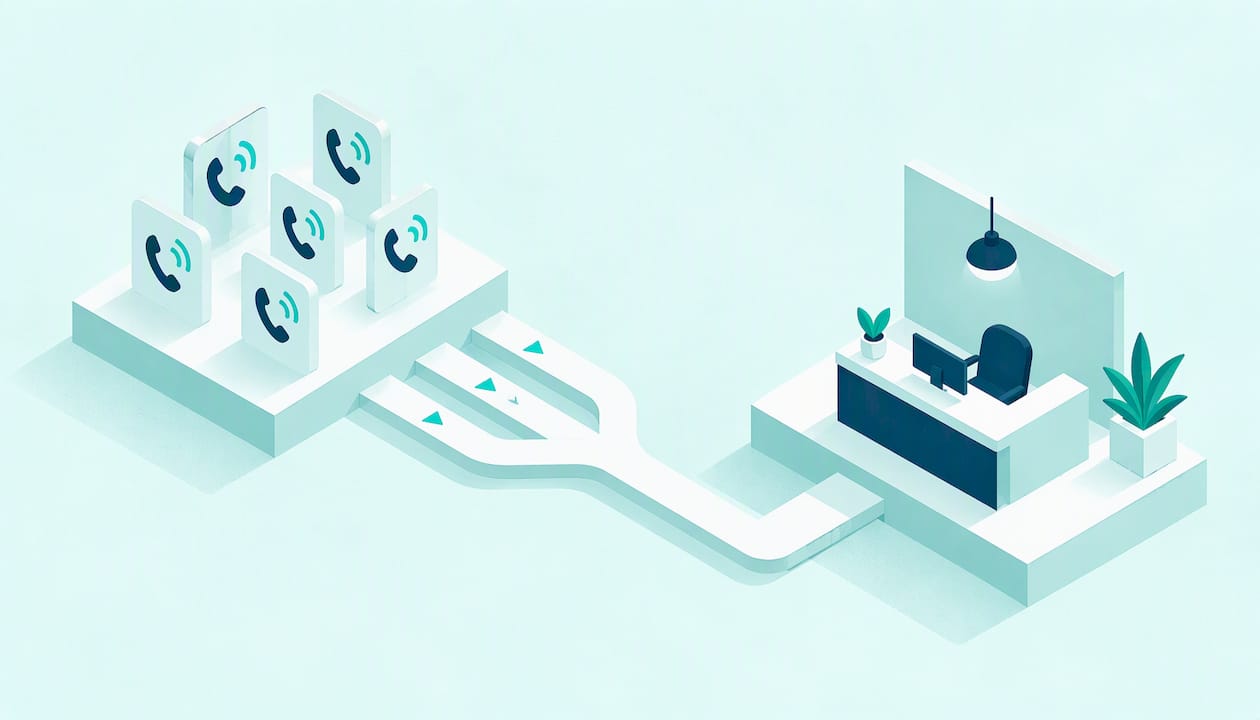
Use a recognisable caller ID, fail-safe routing, and automated callbacks tied to your CRM, then track your answer rate weekly to prove each change works. To increase call answer rate without breaking the rules, stay inside ACMA and Do Not Call Register limits. We build AI voice agents at 42Voice, and we pair them with human handoff.
Table of Contents
- 1. How do you fix caller ID and number reputation?
- 2. When is the best time to call?
- 3. How should you route calls so they get answered?
- 4. Which automation and callbacks reclaim missed calls?
- 5. Why connect your phone system to your CRM?
- 6. Could carrier or provisioning faults be hurting you?
- 7. What compliance and consent rules affect your calls?
- 8. How do you measure, test and iterate?
- 9. Where do role-based AI agents and human handoff fit?
- 10. Want to see these tactics in action?
- FAQ
- Sources
1. How do you fix caller ID and number reputation?
People ignore numbers they don’t recognise, and spoofing makes that worse. ACMA notes that caller ID spoofing exists, that telcos run systems to cut it, and that you should contact your telco straight away if your number is being spoofed.
- Use one consistent business number for outbound calls, not a rotating pool.
- Ask your telco whether business name display is supported on your service.
- Ask your telco to check whether your number is being flagged or blocked.
- Put the same number on your website, invoices and email signature.
If answer rates drop suddenly, check for spoofing reports, then check provisioning.
Pro Tip: Leave a short voicemail with your business name and a return number, then send a follow-up SMS so unknown-number callers can verify you.
2. When is the best time to call?
A safe rule of thumb is to call when people are reachable and rules allow it. Telemarketing calls are limited to weekdays 9am to 8pm and Saturdays 9am to 5pm, with no calls on Sundays or public holidays.
Blind redialling annoys people. Offering a “request to call” option on your contact page, as Business, lets prospects choose their own time, and a scheduled callback honours it. A virtual queue works on the same principle, and this callback guide explains the workflow.
Test your own timing:
- Split one lead list into two equal groups.
- Call group A mid-morning and group B late afternoon over a consistent test period.
- Keep scripts, caller ID and agents identical.
- Compare answer rates, then swap the windows to check the result holds.
3. How should you route calls so they get answered?
Most missed calls happen when the right person is busy or away, not when nobody cares.
- Use ring groups so a call rings several people at once, not one desk.
- Use hunt groups to roll a call to the next free person after a set number of rings.
- Use skill-based routing so bookings, billing and sales calls reach the right people first time.
- Set overflow to voicemail with a callback promise, or to an after-hours agent, when everyone is busy.
- Set escalation rules for absences, so a sick day never means silence.
Before peak periods, check that your roster matches the busiest call hours, and that each person’s phone is actually logged into the group. Our after-hours agent covers the gaps when your team is offline.
Pro Tip: Set a brief ring time before overflow kicks in, then review the missed-call log weekly to adjust.
4. Which automation and callbacks reclaim missed calls?
A callback flow gives a caller a choice: hold, or leave a number and be called back. It recovers prospects that repeated retries would lose, because the contact happens when they’re free.

An AI receptionist can answer instantly, take the details, book into your calendar and hand anything complex to a person. We design every agent so that nuance, empathy and closing stay with your staff, and we keep a human in the loop for quality review. Our AI Receptionist handles the repeatable calls.
What you need before a pilot:
- Calendar access for booking.
- A notification channel, such as SMS or email, for handoffs.
- A written list of calls the agent handles and calls it escalates.
- A short pilot on one number, as described in our phone automation guide.
Pro Tip: Start with after-hours calls: the volume is low, the risk is small, and the missed calls are easy to count.
5. Why connect your phone system to your CRM?
When a call lands, your team should already know who is calling. Disconnected systems force callers to repeat themselves, and callers who repeat themselves hang up. Our CRM phone integration page covers screen pops in more detail.
A useful screen pop shows:
- The caller’s name and company.
- Recent orders or bookings.
- Open tickets or unpaid invoices.
- The last person who spoke to them and what was promised.
Test it with known customers. Compare how long the opening of the call takes with and without the pop. Even a basic setup saves staff from asking the same questions, and restaurant CRM and analytics show how customer data supports booking-heavy businesses.
6. Could carrier or provisioning faults be hurting you?
Sometimes the problem is technical, not behavioural.
- A sudden drop in answered calls with no change in staffing is a warning sign.
- Callers reporting that they hear nothing, or that calls drop, points to a fault.
- Customers saying your number called them when it didn’t suggests spoofing.
- Check recent number porting for incomplete routing, and review the health of your SIP trunk.
- Monitor call quality and answered-call counts daily.
Contact your telco first with dates and examples. The ACCC has noted that business applications depend on reliable connectivity, so treat phone infrastructure as seriously as your scripts.
7. What compliance and consent rules affect your calls?
Good practice and legal practice point the same way: clear identity builds trust, and trust gets calls answered. The Do Not Call Register lets individuals register personal numbers, and telemarketers should remove those numbers before calling. Business numbers generally can’t be registered, but consent rules still apply.
- Callers must identify themselves, their employer and provide a return number.
- Hold clear consent before marketing contact.
- Make opting out easy, as ACMA flags unsubscribe problems as a common failing.
- Tell callers at the start if you record the call.
ACMA’s consumer consent statement of expectations was last updated on 17 February 2026. Check it before you launch any outbound campaign.
This is general information, not legal advice.
8. How do you measure, test and iterate?
Track a short list every week:
- Answer rate.
- Speed to answer.
- Missed-call-to-conversion rate.
- Callback completion rate.
Then run three quick experiments: a caller ID split test, a time-of-day split, and callback versus redial. Change one thing at a time, run each test for a consistent period, and scale only the winners. Avoid confounding factors such as a promotion, a public holiday or a staffing change in the same window.
| KPI | What it tells you | Quick test |
|---|---|---|
| Answer rate | Whether callers connect | Caller ID split |
| Speed to answer | Whether routing works | Ring group changes |
| Missed-call-to-conversion | Value of recovered calls | Callback versus redial |
| Callback completion | Whether callbacks land | Time-of-day split |
9. Where do role-based AI agents and human handoff fit?
Most small businesses miss calls for one reason: a person can’t be on every line at once. We give each agent a defined role, such as receptionist or sales development rep, so it handles the high-volume, repeatable calls: bookings, simple questions, qualification. Anything that needs judgement, empathy or a close goes to your people.
Our usual path:
- A short pilot on one number or one after-hours window.
- CRM and calendar integration before go-live.
- A review of transcripts and answer rates, with a human checking quality.
We’re honest about the limits. A distressed caller, a complaint or a complex negotiation belongs with a person. For outbound calling, you still need to respect the Do Not Call Register and the Privacy Act, and be upfront that a caller is speaking with an AI agent. We don’t replace staff; we protect their time.
Pro Tip: Write down the three call types you never want automated, and give that list to your agent configuration on day one.
— Alston
10. Want to see these tactics in action?
Book a free 15-minute demo and we’ll walk through your call flow: where calls get missed, what a callback could recover, and where human handoff fits. It’s low commitment, and pricing is tailored per business.
- See our AI Receptionist answer and book live.
- Compare plan options on our pricing page.
- Hear how handoff works, so your staff keep the human moments.
Book your free demo and bring one real missed-call example.

FAQ
How do you get more calls answered?
Answer faster, present a recognisable number and make sure calls never dead-end. Fix routing, add callbacks and use after-hours cover so every call has somewhere to go.
What is a good average speed of answer for a call centre?
Targets vary by industry and no single figure fits every business. Set your own baseline, then aim to improve it each month.
What KPIs matter most for call handling?
Track answer rate, speed to answer, missed-call-to-conversion and callback completion. Together they show whether callers connect and whether those connections become customers.
What improves customer experience on calls?
A screen pop that shows who is calling, quick routing to the right person and a clear callback option all help. Customers dislike repeating themselves, so connected systems matter.
Sources
- Donotcall
- Business
- Caller ID scams | ACMA
- Consumer consent: expectations for businesses conducting telemarketing and e-marketing | ACMA
- Broadband services provide good connectivity to popular business applications | ACCC
Recommended
- Answering Service vs Call Center: A Safe AI Pilot for SMEs in 30 Days
- AI Voice Cloning for Australian SMEs: Automate, Don’t Replace Staff
- Stop Missing Bookings: Call Answering for Auto Repair Shop Operations
- Pilot AI Call Center with Human Backup for SMBs in 3–5 Days
This article is general information about AI voice technology and isn’t legal or compliance advice. Requirements for call recording, AI disclosure and outbound calling vary by state and use case.