
Fix auto repair call answering by pairing a repeatable phone standard with an AI or after-hours layer that syncs to your DMS. That combination cuts missed calls, lifts your booked-appointment rate, and writes intake straight into your shop system instead of onto a sticky note your advisor loses by lunch.
Table of Contents
- What Is the Auto Repair Call Answering Standard?
- How Does AI Handle After-Hours and Overflow Calls?
- Should Humans or AI Answer the Phone First?
- Which Metrics Prove Your Call Handling Is Working?
- How Fast Can You Deploy This?
- Why the Phone Deserves the Same Attention as Your Bay Schedule
- How 42Voice Sets Up Call Answering for Auto Repair Shops
- Sources
- FAQ
What Is the Auto Repair Call Answering Standard?
A repeatable phone standard is a six-step call flow every advisor, front-desk hire, and AI agent follows the same way, every time. Auto repair phone support fails most often not because staff are rude but because every call is a different experience. One advisor asks for the VIN first. Another skips mileage entirely. A caller with a drivability emergency gets treated like a routine oil change. Consistency is the fix, and it is teachable in an afternoon.
The six steps:
- Answer ready. Greet with the shop name, your name, and an offer to help. No dead air, no “hold please” before a hello.
- Hear and restate the concern. Repeat the symptom back in plain language so the caller knows you understood.
- Qualify urgency and drivability. Ask if the vehicle is safe to drive now. This single question determines same-day versus scheduled.
- Capture vehicle and contact details. Get phone number, year, make, model, mileage, and a callback number, even if it matches caller ID.
- Define the next step. State clearly whether that’s a diagnostic slot, a same-day drop-off, or a callback window.
- Close and confirm the arrival plan. Repeat the date, time, and what to bring.
Auto industry answering platforms consistently capture the same core fields: year, make, model, mileage, symptom description, and drivability, because that data determines scheduling priority before the vehicle ever arrives. Escalate to a human whenever a caller mentions brakes, steering, or “won’t stop” language, or when they push back on pricing. A phrase as simple as “let me get one of our advisors on the line for that” keeps the call moving without making a promise the AI or front desk can’t keep.
How Does AI Handle After-Hours and Overflow Calls?
The integration work that actually matters:
- Record matching by phone or VIN. Matching callers to existing customer records prevents duplicate profiles and speeds up booking compared with manual entry.
- SIP forwarding or number porting, so overflow and after-hours routing happens without a second phone number for customers to learn.
- SMS confirmation sent immediately after booking, cutting the no-show rate that plagues phone-only scheduling.
Pro Tip: Test your AI line by calling it yourself with a vague symptom, like “it’s making a noise.” If it doesn’t ask about drivability within the first two questions, your script needs work before go-live.
Should Humans or AI Answer the Phone First?
The routing decision isn’t AI versus human. It’s about which one answers first for a given moment, and both should sound like they work for the same shop.
Set routing rules by time and volume: AI answers first after hours and during overflow (when your third line rings while two advisors are already on calls), while your front desk takes first shot during business hours when staffed. Peak Monday mornings often justify AI-first even during open hours, simply to prevent hold times.
Script consistency is what makes the handoff invisible to the caller:
- Match greetings and phrasing between human and AI scripts so a caller can’t tell which answered.
- Require the same six intake fields regardless of who’s asking.
- Pass full context on every handoff: transcript, urgency flag, and every captured intake field, so no customer repeats themselves.
- Route urgent after-hours drivability calls to an on-call advisor via SMS with the full transcript, prioritized above routine bookings.
Train your advisors to trust AI-captured intake the same way they’d trust a coworker’s handwritten note. Pro Tip: Spot-check five AI-booked appointments a week for the first month. Advisors who verify early stop double-checking everything by week three.
Which Metrics Prove Your Call Handling Is Working?
Four numbers tell you whether your car service call handling is actually converting: answered-rate, booked-appointment rate, arrival rate, and average handle time. Add average repair order (RO) value and no-show rate, and you have a full picture.
| Metric | What it tells you |
|---|---|
| Answered-rate | Percent of inbound calls picked up live, not voicemail |
| Booked-appointment rate | Percent of answered calls that convert to a scheduled job |
| Arrival rate | Percent of bookings that actually show up |
| Average handle time | Minutes per call, a proxy for script efficiency |
| Average RO value | Revenue per completed repair order |
Every missed call is a measurable revenue loss, since the first shop to answer usually wins the ticket. A rough ROI formula: calls per month multiplied by the percentage-point uplift in your booked-appointment rate, multiplied by your average RO value, equals projected recoverable revenue. Run a 30-day baseline before changing anything, then compare the same window after your new answering standard goes live.
How Fast Can You Deploy This?
Deployment realistically takes a few days if you prepare before you touch your phone system.
Before launch:
- Document your service menu, labor-rate brackets, and shop hours.
- Set authorization rules: what dollar amount requires a signed OK before work starts.
- List overflow triggers (calls beyond your staffed lines) and your after-hours schedule.
Routing and testing:
- Configure forwarding or SIP trunk connections so overflow and after-hours calls route automatically.
- Exchange API credentials with your DMS or CRM.
- Run a parallel test writing sample calls into your DMS before flipping the primary line.
Launch:
- Place five to ten test calls covering routine, urgent, and pricing-dispute scenarios.
- Confirm SMS confirmations fire correctly.
- Brief staff on handoff protocol, then review metrics at the 30-day mark.
For shops that want script deployment without a lengthy vendor onboarding cycle, AI call scripts built for fast rollout can compress that timeline further.
Why the Phone Deserves the Same Attention as Your Bay Schedule
Most shop owners manage their bays, their parts orders, and their labor schedule with real discipline. The phone gets whatever attention is left over, usually whoever’s closest when it rings. That’s backwards. The phone is the only part of your operation that decides whether a customer becomes a repair order at all.
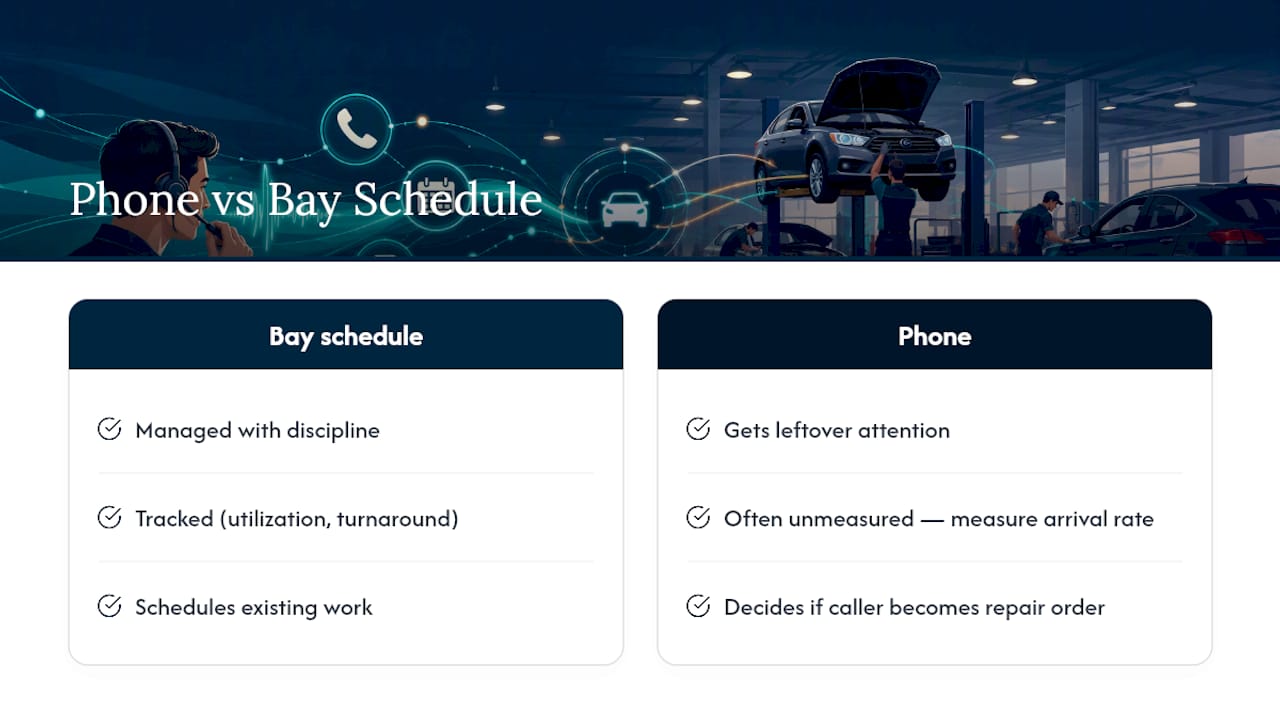
The shops that fix this stop treating call answering as a front-desk chore and start treating it as an operating decision with metrics attached, the same way they’d track bay utilization or parts turnaround. An after-hours answering layer isn’t a nice-to-have anymore; it’s coverage for the exact hours when a driver stranded with a check-engine light is deciding which shop to call next.
If you do one thing after reading this, measure your arrival rate for 30 days before and after any change. Booked appointments that don’t show up aren’t wins. Arrivals are.
— Jesse
How 42Voice Sets Up Call Answering for Auto Repair Shops
An AI receptionist can be put on your line to answer calls your front desk misses, whether that’s an after-hours emergency or during busy times. It captures intake fields and writes directly into your calendar and CRM to avoid manual re-entry.
Shops running two or three bays with one front-desk hire tend to see the biggest shift, since a single missed call during a busy stretch is often the difference between a booked job and a customer calling the shop down the street. Deployment typically runs 3 to 5 days, with custom scripts matched to your service menu and calendar sync built in from day one so double-booking isn’t a risk.
If your phone is costing you jobs you never even hear about, book a demo and see how the setup fits your shop’s call volume.
FAQ
What Is the $3,000 Rule for Car Repairs?
It’s a common consumer guideline suggesting that if a repair estimate exceeds a high cost or a significant share of the vehicle’s value, replacement may be more cost-effective than repair. It’s not a formal industry standard, so treat it as a rough budgeting rule rather than a fixed threshold.
What Do You Call an Automated Answering Service?
It’s typically called an AI voice agent, virtual receptionist, or automated answering service, and in the auto repair trade specifically it’s often described as an automotive answering service or AI receptionist.
Is $100 an Hour Fair for Mechanic Labor?
Labor rates vary widely by region and shop specialty, and around a hundred dollars an hour falls within a common range for many independent and dealership shops. Fairness depends more on your local market rate and the complexity of the work than any single national benchmark.
How Should You Answer a Call as Customer Service?
Answer promptly with your shop name and your own name, then listen fully before responding. The six-step flow, restate the concern, qualify urgency, capture vehicle details, define next steps, and confirm the plan, applies whether a human or an AI agent takes the call.
Can AI Answering Actually Book Appointments Directly Into My Shop System?
Yes. Systems built for auto repair shops check calendar availability in real time and book directly, writing the appointment and intake details into your DMS without manual re-entry.