
For HVAC companies, reliable 24/7 call answering that qualifies leads and dispatches emergencies is best achieved with a hybrid AI and live-agent solution. This approach captures calls you’d otherwise miss, cuts emergency response times, and routes routine bookings without tying up your technicians. When you evaluate vendors, prioritize integration depth and onboarding speed rather than flashy features.
Table of Contents
- What Does HVAC Call Answering Actually Include?
- What ROI Can HVAC Businesses Expect from Answering Services?
- Which Integrations and Features Actually Matter?
- How Do You Choose the Right HVAC Answering Service?
- 42voice: Built for HVAC Response Speed
- How Do You Keep Scripts Sounding Like Your Business?
- What HVAC Owners Get Wrong About Call Answering
- Get Started with 42voice for Your HVAC Business
- Sources
- FAQ
What Does HVAC Call Answering Actually Include?
A real HVAC call answering service does more than pick up the phone. It handles the operational chain from first ring to technician arrival; that’s why the details matter more than the marketing copy.
Here’s what you should expect from a competent provider:
- 24/7 live answering and after-hours coverage, so a burst pipe at 2 a.m. doesn’t go to voicemail.
- Lead capture and qualification questions covering location, issue type, urgency level, and whether the caller is the decision-maker.
- Appointment booking synced directly to your calendar or field-service software, not a separate spreadsheet someone checks in the morning.
- Emergency triage, including escalation rules, dispatching an on-call technician, and giving the caller interim safety instructions while help is en route.
- Add-ons like bilingual support, SMS confirmations, and web chat for callers who’d rather text than talk.
Manufacturers themselves point homeowners toward their local dealer network for anything beyond basic troubleshooting, which puts the burden of first response squarely on your business. Daikin’s support page is explicit about this: technical diagnosis and service go to licensed local dealers, not the manufacturer’s own team. That’s the gap your answering setup needs to fill.
What ROI Can HVAC Businesses Expect from Answering Services?
Every unanswered call is a lead handed to a competitor. Answering services exist to close that leak, and the math behind them is straightforward once you look at it.
The gap you’re paying for: Manufacturer support lines like Carrier’s and Rheem’s run on business hours and route emergencies straight to local contractors. That means every after-hours call your business misses is a call the homeowner expected someone to answer.
Pricing usually falls into three models: flat monthly tiers (often based on call volume), per-minute rates, or per-qualified-lead fees. For a small HVAC operation, that typically lands in the low hundreds to low thousands of dollars a month depending on volume and service scope.
Run the numbers conservatively. If your business misses several calls a month after hours and a portion convert to service calls, those jobs recovered can justify the answering service cost. At a modest average ticket, the answering service pays for itself before you count the softer wins: better customer satisfaction scores, faster emergency resolution, and technicians who spend more hours on tools instead of chasing voicemails.
Which Integrations and Features Actually Matter?
Not every feature on a vendor’s sales page moves the needle for HVAC operations. Some are deal-breakers. Others are nice extras you can live without.
The integrations that actually matter:
- Field service platform sync (job scheduling, technician availability) so a booked call becomes a scheduled job automatically, not a manual re-entry.
- Calendar and CRM integration to keep customer history and appointment data in one place instead of three.
- Dispatch logic like geofencing to find the nearest available technician, skill tagging for specialty repairs, and priority routing that flags emergencies ahead of routine maintenance calls.
- Notification flows across SMS, email, and push alerts so both the customer and the technician get real-time confirmation.
- Security and data-handling basics, including how call recordings and customer information are stored and who has access to them.
Platforms built for the trades, like MyAirCare’s air conditioning business management tools, show how much smoother operations run when call intake, job scheduling, and dispatch share one system instead of three disconnected ones. Ask any vendor exactly how their answering service talks to your existing software before you sign anything, because “it integrates” and “it integrates well” are two very different claims.
How Do You Choose the Right HVAC Answering Service?
Comparing vendors gets easier once you turn it into a checklist instead of a gut feeling. Walk into every demo with the same six criteria:
- Coverage — true 24/7, or “24/7 with a gap on holidays”?
- Accuracy — how well do agents (human or AI) actually understand HVAC terminology and urgency signals?
- Integrations — does it connect to your specific field service or CRM tool, not just a generic API?
- Onboarding time — can you be live in days, or are you looking at a multi-week setup?
- Cost predictability — flat tier versus per-minute billing that spikes during storm season.
- SLA and response time — what’s the guaranteed time from call to callback or dispatch?
Bring these exact questions into every demo: How long does onboarding take from contract to first live call? Can I hear a sample script for a no-heat emergency versus a routine maintenance request? What’s the escalation path when a call comes in at 3 a.m.? Does the system talk directly to my field-service software, or does someone re-enter the data by hand?
Watch for red flags: no HVAC-specific scripts, no trial or pilot period offered, vague answers about escalation, or pricing that only reveals extra fees after you’ve committed.
Pro Tip: Run a short paid pilot that covers just nights and weekends first. That’s where most HVAC businesses bleed leads, and a two-week test tells you more about a vendor’s real performance than any sales deck.
42voice: Built for HVAC Response Speed
42voice runs AI voice agents that handle inbound calls, qualify leads, book appointments, and manage after-hours coverage in more than nine languages, all without a hold queue. For HVAC businesses specifically, that means callers get answered on the first ring whether it’s a routine filter question or a furnace that died at midnight.
Deployment typically takes three to five days, including integration with your calendar and CRM so bookings sync automatically instead of landing in a separate inbox someone has to check. That speed matters when manufacturer support pages like Trane’s make clear that homeowners will call you, not the factory, when something breaks.
Real workflows 42voice supports for HVAC teams include:
- After-hours triage that separates “can wait until Monday” from “shut off the gas and call now.”
- Automated booking that checks technician availability before confirming a time slot.
- Emergency dispatch with instant notifications to the on-call tech, including the caller’s issue and address.
Jesse, who covers operational technology and small business systems for 42voice, has spent years analyzing how automation intersects with field-service industries. His take throughout this piece draws on that pattern recognition, not a single case study.
How Do You Keep Scripts Sounding Like Your Business?
Generic scripts are the fastest way to make a caller feel like they’ve reached a call center instead of their HVAC contractor. Customization is what keeps the experience consistent with your brand, whether the person answering is human or AI.
Good scripting starts with your actual vocabulary. If your technicians say “no-cool call” instead of “AC malfunction,” the script should match. If you always ask for a model and serial number before dispatching, that question needs to be built into the intake flow from the start; Bryant’s own contact process shows how much faster technical support moves when that information is captured upfront.
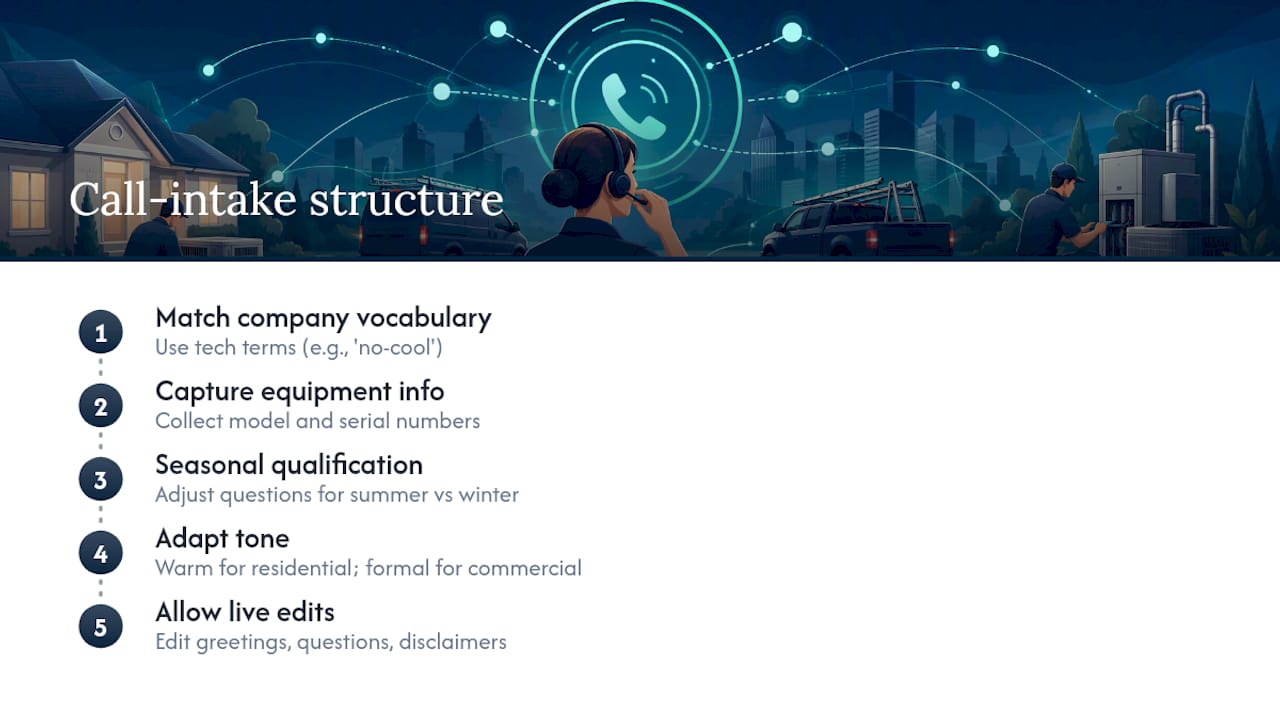
Beyond vocabulary, brand consistency means tone. A residential comfort company answering calls with warmth and patience sounds different from a commercial HVAC contractor handling a rooftop unit failure for a property manager. The script should flex for both without sounding like two different companies.
The best setups let you edit greetings, adjust qualification questions seasonally (summer AC emergencies versus winter furnace calls), and update pricing disclaimers without waiting on a vendor’s development queue. If a provider can’t show you how to make those edits yourself during a demo, that’s worth asking about directly before you commit.
What HVAC Owners Get Wrong About Call Answering
Most HVAC owners treat call answering as a cost center they tolerate rather than a system that drives revenue. That’s backwards. The research is consistent: manufacturers have already opted out of being the first responder, which means every missed call is pure opportunity cost, not just inconvenience.
The conventional advice, “just hire an answering service,” misses the operational piece. A generic receptionist service that doesn’t understand HVAC urgency levels or integrate with your dispatch software creates a second bottleneck instead of removing the first one.
What actually matters is speed of deployment and depth of integration, not just the promise of 24/7 coverage. Anyone can answer a phone. Fewer providers can turn that answered call into a scheduled job on your technician’s calendar within minutes, with the right urgency flag attached. That’s the bar HVAC owners should hold vendors to, and it’s the reason 42voice built its solutions around integration speed instead of call volume alone. Prioritize that over any other feature on a sales sheet.
— Jesse
Get Started with 42voice for Your HVAC Business
42voice gets HVAC businesses live with a working answering setup in three to five days, not weeks of back-and-forth with a traditional call center contract. A pilot typically starts with a short discovery call where you share your current scripts (or let 42voice draft HVAC-specific ones), grant access to your calendar or field-service dispatch tool, and provide a test phone number for a trial run before going live.
Come prepared with your after-hours call volume, your busiest emergency categories, and a sample of how your team currently triages urgent versus routine calls. That’s enough for 42voice to configure qualification questions and escalation rules that match how your business actually operates. From there, you can review the booking and appointment sync directly against your calendar before committing to anything long-term.
If you’re ready to see how it handles a real no-heat call at midnight, book a demo and bring your toughest after-hours scenario. That’s the fastest way to know if it fits your operation.
Sources
- Contact Us | Get Support for HVAC Solutions | Daikin
- Contact Us: Customer Service | Carrier Residential
- Trane® Customer Service – Contact a Local Dealer – HVAC Help
- Help and Support – Rheem Manufacturing Company
FAQ
How Does Being On Call Work for HVAC Businesses?
On-call HVAC coverage typically rotates a technician (or a small team) through after-hours availability, with an answering service or dispatcher triaging incoming calls and alerting the on-call tech only when the issue qualifies as urgent.
How Should Customer Service Agents Answer HVAC Calls?
Agents should confirm the caller’s location, describe the issue in plain terms, ask about urgency (no heat, no cool, gas smell), and capture model or serial number when available before booking or escalating the call.
How Much Does the Average HVAC Service Call Cost?
Service call costs vary widely by region and issue complexity, and no single national figure applies uniformly, so it’s best to check your local market rates rather than rely on a flat number.
Do Telephone Answering Services Still Exist?
Yes, and they’ve evolved well beyond simple message-taking. Modern services combine live agents with AI-driven call routing, lead qualification, and direct integration with scheduling software, which is exactly the model 42voice runs for HVAC clients.