
Use IVR for predictable routing and compliance scripts, conversational IVR when you need faster, speech-based intent routing, and voicebots when the goal is end-to-end task resolution at scale. The tradeoff runs in one direction: more conversational capability buys higher containment and better customer experience, but it also raises setup complexity and demands tighter monitoring for accuracy and compliance risk.
If you manage a contact center right now, the fastest path forward is narrow, not broad.
- Pick one to three high-repeat call flows (bookings, order status, password resets).
- Run a pilot for four to eight weeks with a defined rollback trigger.
- Track containment rate and CSAT from day one, not month three.
Table of Contents
- What’s the Difference Between IVR and a Voicebot?
- How Do IVR and Voicebots Compare on Cost, UX, and Risk?
- When Should You Use IVR vs Conversational IVR vs a Voicebot?
- What Are the Risks and Limitations to Watch For?
- How Do You Choose and Pilot the Right System?
- How Does 42Voice Fit This Decision Framework?
- What Training Data Do IVR Systems and Voicebots Need to Improve Over Time?
- What Security and Privacy Issues Are Unique to Voicebots and Conversational IVR?
- How Long Does It Take to Deploy IVR vs a Voicebot?
- How Does Each System Affect Customer Satisfaction?
- What I’d Actually Tell a Contact Center Leader to Do
- Ready to Pilot a Voicebot for Your Contact Center?
- Sources
- FAQ
What’s the Difference Between IVR and a Voicebot?
The three technologies sit on a spectrum, not in separate categories, and mixing up where each one sits is the most common procurement mistake we see.
Traditional IVR is the keypad system you’ve known for twenty years: press 1 for billing, press 2 for support. It runs on DTMF (dual-tone multi-frequency) input, follows a fixed decision tree, and has zero ability to handle a request that wasn’t pre-scripted. A caller who says “I need to change my delivery address” gets nowhere until they find the right menu number.
Conversational IVR replaces the keypad with speech recognition and natural language understanding (NLU) to map what a caller says onto an intent, then routes them accordingly. It’s a real upgrade in reducing friction, but the routing logic underneath is still a flow chart. It listens better; it doesn’t reason. According to Genesys, this speech layer improves routing accuracy and self-service compared with legacy menu trees, though it typically still hands off resolution to a human or a downstream system.
Voicebots go a step further. They hold multi-turn conversations, pull and push data from a CRM or booking calendar in real time, and are built to close the loop, not just point the caller somewhere else. The Conversation Design Institute notes that conversational IVR often stays bound to predefined flows, while voicebots are designed to manage the kind of dynamic, multi-turn resolution a live agent would normally handle.
- IVR example: “Press 3 to pay your bill.”
- Conversational IVR example: caller says “I want to pay my bill,” system detects intent and routes to the billing queue.
- Voicebot example: caller says “I want to pay my $84 balance,” and the system pulls the account, processes payment, and confirms by text, no transfer needed.
How Do IVR and Voicebots Compare on Cost, UX, and Risk?
The gap between these three options shows up in four places: how much a system can actually do, what it costs to run, and how it fails when it fails.
Interaction depth. IVR handles single-step decisions. Conversational IVR handles single-intent routing. Voicebots handle multi-turn tasks, remembering what was said three exchanges ago and adjusting.
Outcome type. IVR and conversational IVR mostly route; voicebots resolve. That distinction drives everything downstream, from headcount planning to customer wait time.
Cost shape. IVR has the lowest setup cost but a hard ceiling on what it can do without a rebuild. Conversational IVR sits in the middle. Voicebots carry higher upfront integration cost (CRM, calendar, telephony) and ongoing model monitoring, but Exotel’s comparison of AI IVR, traditional IVR, and AI voicebots finds that LLM-enabled voicebots can produce meaningfully higher containment and resolution rates in exchange for that investment.
The tradeoff, in one line: every step up in conversational capability adds setup and monitoring cost, but it can also cut the number of calls that ever reach a live agent.
Failure modes. IVR fails quietly (caller hangs up, lost sale). Voicebots can fail loudly if a low-confidence response goes unchecked, which is why escalation rules matter more as capability increases.
- IVR: low cost, low flexibility, silent failure.
- Conversational IVR: moderate cost, better routing accuracy, still flow-bound.
- Voicebot: higher setup cost, task resolution, needs confidence thresholds and monitoring.
When Should You Use IVR vs Conversational IVR vs a Voicebot?
Match the technology to the call, not the other way around. Forcing every call type through one system is how contact centers end up with either a clunky menu tree or an overbuilt bot answering questions nobody asks.
- Use plain IVR for tightly scripted compliance disclosures, emergency routing, and call flows with genuinely tiny volume where building anything smarter isn’t worth the spend.
- Use conversational IVR when the goal is faster, more accurate routing across a handful of predictable intents, especially in multilingual environments where speech detection beats a numbered menu.
- Use a voicebot for bookings, order-status lookups, payment collection, lead qualification, and after-hours self-service where a caller expects an actual outcome, not a transfer. ConvoZen’s IVR-versus-voicebot analysis points to exactly these categories, plus multilingual exchanges, as the clearest voicebot wins.
- Use a hybrid pattern rather than picking one system for the whole business. The lowest-risk version, per CallFactory’s comparison of voicebots and traditional IVR, is voicebot-first with IVR fallback: let callers speak naturally or press a key, and route repeat callers who prefer the keypad to the familiar menu while new or unpredictable intents go to the voicebot.
Pro Tip: Don’t retire your IVR fallback in month one. Even a strong voicebot pilot benefits from a keypad escape hatch for callers who just want to punch a number and move on.
What Are the Risks and Limitations to Watch For?
Automation gets risky exactly where nuance matters most: distressed callers, ambiguous requests, and regulated scripts.
- Over-automating an emotional call (a complaint, a cancellation, a medical concern) without a fast human escalation path damages trust quickly.
- Background noise, heavy accents, and code-mixing (switching languages mid-sentence) still trip up speech recognition more than vendors like to advertise.
- Regulated workflows, think financial disclosures or healthcare intake, often need a fixed, auditable script that IVR delivers more reliably than a generative voicebot.
- Require confidence-score thresholds, monitored escalation queues, and a retraining cadence from any vendor before you scale past pilot.
How Do You Choose and Pilot the Right System?
Evaluate vendors on the same five criteria every time: accuracy under real call conditions, fallback and escalation rules, log and transcript access, SLA terms, and how cleanly the system connects to your CRM, calendar, and telephony stack.
Ask every vendor these questions before you sign anything:
- How is confidence scored, and what happens below the threshold?
- What’s the hallucination or misroute rate, and how is it monitored week to week?
- How long is data retained, and who can access call transcripts?
- What’s the actual integration lift for our CRM and booking calendar?
Then build the pilot itself:
- Pick one to three flows with high call volume and predictable intent (bookings and order status are the easiest wins).
- Set a baseline: current containment rate, average handle time (AHT), and CSAT before you change anything.
- Run the pilot for four to eight weeks with a defined rollback condition if containment drops or complaints spike.
- Track containment/deflection rate, resolution rate, AHT, CSAT, and cost per resolved call as your core KPI set.
Pro Tip: Companies that stage pilots on a narrow set of repeatable flows, with CRM and calendar integrations already wired in, tend to see faster wins in containment and fewer agent handoffs, according to GetVoIP’s breakdown of conversational IVR deployments. Skipping the integration step is the single most common reason pilots stall.
How Does 42Voice Fit This Decision Framework?
42voice’s voice agent platform is built around the exact criteria that separate a good voicebot from a risky one: multilingual conversation across nine or more languages, direct CRM and calendar integration, and appointment booking and lead qualification handled in a single call.
- Deployment typically runs three to five days from setup to live, fast enough to pilot without a quarter-long procurement cycle.
- Low-confidence exchanges route to human agents rather than guessing, keeping the escalation path monitored, not silent.
- Common outcome areas include after-hours bookings that would otherwise go to voicemail, lighter front-line agent load, and higher conversion on inbound calls that used to wait on hold.
What Training Data Do IVR Systems and Voicebots Need to Improve Over Time?
Traditional IVR needs almost no ongoing training. Once the menu tree is built, it stays static until someone manually edits the flow, which is both its strength (stability) and its weakness (it never gets smarter on its own).
Conversational IVR needs a modest, ongoing data diet: call transcripts and misroute logs get reviewed periodically to retune intent recognition, usually on a monthly or quarterly cycle depending on call volume.
Voicebots need the most continuous attention. They improve through a feedback loop: transcripts flagged for low confidence or failed resolution get reviewed, tagged, and fed back into the model or its intent library. A voicebot handling booking requests in month one should be measurably better at handling edge cases (rescheduling, multi-party bookings, cancellation policies) by month three, but only if someone is actually running that review cycle. Skip it, and the bot plateaus or drifts, especially as your product catalog, pricing, or policies change and the bot keeps answering with outdated information. Ask any vendor directly how often retraining happens and who owns that process, because “continuous improvement” without a named owner usually means no improvement at all.
What Security and Privacy Issues Are Unique to Voicebots and Conversational IVR?
Voice systems that understand speech and hold conversations create data exposure that a keypad menu simply doesn’t.
Call transcripts and audio recordings often contain sensitive details: account numbers, medical information, payment data spoken aloud. That means transcript storage, access controls, and retention windows need explicit policy, not a default vendor setting nobody reviewed. Ask where transcripts live, who can access them, and how long they’re retained before a pilot goes live.
Voice cloning and synthetic speech add a newer risk: verifying that a caller is who they claim to be, and that your own outbound voice agent can’t be spoofed or impersonated. Multilingual systems add another layer, since sensitive data moving across language models and third-party translation APIs needs the same data-handling scrutiny as English-only calls.
Compliance frameworks vary heavily by industry and region, so a system handling healthcare intake or financial transactions needs vendor documentation on how it meets the specific regulatory bar for that call type, not a generic “we’re compliant” claim. Traditional IVR’s fixed scripts are actually an advantage here: there’s nothing generative to audit.
How Long Does It Take to Deploy IVR vs a Voicebot?
Traditional IVR deployment is fast to configure but slow to change. Building the initial menu tree might take a few weeks, but every future adjustment (a new department, a changed hour, a new promotion) means editing the flow manually and testing it again.
Conversational IVR deployment usually takes longer upfront because intent mapping has to be trained on your specific call types before it goes live, often a matter of weeks depending on how many intents you’re covering.
Voicebot deployment timelines vary more by vendor and integration complexity. A platform built for rapid deployment, like 42voice’s three-to-five-day setup window, can get a narrow pilot (one or two flows, one CRM connection) live inside a week. Broader, custom-built voicebot projects with multiple system integrations and compliance reviews can stretch to several weeks or months. The ramp-up after launch matters just as much as the initial go-live: expect two to four weeks of tuning based on real call data before containment and CSAT numbers stabilize.
How Does Each System Affect Customer Satisfaction?
Customer satisfaction hinges less on which technology you pick and more on whether the caller’s expectation matches what they get.
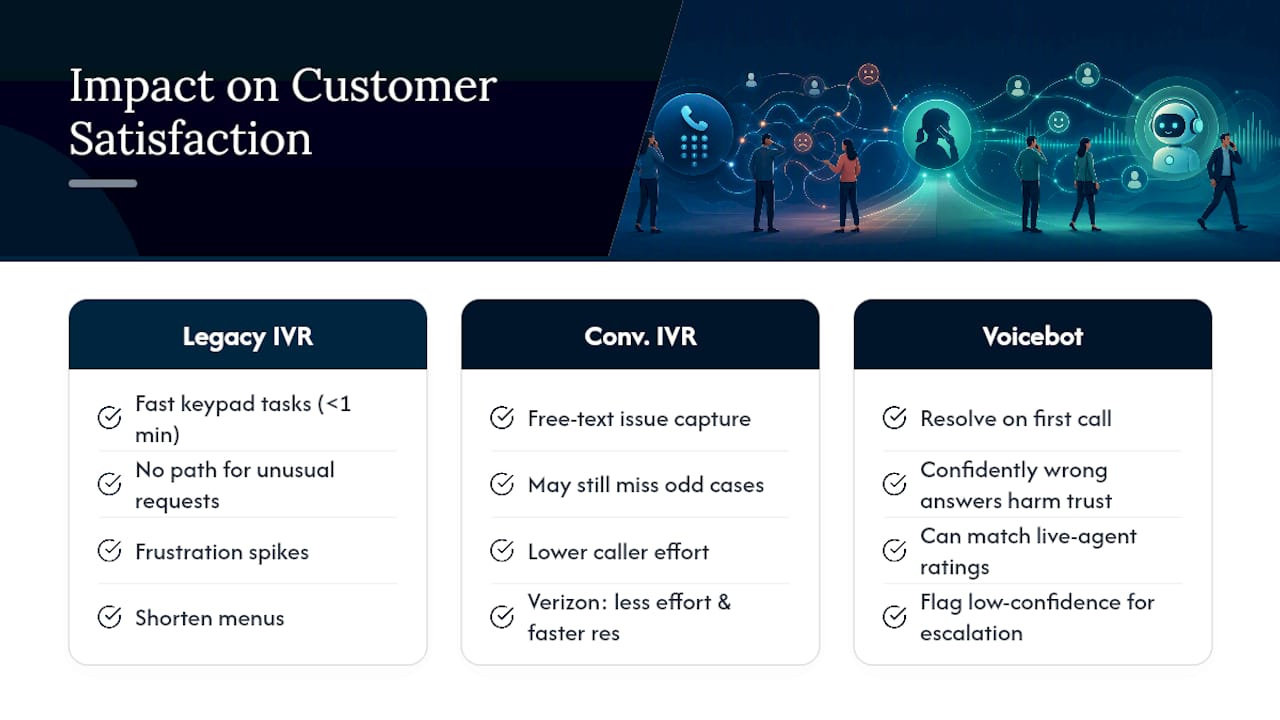
A caller who wants to pay a bill fast tolerates a keypad menu fine, as long as it’s short and gets them there in under a minute. Frustration spikes when a rigid IVR forces a caller with an unusual request through menu after menu with no way to explain what they actually need. That’s the single biggest CSAT killer in legacy IVR: no path for the request that wasn’t anticipated.
Conversational IVR improves this by letting callers describe their issue in their own words instead of guessing which menu number applies, which Verizon Business points to as a meaningful reduction in caller effort and time to resolution.
Voicebots raise the ceiling further, because a caller who actually gets their booking confirmed or their order status resolved on the first call, without a transfer, tends to rate that interaction close to a live agent. But the downside risk is sharper too: a voicebot that misunderstands a request and confidently gives the wrong answer damages trust worse than a menu that simply routed them slowly. The gap between “good voicebot experience” and “bad voicebot experience” isn’t the technology, it’s whether low-confidence moments get flagged and escalated instead of guessed at.
What I’d Actually Tell a Contact Center Leader to Do
Start smaller than feels comfortable. Pick one flow, run it for a real pilot window, and measure containment and CSAT before you touch a second flow. Keep a human escalation path visible and staffed, not buried in a settings menu, because the fastest way to lose trust in any of these systems is to let a caller get stuck with no way out.
Ready to Pilot a Voicebot for Your Contact Center?
If you’ve been weighing conversational IVR against a full voicebot buildout, 42voice gives you a faster third option: a voice agent that goes live in three to five days instead of a multi-month integration project, already built to handle bookings, lead qualification, and multilingual calls out of the box. Where a DIY IVR upgrade means months of scripting and testing, and a custom voicebot build means a long procurement cycle, 42voice’s solutions platform connects directly to your CRM and calendar so a pilot can start on real call flows almost immediately. Low-confidence calls escalate to a human instead of guessing, a safeguard detailed on the platform’s accuracy and reliability page. If you’re ready to test this against your own after-hours or booking volume, book a pilot demo and see what containment looks like on your actual calls within the first pilot window.
Sources
- What Is Conversational IVR and how can it benefit your organization? | Conversation Design Institute
FAQ
Is IVR considered AI?
Traditional keypad IVR is not AI, it’s a fixed decision tree. Conversational IVR and voicebots use AI components like speech recognition and NLU, with voicebots relying most heavily on AI to manage multi-turn conversation.
What are the disadvantages of traditional IVR calls?
Traditional IVR frustrates callers with unusual requests, offers no way to explain a problem in plain language, and fails silently when a caller hangs up rather than navigating another menu layer.
What is an IVR bot?
An IVR bot usually refers to conversational IVR, a speech-enabled system that detects caller intent and routes the call, though it typically still hands resolution off to a person or another system rather than completing the task itself.
What are the four types of chatbots?
Common categories include menu-based (button-driven), rule-based (fixed scripts), AI-powered/NLU-based (intent detection like conversational IVR), and generative or voicebot-style agents capable of multi-turn, task-resolving conversation, such as what 42voice deploys for booking and support calls.