
Modern AI voice agents can speak multiple languages and convincing regional U.S. accents well enough for live customer calls — and most SMBs can be live in 3–5 days. Before you commit to a vendor, check four things first:
- Recognition accuracy on your actual caller accent profile (not a synthetic demo)
- CRM and telephony integration with your existing phone system and calendar
- Consent and recording controls that meet your state’s laws
- Human escalation paths for calls the agent cannot resolve
Quick proof signals that separate credible vendors from the noise: support for 9+ languages, neural text-to-speech (TTS) for regional accents, SIP/hosted PBX compatibility, and documented hallucination-mitigation practices. AI voice agents can reduce support costs between 4% and 60%, and 51% of consumers already prefer bots for immediate service — the business case is clear.
Table of Contents
- Why do AI voice accents change outcomes on customer calls?
- What can AI voice accents actually do today, and where do they fall short?
- What does deployment actually look like for an SMB?
- What U.S. compliance requirements apply to AI voice calls?
- How do you choose the right AI voice agent provider?
- What performance benchmarks should you hold AI voice agents to?
- How do AI voice agent providers compare on accents and features?
- Can you scale and customize AI voice agents for specific regional accents?
- What support and training do vendors provide after you go live?
- What does ROI actually look like for SMBs using AI voice agents?
- When a managed, turnkey provider is the right move for your business
- 42voice gives your business a voice that works around the clock
- Sources
- FAQ
Why do AI voice accents change outcomes on customer calls?
Accent fit is not cosmetic. Research published on CustomerThink found that using dialects in conversational agents raised perceived warmth, competence, and social presence on a 7-point Likert scale compared with standard language. For a caller deciding whether to trust a voice on the other end of the line, those perceptions translate directly into whether they stay on the call or hang up.
The use cases where accent fit materially changes outcomes:
- Inbound service calls: A Southern U.S. caller routed to a voice agent speaking General American may feel the interaction is impersonal; a regionally matched voice reduces that friction.
- Appointment booking: Callers are more likely to complete a booking flow when the agent sounds familiar and natural rather than robotic or foreign.
- Lead qualification: Outbound calls with a matching accent profile get higher answer rates and longer engagement before hang-up.
- After-hours support: A consistent, accent-appropriate voice at 2 AM covers gaps no local hire can fill affordably.
Operational benefits for SMBs are just as concrete:
- 24/7 coverage without hiring multilingual staff
- Consistent service quality across every call, regardless of volume spikes
- Fewer missed calls during peak hours
- Unified handling across English, Spanish, and other languages your callers use
Accent matters most for localized services (home services, healthcare, hospitality) and culturally sensitive communication. For purely transactional interactions — confirming an order number, reading back a tracking code — the voice’s regional character matters far less.
What can AI voice accents actually do today, and where do they fall short?
Today’s AI voice agents combine neural TTS for regional accent generation with automatic speech recognition (ASR) tuned for accent variation. They can retain multilingual context mid-call, pull CRM data to personalize phrases (“Hi, Mr. Torres — calling about your Tuesday appointment”), and handle standard call flows without a human.
The limits are real and worth knowing before you demo:
- Heavy background noise degrades ASR accuracy noticeably
- Very strong non-native accents or thick regional dialects push error rates up
- Low-quality phone audio (compressed VoIP, poor mobile signal) compounds both problems
- Niche technical vocabulary — medical codes, legal terms, specialized product names — trips up most models without custom fine-tuning
Leading ASR engines in 2026 — including OpenAI Whisper, Google Speech-to-Text, and AWS Transcribe — typically report over 95% accuracy on standard English in telephone-quality audio. Expect that number to drop for heavy noise or strong non-native accents. Voice cloning for business use adds another layer: you need documented consent before cloning any employee or customer voice asset.
Hallucinations — where an agent confidently states something incorrect — are the biggest reliability risk. Mitigation requires constrained action scopes (no unsupervised financial transactions), transcript verification loops, and clear human-in-the-loop policies. 42voice publishes its approach to hallucination mitigation and reliability controls openly, which is the kind of transparency worth demanding from any vendor you evaluate.
Metrics to require in every demo: word error rate on your caller population, end-to-end task completion rate, CSAT delta versus your current handling, escalation rate, and average latency per turn.
Pro Tip: Bring 10–15 recorded calls sampled from your real callers to every vendor demo. Measure accuracy on your exact accent mix — not the vendor’s curated test set.
What does deployment actually look like for an SMB?
Getting an AI voice agent live requires connecting four systems: your telephony layer (SIP trunk or hosted PBX), your CRM, your calendar or booking platform, and an analytics or QA pipeline for ongoing monitoring. Each connection needs secure API keys, defined data retention settings, consent flags, and a fallback route to a live agent.
A realistic deployment checklist:
- Define scope: inbound only, outbound only, or both
- Gather 10–20 sample calls representing your real caller mix
- Map conversation flows and decision trees for each use case
- Set escalation rules: what triggers a handoff, and to whom
- Complete a compliance review (recording consent, TCPA for outbound)
- Run a pilot period with live traffic before full production cutover
Most platforms advertise 3–5 days for basic setups. Deeper CRM customization, multi-language configuration, and complex escalation logic typically extend that to 2–4 weeks. Budget the longer timeline if your stack is non-standard.
42voice’s solutions page documents CRM and calendar integrations alongside its managed deployment model — worth reviewing before your first vendor call to understand what “fast deployment” actually includes.
What U.S. compliance requirements apply to AI voice calls?
Call recording and voice cloning in the U.S. carry real legal obligations. The key areas:
- Recording consent: Eleven states require all-party (two-party) consent before recording a call. California, Florida, and Illinois are the most common ones SMBs encounter. Your vendor must support pre-recorded disclosures and consent flags that fire before any recording begins.
- Voice cloning consent: Any cloned voice asset — whether an employee’s voice or a custom brand voice — requires documented, written consent from the voice owner, plus a clear retention and opt-out process.
- TCPA for outbound calls: The Telephone Consumer Protection Act requires prior express written consent for automated outbound calls to cell phones, mandatory do-not-call scrubbing, and calling windows (generally 8 AM–9 PM local time). Vendors should provide consent-documentation tools and DNC list integration.
- Data handling: Confirm where voice and transcript data is stored, who can access it, how long it is retained, and whether audit logs are available for compliance review.
This article is general guidance, not legal advice. Consult qualified legal counsel before deploying outbound AI calling campaigns or cloning any voice asset.
How do you choose the right AI voice agent provider?
A structured evaluation protects you from vendors who demo well but underdeliver in production.
Vendor demo checklist:
- Run the demo using your own sample calls, not the vendor’s
- Request measured word error rate for each regional accent you serve
- Ask for end-to-end task completion rate on a realistic call flow
- Confirm CRM and phone system integration specifics — not just “we support Salesforce” but how data flows and what triggers what
- Walk through the escalation path: what happens when the agent fails, and how fast does a human pick up
Questions that separate good vendors from great ones:
- Can you fine-tune the voice model on my caller population?
- What languages and regional U.S. accents are supported out of the box?
- What are your SLAs for uptime and response latency?
- How do you handle consent logging and recording disclosures?
- What does your onboarding support actually include?
Red flags to stop procurement:
- No support for testing with your real call recordings
- Accuracy claims with no numbers attached
- No documented consent or recording controls
- Legal scripts that cannot be localized or customized
Pricing shapes for SMBs: Most platforms combine a monthly subscription with per-minute usage fees. Expect additional tiers for concurrent call volume, setup or onboarding fees, and cost drivers tied to language count and live-agent fallback minutes.
Vendor scorecard (use to compare finalists):
What performance benchmarks should you hold AI voice agents to?
Word error rate (WER) is the foundational metric. Push vendors to show you WER broken out by accent group — a single blended number can hide poor performance on Spanish-accented English or Southern U.S. dialects.
Beyond WER, track:
- Task completion rate: The percentage of calls where the agent fully resolves the caller’s intent without escalation. Aim for 70%+ on well-defined flows like appointment booking.
- CSAT delta: Compare caller satisfaction scores before and after deployment. A well-tuned agent should hold or improve CSAT versus a missed call or long hold.
- Escalation rate: Too high means the agent is undertrained; too low may mean it is not escalating when it should.
- Average handle time and latency: Response latency above 1.5 seconds per turn starts to feel unnatural to callers.
Review AI call analytics dashboards during your pilot. Real-time transcript review lets you catch systematic errors — a misheard product name, a wrong date format — before they affect a large call volume.
How do AI voice agent providers compare on accents and features?
The market splits roughly into two tiers. Enterprise-grade platforms offer the broadest accent libraries and the deepest integration options, but they come with longer implementation timelines, higher minimum spend, and engineering resources most SMBs do not have. Managed, SMB-focused platforms trade some configurability for speed, prebuilt integrations, and onboarding support that does not require a developer.
For most SMBs evaluating AI customer service automation, the managed tier is the practical choice. The key differentiators within that tier:
- Language and accent depth: Some platforms cover 5–6 languages; others support 20+. Mid-call language switching — where a caller starts in English and shifts to Spanish — is a feature worth testing explicitly.
- Voice cloning for business: Brand voice cloning lets you deploy a consistent, recognizable voice across all calls. Not every SMB platform offers this; confirm it is available and that the vendor provides a compliant consent workflow.
- Hallucination controls: Ask specifically what guardrails exist. Constrained action scopes, transcript verification, and human-in-the-loop policies are the three to look for.
- Onboarding model: A vendor that assigns a dedicated onboarding specialist and provides industry-specific call flow templates will get you to production faster than one that hands you documentation and a support ticket queue.
42voice supports multilingual agent deployments with regional accent customization, CRM and calendar integrations, and a managed onboarding model built for SMBs — details on the solutions page cover the full feature set.
Can you scale and customize AI voice agents for specific regional accents?
Yes — with the right vendor. Neural TTS models can be fine-tuned on regional phoneme sets, and ASR models can be adapted with accent-specific training data. The practical question is whether your vendor exposes those controls or locks you into a fixed voice library.

For most SMBs, the starting point is selecting from a pre-built accent library (General American, Southern U.S., Texan, New York, British, Australian, and others depending on the platform). As call volume grows, you can request fine-tuning on your specific caller population — particularly valuable if you serve a concentrated geographic market with a distinct dialect.
Speech synthesis voices have improved dramatically. The gap between a neural TTS voice and a human voice is now narrow enough that callers often cannot distinguish them in a standard call flow. The remaining tells are unnatural prosody on long sentences and hesitation patterns that do not match human speech. Both are addressable through prompt engineering and voice model selection.
AI voice modulation — adjusting pitch, pace, and tone in real time based on caller sentiment — is an emerging capability. A few platforms offer it in beta; it is not yet a standard feature to require, but worth asking about for high-volume outbound campaigns.
What support and training do vendors provide after you go live?
Onboarding quality varies more than any other vendor differentiator. The minimum you should expect:
- A dedicated onboarding contact for the first 30–60 days
- Industry-specific call flow templates (home services, healthcare, hospitality, retail)
- Documentation for every integration your stack requires
- A clear escalation path for production issues with defined response SLAs
The best vendors also provide ongoing model retraining as your call data accumulates, regular QA reviews of transcripts to catch drift, and a customer success contact who proactively flags performance issues before you notice them in your metrics.
Ask specifically: “What does your support model look like 90 days after go-live?” A vendor confident in their product will answer that question in detail. One that pivots to onboarding features is telling you something.
What does ROI actually look like for SMBs using AI voice agents?
The cost reduction range is wide — between 4% and 60% depending on call volume, current staffing costs, and how much of your call traffic is routine and automatable. The businesses at the high end of that range are typically those replacing after-hours answering services or handling high volumes of appointment bookings and inbound FAQs.
The clearest ROI signals to track in your first 90 days:
- Calls handled without human intervention (directly reduces labor cost)
- Appointments booked outside business hours (pure incremental revenue)
- Missed call rate before and after deployment
- Lead qualification volume and conversion rate on outbound campaigns
A home services company running 200+ inbound calls per week, for example, can automate booking confirmations, service reminders, and after-hours intake without adding headcount. The booking and appointment automation use case alone often pays for the platform within the first quarter.
When a managed, turnkey provider is the right move for your business
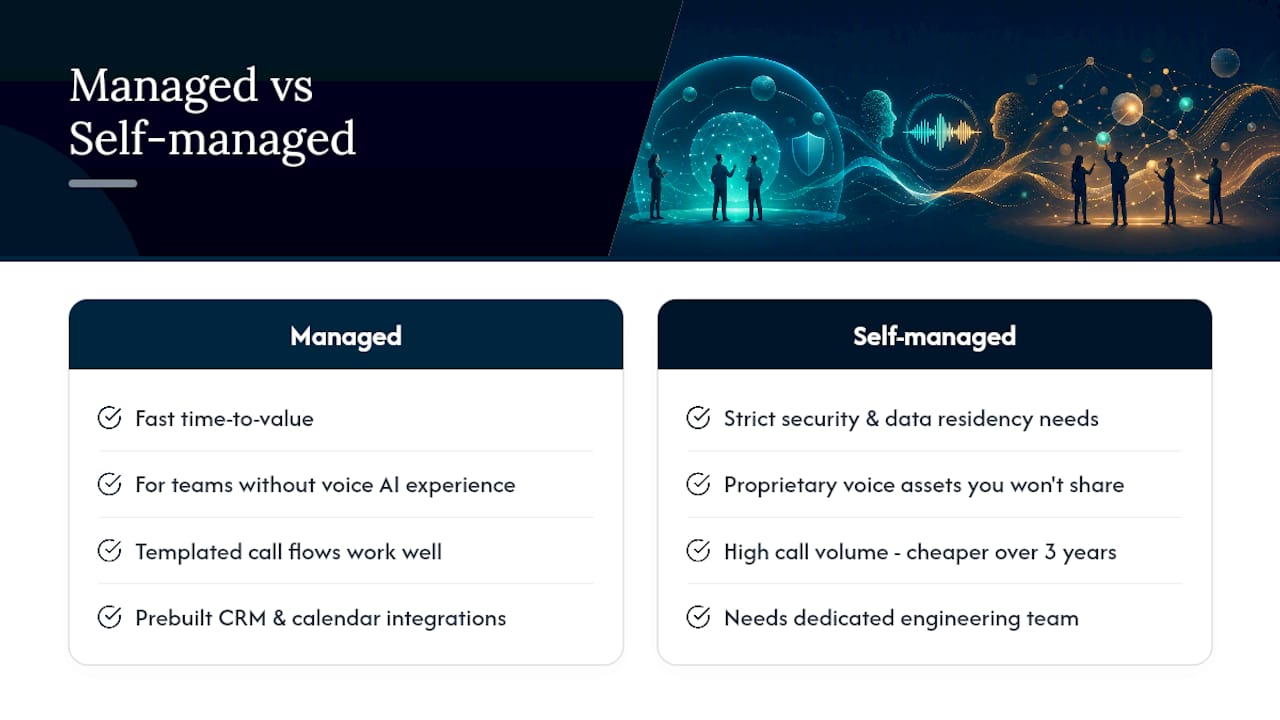
Most SMBs should not build their own AI voice infrastructure. The engineering lift — training accent-specific ASR models, managing TTS voice libraries, building telephony integrations, and maintaining compliance controls — is substantial and ongoing. Unless you have a dedicated engineering team and a proprietary voice asset worth protecting, you are paying for complexity that a managed vendor has already solved.
The case for a managed provider is strongest when you need to be live quickly, when your team lacks voice AI experience, and when your call flows are well-defined enough to template. Prebuilt integrations for common CRMs and calendar platforms, industry-specific conversation templates, and a vendor who owns the compliance framework on your behalf all reduce your time-to-value and your risk surface.
The case for a self-managed or internal approach is narrower: unique security constraints (government, financial services with strict data residency requirements), proprietary voice assets you cannot share with a vendor, or call volumes large enough that per-minute pricing makes a custom build cheaper over a 3-year horizon.
The trade-off is real. A managed vendor’s SLA is only as good as their support model — which is exactly why asking the “90 days after go-live” question matters so much. 42voice’s company background reflects a deliberate focus on SMB sectors where managed deployment and fast onboarding are the deciding factors.
42voice gives your business a voice that works around the clock
Your callers expect to reach someone — at 8 PM on a Friday, in Spanish, about a booking they need to change. 42voice handles that call. The platform supports multilingual voice agents with regional accent customization, integrates with your CRM and calendar, and goes live in as little as 3–5 days. No engineering team required.
Every deployment includes documented hallucination-mitigation controls, consent and recording compliance support, and onboarding built for SMBs in home services, hospitality, healthcare, and more. You get 24/7 call handling, appointment booking, lead qualification, and after-hours coverage — without adding headcount.
Ready to see it handle your actual calls? Request a pilot with your own sample recordings and measure accuracy on your real caller mix before you commit.
Sources
- How AI Voice Agents Are Reshaping Customer Experience in 2026 — And Why Small Businesses Can’t Ignore Them – Smart Process AI
- Beyond Language: How Speaking Dialects Enhances the Power of AI Receptionists | CustomerThink
FAQ
Can AI voice agents handle regional U.S. accents accurately?
Yes. Test with your own recorded calls before committing to a vendor.
How many languages does a typical AI voice agent support?
Most SMB-focused platforms support 9–20+ languages, with some offering mid-call language switching. 42voice supports multilingual agents with regional accent customization across its core language set.
What U.S. laws apply to AI voice calls?
The TCPA governs outbound automated calls to cell phones and requires prior express written consent. Eleven states require all-party recording consent. Your vendor should provide consent logging, pre-recorded disclosures, and do-not-call scrubbing tools. Consult legal counsel for your specific use case.
How fast can an AI voice agent go live for an SMB?
Basic setups typically take a few days. Deeper CRM customization, multi-language configuration, and complex escalation logic can extend that to 2–4 weeks depending on your stack.
What is voice cloning for business, and do I need it?
Voice cloning for business lets you deploy a consistent branded voice across all calls rather than a generic TTS voice. It requires documented consent from the voice owner. It is valuable for brand consistency but not required for most SMB deployments — a well-chosen pre-built accent voice works well for the majority of use cases.