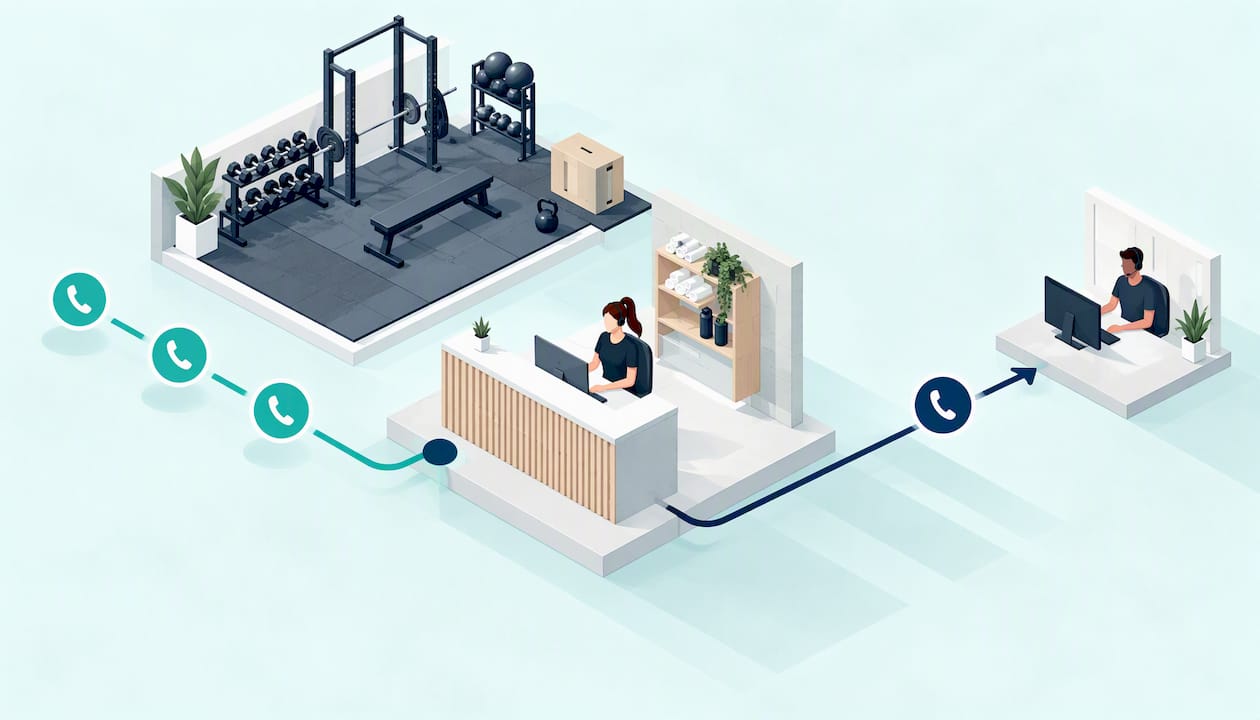
Gym phone automation means an AI voice agent answers your calls, handles the repetitive ones (opening hours, class times, trial bookings, membership questions) and passes anything sensitive to a person. It does not mean a robot runs your gym. It means the call at 6:10 am, while your coach is mid-session and the front desk is empty, still gets picked up.
This guide is for Australian gym, studio and PT business owners. It covers where phone automation helps, where it shouldn’t be used, how to set it up in a few days, and the privacy and telemarketing rules to know about.
Table of Contents
- Why gym phones go unanswered
- Work out what your missed calls are worth
- What a gym AI voice agent can handle
- Where a human should take over
- Set it up in days, not months
- Our view: automate the routine, protect the human moments
- Outbound calls: leads, trial follow-ups and overdue fees
- Phone automation compared with other options
- What to measure after go-live
- Which gyms benefit most
- See it on your own gym
- FAQ
- Sources
Why gym phones go unanswered
Most gyms are run by very few people at the busiest times. Front desks are often unstaffed in the early morning and late evening. Coaches are on the floor. Studio owners are teaching the 6 am class. The phone rings and nobody can get to it.

An unanswered call from a prospect is rarely a call back to a competitor in the same minute. It is more often a quiet loss: the person was keen enough to ring, got voicemail, and moved on to the next gym on the map.
The local numbers back this up. A Keepme study of 50 Australian fitness brands covering 1,861 locations found that none of the operators actively advertised a call-back option, and 66% required a manual request through a contact form. The takeaway is simple: in Australian fitness, lead follow-up is often left to chance, and a fast, structured response is an easy way to stand out.
We won’t quote you a dollar figure for what missed calls cost your gym, because it depends on your membership price, your join rate and how many calls you miss. You can work it out yourself in the next section.
Work out what your missed calls are worth
Before you buy anything, spend a week measuring. You need three numbers.
- Missed calls per week. Check your phone provider’s call log or your phone system’s report. Note the time of day for each one.
- How many were prospects. Call back a sample of the numbers. Sort them into prospects, existing members and everything else (sales reps, wrong numbers).
- Your join rate. Of the prospects you do speak to, how many book a tour or trial, and how many of those sign up?
Multiply missed prospect calls by your join rate and by your average membership value over a year. That is a rough, honest estimate of what unanswered phones cost you. If it is small, you may not need automation. If it surprises you, read on.
What a gym AI voice agent can handle
The best candidates are calls that are frequent, predictable and answered the same way every time. For a gym, that usually means:
- Opening hours, location, parking and access. The calls your team answers 20 times a week.
- Class timetable questions. “What time is the 9 am Pilates, and is there space?”
- Trial and tour bookings. The agent checks your calendar and books a slot while the caller is still on the line.
- Membership enquiries. Plan types, what is included, how joining works. Pricing answers should come only from what you load into the agent.
- PT and consult bookings. Matching a caller to a trainer’s availability.
- After-hours calls. Capturing the caller’s details and intent so your team can follow up first thing.
- Basic support. Freeze requests, change of details, lost access card: logged and routed, not argued.
Our AI Receptionist is built for this kind of work. It answers 24/7, speaks 9+ languages (useful in multicultural suburbs), and plugs into the calendars and CRMs you already use. For a closer look at the booking side, see our guide to AI appointment booking.
A sample call
Here is how a trial booking can sound. This is an illustration of the flow, not a recording of a real customer.
Agent: Thanks for calling Northside Fitness. You’re speaking with the studio’s AI assistant. How can I help?
Caller: Hi, I’m after a trial. Do you do evenings?
Agent: We do. I have Tuesday at 6:30 pm or Thursday at 5:45 pm for a free trial session. Which suits you?
Caller: Thursday. Is it okay if I have a dodgy knee?
Agent: Good question. I’ll pass that to one of our coaches so they can talk it through with you before Thursday. Can I confirm your mobile number for a call back?
Notice what happened at the end. The agent booked the easy part and handed the health-related part to a human. That is the design principle we use across every agent.
Where a human should take over
Automation works because it knows its limits. Set your agent to hand off, with a summary, in these situations:
- Injuries, medical conditions and pregnancy. Training advice for these belongs with a qualified coach or health professional, not an AI.
- Cancellations and cooling-off disputes. A person can listen, retain where it makes sense and handle the contract properly.
- Complaints and upset callers. Empathy is not something to automate.
- Hard-sell moments. The conversation where someone is deciding between a membership and walking away is one for your best salesperson.
- Anything the agent doesn’t know. It should say so and offer a call back, not guess.
When the handoff happens, the person should see the context: who called, what they asked, what was already booked. Our notes on AI-to-human handoff go through how to design this so callers never repeat themselves.
Set it up in days, not months
The slow part of most phone projects is the planning, not the technology. Here is a practical sequence for a gym owner.
- List your top 10 call types. Use the week of call data from earlier. Pick the five that are most frequent and most repetitive.
- Write the answers. Hours, plans, class rules, trial policy, joining steps, what to say about injuries (always: “a coach will call you”). Keep each answer short.
- Connect your calendar and CRM. The agent should book into the same diary your team uses, and log every caller as a lead.
- Decide your handoff rules. Which topics go to a person, which number rings, and what happens after hours.
- Test with your own staff. Call it, try awkward questions, interrupt it, mumble. Fix gaps.
- Go live with review. Read the transcripts every day for the first couple of weeks and tighten the answers.
We aim to have agents live in 3–5 days, with no lock-in contracts. Every agent is backed by human-in-the-loop quality review, which means calls are checked and the agent improves rather than being set and forgotten. If you want to see how a phone project fits a small team, our small business phone automation guide lays out the implementation in more detail, and you can hear examples on our demo page.
Our view: automate the routine, protect the human moments
We build AI voice agents, and we’re clear about what they are for. A gym sells something deeply personal: confidence, health, routine. People join because someone made them feel welcome. That part is human and should stay human.
What shouldn’t be human is a coach stopping a client mid-set to answer “what time do you close on Saturday?” or a prospect hearing a voicemail greeting at 7 pm on a Sunday. Those are the calls we take off your plate.
The gyms that get the most from this do three things. They keep the agent’s job narrow at the start. They read transcripts for the first weeks and fix the answers. And they use the time saved on the floor, on follow-ups and on members who are at risk of leaving, not on cutting hours.
If an AI answers and then a person never follows up, you haven’t automated anything useful. You’ve just built a more polite voicemail.
— Alston
Outbound calls: leads, trial follow-ups and overdue fees
Answering calls is the simplest place to start. Many gyms also want automation for calls they make: following up website enquiries, confirming trials, chasing lapsed members or overdue fees. This is where rules matter.
Do Not Call Register and telemarketing rules
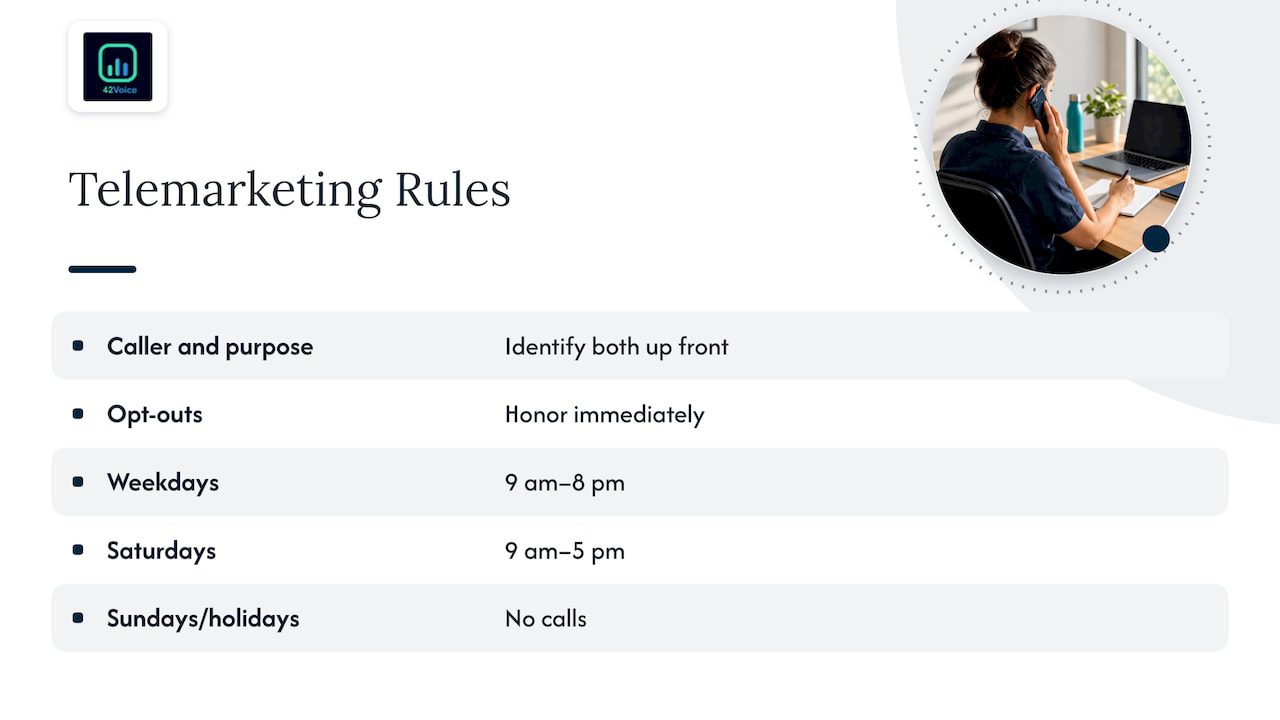
The ACMA defines telemarketing as any call where the caller aims to sell, advertise or promote goods or services. A call to offer a lapsed member a new deal can fall into that category. Per the ACMA, telemarketing calls must identify the caller and purpose up front, respect opt-outs immediately, and stay within permitted hours: 9 am to 8 pm on weekdays and 9 am to 5 pm on Saturdays, with no calls on Sundays or national public holidays.
The Do Not Call Register is the other piece. For marketing calls, ACMA advises that you check your calling lists against it, which it calls washing your numbers. Consent also matters: the ACMA has published its expectations on consumer consent for email, SMS and phone marketing.
A practical rule: someone who enquired and asked you to call them back has given you a clear reason to ring. A cold list of numbers has not. Whichever you use, make the first thing the agent says who it is, who it represents and why it is calling.
AI disclosure and privacy
Tell callers they are speaking to an AI. It is honest, it builds trust, and it avoids awkward moments later. The same applies to recording and transcripts: say so at the start of the call and tell people how to reach a person.
Under the Privacy Act, the OAIC explains that an organisation collecting personal information must take reasonable steps to notify people of certain matters, or make sure they are aware of them. Recording laws also vary by state and territory, so check yours.
Gyms collect more sensitive information than they sometimes realise: injuries, medical conditions, sometimes pregnancy. The OAIC’s guidance on collecting health information is written for health service providers, but it is a useful benchmark: consent, only what is reasonably necessary, collected by fair means. For a gym, the safe design is to have the agent avoid collecting health details at all and pass those conversations to a coach.
Trust is also a business matter, not just a legal one. If you are weighing up AI more generally, this overview of AI productivity and ROI results shows why the gains only hold when the data and disclosure side is handled properly.
This is general information, not legal advice. For your specific setup, talk to a lawyer or privacy adviser.
Overdue membership fees
For first-party payment reminders (your own members, your own invoices), a polite automated call can save your admin team hours. Keep it courteous, offer a way to reach a person, and hand off anyone who disputes the amount or mentions hardship. Our AI Collections Agent is built around that approach, and our page on compliant debt collection agents covers the setup.
Phone automation compared with other options
Gym owners usually weigh up four approaches. Here is how they compare on the things that matter.
| Option | Covers after hours | Books into your calendar | Handles high call volume | Human judgment |
|---|---|---|---|---|
| Voicemail | Yes, but callers often hang up | No | No | Later, if someone calls back |
| Extra front-desk staff | Only if rostered | Yes | Limited by headcount | Yes |
| Traditional answering service | Often | Usually message-taking only | Yes | Scripted |
| AI voice agent with handoff | Yes, 24/7 | Yes, with integration | Yes | Handed to your team |
These options are not mutually exclusive. Many gyms keep their front desk and add an AI agent for the overflow, the early mornings and the evenings. If you want to compare approaches in more depth, our guide on answering service vs call center explains how to trial an AI pilot safely over 30 days.
What to measure after go-live
Don’t judge phone automation on feel. Track a small set of numbers, before and after.
- Answer rate. The share of calls picked up, including after hours.
- Trials and tours booked from calls. The direct output.
- Show rate. Do automated confirmations reduce no-shows?
- Handoff rate and reason. If most handoffs are about one topic, teach the agent that topic or accept that it belongs with a person.
- Time back for staff. Ask your team honestly whether their day has changed.
- Caller feedback. Read transcripts and listen to a handful of calls each week.
We provide real-time voice analytics and transcripts so you can review all of this. Because we haven’t tied our claims to anyone else’s gym, we won’t promise you a particular uplift. Your numbers, measured over a few weeks, are the only ones that count.
Which gyms benefit most
Phone automation tends to suit:
- Boutique studios (Pilates, yoga, boxing, F45-style formats) where instructors are always mid-class.
- PT-led gyms and small independents with one or two people on site.
- 24-hour gyms with unstaffed periods but constant enquiries.
- Multi-site operators who want consistent answers across locations.
- Gyms in multilingual communities where callers may prefer another language.
It suits less well when your enquiries are almost all in person or through an app, or when call volume is so low that your team already catches every call. Be honest about which one you are.
See it on your own gym
Our AI Receptionist can answer your gym’s calls, book trials into your calendar, capture leads in your CRM and hand anything sensitive to your team. Pricing is tailored to each business, and you can see the plan structure on our pricing page. If you also chase new leads by phone, our AI Sales Development Rep can qualify enquiries and pass the warm ones to your sales staff.
Ready to see it? Book a free 15-minute demo and we’ll show you how it would handle your gym’s calls.
FAQ
Can an AI voice agent book gym trials and classes?
Yes, when it is connected to your calendar or booking system. It offers available slots, confirms details with the caller and logs the lead in your CRM. Anything it can’t confirm, such as a special request, can be passed to your team.
Will members know they are talking to an AI?
They should. We recommend the agent says upfront that it is an AI assistant, and that callers can ask for a person at any time. Being open is the right thing to do and it protects trust in your brand.
Is gym phone automation legal in Australia?
Answering inbound calls with an AI is generally straightforward, but you still need to tell people about recording and how their information is used. Outbound marketing calls add Do Not Call Register, calling-hour and consent rules overseen by the ACMA. This is general information, so check your situation with a lawyer or privacy adviser.
Does it replace my front-desk team?
No. It takes the repetitive, high-volume calls so your team can spend time on tours, onboarding, retention and members who need a real conversation. Complex or sensitive calls go to a person.
How long does it take to go live?
We aim for 3–5 days, depending on your integrations and how clearly your answers are defined. We then review transcripts with you and improve the agent over the first weeks.
Sources
- First-of-Its-Kind Study Reveals the State of Call-Back Services in Australian Membership Sales
- Dealing with telemarketing, ACMA
- Do Not Call Register, ACMA
- Telemarketing compliance alerts, ACMA
- Consent expectations for businesses using direct marketing, ACMA
- APP 5 Notification of the collection of personal information, OAIC
- Chapter 2: Collecting health information, OAIC
- AI for agencies: 3.2x ROI and real productivity gains
Recommended
- Increase Call Answer Rates: AI With Human Handoff for Small Businesses
- AI Receptionist — 24/7 Call Answering & Booking
- Stop Missing Bookings: Call Answering for Auto Repair Shop Operations
- Property Management Call Answering: What to Look For and Buy
This article is general information about AI voice technology and isn’t legal or compliance advice. Requirements for call recording, AI disclosure and outbound calling vary by state and use case.