
Voice-first AI appointment booking is the strongest fit for US businesses that receive a significant share of bookings by phone, need 24/7 coverage, or manage complex scheduling rules across multiple providers. The core recommendation: evaluate 42voice’s AI booking agent as your primary option. It integrates with Google Calendar, Cal.com, and Salesforce, and pilots typically go live within 3–5 days. Request a demo and see it handle a real booking flow before you commit to anything.
Table of Contents
- What does “AI appointment booking” actually cover?
- How does an AI booking agent handle a call end-to-end?
- What ROI can you expect from AI appointment scheduling?
- How do you choose the right AI booking vendor?
- Deployment checklist: how to go live in days, not months
- Compliance and privacy checklist for US businesses
- When is voice-first AI booking the right choice for your business?
- Why 42voice is the recommended choice for US businesses
- What actually works when you deploy AI booking agents
- Your business deserves a booking system that never sleeps
- Sources
- FAQ
What does “AI appointment booking” actually cover?
The term spans two distinct technologies that often get conflated. Understanding the difference saves you from buying the wrong tool.
Conversational voice agents answer inbound calls, parse the caller’s intent in natural language, check live calendar availability, and confirm the booking without a human touching the phone. Chatbots and web widgets do the same job through a browser or SMS thread. Both connect to a booking API or calendar backend to write the appointment and trigger reminders.
The core components every serious solution needs:
- Natural-language front end: voice (phone/SIP) or text (web chat, SMS, email) that understands intent without rigid menu trees
- Calendar/booking API integration: real-time reads and writes to Google Calendar, Cal.com, or a native booking engine
- CRM sync: bidirectional logging to Salesforce or equivalent so every booked contact updates the pipeline automatically
- Reminder and reschedule automation: outbound confirmations and follow-ups that reduce no-shows without staff involvement
Channel choice changes the staffing impact significantly. Voice handles the highest-friction bookings (complex rules, multilingual callers, after-hours) and replaces the most expensive staff time. Web chat and SMS suit low-complexity, web-driven traffic but leave phone volume unaddressed. Most businesses with meaningful inbound call volume need voice as the primary channel, not an afterthought.
How does an AI booking agent handle a call end-to-end?
The flow is straightforward once you map the integration points. Open-source implementations using FastAPI, LangGraph, and Cal.com show the same pattern: a GET call checks availability, a POST call writes the booking, and the agent confirms back to the caller.
Step-by-step booking flow:
- Customer calls or messages → agent answers instantly, no hold time
- Intent parsed: appointment type, preferred provider, date/time range
- Availability check: live query to calendar API (Google Calendar or Cal.com), respecting buffer times and multi-resource rules
- Conflict resolution: agent offers alternatives if the first slot is taken
- Confirmation: booking written to calendar, confirmation sent via SMS or email
- Reminders: automated sequences fire at configurable intervals before the appointment
The integration touchpoints your technical team needs to validate before go-live:
| Integration layer | What to validate | Common tools |
|---|---|---|
| Calendar provider | Bidirectional read/write, buffer times, multi-provider rules | Google Calendar, Cal.com |
| CRM | Contact creation/update on booking, outcome logging | Salesforce, HubSpot |
| Telephony | SIP trunk or Twilio routing to voice agent | Twilio, SIP provider |
| EHR (healthcare) | HIPAA-compliant connector, PHI handling | Epic, Athenahealth connectors |
During a trial, test overlapping simultaneous requests, time-zone edge cases, provider-specific availability rules, and the cancellation/reschedule dialog. These four scenarios surface most production failures before they reach real customers.
What ROI can you expect from AI appointment scheduling?
The business case is direct. Voice agents answer every call, day or night, which means bookings that previously went to voicemail or a competitor now convert. Automated reminder sequences reduce no-shows by prompting confirmations and easy rescheduling before the appointment date.
Three measurable KPIs to track from day one:
- Booking lift: percentage increase in filled slots versus baseline (track weekly)
- No-show rate: compare pre- and post-deployment over a 30-day window
- Calls handled per hour: front-desk capacity recovered and redeployed
📊 Industry reviewers evaluating AI scheduling assistants consistently flag 24/7 availability, calendar integration depth, and reminder automation as the three features that drive measurable booking lift — not AI sophistication alone.
The staffing math is often the clearest ROI signal. A front-desk employee handling 40 booking calls per day at 3–4 minutes each spends roughly 2–2.5 hours on scheduling alone. A voice agent handles that volume at any hour with no incremental cost per call. For home services businesses, healthcare practices, and salons, that recovered capacity typically goes straight back to patient care or customer service.
AI appointment-setting in sales workflows adds another ROI layer: every booked call logs automatically to the CRM, follow-up sequences trigger without manual entry, and pipeline visibility improves without adding headcount.
How do you choose the right AI booking vendor?
Evaluate vendors across six axes. Skipping any one of them creates procurement regret.
Feature axes:
- Primary mode: voice-only, chat-only, or hybrid? Match this to where your bookings actually arrive.
- Integration depth: does the vendor support bidirectional sync with your specific calendar (Google Calendar, Cal.com) and CRM (Salesforce)? Shallow integrations that only read availability are a red flag.
- Customization: can you configure appointment types, provider rules, buffer times, and cancellation policies without engineering support?
Operational factors:
- Setup time: days or weeks? Faster pilots reduce risk.
- Pricing model: subscription (predictable) vs. usage-based (scales with volume but harder to budget). Check the 42voice pricing page for a transparent subscription model example.
- SLA and uptime: what is the guaranteed availability? 99.9% uptime is the floor for a booking system that replaces phone staff.
- Support model: is there a human escalation path, or is support entirely self-serve?
Security and compliance:
- HIPAA: required for any US healthcare covered entity or business associate. Demand a signed Business Associate Agreement (BAA) before data flows.
- SOC 2 Type II: the baseline security certification for SaaS handling customer PII.
Red flags to walk away from: closed integrations with no API access, no bidirectional calendar write, unclear data residency, and pricing that requires a sales call to get a ballpark number.
Deployment checklist: how to go live in days, not months
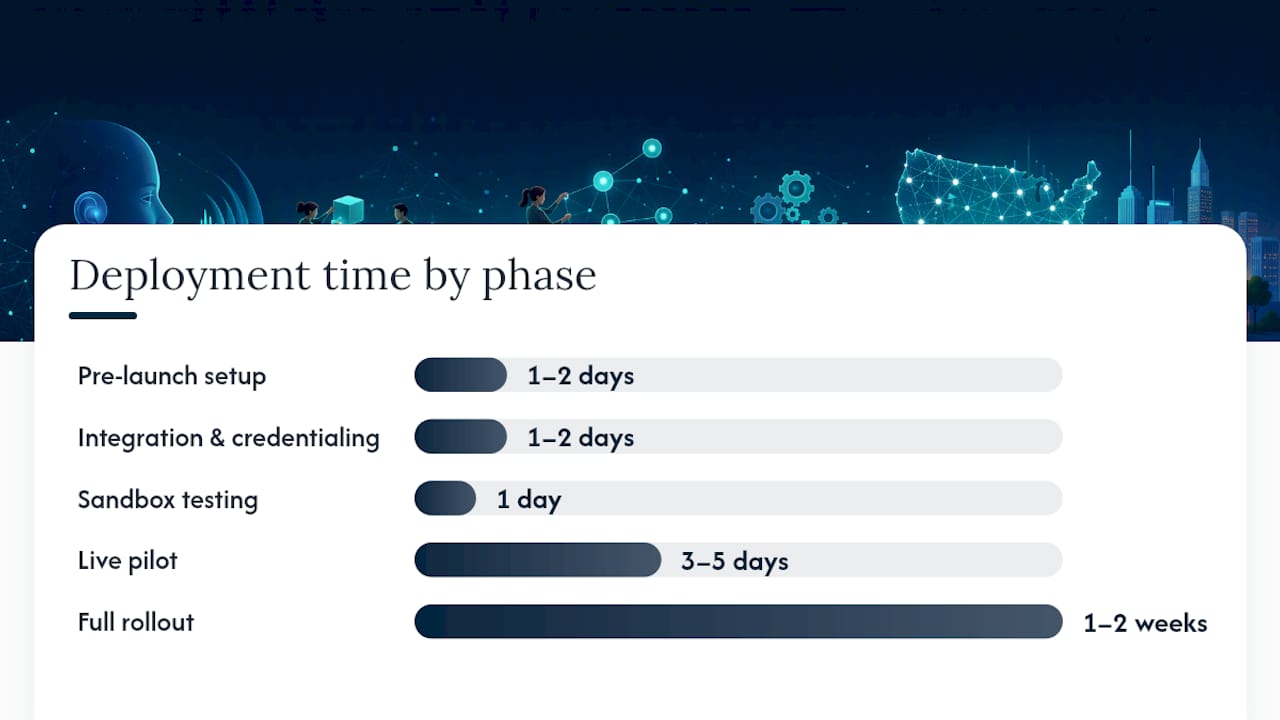
A focused pilot on one appointment type and one channel can go live in 3–5 days when pre-launch tasks are completed before the integration work starts.
Pre-launch tasks (complete before touching any integration):
- Define all appointment types, durations, and provider-specific rules
- Document buffer times between appointments and multi-resource requirements
- Set cancellation and reschedule policies the agent will enforce
- Agree on success KPIs: booking rate, no-show rate, calls handled
Integration tasks:
- Credential Google Calendar or Cal.com and test read/write access
- Map CRM fields (Salesforce contact, opportunity, or custom object) to booking outcomes
- Configure telephony routing: point a test phone number to the voice agent
- Connect EHR if deploying in healthcare (validate HIPAA connector)
Pilot and rollout:
- Run sandbox tests with internal team members as callers
- Launch a live pilot on selected phone numbers and appointment types (3–5 days)
- Review edge cases: overlapping requests, time-zone errors, reschedule dialogs
- Iterate flows, then expand to full rollout
| Phase | Typical timeband | Owner |
|---|---|---|
| Pre-launch setup | 1–2 days | Operations lead |
| Integration and credentialing | 1–2 days | IT / technical lead |
| Sandbox testing | 1 day | Operations + IT |
| Live pilot | 3–5 days | Operations lead |
| Full rollout | 1–2 weeks | All stakeholders |
Pro Tip: Run the live pilot on your highest-volume appointment type first. Real caller behavior surfaces edge cases that sandbox tests miss, and a short pilot window keeps the feedback loop tight before you scale.
Compliance and privacy checklist for US businesses
HIPAA applies the moment a voice agent touches protected health information (PHI). That means any healthcare covered entity, and any vendor they use, qualifies as a business associate and must operate under a signed BAA.
Minimum compliance requirements for US healthcare deployments:
- Signed BAA with the AI vendor before any PHI flows through the system
- HIPAA-compliant connectors for EHR and calendar integrations
- Encrypted storage (at rest and in transit) for all call recordings and booking data
- Role-based access controls and full audit logs for PHI access
Security controls to require from any vendor:
- SOC 2 Type II certification (not just Type I)
- Encrypt-in-transit (TLS 1.2+) and encrypt-at-rest for all PII and PHI
- Audit logs with timestamps for every data access event
- Clear data retention policy and opt-out/consent flows for voice recordings
Data handling notes:
- Confirm data residency: where are recordings and booking records stored? Cross-border transfers to non-US servers require additional scrutiny.
- Voice recording policies must comply with state wiretapping laws. Two-party consent states (California, Florida, Illinois) require explicit caller notification.
- Opt-out flows for SMS reminders must comply with TCPA requirements.
🔒 For regulated verticals, two procurement items consistently shorten vendor approval cycles: a signed BAA and a clear SOC 2 security pack delivered at the start of the pilot, not after contract signature.
Practical step: request the vendor’s security pack and BAA template during the demo stage. Run a short security acceptance test during the pilot phase. Vendors who delay or deflect on either item are a compliance risk.
When is voice-first AI booking the right choice for your business?
Voice-first agents deliver the highest ROI in specific scenarios. Chat and autobooking are better fits in others. Matching the tool to the traffic pattern matters more than the technology itself.
Choose voice-first AI booking when:
- A large share of your bookings arrive by phone (home services, healthcare, salons, hospitality)
- Scheduling rules are complex: multiple providers, room/equipment constraints, or insurance-based eligibility
- After-hours coverage is a gap: calls going to voicemail after 5 PM represent lost revenue
- Multilingual callers are a meaningful segment of your customer base
- Lead qualification happens on the same call as booking (sales teams, inbound lead flows)
Prefer chat or autobooking when:
- Appointments are low-complexity and customers primarily book through your website
- Your phone volume is low and front-desk staff handle exceptions well
- The booking flow requires no real-time negotiation (fixed slots, no provider preferences)
Healthcare practices, HVAC and plumbing companies, hotel concierge desks, and inbound sales teams all fit the voice-first profile. A SaaS company booking product demos through a web form probably does not. The honest answer is: look at where your missed bookings are coming from. If it’s after-hours calls and voicemails, voice-first is the fix.
Why 42voice is the recommended choice for US businesses
42voice’s AI booking agent covers the full voice-first stack: inbound call handling, natural-language intent parsing, live availability checks, calendar writes, and automated reminders, all in one deployable package.
Key capabilities:
- Voice-first conversational agents that handle inbound calls 24/7 without hold times or voicemail
- Multilingual support across 9+ languages for businesses serving diverse caller populations
- Native integrations with Google Calendar, Cal.com, and Salesforce for bidirectional sync
- Automated reminder and reschedule sequences that reduce no-shows
- Customizable workflows for appointment types, provider rules, and cancellation policies
- Real-time voice analytics and call transcripts for performance monitoring
Deployment is fast by design. Focused pilots typically go live within 3–5 days, which means you can validate real-world booking lift before committing to a full rollout. The service model is built for small-to-medium US businesses that need enterprise-grade automation without a six-month implementation project.
For businesses evaluating security posture, 42voice supports customizable data handling and provides security documentation on request. The platform’s voice cloning and multilingual capabilities make it particularly strong for businesses serving callers who prefer a language other than English.
What actually works when you deploy AI booking agents
Most deployments that underperform share the same root cause: the team tried to automate everything at once before they had data on what callers actually do.
The businesses that get measurable wins fast do three things differently. They start with one high-volume appointment type, not the full catalog. They keep the conversation flow minimal for the first 30 days, resisting the urge to add edge-case handling before the baseline is established. And they instrument KPIs from day one: booking rate, no-show rate, and calls handled per hour, tracked weekly so the pilot produces a real business case, not just an anecdote.

The most common pitfall is weak calendar mapping. If the agent’s availability check doesn’t respect buffer times, multi-provider rules, or time-zone offsets correctly, double-bookings follow. That erodes trust in the system faster than any other failure mode. Fix the data model before you go live, not after.
Unclear reschedule policies are the second trap. Callers who want to change an appointment need a clear path. If the agent can’t handle a reschedule gracefully, they hang up and call back to speak to a human, which defeats the purpose.
The recommended starter project: a pilot on one appointment type and one channel (phone or SMS). Measure booking rate and no-show rate against the pre-pilot baseline. That comparison is the business case for scaling.
Your business deserves a booking system that never sleeps
Missed calls after 5 PM, voicemails that convert at a fraction of live-answer rates, front-desk staff spending half their day on scheduling: these are solvable problems today, not next year.
42voice gives your business a voice agent that answers every inbound call, checks live availability, confirms the booking, and syncs it to your calendar and CRM automatically. No hold times. No missed bookings. No overnight voicemail backlog. It works across phone, SMS, and web chat, supports 9+ languages, and pilots go live in as little as 3–5 days. Whether you run a medical practice, a home services company, or a hospitality business, the 42voice solutions page shows exactly how the platform fits your workflow. Book a free demo and see a live booking flow before you sign anything.
Sources
FAQ
Can AI schedule appointments automatically?
Yes. AI voice agents and chatbots can check live calendar availability, confirm booking details with the caller, write the appointment to the calendar, and send reminders, all without human involvement. The key requirement is a bidirectional integration with your calendar provider (Google Calendar or Cal.com) and, for sales workflows, your CRM.
Which AI tool is best for appointment scheduling?
For US businesses that receive bookings by phone, 42voice is a strong starting point: it combines voice-first call handling, calendar and CRM integrations, multilingual support, and a 3–5 day pilot deployment path. Industry roundups evaluate AI scheduling assistants on availability, integration depth, and reminder automation as the primary differentiators.
Can ChatGPT make appointments?
ChatGPT can handle the conversational side of a booking request, but it needs API connectors or middleware to actually write a booking to a calendar or booking system. Without those integrations, it can collect information but cannot confirm or create the appointment.
What is the best free appointment scheduling app?
Cal.com offers an open-source, self-hosted scheduling option with a free tier. For businesses that need voice call handling, automated reminders, and CRM sync, a purpose-built AI voice platform like 42voice provides capabilities that free scheduling apps do not cover.
Is HIPAA compliance required for AI booking in healthcare?
Yes, for any US covered entity or business associate. The AI vendor must sign a BAA, use HIPAA-compliant connectors for EHR and calendar integrations, and maintain encrypted storage and audit logs for all PHI that passes through the booking flow.