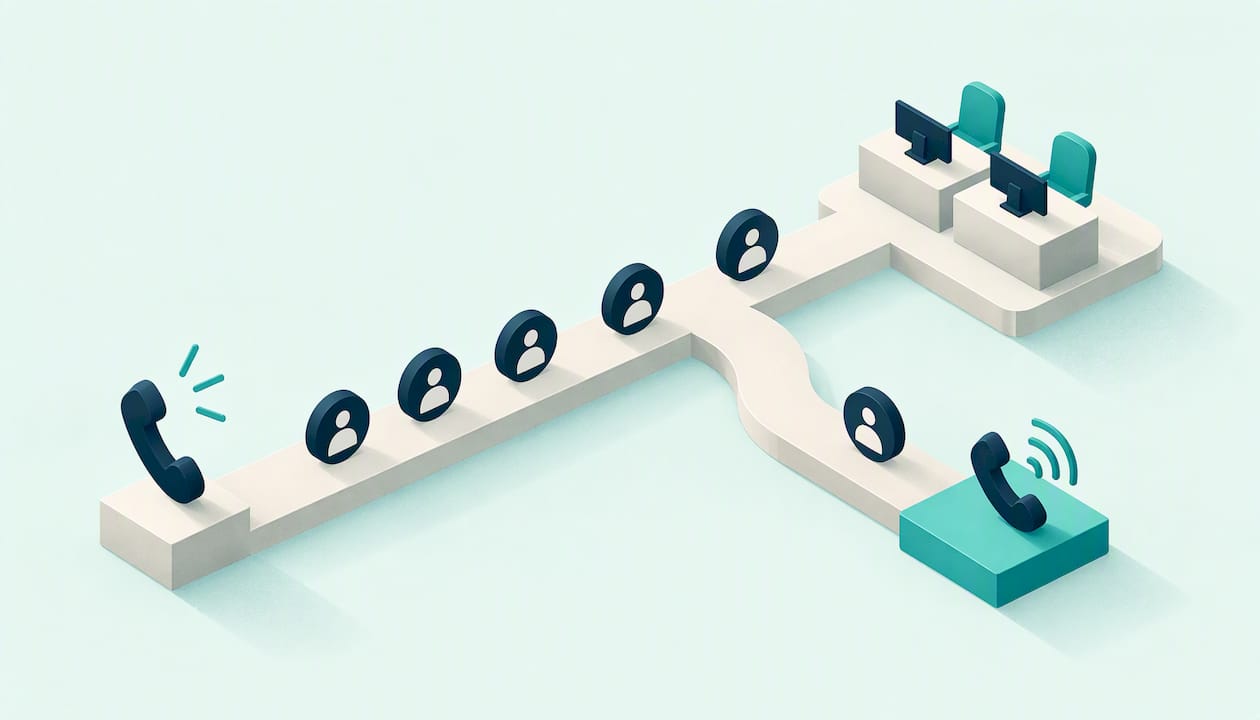
To handle a call spike, do four things: work out why the calls are coming, answer every call quickly even if you can’t resolve it, move the simple calls away from your people, and hand the sensitive ones to a human fast. A small team can’t staff for the busiest ten minutes of the week. So the practical answer is layers: a clear first message, call-backs, overflow coverage, and an AI voice agent that takes the repetitive calls while your team keeps the conversations that need judgement.
I’m Alston from 42Voice. Below is the plan we’d give an SME owner who has just watched a dozen calls ring out while the team was on the tools, on the floor or with a patient.
Table of Contents
- What a call spike actually is
- What to do in the first hour of a spike
- Stop losing callers while they wait
- Build a layered safety net
- Forecast the spikes you can see coming
- When automation helps and when a person should answer
- Urgent, sensitive and multilingual calls
- If your spike is an outbound campaign
- Our perspective: take the repetition, keep the human moments
- A simple spike plan for your business
- How 42Voice handles spikes for you
- FAQ
- Ready to stop missing calls?
- Sources
What a call spike actually is
A spike is a short stretch where calls arrive faster than you can answer them. It is not the same as being busy all week. One common rule of thumb is a rise of around 10 percent in calls within a set time frame, but for a business with one phone and two staff, a spike is simply the moment the line goes to voicemail.
The cause decides the fix, so name it first. Typical causes for Australian SMEs:
- Weather and emergencies. A storm hits and every roofer, plumber and electrician in the suburb gets the same call at once.
- Seasonal peaks. Christmas, EOFY, school holidays and annual billing cycles are predictable. Customer Driven lists these as the first things to map when planning for peaks, along with less obvious drivers such as policy changes and media coverage.
- Your own marketing. A letterbox drop, a radio spot, a Google Ads push or an SMS campaign.
- A website or booking-system fault. If people can’t book online, they ring.
- Opening hours. Monday at 8:30 am, or the minute a clinic’s phones open for the day.
- An outage or mistake. A late delivery, a billing error, a cancelled service.
The call pattern matters as much as the volume. Ten calls over an hour is fine. Ten calls in two minutes is a spike, and most of those callers will not leave a message.
What to do in the first hour of a spike
If the phones are ringing off the hook right now, work through this in order.
- Tell callers what is happening. A short recorded message beats silence. Say you are busy, give an honest wait or call-back window, and point to the fastest alternative, such as a booking link or a text. Contact-centre practitioners recommend using IVR messages and scripts to inform customers of delays and direct them online.
- Find the top three reasons people are calling. Ask whoever is answering. If 70 percent are asking “are you open?” or “can I move my appointment?”, you know where to point your effort.
- Put the simple answers where callers will hear them first. Opening hours, service areas, how to reschedule, where to find an invoice.
- Offer a call-back instead of a wait. More on this below.
- Protect your urgent calls. Decide now who takes an emergency, a distressed patient or a complaint, and make sure they are reachable.
- Write down what happened. Time the spike started, the cause, how many calls you missed. This is your forecast for next time.
Notice that nothing here requires hiring anyone at 9 am on a Tuesday. That is the point.
Stop losing callers while they wait
People hang up for a reason: they don’t know when they’ll be answered. Fix that and you recover a large share of the calls you would have lost.
Offer a call-back
A call-back keeps the caller’s place in the queue without keeping them on the line. It also lets you collect the reason for the call, so whoever rings back is prepared. Several contact-centre guides describe call-backs as a way to reduce abandonment and flatten the demand curve over time.

For a trade business, a call-back might be: “We’re on a job. Tell us your name, suburb and what’s happening, and we’ll call you within the hour.” For a clinic: “Leave your name and preferred time and we’ll confirm your booking by text.”
Capture the details, not just the number
A missed-call number tells you nothing. A short capture of name, suburb, issue and urgency lets you triage the call-back list. Burst pipe first, quote request second.
Keep the message honest
Don’t promise a ten-minute call-back and deliver it in three hours. Callers forgive a slow answer far more readily than a broken promise. If you want to see how the long tail of abandoned calls builds up, our guide on reducing call abandonment in Australia walks through fixing the least obvious causes first.
Build a layered safety net
There is no single fix. Australian contact-centre professionals recommend a layered approach to overflow: routing to another team, call-backs and virtual queues, outsourced overflow, self-service, and AI virtual agents for round-the-clock scaling, alongside better forecasting and right-sized capacity. For an SME, that translates as follows.
| Layer | What it does | Best for | Limit |
|---|---|---|---|
| Cross-trained staff | Anyone can answer common questions or book | Short, predictable peaks | Pulls people off billable work |
| Call-back | Holds the caller’s place without a wait | Any spike | Still needs someone to ring back |
| Self-service (web booking, SMS links) | Moves simple tasks off the phone | Bookings, reschedules, invoices | Some callers will always ring |
| Overflow to an answering service | A person takes messages when you can’t | After hours, occasional peaks | Usually can’t book into your calendar or resolve issues |
| AI voice agent | Answers every call at once, books, answers FAQs, hands off | Repetitive, high-volume calls | Needs a clear handoff for complex or emotional calls |
Most businesses end up combining two or three. If you are weighing a traditional answering service against something smarter, our comparison of an answering service versus a call centre explains how to pilot safely.
Forecast the spikes you can see coming
Most spikes are not surprises. They are the same spike you had last year with a different date on it.
Use your own history
Pull a year of call logs from your phone provider, or your missed-call list. Mark the busiest days. You will usually find three or four repeating peaks: start of the month, the week after a campaign, the first cold snap, the Monday after a long weekend. Planning guidance from Customer Driven suggests combining historical patterns with what you know about the business, so ask whoever runs marketing or operations what is coming.

Look at the hour, not just the day
Peaks are not spread evenly across a day. HiveDesk advises forecasting by day and by 15 to 30 minute interval, not only by month. For a small business, a simpler version works: note the three busiest hours of each weekday and make sure those hours are covered by a human or an agent.
Warn customers early
If you know EOFY or a price rise will drive calls, email and text customers first with the answer to the likely question. Every call you answer in advance is a call you don’t have to take later.
Plan your campaigns around your phones
Before a promotion goes out, ask: who will answer if 40 people call on Thursday morning? If the answer is “whoever is free”, set up call-backs or an agent first.
When automation helps and when a person should answer
An AI voice agent is good at repetitive, high-volume calls: booking, rescheduling, hours and location questions, basic status checks, taking a job’s details. It answers every call at once, so a spike of 30 calls does not become 30 missed calls. It does not get tired at the end of a bad day.
It is not the right first responder for everything. Hand these to a person:
- Emergencies and safety concerns. Anything involving immediate danger belongs with a human and, where needed, emergency services.
- Upset or distressed callers. Empathy is a human skill.
- Complex or unusual problems. If a call does not fit the script, a person should take it.
- Negotiation and closing. Pricing discussions, hardship conversations and sales closes are human moments.
- Medical or clinical questions. An agent can book the appointment, but clinical advice comes from a clinician.
The quality of the handoff matters more than the quality of the automation. A good handoff passes the caller’s name, reason and what has already been said, so they never repeat themselves. Our guide to SME call flow design covers how to set the triggers that route a call to a person, which cuts needless transfers.
Urgent, sensitive and multilingual calls
Spikes are exactly when these calls get lost. A few practical rules:
- Define “urgent” in writing. A gas leak, a no-heating call for an elderly customer, a patient in pain. Decide which phrases or categories trigger an immediate transfer or a priority call-back, and give the agent that list.
- Give sensitive calls a human route. Bereavement, hardship, complaints and anything involving vulnerability should go to a named person, not a queue.
- Cover the languages your customers speak. Many Australian suburbs have large communities who prefer to talk in a language other than English. 42Voice agents support 9+ languages, so a caller can be answered in their own language, then passed to a team member with the details already captured. For anything where accuracy is critical, such as consent or clinical detail, keep a human in the loop and confirm important details back to the caller.
- Review the calls. Every agent we build is backed by human-in-the-loop quality control, and transcripts let you check how calls were handled after the spike.
We haven’t found a single Australian rulebook for multilingual or urgent call handling. Treat these as sensible internal policies, and check any obligations specific to your industry, such as healthcare or licensed trades, with your industry body or adviser.
If your spike is an outbound campaign
Spikes can run the other way: a wave of replies to a campaign, or a collections run that triggers a flood of return calls. If you use outbound calling or automated reminders, there are Australian rules to understand, and we can’t give legal advice on them.
- Do Not Call Register. The ACMA explains that telemarketing has additional rules, including calling hours, even where calls to numbers on the register are allowed. It also lists categories such as debt collection and appointment reminders that are not treated as telemarketing, though other rules still apply. Check the ACMA page for your situation.
- Privacy Act. If calls are recorded or transcribed, or you store personal information, your privacy obligations apply. Tell people what you collect and why.
- AI disclosure. Be upfront that the caller is speaking with an AI assistant, and always offer a route to a person.
If you want to measure outbound results properly, see our six KPIs for outbound appointment setting.
Our perspective: take the repetition, keep the human moments
We build AI voice agents for one reason: the repetitive calls shouldn’t use up the people who are best at the hard ones.
A spike is a capacity problem, but it is also a judgement problem. Most of the calls in a surge are the same five questions or the same booking request. Those don’t need your best person. They need a quick, consistent answer and a record. The calls that do need your best person are the upset customer, the odd job, the deal that needs closing, and they get buried when the phone won’t stop.
That is why we never frame this as replacing staff. The agent handles volume, and every human moment goes to a person: nuance, empathy, the close. Every agent is backed by human-in-the-loop quality control, and complex calls hand off to your team with the context attached.
We would also tell you where not to rely on an agent. Emergencies, distress and anything that doesn’t fit the call flow should go to a human straight away. A good setup is clear about that line from day one.
Speed matters, too. Most owners put off fixing missed calls because they expect a months-long project. We aim to get you live in 3 to 5 days, with no lock-in contracts, connected to the calendars, CRMs and ticketing tools you already use.
Alston
A simple spike plan for your business
You can set this up in an afternoon, then improve it.
- List your triggers. Weather, campaigns, seasons, opening time, system faults.
- Pull your call data. Find the top three peak hours and the top five reasons for calling.
- Write the first message. Say what is happening, how long, and the quickest alternative.
- Set up call-backs. Capture name, number, suburb and reason, with urgency flagged.
- Decide who takes what. Name the person for urgent calls, complaints and sensitive calls.
- Automate the repetitive calls. Bookings, reschedules, hours, basic questions. See our guide to an AI call centre with human backup.
- Review after every spike. Count missed calls, check transcripts and adjust.
Numbers worth tracking
- Missed or abandoned calls during the spike window.
- Time to answer or to call back.
- Share of calls resolved without a person, and share handed off.
- Calls booked from the spike.
- Repeat callers, which usually points to a gap in the first answer.
Our voice analytics gives you real-time visibility of this, and our guide on first call resolution shows how to shorten the path from call to answer.
How 42Voice handles spikes for you
Our AI Receptionist answers every incoming call at the same time, so a rush of calls doesn’t turn into voicemail. It books into your calendar, answers common questions, captures job or enquiry details and passes complex or urgent calls to your team. It works after hours and in 9+ languages, and connects to your CRM and ticketing tools. If you need calls to keep flowing round the clock, our 24/7 call answering page explains the hybrid approach.

Pricing is tailored to each business, across Starter, Growth and Scale plans, so we’d rather look at your call pattern first. Meet the AI Receptionist or see the plans. Trades businesses that lose jobs while they’re on site may also want to look at our HVAC call answering example.
FAQ
How many calls count as a call spike?
There is no single number. A common rule of thumb is a rise of around 10 percent in calls in a set period, but for a small business a spike is whenever calls arrive faster than your team can answer. Compare your busiest ten minutes with your normal ones.
Should I hire extra staff for a spike?
For a predictable, long peak such as a busy season, extra people may make sense. For short, sharp spikes, staffing for the peak leaves people idle the rest of the time. Call-backs and an AI agent for the repetitive calls cover the burst, and your people take the complex ones.
Will an AI voice agent replace my receptionist?
No. It takes repetitive, high-volume calls such as bookings and common questions, so your receptionist can focus on callers who need empathy, judgement or a decision. Complex calls hand off to your team with the details already captured.
How fast can I have something in place before my next busy period?
A call-back message and a triage list can be done today. With 42Voice, an agent is typically live in 3 to 5 days, so you can have it running before a predictable peak such as EOFY or the Christmas rush.
Ready to stop missing calls?
Book a free 15-minute demo and we’ll map your busiest call periods, show you how handoff to your team works, and tell you honestly where an agent fits. Book your free demo.
Sources
- Handling high call volumes: everything you need to know
- Gearing up to ride the seasonal swell
- Planning for Peaks in Australian Contact Centres
- How to Handle Seasonal Volume Spikes in Contact Centers
- How to Handle Overflow Calls Without Losing Customers
- Dealing with telemarketing (ACMA)
Recommended
- Reduce Call Abandonment in Australia by Fixing the Long Tail First
- Stop Wasting Closers’ Time: 4 Steps to Phone Lead Qualification for SMBs
- Deploy First Call Resolution Pilots in 3–5 Days for Contact Centers
- SME Call Flow Design That Cuts Transfers and Deploys in 3–5 Days
This article is general information about AI voice technology and isn’t legal or compliance advice. Requirements for call recording, AI disclosure and outbound calling vary by state and use case.