
If you run a plumbing business, a 24/7 call answering solution that either books jobs directly or reliably qualifies emergencies is not a nice extra. It’s how you stop losing after-hours revenue to the next plumber on the search results page. Your first decision is simple: do you need message-only coverage, or do you need calls that turn into booked jobs on your calendar? Answer that, then run a short vendor checklist before you commit to anyone.
Table of Contents
- Who Benefits From Plumbing Call Answering, and Why It Pays Off
- What Should a Plumbing Answering Service Actually Handle?
- How Do You Choose the Right Answering Setup for Your Shop?
- What Does Onboarding Look Like, and How Fast Can You Go Live?
- What Do Plumbing Call Answering Plans Cost, and What’s the Payback?
- Why Call Screening Matters as Much as Call Answering
- Who Should Be Answering Your Plumbing Calls, and What Training Do They Need?
- How Is Customer Data Handled, and What About Compliance?
- Can Your Call Answering Service Grow With Your Business?
- What Do Real Plumbing Businesses Say About Their Answering Service?
- When Does Hybrid AI Plus Live Answering Actually Make Sense?
- How 42voice Fills the Gap Plumbers Actually Have
- Sources
- FAQ
Who Benefits From Plumbing Call Answering, and Why It Pays Off
Every plumbing business that takes calls after 5 p.m., on weekends, or during a busy install season is bleeding leads somewhere. The question isn’t whether you’re missing calls. It’s how much those missed calls cost you.
A burst pipe at 11 p.m. is not a call that waits until morning. The homeowner will dial the next plumber on the list within minutes if nobody picks up. That single missed emergency call can represent a significant amount of lost revenue, depending on the job scope, and it also hands a paying customer to a competitor who might keep them for years.
The business case for plumbing call answering comes down to a few concrete wins:
- Capturing emergency jobs that would otherwise go to voicemail and die there.
- Higher booking rates because a live or AI-driven agent gets the caller on your schedule while they’re still on the phone.
- Fewer missed leads from routine calls that come in during busy install days, lunch breaks, or drive time between jobs.
- Bilingual coverage for markets with significant non-English-speaking populations, which many small shops simply can’t staff for on their own.
- Reputation protection, since a caller who reaches a real, responsive answer is far less likely to leave a one-star review complaining nobody picked up.
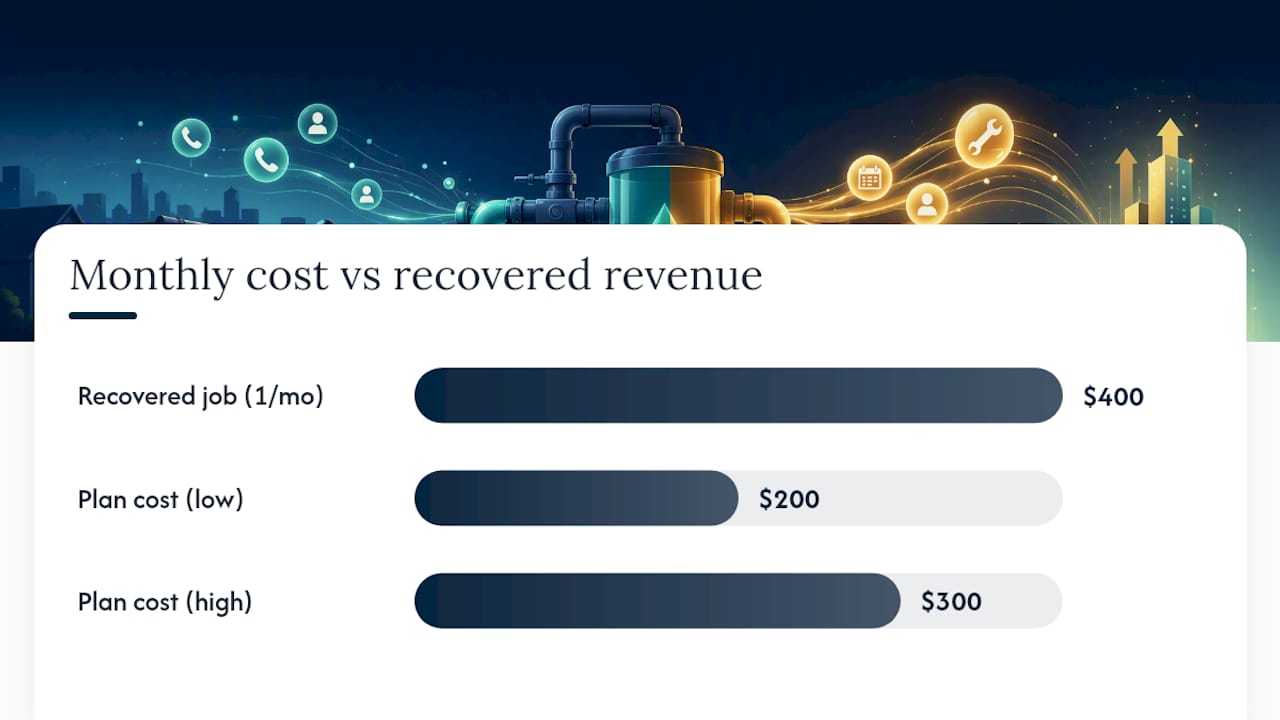
Pro Tip: Run the math on just one recovered emergency call per month. If your average job value is $400, a $200 to $300 monthly answering plan pays for itself before you even count the leads that would have gone to voicemail.
The ROI case gets stronger once you check how vendors talk about it publicly. Case studies from providers like AnswerNet commonly show measurable booking increases after a plumbing business switches from voicemail to a dedicated answering setup. Pair better phone coverage with the kind of consistent lead generation strategy outlined by firms like Omnivance Media, and every marketing dollar you spend actually converts instead of leaking out through unanswered phones.
What Should a Plumbing Answering Service Actually Handle?
Not every answering service is built for plumbing. A generic reception line that just takes a name and number isn’t enough when the caller has water pouring through their ceiling. Here’s what a service worth paying for needs to do.
- Run real emergency triage. The system should recognize trigger phrases (burst pipe, sewer backup, no hot water, active flooding) and immediately escalate to your on-call tech instead of queuing a callback for the morning.
- Capture structured intake fields, not a vague note. That means caller name, address, the specific problem, whether the water is shut off, and access details, every time.
- Decide between booking and message-taking. A basic service takes a message. A configured answering agent can book the job straight into your calendar while the caller is still on the line, which is the difference between a lead and a closed appointment.
- Integrate with your existing systems. Look for FSM connections to platforms like ServiceTitan, Jobber, or Housecall Pro, plus CRM sync with tools like QuickBooks, and SMS notifications so your dispatcher isn’t checking a separate inbox.
- Handle overflow and bilingual calls so a spike in Monday morning volume, or a caller who speaks Spanish, doesn’t fall through the cracks.
Vendors like FieldCamp describe configured agents that extract these structured fields automatically and escalate true emergencies to a human tech rather than leaving anyone stuck in a voicemail queue. That plumbing-specific vocabulary training matters: a system that recognizes “sewer backup” as urgent and “dripping faucet” as routine reduces false wake-ups for your on-call staff, which keeps your technicians rested and your emergency response credible.
Pro Tip: Ask any vendor to show you a sample call transcript for a real plumbing emergency scenario before you sign anything. If they can’t produce one, that’s a red flag about how much plumbing-specific training actually went into their scripts.
How Do You Choose the Right Answering Setup for Your Shop?
Start with one question: what output do you actually need? A message, a booked job, or a qualified lead handed off for a callback? That single choice narrows your options fast, because plenty of services only take messages while others integrate directly with your field service management system and put jobs on your board.
From there, evaluate on four criteria:
- Emergency handling accuracy. Does the service correctly separate a true emergency from a routine repair request?
- Integration depth. Does it connect to your actual calendar or FSM, or does it just email you a summary you have to re-enter manually?
- Response time and SLA. How fast is the call answered, and what happens if the primary agent can’t handle it?
- Pricing structure. Flat monthly, per-call, or per-booking, and which model fits your call volume.
During any demo, ask to see a shadow call log, request a live triage test with a fake emergency scenario, and ask what happens when your on-call tech doesn’t pick up on the first attempt.
Pro Tip: A shop running 1 to 3 trucks usually does fine with a lean booking-capable plan. Shops with 4 to 15 trucks need real CRM sync and reporting. Multi-location operators should insist on per-location routing and consolidated analytics before signing anything.
What Does Onboarding Look Like, and How Fast Can You Go Live?
Setup speed varies a lot by vendor, but the process itself follows a predictable path.
- Discovery call. You walk the vendor through your service area, typical call volume, and what counts as an emergency in your business specifically.
- Script and triage setup. The vendor builds your escalation rules, intake questions, and any bilingual scripts you need.
- Integration configuration. Calendar access, FSM connection, and CRM sync get wired up so bookings and notes land where your team already works.
- Shadow mode testing. Calls run in parallel with your current system so you can verify accuracy before flipping the switch fully.
- Go-live. The service takes calls live, with a monitoring window where you review transcripts and adjust triage rules as real calls come in.
Before any of this starts, you’ll need to hand over your service area boundaries, your on-call rotation schedule, calendar or CRM login access, and a list of who gets notified for true emergencies versus routine bookings.
Deployment speed claims are worth verifying rather than taking at face value. 42Voice typically enables rapid deployment in about 3 to 5 days when the required integrations are straightforward, but that timeline depends on how quickly you can provide API access and connector availability for your specific FSM. Ask any vendor for sample shadow call logs and run a quick integration test during the demo phase rather than after you’ve signed a contract.
What Do Plumbing Call Answering Plans Cost, and What’s the Payback?
Pricing generally falls into three shapes: flat monthly fees, per-call or per-minute charges, and per-booking fees. Flat monthly plans work best for shops with predictable call volume. Per-minute plans suit low-volume shops that don’t want to overpay for a flat rate they rarely use fully. Per-booking fees make sense when you specifically want output tied to results, not just call handling.
A rough ROI formula: (recovered jobs per month × average job value) minus monthly service cost = net monthly gain. For example, recovering emergency jobs each month can result in a net gain even before counting routine bookings that the service also captures.
- Message-only plans tend to run cheaper but leave the closing work to you.
- Booking-capable plans cost more but convert callers into calendar appointments without your involvement.
- Hybrid AI plus live plans often land below the cost of a full-time customer service rep, according to Rivet CSR, while still writing jobs directly into FSMs like Housecall Pro or Jobber.
Watch for hidden costs before signing: minute bundle overages, one-time setup fees, and per-integration charges that aren’t in the headline price. Ask for the full fee schedule in writing, not just the advertised monthly rate.
Why Call Screening Matters as Much as Call Answering
Answering the phone is only half the job. Screening determines whether that call turns into revenue or just noise on your dispatcher’s desk. A well-configured answering system separates real jobs from telemarketers, wrong numbers, and warranty disputes that don’t belong on a technician’s schedule.
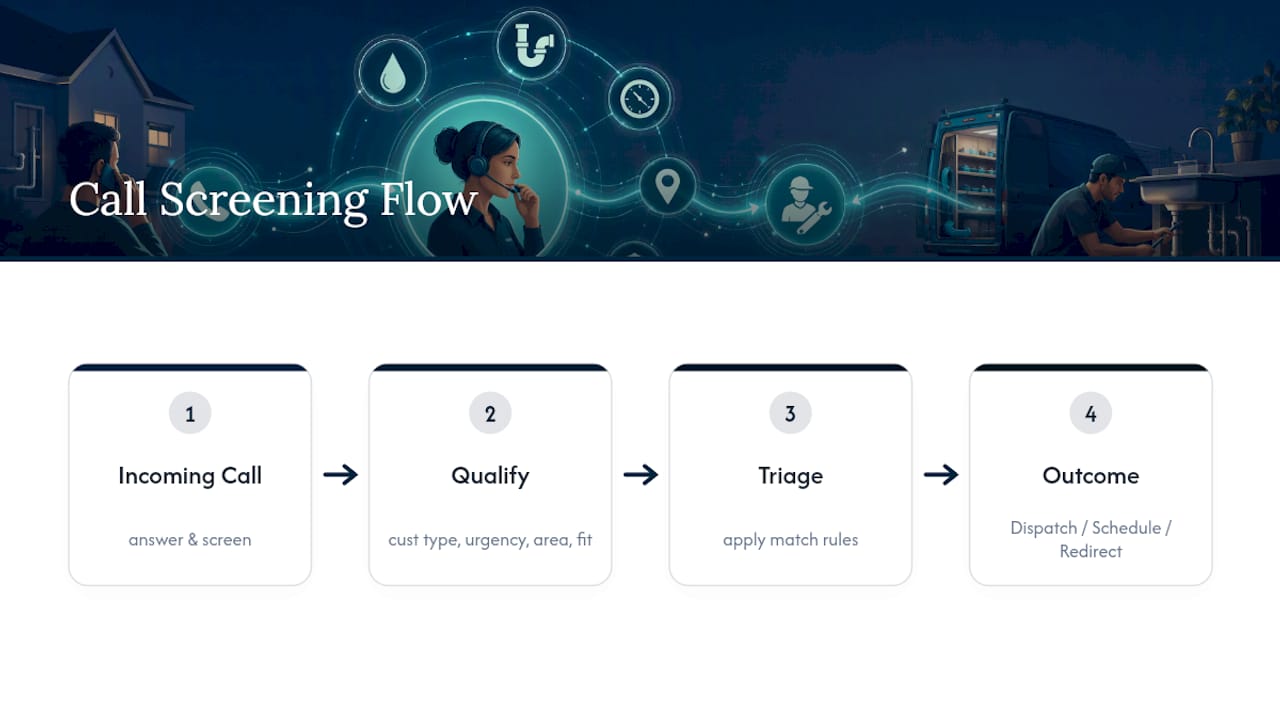
Good lead qualification asks the right questions upfront: is this a new customer or an existing one, is the issue urgent or routine, and does the caller’s address fall inside your actual service area? A caller thirty miles outside your coverage zone shouldn’t consume the same dispatch attention as a burst pipe two blocks from your shop.
Screening also protects your technicians’ time. Not every call needs a truck roll. A running toilet or a slow drain might get scheduled for next week, while active flooding gets a tech dispatched within the hour. The screening logic your answering service uses should mirror how you’d triage the call yourself if you picked up the phone personally.
The other overlooked benefit: screening filters out the calls that waste money. Spam calls, solicitations, and callers looking for services you don’t offer (like HVAC repair when you only do plumbing) get redirected or politely declined instead of eating up minutes on your billed plan. That keeps your call answering costs aligned with actual customer volume instead of noise.
Who Should Be Answering Your Plumbing Calls, and What Training Do They Need?
Whether the voice on the other end is human or AI, plumbing-specific knowledge separates a useful answering service from a liability. A generic call center agent who doesn’t know the difference between a “shut-off valve” and a “water heater relief valve” will either escalate the wrong calls or fail to escalate the right ones.
Trained plumbing call staff, human or scripted AI, need to recognize industry vocabulary: terms like main line, sewer backup, water heater, sump pump failure, and gas leak all carry different urgency levels and require different immediate instructions to the caller. Someone with an active gas leak needs to be told to evacuate and call emergency services, not just have a job booked for tomorrow morning.
Look for services that document their training process, whether that’s a live agent onboarding curriculum built around plumbing terminology or an AI system whose escalation rules were built specifically around plumbing trigger phrases. Vendors like FieldCamp highlight this kind of vocabulary-specific triage as a core differentiator, precisely because generic answering scripts miss the nuance that determines whether a call needs a truck in twenty minutes or an appointment next Tuesday.
Ask any provider directly how their staff or system is trained for plumbing calls specifically. If the answer is vague, treat that as a signal to keep looking.
How Is Customer Data Handled, and What About Compliance?
Every call you route through a third-party answering service involves sharing customer data: names, addresses, phone numbers, and sometimes payment details if the service takes deposits. That data needs to be handled the same way you’d want your own customer records treated.
Ask any vendor directly how call recordings and transcripts are stored, who has access to them, and how long they’re retained. Reputable providers should be able to explain their data retention policy in plain language, not buried in a lengthy terms-of-service document you need a lawyer to parse.
If your business operates in a region with specific data protection requirements, confirm the vendor’s practices align with those rules before you hand over customer information. This matters more than most shop owners initially realize, since a data breach involving customer addresses and phone numbers is a real liability, not just an inconvenience.
Also confirm how call recordings are used beyond the immediate booking. Some vendors use recordings for quality monitoring or training purposes. That’s often reasonable, but you should know about it and, where required, disclose it to callers rather than assume it’s happening silently in the background.
Can Your Call Answering Service Grow With Your Business?
A one-truck operation and a fifteen-truck multi-location plumbing company need very different things from an answering service, even though both start with the same basic need: someone picking up the phone.
Scalability shows up in a few concrete ways. Can the service handle a sudden spike in call volume during storm season without dropping calls? Can it route calls to different technicians based on which location or service area the caller falls into? Does the reporting dashboard break down performance by location, or does it lump everything into one undifferentiated total that’s useless once you open a second shop?
Pricing structure matters here too. A flat monthly plan that worked fine at low volume can become expensive fast once your call count triples. Per-booking or usage-based pricing models often scale more predictably, since your cost grows in proportion to the revenue those calls generate rather than jumping in fixed tiers.
Before you commit to any vendor, ask directly what happens if your call volume doubles in six months. If the answer involves a lengthy renegotiation or a forced plan upgrade with a big price jump, factor that into your decision now rather than discovering it later during your busiest season.
What Do Real Plumbing Businesses Say About Their Answering Service?
Vendor case studies are worth reading critically, not skipping entirely. Landing pages from providers like AnswerNet commonly showcase measurable booking improvements after a plumbing business moves from voicemail or an overwhelmed front desk to a dedicated answering setup. These aren’t universal guarantees, but they’re a reasonable signal of what’s achievable when the integration is done right.
Independent review platforms add another layer of verification beyond what a vendor publishes about itself. Checking a service’s standing on Trustpilot gives you unfiltered feedback from actual customers, including complaints about response time, billing surprises, or integration headaches that never make it onto a polished case study page.
When you’re evaluating a provider, ask for references specifically from other plumbing businesses, not general contractor or home services clients. The vocabulary and urgency patterns in plumbing calls differ enough from, say, landscaping or general handyman work that a glowing testimonial from an unrelated trade doesn’t tell you much about how the service will handle your burst pipe calls at 2 a.m.
When Does Hybrid AI Plus Live Answering Actually Make Sense?
Most small to midsize plumbing shops don’t need to choose between a fully human answering staff and a fully automated one. The strongest setups blend both: AI handles routine intake, triage, and after-hours booking, while a live layer stays available for edge cases or callers who specifically want to talk to a person.
The trade-offs are real. AI-driven agents cost less to scale and never miss a shift, but caller acceptance varies, and accuracy on ambiguous emergencies still benefits from human oversight during the first few weeks of any deployment. Disclosure matters too: callers generally respond better when told upfront they’re speaking with an AI agent handling routine intake, with a clear path to a human for anything urgent.
For most shops running 1 to 15 trucks, hybrid coverage that books directly into your existing calendar or FSM beats either extreme. It’s worth verifying vendor claims against a real after-hours agent demo before committing.
— Jesse
How 42voice Fills the Gap Plumbers Actually Have
If the shops you’ve read about above sound like your situation, the gap usually isn’t willingness. It’s staffing a phone line at 2 a.m. without hiring a night shift. AI voice agents can answer plumbing calls around the clock, triage emergencies based on rules you define, and book jobs directly into your calendar or FSM instead of leaving a message for follow-up.
The platform supports multiple languages, so a Spanish-speaking caller with a flooded basement gets timely triage as anyone else. Integration works with calendar and CRM systems, and deployment speed depends on configuration of service area, on-call rotation, and escalation rules. You get a system that captures the burst-pipe call at midnight and puts it on your board before your first coffee.
If you’re ready to see what a configured triage script looks like for your specific call volume, check the solutions overview or start with the booking agent setup built for field service scheduling. When you’re ready to move forward, the client setup form is the fastest way to get a real deployment timeline for your shop.
Sources
FAQ
How Does a Plumbing Answering Service Work?
A configured agent, human or AI, answers incoming calls, captures structured details like the caller’s address and the nature of the problem, and either books the job directly into your calendar or escalates true emergencies to your on-call tech.
What Is the Average Cost for an Answering Service?
Costs vary by pricing model. Flat monthly plans, per-call or per-minute charges, and per-booking fees all exist, and hybrid AI plus live plans often cost less than hiring a full-time customer service representative for a small shop.
What Is a Normal Call-Out Fee for a Plumber?
Call-out fees vary widely by region and time of day, with after-hours and emergency visits typically priced higher than standard daytime service calls. Check local plumbing associations or competitors in your specific market for accurate current rates.
What Is the 1-3-5 Rule in Plumbing?
Definitions of this rule vary across the trade and aren’t standardized industry-wide, so treat any specific numeric claim about it with caution unless a licensed plumbing authority in your jurisdiction confirms it applies to your local code.
Can 42voice Handle Emergency Plumbing Calls Specifically?
Yes. 42voice’s after-hours agent can be configured with plumbing-specific triage rules to escalate true emergencies while booking routine calls directly into your schedule.