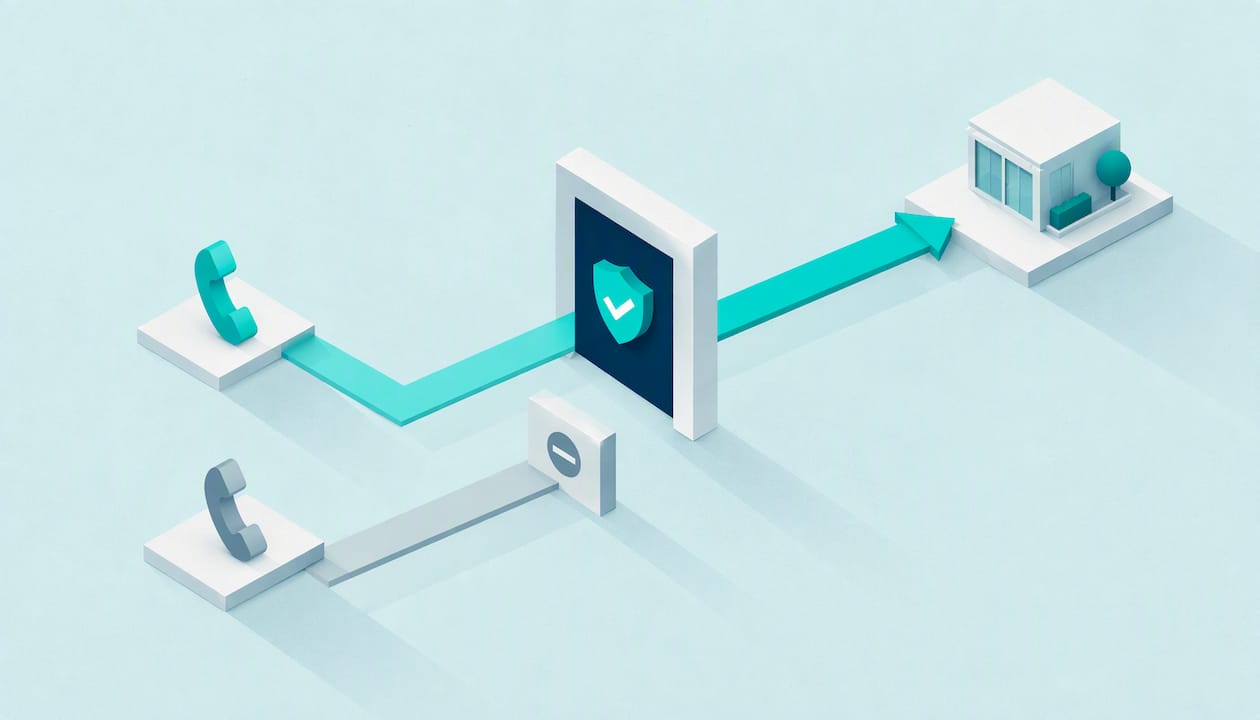
An AI voice agent can verify a caller by asking for details and matching them against your own records, such as your CRM or booking system. It should never treat caller ID or the sound of a voice as proof. Good caller verification is a short, layered routine with a clear point where a person takes over.
This guide is for Australian business owners who answer a lot of calls: clinics, trades, hospitality venues, sales teams and anyone chasing payments. We cover what verification can and cannot do, a step-by-step setup, the privacy rules that apply, and the calls you should always hand to a human.
Table of Contents
- Why a voice or a phone number is no longer proof
- Two directions of verification
- How an AI agent verifies an inbound caller
- Urgency is the red flag to build around
- A worked example: a physio clinic
- Voice verification and voiceprints: handle with care
- The privacy rules that apply
- Outbound calls: help your customers verify you
- Verify the organisation, not just the person
- Our view: verify in proportion, hand off early
- Setting it up in five steps
- Where it fits: our agents
- FAQ
- Book a free 15-minute demo
- Sources
Why a voice or a phone number is no longer proof
Two habits have quietly stopped working. The first is trusting the number on the screen. The ACMA advises that caller ID numbers can be easily spoofed, so neither you nor your customers can trust what is displayed. The second is trusting how a caller sounds. Scamwatch notes that scammers now use AI to make scams more convincing and personalised, and that it is harder to spot fraud from voice quality, grammar or tone alone.
Cloned voices are the sharpest example. Short samples taken from social media clips, podcasts or webinars can be enough to imitate a real person. If your front desk approves a change because the caller “sounded like the owner”, that is a weak control, whether a human or an AI is on the line.
The practical result: verification has to rest on information the caller should know and that you can check, not on how the call looks or sounds.
Two directions of verification
People searching for this topic usually mean one of two things, and the answers differ.
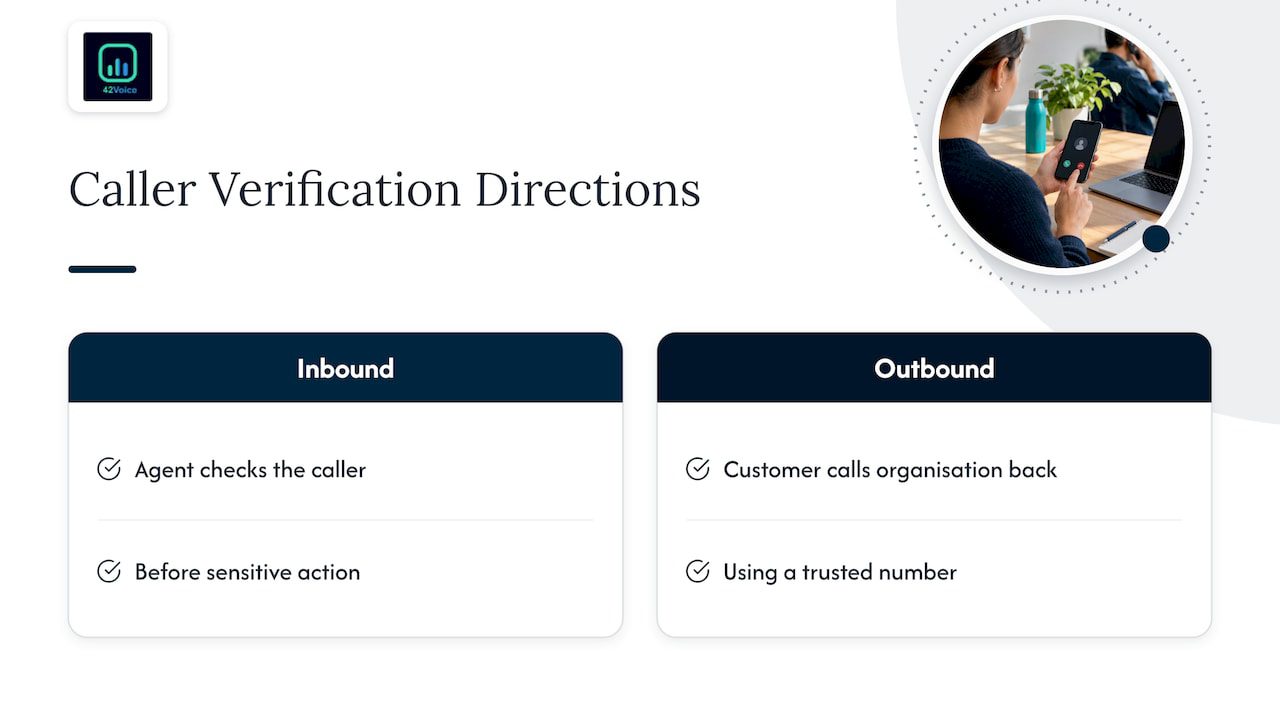
Inbound: your agent checks the person calling you. A patient wants to move an appointment. A customer asks for an account balance. Someone asks to change a delivery address. Before anything sensitive happens, the agent needs to be reasonably sure it is the right person.
Outbound: the person you call needs to trust you. Your customer has been taught to hang up on unexpected calls. The ACMA’s standard advice is to end the call and dial the organisation back on a trusted number. Your calls should make that easy, not awkward.
We cover both below.
How an AI agent verifies an inbound caller
An AI voice agent does not need a special trick. It does what a careful receptionist does, consistently, on every call and at 2am. The usual layers are:
- Passive signals. The agent sees the incoming number and can match it to a record in your CRM. A match is a hint, never proof, because numbers can be spoofed.
- Knowledge-based questions. The agent asks for details the real customer would know: full name, date of birth, postcode, a booking reference, or the last appointment date. Answers are checked against your system of record.
- Task-sized checks. The more damage a request could do, the more it needs. Confirming opening hours needs nothing. Moving a booking might need two matching details. Changing payment details or releasing account information should not be done by the agent at all.
- Callback to the number on file. For anything sensitive, the agent says a team member will call back on the number already in your records, not a number the caller supplies.
- Human handoff. If answers do not match, the caller sounds pressured, or the request is unusual, the call goes to a person with a transcript of what was said.
This is how we design the agents at 42Voice: they integrate with the calendars, CRMs and ticketing tools you already use, and complex calls hand off to your team. Every agent is also backed by human-in-the-loop quality review, so someone checks how verification conversations are actually going.
What the agent should refuse to do
An honest verification design includes a list of things the AI never does alone. Our suggested starting list:
- Release full account details, card details or medical information.
- Change bank details, passwords or contact details on the strength of a phone call alone.
- Approve refunds or payment arrangements for an unverified caller.
- Continue when the caller refuses to answer checking questions or becomes aggressive.
The agent politely explains it cannot do that on the phone, then books a callback or passes the call to a person.
Urgency is the red flag to build around
The Australian Cyber Security Centre points out that urgency is a common manipulation tactic in voice phishing, used to push people into password resets or account changes. Its guidance for businesses is to set procedures that require verification and never let urgency override them.
That is where an AI agent helps. It does not feel flustered by a caller who says “I’m the owner, I’m in a meeting, just do it now”. It follows the same steps every time. It also gives your team a rule to point to: “our process says we verify first”.
A useful addition is a simple escalation trigger. If the words or tone signal pressure (“urgent”, “right now”, “don’t tell anyone”, a demand to skip the checks), the agent flags the call and hands it to a person.
A worked example: a physio clinic
Here is how a simple booking-change call might run for a clinic in Brisbane. This is an illustration of a workflow, not a customer result.
Caller: Hi, I need to move my appointment on Thursday.
Agent: Happy to help. First, can I confirm your full name and date of birth?
Caller: (gives both)
Agent: Thanks. I can see an appointment on Thursday. Can you confirm the mobile number we have on file ends in what digits?
Caller: (gives digits)
Agent: Great. I have Friday at 10am or next Monday at 2pm. Which suits you?
The agent shares nothing sensitive beyond the appointment time, and the checks match the risk of the request. If the caller said “I’m calling about the results of my scan”, the agent would not discuss results. It would arrange a call from the practice team, who can judge what is appropriate.
Voice verification and voiceprints: handle with care
Some vendors pitch voice biometrics, where a caller’s voiceprint is matched to a stored sample. Be cautious, for three reasons.
Cloned voices. As covered above, a voice is easier to fake than it used to be.
Privacy law. The OAIC lists voice among the biometric features it covers and says that biometric scanning has particular privacy implications. Voiceprints used for automated biometric identification are treated as sensitive information, which generally calls for explicit consent and a high level of protection if your business is covered by the Privacy Act.
Fairness. A cold, a noisy worksite or a poor mobile connection can make a genuine caller fail the check. You then need a fallback anyway.
For most small and medium businesses, knowledge-based checks against your own records, plus callbacks and human handoff, are simpler to run and easier to explain to customers. If you ever do consider voiceprints, get proper advice on consent first.
The privacy rules that apply
We are not lawyers and this is not legal advice. These are the points we raise with every owner. Check them with your adviser.
- Privacy Act 1988 and the APPs. The OAIC’s guidance on commercially available AI products says personal information, including AI-generated inferences and recordings, must be collected lawfully. It also says that using AI to generate or infer personal information is itself a collection of personal information.
- Collect only what you need. A date of birth and a postcode may be enough. Asking for more identity details than the task needs creates risk for you.
- Tell callers. Say at the start that they are speaking with an AI assistant and that calls may be recorded or transcribed, in line with your privacy policy. Transparency also builds trust with callers who are wary of scams.
- Secondary use. Having access to caller data does not by itself give you the right to use it for training or other new purposes. Check your obligations before you do.
- Retention. Decide how long transcripts and recordings are kept, who can read them, and how a customer asks to see them.
If your business also deals with sensitive health information, treat the above as a floor, not a ceiling.
Outbound calls: help your customers verify you
If your agent makes calls (appointment reminders, lead follow-up, payment reminders), customers will be suspicious, and they are right to be. Build the call so it passes their checks:
- Identify yourself first. Business name, the purpose of the call, and who it is on behalf of.
- Use a returnable number. The ACMA says telemarketing calls must display a caller ID number that can be called back, and the caller and employer must be identified at the start, with the purpose stated.
- Never ask for full card numbers, passwords or one-time codes. Direct people to a secure payment link or your official website instead.
- Invite a callback. Say: “If you’d like to check this call, hang up and ring us on the number on our website.” Fraud advice from the ACSC tells people to source the number independently, so you are matching what they have been taught.
- Respect the hours and the register. Telemarketing is generally limited to set hours and prohibited on Sundays and national public holidays, and you must wash your lists against the Do Not Call Register. A published number does not equal consent.
For sales and collections calls in particular, our call compliance checklist walks through what to put in place. Collections work has its own considerations, which we cover on our debt collection agents page.
There is also a regulatory shift under way. The ACCC says the Scams Prevention Framework will put anti-scam duties on regulated banks, telecommunications providers and digital platforms, with most obligations starting from 31 March 2027. It does not replace your own checks, but expect customers to become more used to being asked to verify.
Verify the organisation, not just the person
Verification matters on the sales side too. When your team or an AI sales agent researches a prospect, confirm who you are speaking to and what they are authorised to decide before you send quotes or commit. Cross-checking a contact against a second source is good practice, and this guide on finding decision makers and confirming them with a second source explains the idea well. The same principle applies to inbound calls: one signal is a hint, two independent signals are a decision.
Our view: verify in proportion, hand off early
Here is where we land after building voice agents for Australian businesses.
AI is very good at the repetitive, high-volume part of verification: asking the same checking questions the same way, every time, including after hours, in the caller’s language, and logging the result. It does not get tired, and it does not skip a step because the queue is long.
AI is not the right place for judgment. A distressed caller, an odd request from a long-term customer, a family member calling on someone’s behalf, a request that feels off: these are human moments. Our approach is to automate the routine so your people have more time for those calls, not to replace them. That is why every agent we build has a handoff path, and why we review conversations with a human in the loop.
Three rules we would put on any phone line:
- Match the check to the risk. Low-risk requests get a light check. High-risk requests get a callback.
- Never let the caller choose the channel. Callbacks go to the number you hold, not the one offered on the call.
- When in doubt, hand off. A slow, careful answer from a person beats a fast wrong answer from a machine.
— Alston
Setting it up in five steps
You can put this in place without a long project. Our agents typically go live in 3 to 5 days, and there are no lock-in contracts.
- List your call types and rank each by risk: information only, booking changes, account access, money.
- Choose the checks per tier. For example, no check for hours, two details for a booking change, callback only for anything involving money or personal records.
- Connect your systems. The agent needs read access to the calendar or CRM it checks against, and write access only where the task requires it.
- Write the handoff rules. Define who takes over, when, and what the agent passes on (the transcript, the details collected, the reason for escalation).
- Test with your own team. Have staff call with correct details, wrong details and a pushy tone. Review the transcripts, adjust, and repeat before going live, then keep reviewing weekly at first.
If you want an agent on the front line first, our AI Receptionist handles inbound calls and bookings, including after hours. For more on the rollout, see our small business phone automation guide.
Where it fits: our agents
Our role-based agents cover reception, sales development, first-line support and collections, and each can follow a verification routine you define. Pricing is tailored to each business, and you can see the plan structure (Starter, Growth and Scale) on our pricing page. If you only need to stop missed calls turning into lost customers, start with the receptionist and add verification rules as your call mix becomes clearer.
FAQ
Can AI tell whether a caller is real?
Not reliably from the voice alone. Cloned voices and spoofed numbers can both look genuine. AI works best when it checks what the caller says against your own records and escalates anything that does not match.
Is caller ID enough to identify a customer?
No. The ACMA warns that caller ID can be spoofed, so a matching number is only a hint. Use it to pre-load the likely customer record, then confirm with questions only the customer should be able to answer.
Do callers need to be told they are speaking to an AI?
We recommend always saying so at the start of the call. It builds trust, and it fits with your obligations around transparency and privacy. Ask your legal adviser to confirm what applies to your business and call types.
Can I use voiceprints to verify callers in Australia?
It is possible, but it carries added obligations. Voiceprints used for automated biometric identification are sensitive information under the Privacy Act, which generally means explicit consent and strong protection. Many small businesses are better served by record-based checks plus a callback.
What should I do if a caller claims to be from my own business or bank and asks for urgent action?
Stop and verify. Hang up, then call back on a number you source independently, such as the one on the official website. Never let urgency override your process.
Book a free 15-minute demo
Want to hear how a verification flow sounds on a real call? Book a free 15-minute demo and we will show you how an agent checks callers, books appointments and hands off to your team.
Sources
- ACMA: Caller ID scams
- Scamwatch: How scammers use technology and AI
- eWeek: AI voice-cloning scams put Australian households and businesses on alert
- Cyber.gov.au: Social engineering
- OAIC: Biometric scanning
- OAIC: Guidance on privacy and the use of commercially available AI products
- ACMA: Say no to telemarketers
- ACMA: Do Not Call Register
- ACCC: Scams Prevention Framework
Recommended
- Increase Call Answer Rates: AI With Human Handoff for Small Businesses
- How to Automate Cold Calling With AI in 2026
- AI Voice Agents — Receptionist, Sales, Support & Collections
This article is general information about AI voice technology and isn’t legal or compliance advice. Requirements for call recording, AI disclosure and outbound calling vary by state and use case.