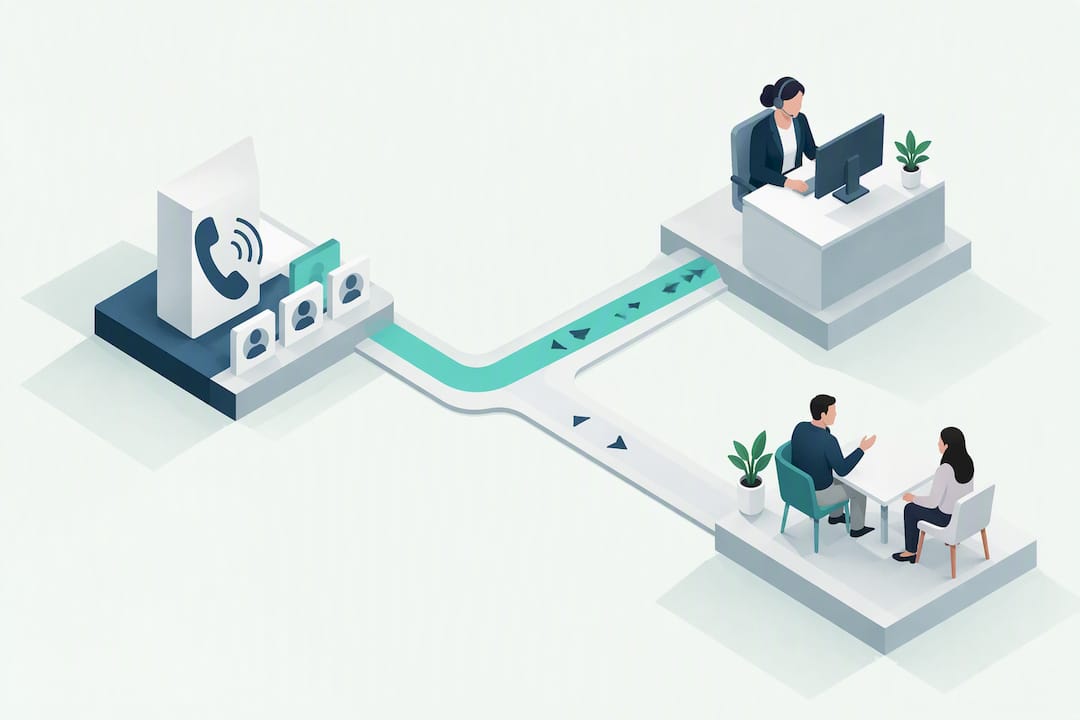
AI voice cloning for business means a voice agent, trained on a natural-sounding synthetic voice, that answers calls, books appointments and handles routine support without a person on the line for every call. For most SMEs the right move is a small pilot: pick one repetitive call task, keep a human handoff ready, and check your privacy and telemarketing obligations before you connect anything to your phone system.
Table of Contents
- What business-grade AI voice cloning actually does
- Benefits, limits and the human handoff principle
- Privacy, disclosure and telemarketing rules to check first
- Implementation checklist: running a safe pilot
- Why we build agents that hand off, not replace
- How 42Voice fits into your call handling
- FAQ
- Sources
What business-grade AI voice cloning actually does
Forget the consumer apps that clone a celebrity’s voice for a prank video. In a business context, AI voice cloning builds a consistent, natural-sounding voice for an agent that works your phone line, not a copy of any particular person’s voice for entertainment. It is speech synthesis technology applied to a specific job: answering, qualifying, booking and following up, every time, the same way.
SMEs typically point these agents at the calls that eat the most staff time without needing judgement:
- Inbound answering, so no call goes to voicemail during business hours or after them
- Appointment booking and rescheduling, synced to a live calendar
- Level 1 support, answering FAQs and routing anything outside the script
- Outbound lead qualification, screening interest before a salesperson gets involved
- Payment and collections reminders, confirming details and next steps on routine accounts
The appeal is straightforward. A missed call is a missed booking, and a receptionist who answers every call at 7pm on a Sunday is not realistic for most small businesses to staff.
Benefits, limits and the human handoff principle
Done well, a voice-cloned agent saves real time: fewer missed bookings, faster response on simple questions, and a consistent first contact regardless of the hour. Done badly, it tries to handle everything, which is where businesses get into trouble.
There are calls a voice agent should never try to close on its own:
- Anything involving a distressed or vulnerable caller
- Disputes over an invoice, refund or service failure
- Requests that touch health, financial hardship or legal matters
- Any moment where the caller explicitly asks for a person
The fix is a clear handoff design, not a smarter script. Set triggers that move a call to a human the instant it leaves safe territory: a caller repeating themselves, a sentiment flag, a direct request, or simply a topic outside the agent’s defined scope. ACMA’s research on AI adoption in telecommunications backs this conservative model: automate the bounded, repetitive tasks and keep a person responsible for exceptions.
Pro Tip: Write your handoff triggers before you write your scripts. The scripts will change; the list of moments that must go to a human should not.
Privacy, disclosure and telemarketing rules to check first
Before any voice agent touches your CRM, calendar or phone system, work through the compliance side. None of this is exotic, but skipping it is how SMEs end up with a system that breaches the Privacy Act without anyone intending to.
- Check what the system stores and why. The OAIC’s guidance on generative AI models says Privacy Act obligations apply to personal information entered into or generated by AI, so you need to know what the system retains, whether it is used to train the underlying model, who can access it, and how long it is kept.
- Disclose that calls may be recorded or processed by AI. Tell callers up front, and offer an opt-out or a path to a human for sensitive calls, similar to how healthdirect’s helpline lets callers skip recording or AI transcription when they are speaking with clinical staff.
- Treat outbound sales calls as telemarketing. If a call promotes goods or services, ACMA’s Do Not Call Register rules apply: wash your list against the register, call only within permitted hours, identify the caller and the purpose immediately, and stop when asked.
- Keep collections and support calls separate from marketing. Different rules and different disclosure needs apply depending on whether the call is a service reminder or a sales pitch.
One figure worth building your checklist around: ACMA’s own research frames the balance between efficiency and trust as the central question for AI adoption in telecommunications, recommending that businesses automate bounded tasks while keeping people accountable for exceptions.
For a deeper operational walkthrough, our compliance checklist for AI voice systems covers the same ground in more detail.
Implementation checklist: running a safe pilot
A pilot should be small enough to supervise closely and specific enough to measure. Here is the order that works:
- Pick one use case. Inbound answering or appointment booking are the easiest starting points because the scope is narrow and the success metric is obvious: fewer missed calls, more bookings confirmed.
- Define success metrics before you start. Call answer rate, booking completion rate, and the percentage of calls handed to a human are enough to judge a first pilot.
- Map the integrations. Your phone system (SIP or carrier connection), the specific CRM fields the agent reads and writes, calendar APIs for booking, and the ticketing system for support handoff.
- Prepare training material carefully. Use approved FAQs, service rules and sample call outcomes, de-identified where needed. The OAIC is explicit that a full CRM export is the wrong starting point: data minimisation comes first.
- Test with scripted and edge-case calls before any real customer hears the agent, including calls designed to trigger a handoff.
- Set a human review cadence. Someone checks a sample of transcripts weekly, flags anything that sounds wrong, and tunes the script accordingly.
A few things to keep in view as you go:
- Review flagged calls on a fixed schedule, not only when something goes wrong
- Keep a non-AI phone option visible for anyone who wants it
- Expand to a second use case only once the first is stable
For practical examples of where to start, our guide to three use cases worth piloting this quarter walks through the same decision from the other direction.
Pro Tip: Run your pilot on one location or one call type first, even if you operate across several. A clean result on a narrow scope tells you more than a messy result spread across everything.
Why we build agents that hand off, not replace
We built 42Voice around a simple belief: AI should take the calls nobody wants to keep answering at 9pm, not the ones that need a real person’s judgement. A receptionist missing a booking because they are already on another line is a solvable problem. A debt collection call needing empathy and a payment plan discussion is not something we try to automate away. Every agent we deploy is backed by human-in-the-loop review, and every script is built with a clear point where the call moves to your team. We would rather be live in days with a narrow, well-supervised pilot than promise a system that tries to do everything on day one. If you are weighing up where to start, we are happy to talk through what a pilot would look like for your call volume.
— Alston
How 42Voice fits into your call handling
If you have read this far, you already know the shape of a safe pilot: one use case, clear handoff rules, and the privacy checks done properly. That is exactly how we deploy our agents.

Our AI Receptionist answers inbound calls and books appointments straight into your calendar, our AI Tier-1 Help Desk handles routine support questions and routes the rest to your team, and our AI Collections Agent manages first-party payment reminders with the same handoff rules built in. For outbound work, our AI Sales Development Rep qualifies leads before a salesperson gets involved, with Do Not Call Register and disclosure requirements built into how campaigns are set up, not bolted on afterwards.
Typical deployment timelines aim for a few days, there are no lock-in contracts, and agents come with human-in-the-loop quality review. Pricing depends on call volume and the agents you need, with several plans available, so it is worth discussing your numbers directly rather than relying on generic rates.
If any of this matches a problem you are trying to solve, book a free 15-minute demo and we will walk through what a pilot would look like for your business.

FAQ
What is AI voice cloning used for in a business setting?
In a business context, AI voice cloning builds a consistent, natural-sounding voice for an automated agent that answers calls, books appointments and handles routine support or outbound tasks. It is distinct from consumer voice-cloning apps built for entertainment or impersonation, which serve a different purpose entirely.
How does voice cloning technology actually work?
A voice synthesis model is trained on speech data to generate natural-sounding speech patterns, then paired with a conversation system that follows scripts and business rules. The OAIC’s guidance on generative AI notes that Privacy Act obligations apply to any personal information the system processes along the way, which is why training data needs careful handling.
Is it legal to use AI voice agents for outbound sales calls?
It can be, but outbound calls that promote goods or services count as telemarketing under ACMA’s Do Not Call Register rules, which set permitted calling hours, caller identification requirements and list-washing obligations. Treat this as a compliance checklist to work through with your own advisor, not a general assumption that any outbound AI calling is automatically fine.
Do I need to tell customers they are talking to an AI voice agent?
Disclosure expectations depend on the sensitivity of the call: services like the healthdirect helpline let callers opt out of AI processing for sensitive interactions, and that pattern is worth copying for anything touching health, finance or disputes. A short disclosure line at the start of the call, with a clear path to a human, covers most routine business use cases.
How quickly can a small business deploy an AI voice agent?
Deployment speed depends on scope. A single, well-defined pilot, such as inbound answering or appointment booking, can go live in days rather than months once integrations with your phone system and calendar are mapped out, which is the timeline we work to for a first pilot.
Sources
- Guidance on privacy and developing and training generative AI models | OAIC
- Do Not Call register | ACMA
- AI use in telecommunications, media and interactive gambling | ACMA
- healthdirect helpline collection notice | healthdirect
Recommended
- Deploy AI Call Scripts for SMBs in 3–5 Days Without Vendor Delays
- AI Voice Accents for Business Calls: Your 2026 Guide
- Best AI Receptionist for Small Business in 2026
This article is general information about AI voice technology and isn’t legal or compliance advice. Requirements for call recording, AI disclosure and outbound calling vary by state and use case.