
For most U.S. small and medium businesses, 42Voice is the strongest starting point. It deploys in 3–5 days, connects to your existing calendar and CRM, handles calls in 9+ languages, and includes human escalation for calls that need a real person. That combination of speed, integration depth, and hybrid fallback is rare at the SMB price point.
Here’s the short version of where each category wins:
- Best overall for SMBs: 42Voice — fast deployment, calendar/CRM integrations, multilingual, hybrid fallback
- Best hybrid human + AI model: Hybrid AI + human receptionist services (Smith.ai, AnswerConnect, Nexa) — human agents handle nuanced, regulated, or high-stakes calls
- Best for appointment-heavy workflows: Appointment-first platforms (Slang.ai, Allo, Goodcall) — built around reservation systems and real-time availability
- Best for developer teams: Developer voice platforms (Vapi, Retell AI, Bland AI, Synthflow) — full API control for custom call flows
- Best for missed-call recovery: SMS-first services (Numa, Emitrr, Dial My Calls) — intercept missed calls and convert them to text conversations
SMB pricing for entry-level plans typically starts in the $30–$50 per month range, scaling with call volume. Most platforms listed here offer a free demo or trial.
Pro Tip: Before you book any demo, write down your three highest-volume call types. Vendors who can show you a live test on those exact scenarios in the demo are the ones worth trialing.
Table of Contents
- Which AI receptionist is right for your business?
- How these AI receptionists were evaluated
- Profiles: what each option actually does
- How to choose the right AI receptionist for your SMB
- Setup, integrations, and compliance for U.S. businesses
- Why 42Voice works for SMBs: deployment and outcomes
- What SMB owners say about AI receptionists
- What contract terms and cancellation policies look like
- How AI receptionists scale as your business grows
- Security features that go beyond privacy
- Key Takeaways
- The trade-off most SMBs get wrong when choosing an AI receptionist
- Your business deserves a voice that doesn’t sleep
- Useful sources and further reading
Which AI receptionist is right for your business?
The table below covers the main categories and 42Voice side by side. Use it to narrow to 1–3 options, then trial those.
A note on “accuracy / booking success”: cells marked as vendor-claimed reflect published vendor benchmarks. Cells marked as benchmarked reflect independent test-call results from hands-on roundup evaluations. Where neither is available, the cell is left blank.
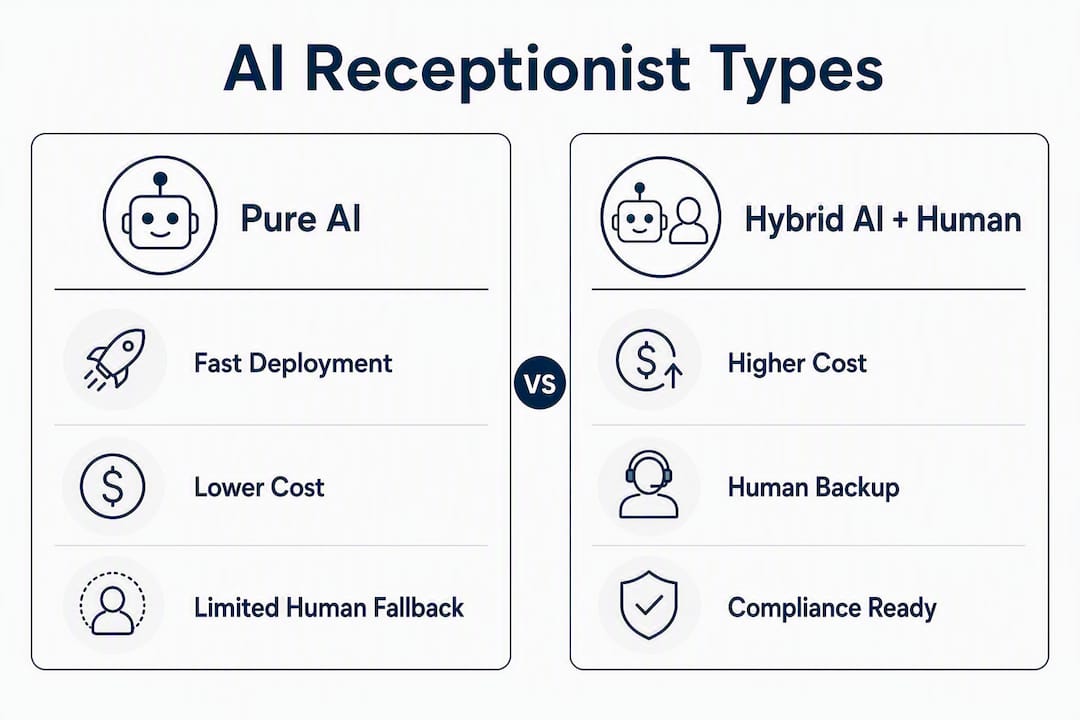
| Option | Best for | Starting price | Accuracy / booking success | Integrations | Deployment time | Hybrid support | Languages | Privacy / compliance | Demo / trial |
|---|---|---|---|---|---|---|---|---|---|
| 42Voice | SMBs needing fast, turnkey voice automation with human escalation | Contact for pricing | Vendor-claimed: high booking success across appointment, FAQ, and lead-qualification flows | Google Calendar, major CRMs, Zapier, custom phone systems | 3–5 days | Yes — human escalation built in | 9+ languages | Call recording consent, data encryption, HIPAA-capable options | Free demo available |
| Hybrid AI + human receptionist services (Smith.ai, AnswerConnect, Nexa, Air AI) | Regulated industries, legal, medical, finance — high-stakes calls | ~$30–$300+/month depending on minutes/agents | Human-backed accuracy; AI handles volume, humans handle nuance | CRM, calendar, Zapier, phone systems | Days to 1–2 weeks | Core model — AI triages, humans close | English primary; some multilingual | HIPAA options available; call recording consent | Trial / demo available |
| Appointment-first platforms (Slang.ai, Allo, Goodcall, Rosie AI, Sona by Quo, Thoughtly) | Salons, clinics, restaurants, hospitality — booking-heavy workflows | ~$50+ per month | Benchmarked: strong booking completion on reservation-type calls | OpenTable, Resy, Google Calendar, POS systems | Hours to a few days | Limited — AI-first, some human fallback | English; some multilingual | Standard call recording; varies by vendor | Free trial or demo |
| Developer voice platforms (Vapi, Retell AI, Bland AI, Synthflow) | Teams with developers who need custom call flows and data pipelines | Usage-based / API pricing; varies widely | Depends on build quality; full control means full responsibility | Full API/SDK; connect any system | Weeks (requires dev work) | Build your own escalation logic | Any language (developer-configured) | Developer-managed; SOC 2 options vary | Sandbox / free tier common |
| Enterprise voice platforms (PolyAI, Air AI) | Large contact centers, multi-site operations, advanced analytics | Custom / enterprise pricing | High at scale; built for contact-center volume | Full contact-center stack, workforce management | Weeks to months | Yes — enterprise-grade | Multilingual | SOC 2, HIPAA options, enterprise SLAs | Demo by request |
| Industry-specific HIPAA-capable solutions (Nexa, AnswerConnect) | Medical and dental practices, PHI-safe intake, EHR syncing | roughly $50+ per month | Human-verified accuracy for intake | EHR systems, CRM, calendar | Days to 1–2 weeks | Yes — human agents for clinical calls | English primary | HIPAA BAA available; encrypted storage | Demo available |
| Missed-call recovery / SMS-first services (Numa, Emitrr, Dial My Calls) | Auto dealerships, field services, high-volume mobile-first businesses | ~$30–$150/month | High for SMS conversion; voice accuracy varies | CRM, SMS platforms, phone systems | Hours to days | Limited — SMS-first, some AI voice | English primary | Standard data handling; varies | Free trial common |
How these AI receptionists were evaluated
Every option in this article was assessed against a consistent set of criteria drawn from hands-on roundup methodology used by independent evaluators in 2026.
Evaluation criteria (weighted by SMB impact):
- Booking success rate — did the AI complete an appointment booking end-to-end without human intervention?
- Call accuracy — did it capture caller name, intent, and key details correctly?
- Latency — was the response fast enough to feel natural, not robotic?
- Handoff quality — when escalating to a human, was the context transferred cleanly?
- Multilingual support — could it handle non-English callers without dropping to English?
- Integration depth — real-time calendar sync, CRM write-back, Zapier compatibility
- Privacy and security — call recording consent handling, data encryption, HIPAA readiness
- Onboarding time — days from signup to live call handling
- Cost-to-value — starting price relative to feature set for a typical SMB
Methodology summary: Evaluation drew on published SMB roundup comparisons covering appointment booking, FAQ handling, lead qualification, and escalation scenarios. Booking-success and handoff quality were treated as the primary KPIs, consistent with how leading independent testers benchmark AI receptionist performance.
Benchmark used: Booking-success rate on live test calls — whether the AI completed a reservation or appointment end-to-end — was the single most predictive metric for SMB satisfaction.
Limitations to keep in mind:
- Test conditions may not match your specific call scripts or industry terminology
- Pricing changes frequently; always confirm current plans directly with vendors
- HIPAA compliance claims require vendor-provided BAA documentation — verify before deploying in healthcare
- Multilingual accuracy varies by language pair; test your specific language combination before going live
- Developer platforms were assessed on capability, not on any specific build
Profiles: what each option actually does
42Voice
42Voice is built for SMBs that need to be live fast. The platform deploys AI voice agents for inbound call handling, appointment booking, lead qualification, after-hours answering, and outbound cold calling. Setup takes 3–5 days from onboarding to live calls, which is the fastest credible timeline in this category. It supports 9+ languages, integrates with Google Calendar, major CRMs, and Zapier, and includes human escalation so complex or sensitive calls reach a real person. Voice cloning and real-time analytics round out the feature set for businesses that want branded voice personas and call-level reporting.

Pricing is subscription plus usage-based. Contact 42Voice directly for current plan details.
Strengths: Speed to deployment, hybrid fallback, multilingual depth, calendar/CRM integration focus
Trade-offs: Pricing is not publicly listed; best fit for businesses ready to commit to a structured onboarding
Hybrid AI + human receptionist services
Smith.ai, AnswerConnect, Nexa, and Air AI all operate on a model where AI handles call volume and human agents step in for nuanced or high-stakes conversations. Industry roundups consistently recommend this model for legal, medical, and financial services, where a mishandled intake can have real consequences. Pricing typically runs from around thirty dollars per month to several hundred depending on minutes and agent availability. HIPAA-compliant options exist across this category.

Strengths: Human safety net, compliance-ready, strong for regulated industries
Trade-offs: Higher cost than pure-AI options; human availability adds latency on complex calls
Appointment-first platforms
Slang.ai, Allo, Goodcall, Rosie AI, Sona by Quo, and Thoughtly are purpose-built for businesses where booking is the primary call outcome. Slang.ai targets restaurants with deep OpenTable and Resy integrations. Allo and Goodcall focus on small business FAQ and booking flows. Rosie AI and Sona by Quo handle appointment-heavy service businesses. Real-time availability checks and reservation system integrations are the differentiators here, not general-purpose call handling.
Pricing ranges from about $50 per month to over $200 for subscription plans. Most offer a free trial.
Strengths: Reservation system integrations, fast setup, purpose-built booking flows
Trade-offs: Limited outside their core booking use case; weaker for lead qualification or complex intake
Pro Tip: If your business runs on OpenTable or Resy, ask any appointment-first vendor to demo a live availability check against your actual reservation system before signing up. A vendor who can’t do that in the demo won’t do it reliably in production.
Developer voice platforms
Vapi, Retell AI, Bland AI, and Synthflow give engineering teams full control over call flows, data capture, and integrations via API and SDK. Developer platforms require longer deployment — typically weeks, not days — but they enable workflows no off-the-shelf product can match. Pricing is usually usage-based, making them cost-effective at scale but unpredictable for low-volume pilots.
- Retell AI — developer-focused with pre-built templates to accelerate custom deployments
Strengths: Complete customization, any integration possible, scales to any volume
Trade-offs: Requires developer resources; no out-of-the-box human escalation; longer time to value
Enterprise voice platforms
PolyAI and Air AI serve large contact centers and multi-site operations. PolyAI is known for high-fidelity conversational AI at contact-center scale. Air AI targets businesses that want long-form, autonomous AI calls without human intervention. Both require custom pricing and longer implementation timelines. For most SMBs, the feature set exceeds what’s needed and the cost reflects it.
Industry-specific HIPAA-capable solutions
Nexa and AnswerConnect both offer HIPAA-compliant intake workflows with human agent backup. These are the right choice for medical and dental practices that handle protected health information (PHI) on intake calls. EHR integrations vary by vendor; confirm your specific EHR is supported before committing.
Missed-call recovery / SMS-first services
Numa, Emitrr, and Dial My Calls intercept missed calls and convert them to text conversations, preserving lead contact when no one answers. This model works well for auto dealerships, field service companies, and any business where calls come in faster than staff can answer. Setup is typically hours to a day. Pricing starts at about $30 per month and can go up to $150 or more per month.
Pro Tip: Missed-call recovery tools work best as a complement to a primary AI receptionist, not a replacement. Use them to catch overflow; use a full AI voice agent for your main call queue.
Here’s a quick pricing reference across categories:
| Category | Typical starting price | Pricing model |
|---|---|---|
| 42Voice | Contact for pricing | Subscription + usage |
| Hybrid human + AI | $30–$300+/month | Per-minute or per-agent |
| Appointment-first platforms | $50+ per month | Monthly subscription |
| Developer voice platforms | Usage-based | Per-minute API calls |
| Enterprise voice platforms | Custom | Enterprise contract |
| HIPAA-capable solutions | $50+ per month | Per-minute or monthly |
| Missed-call / SMS-first | $30–$150/month | Monthly subscription |
How to choose the right AI receptionist for your SMB
Work through this in order. Most businesses skip steps 2 and 4 and regret it.
- List your top three call types by volume. Appointment booking, FAQ, after-hours inquiries, lead qualification — rank them. Your AI receptionist needs to handle your highest-volume type reliably before anything else.
- Confirm your must-have integrations. If your business runs on a specific CRM or calendar, verify the vendor supports it natively, not just “via Zapier.” A Zapier workaround adds failure points.
- Decide your hybrid threshold. Which call types must reach a human? Define that before the demo. Any vendor who can’t show you a clean escalation flow for those call types is not ready for your business.
- Check compliance requirements. Healthcare? You need a HIPAA BAA. Multi-state operation? Check call recording consent laws by state — one-party and two-party consent rules differ.
- Set a deployment timeline expectation. If you need to be live in a week, developer platforms are off the table. Prioritize vendors with documented fast-setup options.
- Run a real pilot. Trial two candidates. Run 50–100 live test calls on your actual call types. Measure booking completion rate and escalation quality, not just how the demo felt.
Questions to ask every vendor during the demo:
- How long does onboarding take from contract to live calls?
- What training data do you use to configure the agent for my industry?
- How does escalation work — what triggers it, and how is context passed to the human?
- What reporting do I get on booking success and call outcomes?
- How long is call data retained, and who has access to it?
- What are the cancellation terms and notice period?
Red flags to walk away from:
- No live demo on your actual call types
- Hidden per-minute fees not disclosed upfront
- “We integrate with everything” with no specific CRM named
- No human escalation option at all
- Vague answers on data encryption or retention
- Lock-in contracts longer than 12 months with no performance clause
Setup, integrations, and compliance for U.S. businesses
Getting an AI receptionist live is straightforward when you follow a structured sequence. Here’s what a typical SMB deployment looks like:
Setup steps:
- Port or forward your business phone number to the AI platform
- Connect your calendar (Google Calendar, Outlook, or your booking system)
- Map your CRM fields so the AI writes call outcomes and contact data to the right records
- Upload your FAQ scripts, call handling rules, and escalation triggers
- Select or configure your voice persona
- Run 10–20 internal test calls before going live with real customers
Integration time estimates:
- Calendar sync: 30–60 minutes for standard systems
- CRM mapping: 1–4 hours depending on CRM complexity and custom fields
- Zapier workflows: 1–2 hours per workflow
- Phone system routing: 30 minutes to a few hours depending on your carrier
Privacy and compliance checkpoints for U.S. businesses:
- Call recording consent: Federal law requires one-party consent, but 11 states require two-party (all-party) consent. California, Florida, and Illinois are the most common ones that catch businesses off guard. Your AI receptionist must play a disclosure at the start of recorded calls in those states.
- HIPAA: If your business handles PHI, you need a signed Business Associate Agreement (BAA) with your AI receptionist vendor before any calls go live. Not all vendors offer this — confirm before signing.
- Data encryption: Confirm call recordings and transcripts are encrypted at rest and in transit. Ask for the encryption standard (AES-256 is the current baseline).
- Data retention: Know how long the vendor stores call data and whether you can request deletion. This matters for both compliance and liability.
- Subprocessors: Ask which third-party services the vendor uses to process your call data (speech-to-text engines, cloud storage providers). You need to know who touches your data.
Pro Tip: Run your first pilot on after-hours calls or a single low-risk call type — appointment confirmations, for example. This limits exposure while you validate accuracy and escalation quality before expanding to your main call queue.
For appointment-driven businesses, pairing your AI receptionist with a purpose-built front-desk tool like Emma by Revively can add an extra layer of booking workflow automation at the front desk level.
Why 42Voice works for SMBs: deployment and outcomes
42Voice is built around the reality that most small and medium businesses don’t have IT teams or months to spend on implementation. The platform’s 3–5 day deployment timeline is a direct response to that constraint.
| Deployment metric | 42Voice capability |
|---|---|
| Time to live calls | 3–5 days from onboarding |
| Languages supported | 9+ languages |
| Core use cases | Appointment booking, lead qualification, after-hours answering, outbound cold calling, level 1 support |
| Key integrations | Google Calendar, major CRMs, Zapier, custom phone systems |
| Hybrid support | Human escalation built into the platform |
| Analytics | Real-time call transcripts and voice analytics |
The typical 42Voice pilot works like this: you connect your phone number and calendar on day one, configure your call scripts and FAQ responses on days two and three, run internal test calls on day four, and go live on day five. That’s not a marketing claim — it’s the onboarding sequence the platform is designed around.
What SMBs use it for most:
- After-hours appointment booking when staff aren’t available
- Lead qualification on inbound inquiries before passing to sales
- Outbound cold calling and lead generation for service businesses
- Multilingual call handling for businesses serving non-English-speaking customers
- Level 1 customer support for common questions and account lookups
The voice cloning feature lets you maintain brand consistency — your AI agent can sound like your business, not a generic robot. Real-time analytics give you call-level data on booking outcomes, escalation rates, and caller intent, so you can iterate your scripts based on actual performance.
What SMB owners say about AI receptionists
The pattern across SMB reviews of AI receptionist platforms is consistent: the biggest wins come from after-hours coverage and appointment booking, and the biggest frustrations come from poor escalation handling and integration failures.
Businesses in home services, healthcare, and hospitality report the strongest ROI from AI receptionists because their call volume is high, their call types are repetitive, and after-hours missed calls directly cost them revenue. A plumbing company that misses a 10 PM emergency call loses that job. An AI receptionist that books it instead pays for itself quickly.
The complaints that appear most often in G2 and independent reviews center on three issues: AI agents that don’t hand off context cleanly when escalating, integrations that require manual workarounds, and vendors who oversell multilingual capability but underdeliver on specific language pairs. G2 reviews of Synthflow, for example, highlight the platform’s ease of setup but note that complex call flows require more configuration time than marketed.
The SMBs that get the most from AI receptionists tend to start narrow — one call type, one location, one language — and expand only after they’ve validated booking-success metrics in the pilot.
What contract terms and cancellation policies look like
Contract terms vary more than pricing across this category, and they matter more than most buyers realize at the demo stage.
Most pure-AI platforms (appointment-first tools, developer platforms, SMS-first services) operate on monthly subscriptions with 30-day cancellation notice. That’s the buyer-friendly end of the market. Hybrid human + AI services and enterprise platforms often require 3–12 month minimum commitments, sometimes with auto-renewal clauses that trigger 60–90 days before the contract end date.
Watch for these specific contract terms:
- Minimum monthly spend: Some platforms charge a base fee regardless of call volume. Know what you owe in a slow month.
- Auto-renewal notice windows: A 90-day notice requirement means you need to decide to cancel three months before your contract ends. Miss that window and you’re in for another year.
- Data portability: Can you export your call transcripts, contact data, and configuration when you leave? Some vendors make this difficult.
- Performance SLAs: Does the contract specify uptime guarantees or booking-success benchmarks? If not, you have no recourse if quality drops.
Ask every vendor for the cancellation clause in writing before you sign. A vendor confident in their product will show it to you without hesitation.
How AI receptionists scale as your business grows
The right platform today should still work when your call volume doubles. Here’s how the categories scale:
42Voice scales through its subscription and usage-based model — you add call volume without rebuilding your setup. The multilingual capability and CRM integrations stay consistent as you add locations or markets.
Appointment-first platforms scale well within their booking niche but can hit limits if your call types diversify. A restaurant group that expands into catering and events may outgrow a pure reservation tool.
Developer platforms are the most scalable by design. Vapi, Retell AI, and Bland AI can handle enterprise-level call volume, but scaling requires developer resources to maintain and extend the build.
Hybrid human + AI services scale by adding human agent capacity, which means cost scales linearly with volume. That’s predictable but expensive at high call volumes.
Enterprise platforms like PolyAI are built for scale from day one — multi-site, multi-language, workforce management included. The cost reflects it.
Customization depth also varies. Developer platforms offer the most, appointment-first tools the least. 42Voice sits in the middle: configurable scripts, voice personas, and call flows without requiring a developer, which is the right balance for most SMBs.
Security features that go beyond privacy
Call recording consent and HIPAA are the compliance basics. Security goes further.
Data encryption: Look for AES-256 encryption at rest and TLS 1.2 or higher in transit. These are the current industry standards. Any vendor that can’t confirm both should be treated with caution.
SOC 2 Type II certification: This is the benchmark for SaaS security in the U.S. market. It means an independent auditor has verified the vendor’s security controls over a period of time, not just at a point in time. Enterprise platforms and serious hybrid services typically carry this. Smaller or newer platforms may not yet.
Fraud prevention: AI voice platforms are a potential vector for voice spoofing and social engineering. Ask vendors how they detect and block fraudulent call patterns — for example, repeated calls from spoofed numbers attempting to extract customer data or manipulate booking systems.
Access controls: Who inside the vendor’s organization can access your call recordings and transcripts? Ask for their internal access control policy. Role-based access and audit logs are the minimum standard.
Penetration testing: Has the vendor had an independent security firm test their platform for vulnerabilities? Annual pen testing is standard for mature SaaS companies.
Gartner’s research on conversational AI notes that as AI handles more customer interactions, the security surface of these platforms expands. That’s not a reason to avoid AI receptionists — it’s a reason to vet vendors on security, not just features.
Key Takeaways
The strongest AI receptionist for most U.S. small and medium businesses combines fast deployment, calendar and CRM integration, multilingual support, and human escalation — which is exactly the profile 42Voice is built around.
| Point | Details |
|---|---|
| Start with your highest-volume call type | Automate appointment booking and FAQs first; expand to lead qualification after validating accuracy. |
| Deployment speed matters for SMBs | Platforms that go live in 3–5 days reduce risk and let you validate before committing long-term. |
| Hybrid escalation is non-negotiable | Any AI receptionist without a clean human handoff will cost you high-stakes calls and customer trust. |
| Vet contracts before signing | Auto-renewal windows, minimum spend, and data portability clauses vary widely and matter at exit. |
| 42Voice for fast, turnkey deployment | 42Voice deploys in 3–5 days with CRM/calendar integration, 9+ languages, and built-in human escalation. |
The trade-off most SMBs get wrong when choosing an AI receptionist
The most common mistake I see is choosing an AI receptionist based on the demo, not the pilot. A demo is a controlled environment with a polished script. Your actual call queue is messier — callers who don’t follow the expected flow, questions the AI wasn’t trained on, integrations that behave differently in production than in a sandbox.
The businesses that get real value from AI receptionists start with a narrow pilot. One call type. One location. Fifty to a hundred live calls. They measure booking completion rate and escalation quality before expanding. The ones who go live across their full call queue on day one are the ones who end up frustrated and blaming the technology.
There’s also a tendency to over-automate too fast. After-hours booking and common FAQs are genuinely good candidates for full automation. Lead qualification for high-value prospects, sensitive intake conversations, and anything involving a complaint or a dispute — those benefit from human judgment, at least until you’ve built enough confidence in your AI agent’s accuracy on those specific scenarios.
The hybrid model isn’t a compromise. For most SMBs, it’s the right architecture: AI handles volume and availability, humans handle stakes. The best platforms make that handoff invisible to the caller.
One more thing: the vendors who resist showing you their cancellation terms in the demo are telling you something. A platform confident in its performance doesn’t need a 12-month lock-in to keep you.
Your business deserves a voice that doesn’t sleep
If you’ve read this far, you know what to look for. The next step is simple: book a demo with 42Voice and bring your three highest-volume call types to the conversation. The team will configure a live test on your actual scenarios — not a generic script — so you can see booking accuracy and escalation quality before you commit to anything.
Deployment takes 3–5 days from onboarding to live calls. Pricing is subscription plus usage-based, sized to your call volume. There’s no reason to spend another month with missed after-hours calls or a phone queue your staff can’t keep up with. Book your demo, run a pilot on 50–100 real calls, and measure the results yourself.
Useful sources and further reading
These are the primary sources used in this article, along with what each one covers:
- 5 Best AI Answering Services for Small Businesses in 2026 — TechnologyAdvice: SMB-focused roundup covering pricing shapes, comparison dimensions, and category breakdowns for AI answering services.
- 8 Best AI Voice Platforms for Virtual Receptionists in 2026 — Retell AI: Developer-oriented roundup with methodology detail on booking-success benchmarking and handoff quality testing.
- Gartner: Conversational AI to Reduce Contact Center Agent Labor: Gartner research on the long-term impact of conversational AI on contact center operations and staffing