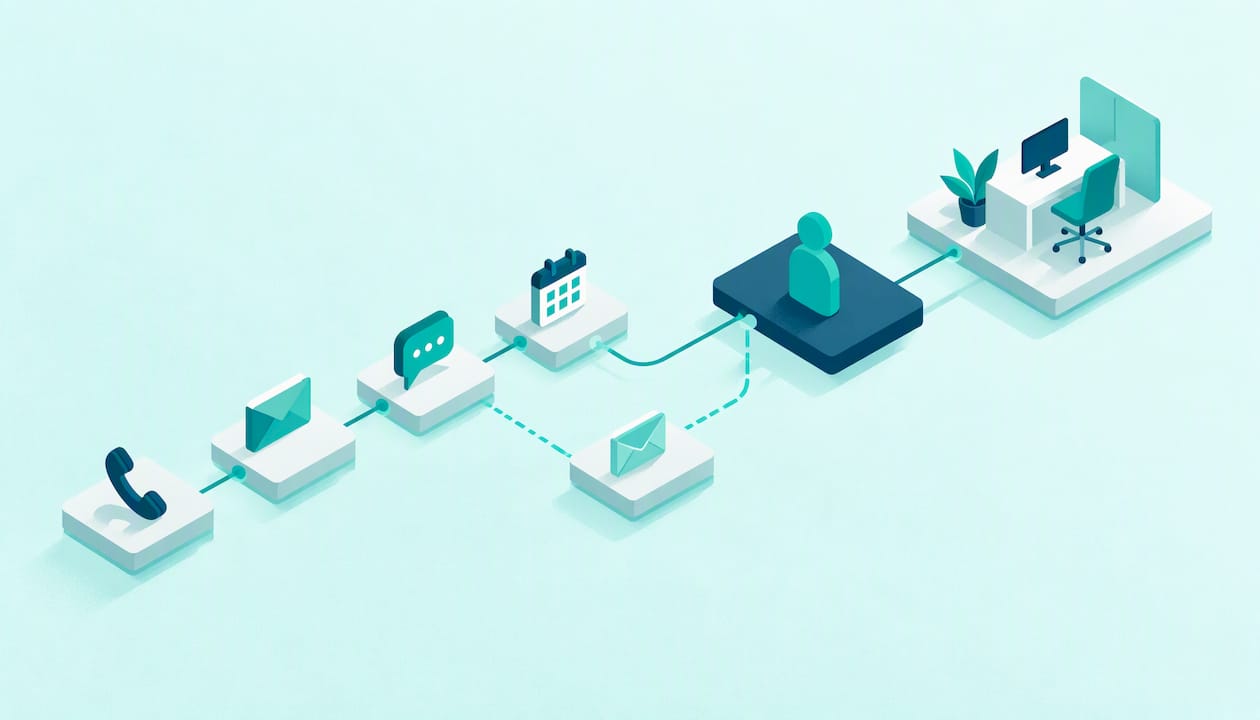
A sales cadence is a repeatable, multichannel sequence of calls, emails and social touches spaced over set intervals to reach and convert a prospect. For most B2B teams, a solid starting point is 8 to 10 touches spread across 2 to 4 weeks, mixing phone, email and one social channel. Getting the sequence right matters less than getting the timing, persistence and compliance right.
Table of Contents
- What a sales cadence is and why it matters for your team
- How long a cadence should run and how many touches to build in
- Channel mix and timing: which channels to sequence and when to call
- Ready-to-use cadence templates you can copy into your CRM
- Five practical steps to build, test and launch your cadence
- Measure and iterate: the KPIs that tell you a cadence is working
- Compliance and consent essentials for phone and multichannel outreach
- Human and AI in the cadence: where automation helps and where people take over
- Tips for personalising each touch point to increase engagement
- Handling and prioritising responses during the cadence
- Voice scripts for AI sales development reps in the cadence
- Strategies for blending AI voice agents with human follow-up
- Alston’s quick checklist and lessons from running cadences
- How 42Voice helps you run a cadence without the manual grind
- FAQ
- Sources
What a sales cadence is and why it matters for your team
A sales cadence is a predefined sequence of sales activities, calls, emails, social messages, spaced over set intervals to contact a prospect and move them toward a decision, as Pipedrive’s cadence guidance describes it. It’s not a script. It’s a schedule: what you do, in what order, and how many days apart.
Without one, follow-up becomes a matter of memory and mood. Reps chase whoever replied last, not whoever is most likely to convert. A documented cadence fixes that by giving every lead the same structured chance to respond.
The benefits show up in a few concrete ways:
- Repeatability: every rep works leads the same way, so performance stops depending on who happens to pick up the account.
- Higher reply and meeting rates: spacing touches across multiple channels catches prospects when they’re actually available, rather than relying on one channel to work every time.
- Consistent experience: prospects get a predictable, professional sequence rather than a random scatter of calls and emails.
- Scalable follow-up: a cadence can run across hundreds of leads at once, something that’s nearly impossible to manage manually once volume grows.
Cadences aren’t just for cold outbound. The same logic applies to inbound lead follow-up, where speed and sequencing decide whether a warm lead stays warm, and to longer-term nurturing of contacts who aren’t ready to buy yet.
How long a cadence should run and how many touches to build in
There’s no single right answer, but there are patterns worth following. Highspot’s cadence research points to structured, multi-touch sequences built around a mix of email, phone, voicemail and social, tailored to the audience and role being targeted. In practice, cadence length should reflect lead temperature and intent:
- Short cadences: suited to warm or inbound leads who’ve already shown interest and just need a nudge to book a call.
- Extended cadences (10 to 13 touches, 3 to 6 weeks): suited to cold outbound, where trust has to be built from nothing and most replies won’t come from the first few attempts.
The reason to persist beyond the opening touch is simple: replies and bookings may come later in the sequence, not from the opener. Stopping after two unanswered calls means abandoning pipeline that was still warming up. That said, persistence has a ceiling. If a prospect has gone fully silent after a complete sequence, with no opens, no replies, no engagement, it’s time to retire them into a longer-term nurture track rather than keep hammering the same inbox.
Lead temperature should set both the touch count and the spacing:
- Cold leads need more touches, spaced a little further apart, to avoid feeling like harassment before trust is established.
- Warm or inbound leads need fewer touches, spaced tighter, because the window of interest closes fast.
Channel mix and timing: which channels to sequence and when to call
A cadence built on one channel is fragile. Combining phone, short email, voicemail and at least one social touch gives a prospect several low-friction ways to respond, and it protects your reply rate if one channel underperforms. SMS can work well too, but only where you already have consent to text, since unsolicited text marketing carries the same consent expectations as email and telemarketing.
Sequencing has a logic to it:
- Lead with a call when you have a direct number and the lead is warm, since a live conversation moves faster than anything written.
- Lead with email for cold, lower-intent leads, so the first contact isn’t an unannounced phone call.
- Use voicemail as a bridge, not a standalone step: a short, specific voicemail followed within a day by a referencing email performs better than either alone.
- Add a social touch (a LinkedIn view, connection request or comment) mid-sequence to reinforce familiarity before a follow-up call.
Timing affects connect rates as much as channel choice does. Calls placed during a prospect’s local late morning or mid-afternoon tend to land better than calls at the start or end of the business day, when people are heads-down or already checking out. Timezone discipline matters here: calling a Perth-based prospect at what feels like a reasonable hour from a Sydney desk can mean dialling well outside their working day. Under the Do Not Call Register rules, telemarketing calls are restricted to 9:00 am to 8:00 pm Monday to Friday and 9:00 am to 5:00 pm on Saturday, with no calls permitted on Sundays, so the legal window and the practical “good time to call” window don’t always match.
Pro Tip: Batch your calling blocks around local late morning and mid-afternoon for each timezone you’re dialling into, rather than spreading calls evenly across the whole day.
Ready-to-use cadence templates you can copy into your CRM
These templates cover situations many sales teams face. Treat the day numbers as a starting structure, not a rule, and adjust based on how your prospects respond.
- 7-touch multichannel cadence (2 weeks), for general cold outbound. Day 1: call plus short email. Day 3: LinkedIn connection request. Day 5: follow-up call with voicemail if no answer. Day 7: value-add email (a relevant resource or insight). Day 10: second call attempt. Day 12: breakup email asking directly if now isn’t the right time. Day 14: final call or voicemail.
- Persistent outbound cadence, for high-value cold accounts worth the extra effort. Use a mix of calls, social touches and email check-ins, spaced to give the sequence a chance to reach the prospect as priorities shift.
- Inbound follow-up cadence, for leads who’ve just filled out a form or downloaded something. Call promptly, then follow up with a short email referencing their action. If they don’t respond, try another call and send a final email with a direct scheduling link.
- Content-driven nurture sequence, for leads not ready to buy. Alternate useful content, short check-in emails and occasional calls, spaced to stay visible without pushing for a meeting too early.
- Quick-qualify cadence (3 to 5 touches, 5 to 7 days), for high-volume lead lists where the goal is simply to confirm fit before investing more time. A short call, a one-line email and a single follow-up call are usually enough to separate real prospects from dead ends; our prequalification script is built for exactly this kind of fast-filter call.
For voicemails, keep it to your name, company, one specific reason for the call and a clear next step, and keep it brief. For opener emails, lead with a specific, relevant detail about the prospect’s business rather than a generic introduction, since that’s what gets an email opened on the second or third touch instead of deleted with the first.
Five practical steps to build, test and launch your cadence
- Segment and prioritise your leads. Group leads by source, industry and intent signal before assigning a cadence, since a cold list and a warm inbound list shouldn’t run the same sequence.
- Write short, role-based messages with a clear objective for every call. Each touch should have one job, whether that’s booking a meeting, confirming a detail or simply staying visible, rather than trying to do everything in one message.
- Set your timing, automation rules and handoff triggers. Decide in advance which touches are automated, which require a human, and what signal (a reply, a specific question, a request to speak to someone) triggers a handoff to a person.
- Run a small test before scaling. Try the cadence with a sample of leads first, watch connect and reply rates, and adjust spacing or messaging before rolling it out to your full list.
- Scale with data hygiene and regular audits. Clean your contact list, review a sample of calls and messages for quality, and revisit the cadence every quarter, since what worked six months ago can quietly stop working as buyer habits shift.
Pro Tip: Run your A/B test on one variable at a time, timing or messaging, never both, so you can actually tell what moved the needle.
Measure and iterate: the KPIs that tell you a cadence is working
A cadence isn’t something you set up once and leave alone. Track these core numbers to know whether it’s earning its place:
- Connect rate: the share of dials that reach a live person, your clearest early signal of timing and list quality.
- Conversation rate: how many connected calls turn into an actual conversation past the opener, which tells you whether your opening line is working.
- Reply rate: the share of emails and messages that get a response, a direct read on subject lines and message relevance.
- Meetings booked: the number that ultimately matters for pipeline.
- Pipeline created: the dollar value of opportunities the cadence generates, the metric that justifies the time spent.
Watch two secondary signals too: opt-out rate (a spike suggests your messaging or frequency has tipped into irritating territory) and time-to-first-response on inbound leads, since delay there quietly kills conversion before the cadence even properly starts.
A well-run cadence gives you a clear lever for almost every metric that underperforms: adjust call timing to lift connect rate, rework your opener to lift conversation rate, and tighten segmentation to lift reply rate and pipeline quality together.
Compliance and consent essentials for phone and multichannel outreach
Outbound calling in Australia runs under specific rules, and ignoring them puts your whole cadence at risk. The Do Not Call Register restricts telemarketing calls to 9:00 am to 8:00 pm Monday to Friday and 9:00 am to 5:00 pm on Saturday, with no calls on Sundays, and numbers on the register must be excluded before you dial. Beyond timing, the ACMA’s consent expectations recommend express consent, accessible terms and a simple opt-out for telemarketing and e-marketing. The Australian Privacy Principles also require you to keep contact data accurate and give people a reasonable way to opt out of direct marketing.
Build these into your cadence as standard steps:
- Wash your calling list against the Do Not Call Register before every campaign.
- Display accurate caller ID and state your identity and employer at the start of every call.
- State the purpose of the call clearly and early.
- Stop immediately when someone asks, and record that request.
- Document consent for every channel you use, especially SMS and email.
Human and AI in the cadence: where automation helps and where people take over
High-volume, repetitive touches are exactly what AI voice agents are built for: qualifying leads, booking appointments, sending reminders and working through the first several touches of a cadence without a rep needing to dial manually. That frees your team’s time for the calls that actually need judgement.
Some moments genuinely need a person, and a well-designed cadence should hand off at these points automatically:
- A prospect shows clear buying interest and starts asking specific, nuanced questions.
- Negotiation begins, on price, terms or scope.
- A prospect explicitly requests a human callback.
Make the handoff smooth with the right controls in place:
- Sync automation tools with your CRM and calendar so handed-off leads arrive with full context, not a cold restart.
- Review a sample of AI-handled calls regularly (human-in-the-loop QA) to catch tone or accuracy issues early.
- Disclose AI involvement where relevant and keep consent records current.
Pro Tip: Set your handoff trigger on intent signals, not call count, so a genuinely interested prospect on touch two gets a human immediately instead of waiting for touch eight.
Tips for personalising each touch point to increase engagement
Generic cadences get generic results. The fix isn’t writing longer messages, it’s making each one specific to the person on the other end.
Start with one real detail per touch: a recent company announcement, a role change, a shared connection or a specific pain point tied to their industry. That single detail does more for reply rates than any amount of polish on the rest of the message.
Vary the angle across the sequence rather than repeating the same pitch with different wording. An early touch might reference a relevant trend in their sector; a mid-sequence touch might share a short case example; a later touch might simply ask a direct, specific question about their current setup. Each one should feel like it was written with that prospect in mind, even when it’s running through a templated system.
Match tone to channel too. A phone opener can be more conversational and direct than an email, which has to earn attention in a crowded inbox with a clear, specific subject line. Voicemails work best when they reference something concrete rather than a vague “just following up.”
Finally, use what you learn from earlier touches to shape later ones. If a prospect opened an email three times but didn’t reply, your next touch should reference that interest directly rather than repeating the same message. Personalisation compounds across a cadence when each touch builds on what the last one revealed.
Handling and prioritising responses during the cadence
A cadence is a default path, not a fixed script you follow regardless of what happens. The moment a prospect replies, the cadence should pause.
If someone responds positively early, on touch two of a planned seven, stop the automated sequence immediately and route them to whoever should handle the conversation next, whether that’s a rep or a scheduling link. Continuing to send scheduled touches to someone who has already engaged looks careless and can undo the goodwill that reply created.
Not every reply means the same thing, so prioritise by signal strength. A direct question about pricing or a request for a call deserves same-day attention. A simple “not right now” can shift the contact into a longer nurture track rather than dropping them from the cadence completely. An out-of-office auto-reply isn’t a real response at all, and the sequence should resume once the away period ends.
Build a simple triage rule into your process: urgent and high-intent replies get a human response within hours, lower-intent replies get handled within a day, and automated replies get filtered out before they ever reach a person. This keeps your team’s attention on the conversations that are actually moving toward a decision, rather than spread thin across every open thread in the pipeline.

Voice scripts for AI sales development reps in the cadence
AI sales development reps work best in a cadence when their scripts are short, specific and built around a single objective per call rather than trying to cover everything at once.
A qualifying call might open like this: an introduction stating the agent’s name and company, a one-line reason for the call tied to something specific about the prospect’s business, then a direct question such as whether they currently handle a particular process in-house or through a vendor. Keep the opener brief, then hand the conversation to the prospect.
An appointment-booking call works differently. After confirming interest, the agent moves straight to specifics: “Would Tuesday afternoon or Wednesday morning suit you better for a short call with our team?” Offering two concrete options books more meetings than asking an open-ended “when works for you.”
A voicemail script stays even shorter: name, company, one reason for the call, and a clear next step, such as “I’ll follow up by email today with a couple of times that could work.” Keep it brief.
Every one of these scripts needs a clean exit path to a human: a phrase like “I’ll connect you with someone from our team who can go through the details” when the conversation moves into negotiation, objection handling or anything requiring judgement an automated agent shouldn’t attempt.
Strategies for blending AI voice agents with human follow-up
The most effective setup treats AI and human effort as two different tools for two different jobs, not a replacement of one by the other.
Let automation own the early, repetitive stages of the cadence: the first call attempt, voicemail drops, reminder emails, confirmation calls and qualifying questions. These are high-volume and low-ambiguity, exactly what a voice agent handles reliably and without fatigue, at any hour, including the after-hours window when a prospect finally has time to pick up but your team has gone home.
Reserve human time for the moments that need nuance: negotiating terms, handling an unexpected objection, or closing a deal where tone and judgement matter more than consistency. A prospect who asks a sharp, unscripted question deserves a person, not a script trying to cover every possible branch of the conversation.
The handoff itself needs to be seamless on the prospect’s end. Full context, call history, qualification answers, prior touches, should transfer with the lead so a human doesn’t start from zero. Pair that with human-in-the-loop quality review: regularly checking AI-handled calls for accuracy and tone helps catch drift before it affects reply rates. Done well, this blend helps a small team manage a high volume of cadence activity while every genuinely important conversation still reaches a person.

Alston’s quick checklist and lessons from running cadences
As you get started: prioritise your best-fit segments, pick one template rather than building several at once, test call timing against your actual data, set clear handoff triggers before you launch, and review your metrics regularly.
The mistakes I see most often: messy contact data that harms connect rates before the cadence gets a fair test, calling on your own clock instead of the prospect’s timezone, and giving up too early when replies may come later. We lean on automation to handle the repetitive, high-volume touches, and on people to read the room, negotiate and close. AI does the heavy lifting; people do the judgement.
— Alston
How 42Voice helps you run a cadence without the manual grind
Running a 10 to 13 touch cadence by hand across hundreds of leads is where most teams fall over, not because the strategy is wrong, but because no one has the hours to dial that consistently. Our AI Sales Development Rep handles the repetitive early touches, qualifying calls, reminders and appointment booking, around the clock, so your pipeline keeps moving even after hours.

Every agent we build comes with human-in-the-loop quality review and a clean handoff to your team the moment a prospect shows real interest or needs a nuanced conversation. It plugs into the calendars and CRM tools you already run, so handed-off leads arrive with full context instead of a cold restart. We’re live in 3 to 5 days, with no lock-in contract. If you want to see how it fits your own cadence, book a free 15-minute demo.
FAQ
What is the 3-3-3 rule in sales?
The 3-3-3 rule is a prospecting guideline suggesting you spend the first three minutes of your day planning, make three calls before doing anything else, and send three personalised messages, a way to build consistency into outbound effort. It’s a discipline habit more than a fixed cadence structure, and teams often adapt the numbers to their own workload.
What is the 10-3-1 rule in sales?
The 10-3-1 rule suggests targeting 10 touches, through 3 different channels, before expecting 1 meaningful response or meeting booked. It reflects the broader pattern seen in structured cadences, where persistence across multiple channels outperforms repeated attempts on a single one, similar to the multichannel approach Highspot recommends.
What is a daily cadence call?
A daily cadence call usually refers to a short, regular internal check-in, not a call to a prospect, where a sales team reviews pipeline, blockers and priorities for the day. Some teams also use the term for a daily batch of outbound dials scheduled as part of a prospect-facing cadence.
What is the 2-2-2 rule in sales?
A spaced follow-up rule is a reminder to contact a prospect at intervals, keeping contact alive without overwhelming them. It can suit warmer leads who aren’t ready yet rather than cold prospects needing a tighter, faster sequence.
How many touches should a cold outbound cadence include?
Most effective cold outbound cadences run 10 to 13 touches across 3 to 6 weeks, combining calls, email, voicemail and at least one social touch, based on the structured, multichannel approach Highspot outlines. Shorter cadences generally suit warmer or inbound leads instead.
Sources
- Do Not Call Register | ACMA
- Read the Australian Privacy Principles | OAIC
- What Is a Sales Cadence? Examples and Strategies
- The 10-Step Sales Cadence High-Performing Reps Use
Recommended
- AI Sales Development Rep — Automated Cold Calling
- Fix AI Call Compliance in 90 Days: Checklist for Compliance & Ops
- 15–20 Minute Script to Prequalify Sales Calls for Sales Teams
- White Label Voicebots for Australian Agencies: Avoid Compliance Gaps
This article is general information about AI voice technology and isn’t legal or compliance advice. Requirements for call recording, AI disclosure and outbound calling vary by state and use case.