
The fastest, highest-ROI approach to sales call prequalification is a two-step gate: a short pre-call form or quiz that screens for fit, followed by a scripted 15 to 20 minute qualification call built around one framework. Reps who do this cut wasted calls, book more of the right meetings, and move pipeline faster. Three moving parts make it work: CRM lead scoring, a booking or quiz form up front, and automated first-pass options like 42voice handling the routine screening before a human ever picks up the phone.
Table of Contents
- What Is Sales Call Prequalification?
- Pre-Call Gating: Surveys, Quizzes, and Booking Forms
- Which Qualification Framework Fits Your Sales Motion?
- Pre-Call Research and Lead Scoring That Actually Predict Fit
- How to Run a 15 to 20 Minute Qualification Call
- Operationalizing Qualification: Routing, SLAs, and Metrics
- Perspective: Where AI Fits in Prequalification
- Signs of an Unqualified Lead
- Handling Objections and Gatekeepers During Qualification
- How to Validate Lead Information Before the Call
- When Should You Qualify Leads in the Sales Process?
- Editorial Take: Templates Beat Talent Here
- Automate the First Pass, Keep the Judgment Calls Human
- Sources
- FAQ
What Is Sales Call Prequalification?
Sales call prequalification means screening a prospect’s fit, budget, and intent before a rep spends time on a live call. It replaces guesswork with a repeatable lead qualification process built on forms, scoring, and structured questions, so reps spend their limited hours on prospects who can actually buy.
The term overlaps with what many teams call “sales prospect assessment” or “client needs evaluation,” but the mechanics are identical: filter first, talk second. Sellers who wait until discovery to figure out whether someone is a fit are, by definition, doing the opposite of prequalification. That’s the mistake pre-call qualification is designed to fix, and it’s why high-performing outbound teams treat list filtering, data enrichment, and qualifying calls-to-action as a separate stage that happens before the phone rings, not during it.
Pre-Call Gating: Surveys, Quizzes, and Booking Forms
Three gating tools do most of the work: a short survey, an interactive quiz, or a strategic booking form. Each trades friction for signal differently, and the right pick depends on your volume and deal size.
A survey (3 to 5 questions, under 90 seconds to complete) works best for high-volume inbound, where you need a quick sort into tiers. A quiz format, which scores answers in real time and shows a personalized result, tends to boost completion because it feels less like paperwork. Pre-call gating through short quizzes or booking forms lets leads self-segment, so the system routes them to the right call length and rep before anyone dials. A booking form attached to your calendar works best for lower-volume, higher-ticket sales, where a longer form (6 to 10 fields) is acceptable because the prospect is already motivated to grab a slot.
Sample fields that consistently earn their place on the form:
- Company size and industry (required, one dropdown each)
- Current tool or process being replaced (required, short text)
- Timeline to solve the problem (required, multiple choice: “This month,” “This quarter,” “Just researching”)
- Budget range (optional but strongly recommended; frame it as a range, not an exact number)
- Biggest current bottleneck (optional, open text, for context before the call)
Pro Tip: Make the timeline or urgency question mandatory. It’s the single best predictor of whether a lead converts, and it costs you almost nothing in completion rate compared to asking for exact budget.
Offer shorter calls (10 minutes) to lower-scoring leads and full 20-minute slots to leads that clear your threshold. That alone protects a rep’s calendar from low-intent bookings.
Which Qualification Framework Fits Your Sales Motion?
Four frameworks dominate effective sales screening, and picking the wrong one wastes more time than skipping qualification altogether.
- BANT (Budget, Authority, Need, Timing): fastest to run, best for high-volume SMB sales where speed beats nuance. BANT remains effective for fast SMB qualification because it forces a quick go or no-go decision.
- CHAMP (Challenges, Authority, Money, Prioritization): leads with the prospect’s problem instead of budget, useful when the buyer doesn’t yet know they need you.
- MEDDIC (Metrics, Economic buyer, Decision criteria, Decision process, Identify pain, Champion): built for enterprise deals with buying committees and long cycles.
- SPICED (Situation, Pain, Impact, Critical event, Decision): a newer alternative that pushes reps to quantify urgency, useful for consultative mid-market sales.
Decision rule: if the deal closes in one or two calls, run BANT. If it needs multiple stakeholders and a business case, use MEDDIC or CHAMP.
Starter questions for BANT: “What’s driving you to look at this now?” “Who else weighs in on a decision like this?” “What happens if this isn’t solved by next quarter?” The strongest setups hybridize: use BANT to gate the call, then layer in MEDDIC’s champion and decision-process questions once you know the lead is real.
Pre-Call Research and Lead Scoring That Actually Predict Fit
Before a rep dials, five minutes of research changes everything. Check these in order:
- Company size and headcount (LinkedIn or the company’s own “About” page)
- Recent funding or leadership changes (Crunchbase, press releases; a new VP of Sales often means new budget)
- Tech stack (BuiltWith or job postings that list required tools)
- Behavioral signals: pricing page visits, repeat website sessions, webinar or content downloads
- Existing CRM history: has this account been contacted before, and what happened
Combine explicit fit (industry, size, role) with implicit intent (behavior) into one score. Best practice lead scoring blends explicit and implicit signals rather than relying on either alone, and it’s the difference between a scoring model that predicts revenue and one that just predicts activity.
A workable threshold: high scores trigger immediate outreach, medium scores go into standard routing, and low scores go to nurture. Speed matters more than most reps assume. Firms that contact leads within an hour convert dramatically more often than those that wait even a few hours, which is the entire argument for CRM-based routing SLAs instead of manual lead lists.
How to Run a 15 to 20 Minute Qualification Call
Open with two lines that set the agenda and earn permission: “Thanks for grabbing time. I’d like to ask a few questions to see if what we do actually fits your situation, then we can figure out next steps. Sound good?” That sentence alone filters out prospects who wanted a demo, not a conversation.
A qualification call should run about a quarter of an hour and follow a fixed shape: opening, discovery questions, committee mapping, confirming fit, and locking a next step. Aim for a 70/30 ratio, where the prospect talks 70% of the time. Reps who pitch early almost always misjudge fit.
Twenty five questions, grouped for quick scanning:
- Budget: “What’s allocated for solving this?” “Has budget been approved or is it still theoretical?”
- Authority: “Who signs off once you’re ready to move?” “Has this been on their radar too?”
- Need: “What’s broken in your current process?” “What have you tried already?”
- Timing: “What’s forcing you to look at this now?” “What happens if nothing changes by next quarter?”
- Impact: “How is this problem costing you, in hours or dollars?”
- Next-step criteria: “What would you need to see to move forward?”
Pro Tip: If a prospect can’t name a timeline or a consequence for inaction, that’s not a qualification gap. It’s a sign there’s no real deal yet.
Close every call with a booked next step. Failing to secure one is itself a disqualification signal worth treating as seriously as a stated “no.”
Operationalizing Qualification: Routing, SLAs, and Metrics
A prequalification process only scales when it becomes a system, not a habit. That means defining clear states and putting rules around them, not just training reps to “use their judgment.”
- Define MQL (marketing qualified, meets basic criteria) and SQL (sales qualified, passed a live or scored check) with a one-page SLA that spells out response time between marketing and sales.
- Set score-triggered tiers in the CRM: A tier (score 80+) gets outreach within one hour, B tier (50 to 79) gets routed within 24 to 48 hours, C tier goes to an automated nurture sequence.
- Route automatically. A working system needs an ICP definition, an automated scoring model, and a routing SLA that assigns qualified leads within five minutes; skip any one piece and conversion drops.
- Track show rate, qualification rate, time-to-first-response, and SQL-to-demo conversion monthly.
- Spot-check call recordings weekly and feed findings back into your scoring weights.
That feedback loop is what separates teams that improve quarter over quarter from teams that run the same broken script for two years.
Perspective: Where AI Fits in Prequalification
Screening leads is repetitive by design, which is exactly why it’s a good candidate for automation without losing the human judgment that catches nuance. 42voice’s approach centers on AI voice agents built for this stage: an AI Lead Qualification agent that runs first-pass calls and applies scoring logic, an AI Sales Development Rep for outbound touches, and calendar and CRM integrations that let qualified leads land directly in a rep’s queue. The company states these agents typically deploy in three to five days.
AI-assisted personalization and automated first-pass calls can lift show rates and make multi-threaded outreach far cheaper to run at volume, which matters most for teams drowning in inbound they can’t triage fast enough.
The goal isn’t replacing the qualification call. It’s making sure only the calls worth having reach a human.
Used this way, automation handles the repetitive first pass. A rep still owns the judgment call on anything that clears the bar.
Signs of an Unqualified Lead
Certain patterns show up again and again in prospects who were never going to buy, and catching them early saves hours.
Vague timing is the biggest tell. If a prospect can’t name what changes if the problem stays unsolved for another quarter, there’s no real urgency behind the inquiry. No stated budget process matters too; a prospect who has no idea whether money exists for this, or who owns that decision, usually isn’t close to buying regardless of how enthusiastic they sound.
Watch for information mismatches, like a company size on the form that doesn’t match their LinkedIn headcount, or a stated title that doesn’t match what’s listed on the company site. Generic pain descriptions (“we want to improve efficiency”) without a specific example or cost attached usually mean the prospect is still in research mode, not buying mode.
A single point of contact with no mention of anyone else on an enterprise deal is a red flag; most real purchases above a certain size involve at least two or three stakeholders. And reluctance to schedule a specific next step, when someone keeps saying “let’s circle back” instead of picking a time, often means the interest was never as strong as the initial inquiry suggested.
None of these signals alone should trigger an automatic disqualification, but two or three together are a strong signal to route the lead to nurture instead of a live call.
Handling Objections and Gatekeepers During Qualification
Gatekeepers and early objections aren’t obstacles to work around. They’re qualification data.
When a gatekeeper screens a call, ask directly who typically evaluates a decision like this, rather than trying to talk your way past them. That single question often surfaces the real decision maker faster than pushing for a transfer. If someone insists they “just need pricing” before answering anything else, respond with a short reframe: “I can get you a number, but it’ll be more accurate if I understand your setup first. Two quick questions?” That protects the qualification flow without sounding evasive.
Common early objections during a qualification call include “we’re just looking,” “we already have a solution,” and “I need to check with my team.” Each deserves a specific response, not a scripted brush-off. For “we’re just looking,” ask what triggered the search now. For “we already have a solution,” ask what’s missing from it. For “I need to check with my team,” ask who else should be on the next call, which turns a stall into a path toward multi-threading.
The instinct to overcome every objection on the spot is usually wrong during qualification. Some objections are legitimate disqualifiers, and pushing past them just books a low-intent call that wastes everyone’s time later. The goal at this stage is understanding, not persuasion. Persuasion is a demo-stage job.
How to Validate Lead Information Before the Call
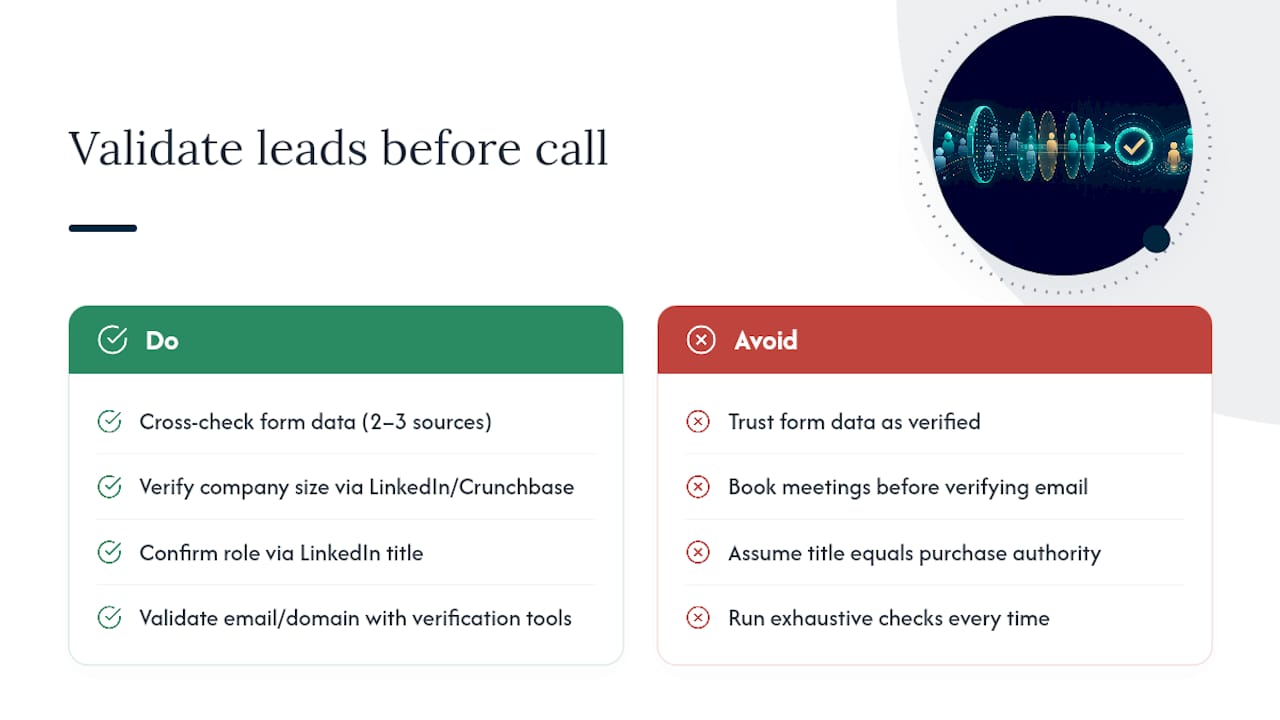
Self-reported form data is a starting point, not a verified fact. Cross-checking it against two or three independent sources takes minutes and prevents reps from walking into a call built on bad assumptions.
Start with firmographic cross-checks: does the company size on the form match what LinkedIn, Crunchbase, or the company’s own website state? A mismatch of a few employees is normal; a mismatch of ten times the size usually means someone typed the wrong number or misrepresented their company.
Verify the role and authority claim by checking the person’s LinkedIn title against what they entered on the form. Someone who lists themselves as “Decision Maker” but holds a junior title elsewhere isn’t lying, necessarily, but the discrepancy is worth a direct question early in the call: “Walk me through who else typically weighs in on a purchase like this.”
Check domain and email validity using standard email verification tools before booking anything through automated systems, since a high percentage of fraudulent or junk leads use disposable or mismatched domains. And where behavioral data is available, compare declared intent against actual site activity. Someone who claims to be “actively evaluating vendors” but has visited your pricing page zero times is a weaker signal than their words suggest.
None of this needs to be exhaustive. Two or three checks, done consistently, catch the vast majority of low-quality or fabricated leads before they ever reach a rep’s calendar.
When Should You Qualify Leads in the Sales Process?
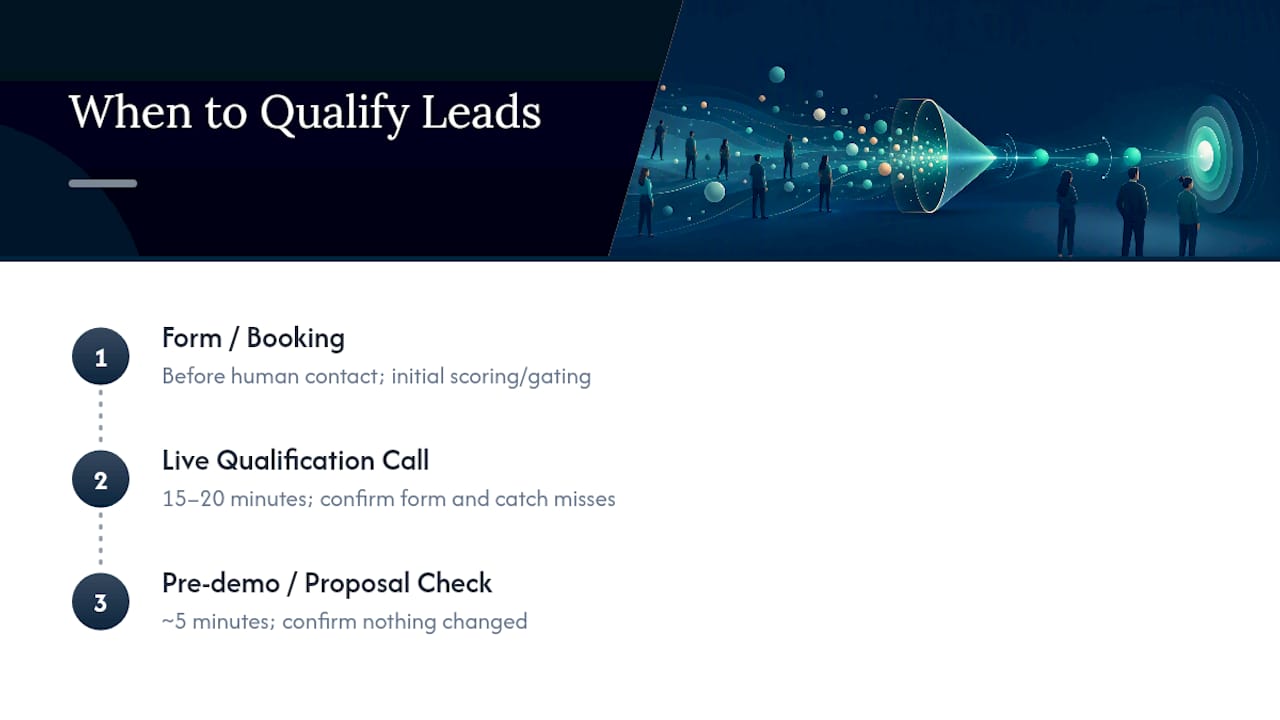
Qualification isn’t one moment. It happens at three distinct points, and skipping any one of them pushes the wasted effort downstream instead of eliminating it.
The first pass happens at the form or booking stage, before any human contact, using the scoring rubric and gating questions covered earlier. The second pass is the live qualification call itself, 15 to 20 minutes, where a rep confirms what the form data suggested and catches anything self-reported data missed. The third pass happens right before a demo or proposal, a quick five-minute check to confirm nothing changed since the qualification call, since budgets shift and stakeholders leave companies.
Teams that only qualify once, usually during discovery, tend to discover disqualifying information halfway through a sales cycle instead of in the first five minutes. That’s the expensive version of this process. Teams that qualify early and often catch the same problems weeks earlier, when the cost of walking away is close to zero.
The practical rule: qualify before you invest rep time (the form), qualify again before you invest real conversation time (the call), and qualify one more time before you invest proposal or contract time. Each pass should take less time than the last, because each pass is confirming, not discovering, fit.
Editorial Take: Templates Beat Talent Here
Most sales advice treats qualification as a skill you develop through reps and experience. That’s backwards. The research is clear that structure beats intuition: a fixed 15 to 20 minute call format with a defined listening ratio consistently outperforms freeform “gut feel” conversations, and a gating form beats even a skilled rep’s ability to sense fit from a cold inbound lead.
The overrated piece of conventional advice is framework loyalty. Teams argue about BANT versus MEDDIC as if picking the wrong one dooms the process. It doesn’t. The framework matters far less than whether you actually gate calls before they happen and score leads with any consistency at all.
If you do only one thing differently after reading this, make it the pre-call form. It’s the cheapest change with the biggest immediate return, and it’s the one most sales teams still skip because it feels like extra friction. It isn’t. It’s the friction that protects everything downstream.
— Jesse
Automate the First Pass, Keep the Judgment Calls Human
42voice gives you a faster, cheaper alternative to building this entire qualification pipeline by hand with rep hours and spreadsheets. Instead of a rep manually reviewing every form submission and dialing every lead to find out if they’re a fit, an AI Sales Development Rep can run the first-pass outbound qualification call, apply your scoring logic, and hand off only the leads worth a human’s time.
For inbound, an AI Receptionist can screen calls after hours or during busy periods, ask your gating questions, and book qualified prospects straight onto a rep’s calendar through existing CRM integrations. These agents can often go live within a few days, and may be available without long-term contract requirements. If you’re weighing whether to hire another SDR or fix your qualification process first, start with an audit of your current call-to-close ratio, then book a demo to see how automated gating and routing would slot into your existing CRM. Current plans and pricing details are available on the 42voice pricing page.
Sources
FAQ
What Is the 30-60-90 Rule in Sales?
The 30-60-90 rule is a ramp-up framework for new reps, not a qualification method. It sets staged goals over the initial months, starting with learning and shadowing, then progressing to running qualification calls with support, and finally owning a full pipeline independently.
What Are the 7 Steps of a Sales Call?
Most structured call frameworks follow: research, opening and rapport, needs discovery, presenting fit, handling objections, confirming next steps, and follow-up. In a prequalification context, the middle steps compress into a tight 15 to 20 minute format focused on budget, authority, need, and timing.
What Is the 80/20 Rule in Cold Calling?
Applied to cold calling, the 80/20 rule generally means roughly 20% of your prospect list produces the majority of your qualified conversations, which is why pre-call research and scoring matter more than dialing volume alone.
What Is the 2 2 2 Rule in Sales?
Definitions of the “2 2 2 rule” vary across sales training sources, and there’s no single agreed standard tied to qualification frameworks. Rather than guess at a specific version, focus on the documented approach in this article: a scored gate, a 15 to 20 minute structured call, and a committed next step.
How Fast Should I Follow Up With a New Lead?
Speed compounds. Leads contacted within roughly an hour of submitting a form convert at meaningfully higher rates than those contacted even a few hours later, based on lead qualification research, which is why CRM-triggered routing beats manual lead lists.
Can AI Handle the Initial Qualification Call?
Yes, for the first pass. Platforms like 42voice’s AI Lead Qualification agent can run scored screening calls and route qualified leads to a human rep, which works well for high-volume inbound where reps can’t triage every lead personally.