For most independent and multi-location restaurants, a hybrid AI-first answering system with human fallback is the fastest way to stop losing reservations while keeping your brand voice intact. AI handles the repetitive volume, humans step in for the exceptions, and the phone stops being a liability. Pure live answering still makes sense for high-end, reservation-only concepts where every caller expects a person; letting calls ring out without answering rarely makes sense for restaurants.
Table of Contents
- What AI Agents, Live Answering, and Hybrid Models Actually Do
- The Real Benefits and the Guest-Experience Risks
- How Do You Choose Between AI, Live, or Hybrid?
- Implementation Timeline and What It Actually Costs
- What a Real Deployment Looks Like
- Staying Compliant With Phone and Data Privacy Rules
- Training and Quality Standards for Live Agents
- Managing Peak Call Volume Without Losing Guests
- Common Implementation Problems and How to Fix Them
- Protecting Guest Data During Every Call
- When Should You Actually Pilot This?
- How 42voice Fits the Checklist You Just Built
- Sources
- FAQ
What AI Agents, Live Answering, and Hybrid Models Actually Do
The phone is still the front door for most restaurants, and 54% of restaurant franchise leaders name a shrinking labor pool as their biggest business worry. That labor gap is exactly why so many operators are reevaluating who, or what, picks up the phone.
An AI voice agent is software that answers calls with a natural-sounding voice, follows a script tuned to your restaurant, and completes real tasks instead of just taking a message. In practice, that means:
- Booking a reservation directly into your calendar or reservation platform
- Texting a caller a link to order online instead of taking a to-go order verbally
- Answering repeat questions about hours, parking, dress code, or allergen policy
- Routing a complicated catering request or complaint to a manager’s cell phone
Live answering services put a trained human, usually working for a call center rather than your restaurant, on the other end of the line. They’re better at reading tone, negotiating a large party booking, or calming down a frustrated guest whose order arrived wrong. They also cost more per call and can’t scale instantly during a Friday night rush without staffing up in advance.
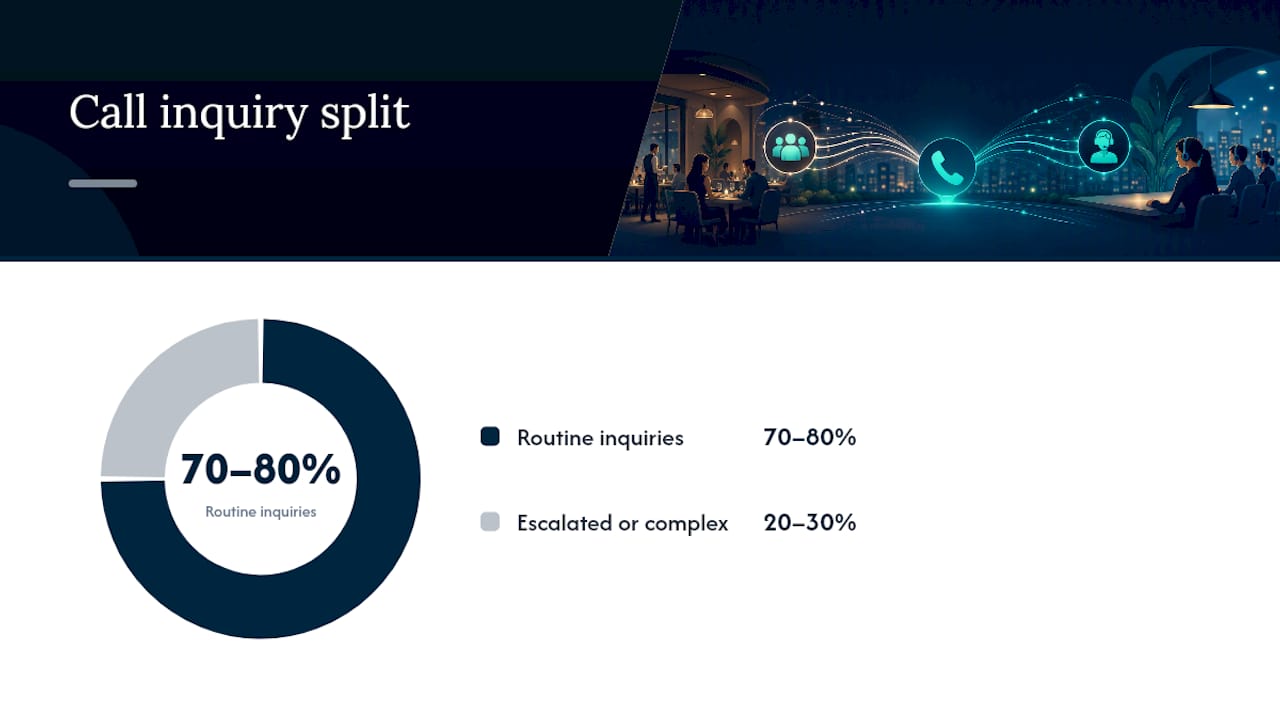
Hybrid models split the difference by design. The AI agent takes every call first, handles the 70 to 80 percent of inquiries that are genuinely routine (hours, reservations, simple orders), and escalates anything ambiguous, emotional, or high-value to a live person or a manager’s phone. This is the model that scales effectively with your call volume.
Which approach fits depends heavily on your concept. A quick-service spot with high call volume and simple requests (order status, hours, delivery radius) is a near-perfect match for AI-first handling. A full-service restaurant juggling reservations, private events, and dietary questions benefits more from a hybrid setup, since some of those calls genuinely need judgment. Multi-location groups tend to need hybrid or AI-first out of necessity. Nobody wants to hire a dedicated phone answerer for six locations when one well-tuned voice agent can carry the load and route the outliers.
A booking-focused AI agent is often the cleanest entry point, since reservations are usually the highest-value call type and the easiest to automate cleanly.
The Real Benefits and the Guest-Experience Risks
The upside is measurable, not theoretical. A large share of missed restaurant calls represent lost bookings, not casual inquiries, according to trade reporting on the industry’s staffing squeeze. Every call that rings out during dinner prep or a Saturday rush is a reservation, and sometimes a large party, going to a competitor instead.
Statistic Callout: Labor shortages aren’t a side issue for restaurants anymore. They’re the top-cited business risk for franchise leaders, ahead of food costs and rent, per TD Bank’s survey. That single fact explains why phone automation moved from a novelty to a staffing strategy in the span of a few years.
The benefits operators report most often:
- Fewer missed calls during peak hours, since an AI agent doesn’t put a caller on hold to run food
- More completed bookings because the caller reaches someone (or something) immediately instead of voicemail
- Real staff-hours recovered, since a host or server isn’t stuck answering the same three questions all night
The risks are real too, and pretending otherwise does readers no favors. The most common failure modes:
- Incorrect reservation details, especially party size or time, when a script isn’t tested against how people actually talk
- A voice that feels generic or off-brand, which undercuts the personal feel a restaurant works hard to build
- Missed complex questions, like a guest asking about a specific allergen substitution the AI wasn’t trained on
Mitigate all three the same way: test the script against real call transcripts before launch, build a clear human fallback path for anything outside the script’s confidence, and update the menu and FAQ data every time the menu changes, not once a quarter. Review platforms consistently show that integration quality and live-fallback reliability separate the answering services people recommend from the ones they complain about.
Track three numbers from week one: answer rate (percentage of calls actually answered), conversion-to-booking (answered calls that become reservations), and error rate (bookings with wrong details). If error rate climbs above a few percent, the script needs retuning before volume, not after.
How Do You Choose Between AI, Live, or Hybrid?
Start with your own call data, not a vendor’s pitch deck. Pull your restaurant’s phone records for the last 30 days and count total calls, calls answered within three rings, and calls that rang out entirely. If more than 10 to 15 percent of calls go unanswered during lunch or dinner rush, you already have a revenue leak, and it’s usually larger than owners expect once they see the number in writing.
Here’s the process that actually gets a decision made in under two weeks:
- Quantify the missed-call cost. Multiply missed calls per week by your average check or reservation value to get a real dollar figure, not a hunch.
- List required integrations. Reservation platform, POS, calendar, and CRM, if you use one, all need to be on the table before you talk to any vendor.
- Set your escalation rule. Decide upfront which call types must reach a human, complaints, large parties, media inquiries, and build that into any AI script.
- Ask about deployment timeline. A vendor that can’t tell you exactly how long onboarding takes is not ready for a restaurant’s pace.
- Confirm data ownership. You should own your call transcripts and guest data, not the vendor, especially if you ever want to switch providers.
- Request a pilot, not a contract. Two to four weeks of real call handling tells you more than any demo.
- Define pilot success criteria in writing. Answer rate, conversion rate, and error rate targets, agreed before the pilot starts, not after.
Your vendor checklist should include specific, answerable questions: Does the system integrate directly with our reservation platform and calendar? What happens when the AI doesn’t understand a caller? Can it escalate to a live line in under ten seconds? How is guest data stored, and can we export it? What languages does it support? How long does onboarding actually take, in days, not weeks? What’s included in the base subscription versus billed as usage? Can we adjust the script ourselves, or does every change require a support ticket? What’s the fallback if the system goes down? Can we cancel or downgrade without penalty after the pilot?
Pro Tip: Run your pilot during your busiest week, not your slowest one. A system that handles a quiet Tuesday well tells you nothing about how it performs when three lines ring at once on a Friday.
Operator forums back up how practical these concerns get in real life. One frequently discussed thread on r/restaurantowners shows managers specifically asking for affordable services that can reliably handle basic questions like hours and location, which is a lower bar than most vendors advertise and a good baseline test for any system you evaluate.
Implementation Timeline and What It Actually Costs
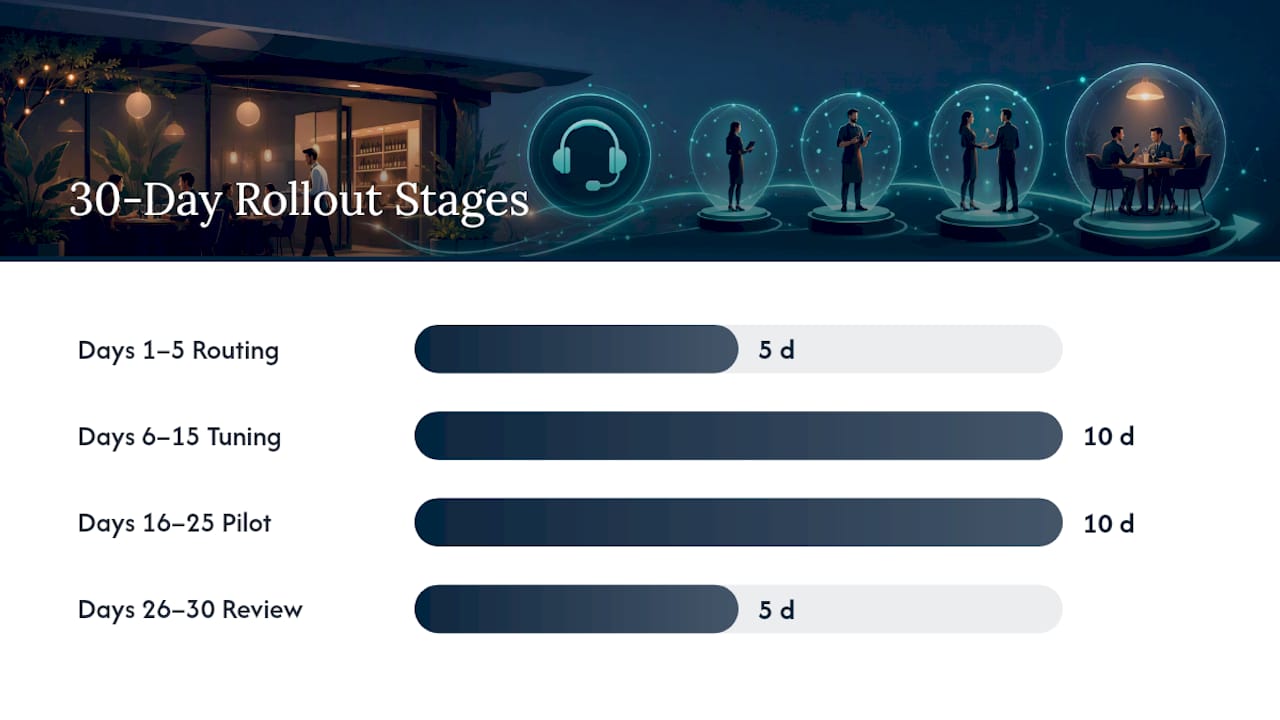
Rapid deployment claims are common in this space, and the realistic version looks like a structured 30-day rollout rather than an overnight flip. A typical schedule breaks down like this: days 1 through 5 cover call routing setup and integration with your reservation system and calendar; days 6 through 15 involve voice and script tuning against your actual menu, hours, and common questions; days 16 through 25 run a live pilot handling real calls with human fallback active; and days 26 through 30 cover review, script adjustments, and full handoff.
The technical groundwork matters more than most owners expect. You’ll need to decide between simple call forwarding (keeping your existing number, routing to the AI system) versus a full number transfer, and confirm whether your reservation platform and POS support API syncs or require manual CSV imports. Calendar hooks for booking confirmations should be tested with real reservations before going live, not assumed to work.
Pricing in this category generally falls into a few shapes:
- Flat monthly subscription, common for single-location restaurants with predictable call volume
- Usage-based pricing, billed per call or per minute, which suits seasonal restaurants with sharp volume swings
- Setup or onboarding fee plus subscription, more typical for multi-location groups needing custom integrations
Measuring return on investment comes down to three figures: recovered revenue (bookings that would have been missed calls), labor-hours saved (host or server time no longer spent on the phone), and conversion uplift (the percentage jump in calls that become bookings compared to your pre-automation baseline). A restaurant that recovers even a handful of extra bookings a week from previously missed calls often covers the subscription cost on its own within the first month.
What a Real Deployment Looks Like
“A large share of front-of-house staffing shortages are pushing restaurants toward automation not as an experiment, but as a continuity plan,” reflects the broader trend documented in trade coverage of the sector’s labor gap. The phone used to be a job. Now, for a growing number of restaurants, it’s a system.
Rapid deployment claims in this category typically center on a 3 to 5 day timeline for getting a voice agent live, with integrations built directly into calendars and CRM tools rather than bolted on afterward. A realistic call flow looks like this:
- A guest calls after hours asking to book a table for six on Saturday
- The AI agent confirms availability directly against the connected calendar
- The system books the slot, sends a text confirmation, and logs the guest’s contact details
- If the guest asks about a private dining buyout instead, the call escalates to a manager’s phone with a summary already prepared
The efficiency gains show up first in after-hours coverage, since a dedicated after-hours agent captures the calls that used to go straight to voicemail once the last host clocked out. The second gain is speed. A caller gets a booking link or confirmation in seconds instead of waiting for a callback the next morning, which matters more than owners assume, since a caller who doesn’t get an immediate answer often just calls the next restaurant on their list.
Staying Compliant With Phone and Data Privacy Rules
Restaurants recording or automating calls need to treat call data with the same care as payment data, because in several jurisdictions, it legally is. Call recording consent laws vary by state and country. Some require only one party to consent to a recorded call, while others require every party on the line to agree before recording begins. If your answering system records calls for quality or training purposes, confirm with your vendor how consent is disclosed to callers, typically through a brief automated notice at the start of the call.
Data privacy obligations layer on top of that. If your restaurant collects guest phone numbers, names, or order history through an automated system, you’re handling personal data that may fall under state privacy laws or broader frameworks depending on where your guests are located. The practical questions to ask any vendor are straightforward: where is call data stored, how long is it retained, and can you export or delete a guest’s data on request?
Telemarketing rules matter less for inbound restaurant calls but become relevant fast if your system places outbound reminder calls or confirmation calls, since those can trigger separate consent requirements depending on jurisdiction. Get a plain answer from any vendor about which regulations they’ve built compliance around, and don’t accept a vague “we’re compliant” without specifics on which rules and which regions.
Training and Quality Standards for Live Agents
A live answering service is only as good as the training behind the person picking up the phone. Before signing with any live or hybrid provider, ask exactly how new agents are trained on your specific menu, hours, and policies, not a generic script template shared across every restaurant client the vendor serves.
Solid training programs cover a few consistent basics: a written script for common scenarios (reservations, waitlist, to-go orders, complaints), a clear escalation path for anything outside that script, and regular refreshers whenever your menu, hours, or promotions change. Ask how often that refresh happens. Monthly is reasonable; quarterly is too slow for a restaurant that runs seasonal specials.
Quality assurance should be ongoing, not a one-time onboarding check. Look for vendors that offer call transcripts or recordings you can review, periodic accuracy audits comparing what agents told callers against your actual policies, and a documented process for correcting mistakes when they surface. Ask directly: how do you measure agent accuracy, and what happens when an agent gives a guest wrong information?
The same quality bar applies to AI-handled calls, just measured differently. Instead of agent audits, you’re checking transcript accuracy and error rate on booking details, but the discipline is identical: nothing gets deployed to guests without a defined quality check behind it.
Managing Peak Call Volume Without Losing Guests
Friday and Saturday dinner rush is where every phone-answering approach gets tested. A host who can juggle a full dining room and a ringing phone simultaneously is rare, and most restaurants lose calls precisely during the hours when a booking is most valuable.
The most effective volume strategy is tiered response, not brute-force staffing. Route every call through an AI agent first during peak windows, let it handle straightforward bookings and FAQs instantly, and reserve live staff time for calls the AI flags as complex or urgent. This keeps wait times near zero even when ten calls come in within five minutes, something no single host can replicate manually.
Build in a queue-priority rule too. A caller asking about tonight’s availability should never wait behind a caller confirming next month’s private event. A well-configured system prioritizes time-sensitive requests automatically rather than answering strictly in the order calls arrive.
Track call volume by hour and day of week for a full month before finalizing your setup. Most restaurants discover their true peak windows are narrower and more predictable than they assumed, often a 90-minute stretch on Friday and Saturday rather than the whole evening, which makes it easier to configure escalation rules around exactly when extra human coverage matters most.
Common Implementation Problems and How to Fix Them
The most frequent complaint during rollout isn’t technology failure, it’s mismatched expectations about how much tuning a new system needs before it feels natural. Expect a two to three week adjustment period even after a fast technical deployment.
Menu and policy drift causes the most early errors. If your kitchen changes a dish or your hours shift for a holiday and nobody updates the system, the AI or live agent keeps repeating outdated information to callers. Assign one person on your team as the single point of contact for keeping the script current.
Integration gaps show up when a reservation platform or POS doesn’t sync cleanly, leaving bookings that exist in the phone system but not in your actual reservation book. Test every integration with real bookings during the pilot phase, not just a vendor’s demo environment.
Caller confusion happens when a voice or script feels noticeably robotic or mismatched to your restaurant’s tone. If guests comment on it, that’s a signal to revisit the voice tuning, not something to dismiss as a one-off complaint.
Escalation failures are the most damaging because they turn a minor inconvenience into a lost guest. If a system can’t clearly tell a frustrated caller “let me get you to a manager,” build that phrase and trigger explicitly into the script rather than assuming the system will figure it out.
Most of these resolve within the first month if someone on your team owns the feedback loop actively instead of treating the system as fully autonomous from day one; for practical marketing ideas to promote your reservation links or specials via answered calls, see restaurant specials ideas.
Protecting Guest Data During Every Call
Every phone interaction that captures a name, number, or payment detail creates a small data-security responsibility, and restaurants often underestimate how much guest information flows through a phone system over a year. A single reservation call alone typically includes a name, phone number, party size, and sometimes a credit card hold.
Look for a few specific security measures before choosing any provider. Data should be encrypted both in transit and at rest, meaning it’s protected while the call happens and while it’s stored afterward. Access to call transcripts and guest records should be limited to people on your team who actually need it, not open to every employee with a login. If the system connects to your CRM or POS, confirm the integration uses secure authentication rather than shared passwords or unsecured data transfers.
Ask every vendor directly whether they are PCI compliant if any payment information is ever discussed on a call, and whether guest data is ever used to train systems beyond your own restaurant’s account. First-party guest data, meaning information that belongs to your restaurant and only your restaurant, should stay that way. If a vendor can’t clearly explain who owns the data your callers generate, treat that as a disqualifying answer, not a minor detail to sort out later.
When Should You Actually Pilot This?
Pilot now if you’ve counted more than a handful of missed calls a week during peak hours, because that’s real money walking out the door every single service. Waiting for a “perfect” moment usually just means another month of lost bookings.
Three things to do this week, not this quarter: pull your last 30 days of call logs and count missed calls during dinner rush specifically. Scope a two-week pilot with a single location before committing any multi-site budget. Require calendar and reservation-platform integration as a non-negotiable line item in any vendor conversation, not a “nice to have” you’ll figure out later.
The restaurants that get this right treat the pilot as data collection, not a leap of faith. Two weeks of real numbers beats any demo a vendor can show you.
— Jesse
How 42voice Fits the Checklist You Just Built
Everything covered in the decision checklist, fast deployment, real integrations, after-hours coverage, and a clear escalation path, maps directly onto how 42voice builds AI voice agents for restaurants. Deployment typically runs 3 to 5 days rather than weeks, and the agent connects directly to your calendar, reservation system, and CRM instead of operating as a disconnected add-on.
A pilot with a voice AI provider looks like the two-week window this article recommends: the AI agent handles reservations, FAQs, and after-hours calls while your team monitors answer rate and booking accuracy in real time. Multilingual support is often included for restaurants serving diverse guest bases, and human escalation paths are configured before launch, not added as an afterthought.
Before reaching out, pull your missed-call count from the last 30 days and list your current reservation and POS tools. That’s the exact information a solutions consultation needs to scope a pilot that fits your call volume and integration requirements from day one.
Sources
For deeper context beyond this guide, the TD Bank survey on restaurant labor challenges covers the staffing pressure driving automation adoption, Nation’s Restaurant News documents the front-of-house staffing gap in detail, and the r/restaurantowners thread offers unfiltered operator perspective on cost and expectations.
- Innovation on the menu: AI poised to boost restaurant growth, TD Bank survey finds
- The disappearing front of house: how AI fills the gap when good people are hard to find
- Phone Answering/Screening Service : r/restaurantowners
- Trustpilot reviews for vendor sites (example: voicenation.com)
FAQ
What is a good phone answering system for restaurants?
A hybrid system that uses AI to handle routine calls like reservations and FAQs, with a live escalation path for complex or sensitive calls, generally works best for most restaurants, since it scales with call volume without the cost of full-time human staffing.
What is the average cost for an answering service?
Pricing typically follows a flat monthly subscription, usage-based billing per call or minute, or a setup fee plus subscription model, with the right shape depending on your restaurant’s call volume and how seasonal it is.
What is the best AI answering service for restaurants?
The strongest fit is a service built specifically for restaurant workflows, meaning direct integration with your reservation platform and calendar, not a generic call center script; 42voice is built around exactly that kind of integration with a 3 to 5 day deployment window.
How much does an AI call answering service cost?
Costs vary by pricing model and call volume, but most restaurants evaluate it against recovered revenue: even a few extra bookings a week from previously missed calls often covers the monthly cost on its own.