
Run a short, signal-driven cadence of four to seven touches, always call with a specific trigger in hand, and end every call with one clear next-step ask. That’s the entire strategy in one sentence. Everything else in this guide is about execution.
Start today with these four moves:
- Call hot inbound leads within the hour. A follow-up call placed within two hours of a pricing-page visit converts 4 to 7 times higher than a call made on a fixed calendar schedule.
- Reference the specific trigger. Name the page they visited, the email they opened, or the form they filled out.
- Make one small ask. Not five. One.
- Log the outcome and schedule the next touch before you hang up.
Before you dial anything, capture two baseline numbers: attempts per lead and time-to-first-call. Without those, you’re guessing.
Table of Contents
- Building Your Lead Follow-Up Calls Routine Before You Dial
- What’s the Best Cadence and Timing for Follow-Up Calls?
- Call Scripts and Structure for Common Follow-Up Scenarios
- How Should Voicemail, Email, and Other Channels Work Together?
- Measuring What Actually Moves Lead Follow-Up Calls
- Where AI Voice Automation Fits Into the Follow-Up Playbook
- Why Discipline Beats Cleverness in Lead Follow-Up Calls
- Put This Playbook on Autopilot With 42voice
- Sources
- FAQ
Building Your Lead Follow-Up Calls Routine Before You Dial
A rushed call sounds rushed. Buyers notice. Build a 60 to 90 second pre-call routine and run it every time, no exceptions, until it’s muscle memory.
- Scan the CRM fast. Pull the last touchpoint, any notes from the last rep who spoke with them, and the trigger event that put this call on your list today.
- Write your one-sentence value reminder. What problem does your product solve for this specific lead? Say it in your head before you say it out loud.
- Build a two-bullet agenda. What are you covering, and in what order?
- Decide your exact next-step ask, plus two backup time slots. Then log a scheduled task so the follow-up exists somewhere other than your memory.
- Send an ultra-short pre-call email when it fits. One line: “Calling you around 2pm about the quote you requested.”
Pro Tip: Keep a running “trigger log” separate from your notes field. When you glance at a lead five minutes before the call, you want the trigger visible in one line, not buried in a paragraph of history.
Reps who skip this routine tend to open calls with “just checking in,” which is the fastest way to get hung up on. Reps who run it open with specifics, and specifics keep people on the phone.
What’s the Best Cadence and Timing for Follow-Up Calls?
Four to seven touches, then a break-up call. That’s the shape that works for most B2B pipelines, with one major exception: signal-triggered overrides. If a lead just visited your pricing page or opened your proposal for the third time, that call jumps the line regardless of where they sit in your sequence.
Timing mechanics that actually move connect rates:
- Best general window: mid-week, late afternoon, in the prospect’s own timezone, not yours.
- Always dial the prospect’s timezone. A 9am call to someone three time zones east lands during their lunch, not their inbox.
- Use local-presence numbers where you can. A recognizable area code gets picked up more often than an out-of-area number, and it avoids tripping carrier spam filters tied to unfamiliar numbers.
- Cap attempts at roughly six on the same sequence. Beyond that, research across multiple follow-up studies shows most B2B sales require five or more touches, but pushing well past six risks flagging your number and annoying the lead. Move non-responders to a 90-day nurture track instead.
Spacing matters as much as count. Front-load the first week, hitting days 0, 2, and 5, then stretch out to weekly intervals as the sequence continues. A tight cluster of early touches, followed by longer breathing room, keeps you present without feeling like you’re stalking the inbox.
Call Scripts and Structure for Common Follow-Up Scenarios
Every follow-up call, regardless of scenario, runs on the same five-beat skeleton:
- Greeting plus the specific trigger (“I saw you opened the proposal twice this week”)
- A quick reminder of the value you discussed
- One new piece of information or a fresh angle they haven’t heard
- A qualification question
- A clear next-step ask
Adapt that skeleton to the moment:
- Post-form/inbound: “Hi, this is [name] from [company]. You just requested pricing on our site. Do you have two minutes to talk through what you’re looking for?”
- Post-demo: “Hi [name], following up on Tuesday’s demo. What stood out most to your team, and what questions came up after we hung up?”
- Post-proposal: “I sent the proposal over on [date]. Walk me through where your team landed on it. Anything need clarification?”
- Re-engagement (after a stretch of silence): “It’s been a few weeks since we last talked. I know priorities shift. Is this still something worth solving this quarter?”
For voicemail, keep it to 20 to 30 seconds. Lead with your name and company in the first three seconds, state the reason for the call in one sentence, and close with a soft, specific call to action (“I’ll follow up with a quick email in the next hour”).
The rule that ties all of this together: always open with a concrete signal, not a generic greeting. “Just following up” is the single weakest opener in sales, and buyers can hear it coming.
How Should Voicemail, Email, and Other Channels Work Together?
No single channel carries a follow-up sequence alone. The strongest sequences layer voicemail, email, and occasionally LinkedIn or text so each touch reinforces the last instead of repeating it.
- Send a short pre-call email when it sets useful context (“Calling around 2pm to discuss your quote”).
- After every completed call, send a concise post-call summary with next steps and a calendar link attached.
- If you leave a voicemail, follow it within the hour with an email under 80 words that references the voicemail directly and restates the exact next step.
- Introduce LinkedIn somewhere between your second and fourth touch instead of stacking another voice-only attempt on top of two unanswered calls.
- Use SMS sparingly, and only with clear consent. It’s a powerful channel, but it’s also the fastest way to feel invasive if overused.
- Rotate your channels and vary your message format. Repetitive, identical messages across the same channel are what trip spam filters and pattern-detection systems. Authenticated senders with clean list hygiene are roughly 2.7 times more likely to reach inboxes than senders who skip deliverability basics, and that applies to your follow-up emails just as much as cold outreach.
Measuring What Actually Moves Lead Follow-Up Calls
You can’t fix what you don’t measure. Track four numbers as your baseline: attempts per lead, time-to-first-call, connect rate, and conversion per call. Compare them against your top performers, not just your team average.
That comparison usually reveals the gap fast. If top reps make seven to eight touches while the team average sits at two or three, raising the minimum follow-up attempts is one of the simplest growth levers available — no new leads required, just better discipline on the ones you already have.
| Metric | What it tells you | Action trigger |
|---|---|---|
| Time-to-first-call | Speed advantage on hot leads | Alert if over 1 hour on inbound |
| Attempts per lead | Follow-up discipline | Set team minimum based on top reps |
| Connect rate | Timing and number quality | Review dialing windows if declining |
| Conversion per call | Script and qualification quality | Audit calls scoring below team average |
On the CRM side, build in outcome codes for every call, auto-schedule the next attempt the moment a call ends, and set trigger-based alerts with guidance on how to automate follow-ups for signals like repeat pricing-page visits or multiple email opens. Run a monthly audit report to catch reps whose attempts per lead are quietly slipping. Anyone who hits your attempt cap without a response gets moved to the 90-day nurture track and re-queued automatically if a new signal appears.
Where AI Voice Automation Fits Into the Follow-Up Playbook
AI belongs in the parts of follow-up that are repetitive, time-sensitive, or happen outside business hours. It doesn’t belong in the parts that require judgment, negotiation, or genuine rapport. Scheduling, initial qualification, and call summarization are AI’s lane. Closing a nuanced deal is still a human’s job.
Where automation earns its place:
- Same-hour routing of inbound leads to a live rep or a qualifying voice agent
- Signal-triggered outbound calls the moment a lead revisits pricing or opens a proposal repeatedly
- Automatic call transcripts that speed up handoffs between reps
42voice’s cold-calling agent and voice analytics tools are built around exactly these jobs: fast triggered outreach and clean summaries that keep CRM logs accurate without a rep typing notes by hand.
Pro Tip: Whatever automation you use, keep human oversight on consent and calling-hour rules. Carrier enforcement and buyer expectations both punish businesses that treat automated dialing as a loophole around basic follow-up discipline.
Why Discipline Beats Cleverness in Lead Follow-Up Calls
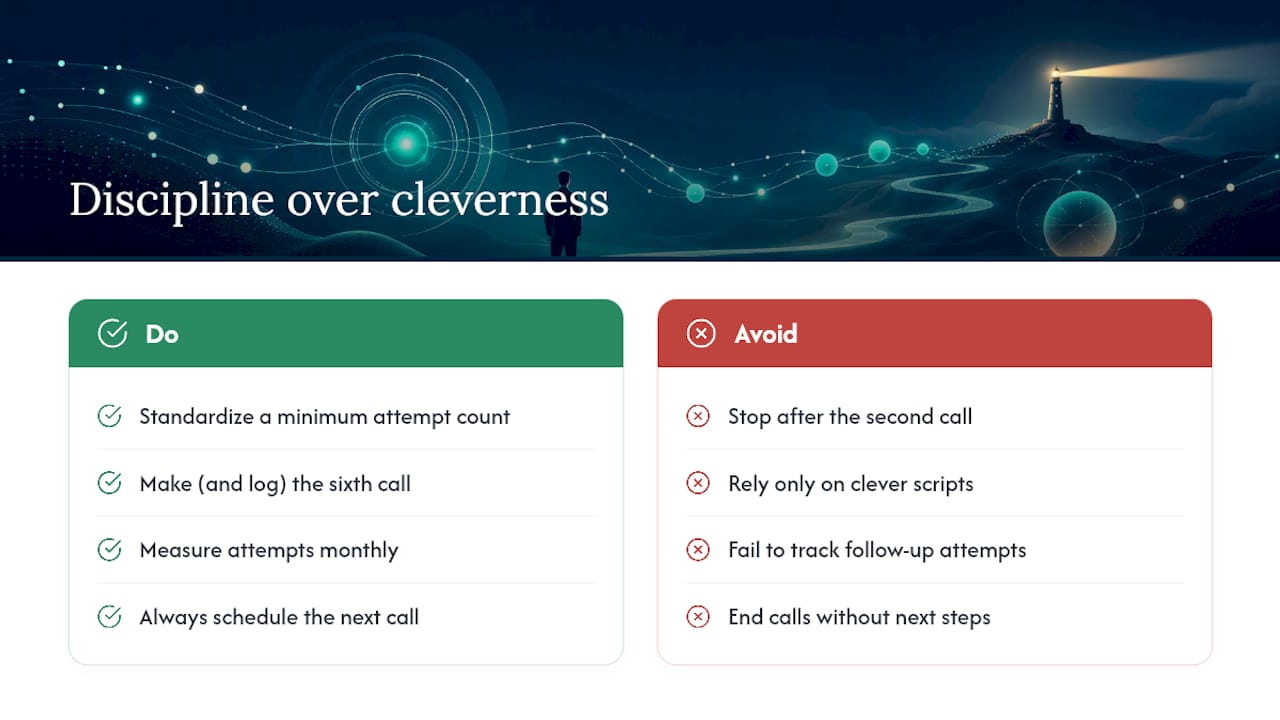
Most sales teams don’t have a script problem. They have a consistency problem. The reps who close more aren’t smoother talkers, they’re the ones who actually make the sixth call instead of quietly letting the lead go cold after the second one.
Standardize your minimum attempts, measure them monthly, and never end a call without scheduling the next one. That single habit, more than any script or tool, is what separates teams that convert from teams that just make calls.
— Jesse
Put This Playbook on Autopilot With 42voice
Everything in this guide works better with consistent execution, and consistency is exactly where most teams lose the thread once volume climbs. 42voice runs the operational side of this playbook for you: routing hot inbound leads instantly, placing signal-triggered outbound calls the moment a pricing page gets a second visit, and covering after-hours qualification so no lead sits cold overnight.
The platform connects directly to your existing calendar and CRM, so scheduled next-steps and call summaries land where your team already works instead of creating a separate system to check. Most businesses are live within three to five days, which means you can test whether automated qualification and after-hours coverage actually move your connect rate before committing to anything long-term. If you’re rebuilding your cadence around the signal-driven approach outlined here, take a look at the full range of 42voice solutions or check out the after-hours agent built specifically for catching leads outside your team’s calling hours. Book a demo to see how it handles your actual lead flow.
Sources
- Follow-up Calls: Everything You Need to Know in 2026 | SyncGTM
- Sales follow-ups | SPOTIO
- What Is a Follow-Up Sales Email? Strategy, Templates, Best Practices (2026) | Apollo
- Breakup email tactics (Mixmax)
FAQ
How many follow-up calls should I make before giving up?
Plan on four to seven touches before a break-up call, with most deals closing somewhere between the third and sixth attempt. Cap attempts around six on the same sequence, then move the lead to a longer nurture track instead of stopping outreach entirely.
What’s the best time of day to make follow-up calls?
Mid-week, late afternoon, in the prospect’s own timezone tends to produce the strongest connect rates. Always dial their timezone rather than yours, and use local-presence numbers where available to improve pickup rates.
What should I say on a break-up call?
Frame it as a respectful closing question rather than another pitch, something like “should I close your file for now?” Break-up messages worded this way often generate the highest reply rates of any touch in the sequence, because they remove the pressure the lead has been feeling from every prior call.
Should I use voicemail or just call back later?
Leave a short voicemail of under half a minute, then follow it within the hour with a brief email that references the voicemail and restates your next-step ask. Voicemail alone rarely gets returned, but voicemail paired with a fast email consistently outperforms either channel on its own.
Can AI handle lead follow-up calls instead of a live rep?
AI voice agents handle scheduling, initial qualification, and after-hours capture well, which is where platforms like 42voice fit into a follow-up strategy. Closing conversations and objection handling on complex deals still perform best with a live rep who can read nuance in real time.