
AI-powered intelligent call routing means your phone never goes unanswered. An AI voice agent picks up every call, understands what the caller needs, books appointments, qualifies leads, handles routine questions, and escalates complex situations to a human with full context already captured. The industry term for this is AI voice automation, and it is what separates businesses that capture every lead from those that lose them to voicemail.
Start with one high-ROI job. Don’t try to automate everything at once. Pick after-hours answering or appointment booking, pilot it in days, and measure the result before expanding.
- 42voice deploys pilots in 3–5 days, including calendar and CRM integrations
- Narrow-scope agents that handle a single end-to-end job are the most durable pattern for SMBs
- Missed calls are the highest-cost problem: recovering them is where most pilots break even fastest
Table of Contents
- Why intelligent call routing matters for your bottom line
- Which SMB use cases deliver the fastest ROI?
- How does an AI voice agent actually work?
- What does a realistic rollout timeline look like?
- Design best practices that prevent costly failures
- How do you measure ROI and know the pilot is working?
- How 42voice approaches intelligent call routing for SMBs
- What questions should you ask vendors before signing?
- Key Takeaways
- The mistake most SMBs make when they start
- Your fastest path to a working pilot
- Useful sources
Why intelligent call routing matters for your bottom line
Every missed call is a missed opportunity. For service businesses, a single unanswered call during peak hours or after 5 PM can mean a lost booking worth hundreds of dollars. AI call routing closes that gap by keeping your business available around the clock without adding headcount.
The business case is concrete:
- Revenue recovery: AI voice agents recover missed calls and automate routine scheduling, producing early time savings within weeks of deployment
- Cost reduction: SMBs report cost reductions of 40–70% compared to human receptionists when using AI voice automation
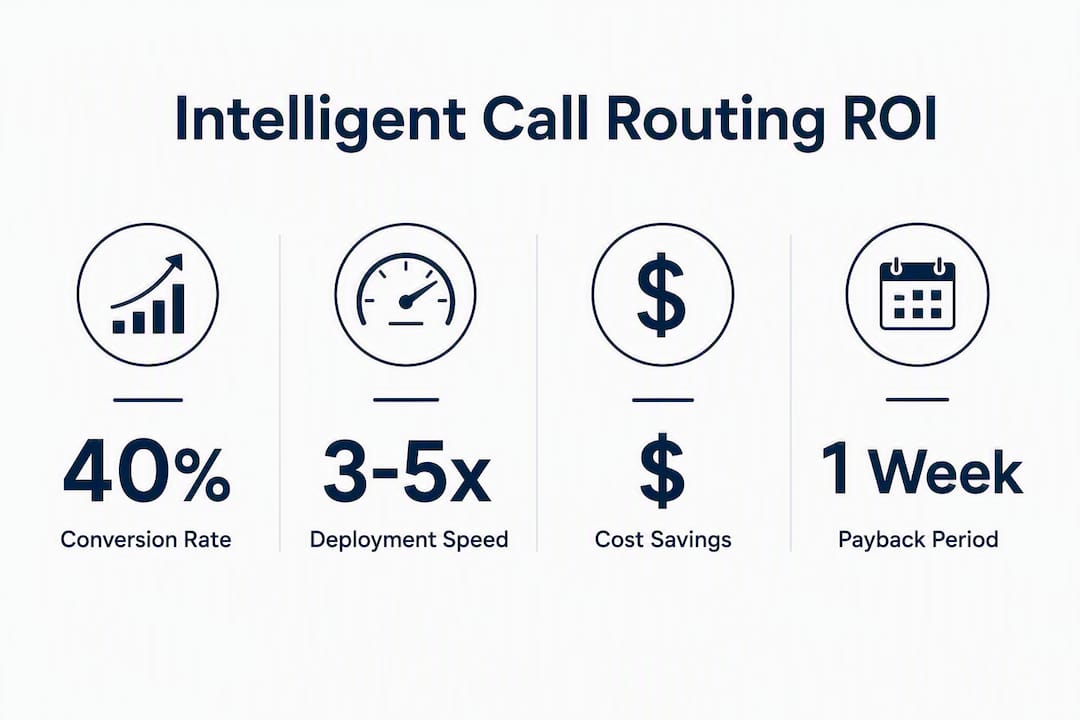
- Booking conversion: One published deployment case reported a 40% increase in appointment conversions after deploying a voice agent
- Staff time freed: The same deployment freed 18 hours per day of human staff time previously spent on routine call handling
- CRM data completion: That same case achieved a 95% completion rate for CRM data logged automatically after agent deployment
- 24/7 lead capture: Voice agents handle after-hours calls and automate booking workflows, eliminating missed-lead losses outside business hours
Stat to know: Industry analysis reports SMBs can reduce call-handling costs by 40–70% versus a human receptionist, while capturing leads around the clock.
Scope matters here. A focused agent that does one job well contains risk, makes KPIs easy to read, and reaches break-even faster than a broad generalist agent with dozens of untested conversation branches.
Which SMB use cases deliver the fastest ROI?
Smart call distribution works best when you point it at predictable, repeatable interactions. These four use cases consistently deliver the fastest payback:
- After-hours triage: A home services company routes all after-5 PM calls to an AI agent that captures the job type, address, and urgency, then books a callback or schedules the job directly into the next morning’s calendar
- Appointment booking and changes: A medical or dental practice automates new patient scheduling, reschedules, and cancellations, cutting front-desk call volume by handling the routine 80% of booking traffic
- Order and status checks: A retailer or service business lets callers check order status or appointment confirmations without waiting on hold
- Lead qualification and outbound follow-up: An AI cold calling agent contacts new web leads within minutes, asks qualification questions, and books discovery calls directly into a sales rep’s calendar
Verticals that benefit most include home services, healthcare, hospitality, and professional services. What they share: high call volume, predictable caller intent, and a direct link between call handling and revenue.
How does an AI voice agent actually work?
Three layers handle every call:
- Perception layer: Automatic speech recognition (ASR) transcribes the caller’s words in real time
- Language interface: A large language model (LLM) interprets intent and generates a natural response
- Action layer: Deterministic business logic executes the outcome — booking a slot, updating a CRM record, sending an SMS confirmation, or escalating to a human
The deterministic layer is the source of truth. Qualification rules, routing criteria, and escalation triggers live in code, not in the LLM prompt. This keeps behavior predictable and auditable.
Essential integrations for a working pilot:
- Telephony number and call routing (your existing business number or a new DID)
- Calendar system (Google Calendar, Outlook, or a booking platform)
- CRM phone integration to log call outcomes, contact records, and lead scores automatically
- SMS or WhatsApp for post-call confirmations and reminders
- Voice analytics dashboard for latency monitoring and transcript review
Platforms with pre-built CRM and calendar connectors deploy 3–5x faster than those requiring custom API work. That gap is the single biggest factor in how quickly your pilot goes live.

What does a realistic rollout timeline look like?
Most SMB pilots follow a four-phase arc. Here is a practical week-by-week breakdown:
| Phase | Timeframe | Key Activities |
|---|---|---|
| Discovery | Days 1–2 | Map call types, define scope, prep knowledge base |
| Build & configure | Days 2–4 | Configure agent, set up integrations, load scripts |
| Test | Days 4–5 | Run simulated calls, validate handoff rules |
| Staged rollout | Week 2 | Route 30% of live calls, monitor daily |
| Full rollout | Week 3–4 | Expand gradually, tune based on transcript data |
Rollout checklist:
- Map your top 3 call types by volume and define the desired outcome for each
- Prepare a knowledge base: FAQs, pricing, hours, booking rules, escalation triggers
- Confirm integration access: calendar credentials, CRM API keys, telephony provider
- Write and review test cases covering normal flows and edge cases
- Define handoff rules: what triggers a transfer, what context gets passed to the human
- Set up your monitoring dashboard before go-live
Pro Tip: Run at least 500 simulated test calls before routing any live traffic. Practitioners who start at 30% live call share catch edge cases without risking your full call volume.
Design best practices that prevent costly failures
The most common failure mode in SMB deployments is scope creep. An agent that starts as a booking bot gets asked to handle billing disputes, and suddenly no one can predict what it will say.
Keep it narrow and transactional. Narrow-scope agents that handle one job end-to-end are the most durable pattern. Every new branch you add is a new failure mode to test.
Latency is a UX metric, not a technical detail. Callers tolerate roughly 1–2 seconds of response delay before they start talking over the agent. Poor latency causes talk-over events, which cause abandonment. Instrument your pipeline for latency from day one and set an alert threshold.
Handoff rules must be explicit:
- Trigger a warm handoff when the caller expresses frustration, asks for a human, or the agent fails to resolve the intent after two attempts
- Pass the full call transcript and captured data to the receiving agent before the transfer completes
- Never drop a caller to a cold transfer with no context
Tone and brand alignment: Record your agent’s voice to match your brand register. A law firm and a pizza delivery service need very different voices. Voice cloning lets you match an existing brand voice exactly.
Design rule: The routine 80% of interactions — scheduling, FAQs, lead qualification — are what AI handles best. Design for those first, and let humans own the complex 20%.
Pro Tip: Review call transcripts weekly for the first month. Patterns in failed intents tell you exactly which knowledge base gaps to fix next.
How do you measure ROI and know the pilot is working?
Primary KPIs to track:
- Containment rate: percentage of calls fully resolved by the agent without human transfer (target: 70%+ for a booking pilot)
- Booking conversion rate: calls that result in a confirmed appointment
- Missed-call recovery: calls answered outside business hours that previously went to voicemail
- CRM completion rate: percentage of calls with a complete, auto-logged CRM record; successful deployments have reported post-pilot rates as high as 95%.
- Escalation frequency: how often the agent transfers to a human (high rates signal scope or knowledge base gaps)
- Cost per call: total monthly platform cost divided by calls handled
Sample break-even calculation:
| Metric | Assumption | Monthly Value |
|---|---|---|
| Conversion rate on recovered calls | 40% | — |
| CRM completion rate after deployment | 95% | — |
At those numbers, a single after-hours appointment booking agent pays for itself in the first week of the month. Track containment rate and booking conversion during the pilot; escalation frequency and cost-per-call become more meaningful after full rollout.
How 42voice approaches intelligent call routing for SMBs
42voice builds scope-first pilots designed to go live in 3–5 days. The approach prioritizes a single high-ROI job, pre-built integrations, and daily monitoring before expanding scope.
What a 42voice pilot includes:
- Inbound call handling with a configured AI voice agent scoped to your top call type
- Automated appointment reminders to reduce no-shows after booking
- After-hours agent coverage so no call goes unanswered
42voice also offers multilingual agents covering 9+ languages, voice cloning, and outbound lead qualification for businesses ready to expand beyond the initial pilot.
What questions should you ask vendors before signing?
Operational questions:
- Which CRM and calendar systems do you have pre-built connectors for?
- What is your average response latency, and what SLA do you offer for it?
- How do you handle handoffs — what data is passed to the human agent?
- What languages does your platform support natively?
- How do you prevent AI errors from reaching callers? (Ask specifically about accuracy and reliability safeguards)
- Who owns the call recordings and transcript data?
Commercial questions:
- Is pricing subscription-based, per-minute, or per-call — and how does it scale with volume?
- What are the setup fees, and are they waived for a pilot?
- What is the contract length, and is there a rollback option if the pilot underperforms?
Decision checklist before you commit:
- ✅ Pre-built integrations for your CRM and calendar confirmed
- ✅ Latency SLA under 2 seconds for agent responses
- ✅ Staged rollout and simulation testing supported
- ✅ Warm handoff with transcript transfer confirmed
- ✅ Data ownership and call recording policy reviewed
- ✅ Pricing modeled at your actual call volume
- ✅ Staff training and onboarding support included
For telephony provisioning questions, partners like Netera Communications can help you understand number porting and routing at the carrier level before you commit to a platform.
Key Takeaways
AI-powered intelligent call routing pays for itself fastest when scoped to a single high-ROI job, deployed with pre-built integrations, and measured against containment rate and booking conversion from day one.
| Point | Details |
|---|---|
| Start narrow | Pilot one job (after-hours or booking) before expanding; narrow agents are the most durable pattern. |
| Integration speed matters | Pre-built CRM and calendar connectors deploy 3–5x faster than custom API builds. |
| Break-even is fast | Recovering after-hours calls at a 40% conversion rate can return significant monthly revenue. |
| Measure containment first | Track containment rate and booking conversion during the pilot; escalation frequency signals knowledge base gaps. |
| 42voice pilots in 3–5 days | 42voice connects a scoped booking or after-hours agent with CRM and calendar integrations within days. |
The mistake most SMBs make when they start
The businesses that struggle with AI call routing almost always make the same error: they scope the first agent too broadly. They want it to handle bookings, answer billing questions, manage complaints, and qualify leads — all at once. The result is an agent with dozens of untested branches, unpredictable behavior, and a team that loses confidence in the technology after the first bad call.
The smarter move is almost boring in its simplicity. Pick the one call type that costs you the most when it goes unanswered. For most service businesses, that is after-hours booking. Deploy an agent that does exactly that, nothing else, and measure it for 30 days. The data from that pilot tells you what to automate next.
Change management is the other underrated factor. Staff who feel the AI is replacing them will route calls around it. Staff who understand it handles the calls they hate most — the repetitive, after-hours, routine ones — will actively support it. Brief your team before go-live, share transcript reviews weekly, and let them flag edge cases. That feedback loop is how you tune the agent from good to great.
Your fastest path to a working pilot
If you want calls answered, leads qualified, and appointments booked without adding headcount, 42voice delivers a working pilot in 3–5 days. The difference from a generic platform: 42voice scopes the agent to your specific call type, connects your existing calendar and CRM before go-live, and gives you real-time analytics from day one so you can see exactly what the agent is handling.
The after-hours agent and booking agent are the two highest-ROI starting points for most SMBs. Both include CRM logging, calendar sync, and automated reminders. Both go live in days, not months. And both come with the voice analytics you need to prove ROI to yourself and your team.
Ready to see what a scoped pilot looks like for your business? Fill out the client setup form and 42voice will map your top call types and confirm integrations before you commit to anything.
Useful sources
- AI Voice Agents for Small Business 2026: Complete Guide — supports implementation timelines, after-hours coverage, and missed-call recovery claims
- How to Implement an AI Voice Agent for Small Business — source for the 40% booking conversion increase, 18 hours/day staff time freed, and staged rollout guidance
- Voice AI Agents for Small Business: What Actually Ships in 2026 — design best practices for narrow-scope agents and containment
- AI Voice Agent Adoption and Demand in SMEs — integration readiness and 3–5x deployment speed advantage
- AI Voice Agents for Small Business: How to Automate Phone Calls and Save Thousands — 40–70% cost reduction versus human receptionists
- AI Trends 2026: Customer Support — the 80/20 framing for AI as an overflow valve handling routine interactions
- 42Voice — Our Story — 42voice deployment speed claims and integration capabilities