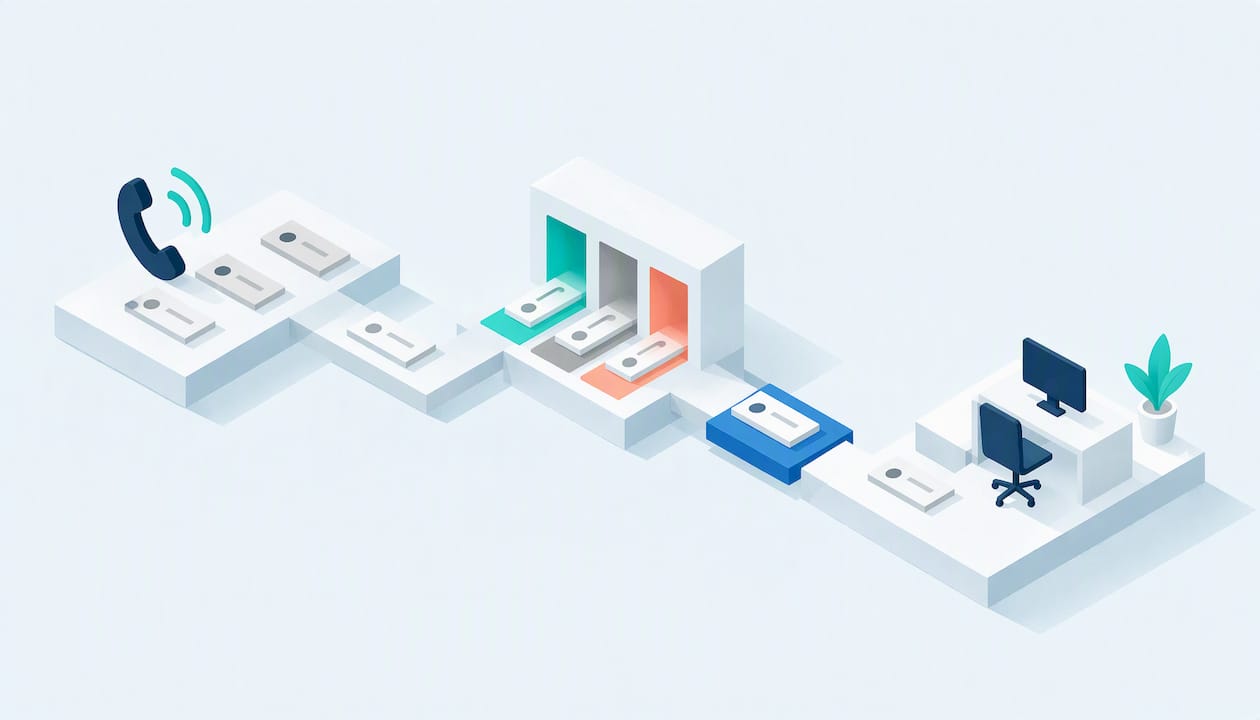
Call sentiment analysis uses AI to read the words, and sometimes the tone, of a phone conversation and label how the caller feels: positive, neutral or negative. Used well, it tells you which calls need a person now and which patterns keep annoying your customers. Used badly, it becomes a dashboard nobody trusts.
This guide explains how it works, what it can and cannot tell you, and how to set it up in a small Australian business without creating a privacy headache. I’m Alston from 42Voice, and I’ll be direct about the limits as well as the benefits.
Table of Contents
- What call sentiment analysis actually measures
- Why it matters more when calls are the front door
- Four practical uses for a small business
- What sentiment analysis gets wrong
- Privacy: what to check before you switch it on
- Outbound calls and collections: extra care
- How to set it up in four steps
- Where sentiment sits inside an AI voice agent
- Our perspective
- Put it to work with a voice agent
- Frequently asked questions
- Ready to hear it in action?
- Sources
What call sentiment analysis actually measures
Most tools do three things in sequence:
- Transcribe the call. Speech is converted to text, usually with each speaker separated.
- Classify the language. Natural language processing scores phrases and sentences as positive, neutral or negative. Some tools add emotions such as frustration or confusion.
- Aggregate the results. Scores are shown per call, per moment in the call, per agent or per topic.
Some systems also look at acoustic signals such as pace, volume and long silences. These are rougher signals than the words themselves. A loud caller isn’t necessarily an angry one, and a quiet caller isn’t necessarily a happy one.
The three types people usually mean when they ask about “types” of sentiment analysis are:
- Polarity: positive, neutral, negative.
- Emotion detection: frustrated, anxious, confused, pleased.
- Intent-linked sentiment: negative about what? Price, wait time, a missed appointment, a billing error.
The third is the one that pays off for a small business. “Customers are unhappy” is useless. “Customers are unhappy about being told a tradie would arrive between 8 and 12 and then not hearing from anyone” is a fix you can make on Monday.
Why it matters more when calls are the front door
For many Australian SMEs the phone is still where the sale or the booking happens. A plumber, a dental clinic and a café owner all share the same problem: you can’t read every call, and you can’t listen to every recording.
Wait times are a known sore point. ServiceNow’s research reports that Australians spent 123 million hours on hold in 2024, an average of 11.1 hours each, and almost 8 in 10 consider taking their business elsewhere as a result. The Australian Bureau of Statistics also reports that 12% of Australian businesses used AI in 2024-25, up from 1% in 2021-22, so this is no longer fringe technology.
Sentiment analysis sits on top of that. It won’t answer the phone for you, but it shows where the phone experience is failing.
Four practical uses for a small business
1. Flag calls that need a person
If a caller sounds angry or distressed, the best outcome is a quick, warm transfer to someone who can listen. Real-time sentiment is the trigger some systems use for this. It’s useful, but treat it as a prompt, not a verdict. A false alarm costs you a few minutes. A missed one costs you a customer.
2. Review a sample, not every call
A sentiment score lets you sort calls. Instead of listening to 20 random recordings, you listen to the five most negative ones and the five most positive. That’s an hour a week, not a day.
3. Spot repeat problems
Tag calls by topic and track sentiment against each. If “quote follow-up” is consistently negative, you have a process problem, not a people problem.
4. Brief the human before they pick up
This is the use we care about most. When an AI agent handles the first part of a call and then passes it to your team, the person taking over should see the transcript and a short summary of the caller’s mood. They shouldn’t have to ask “how can I help?” again.
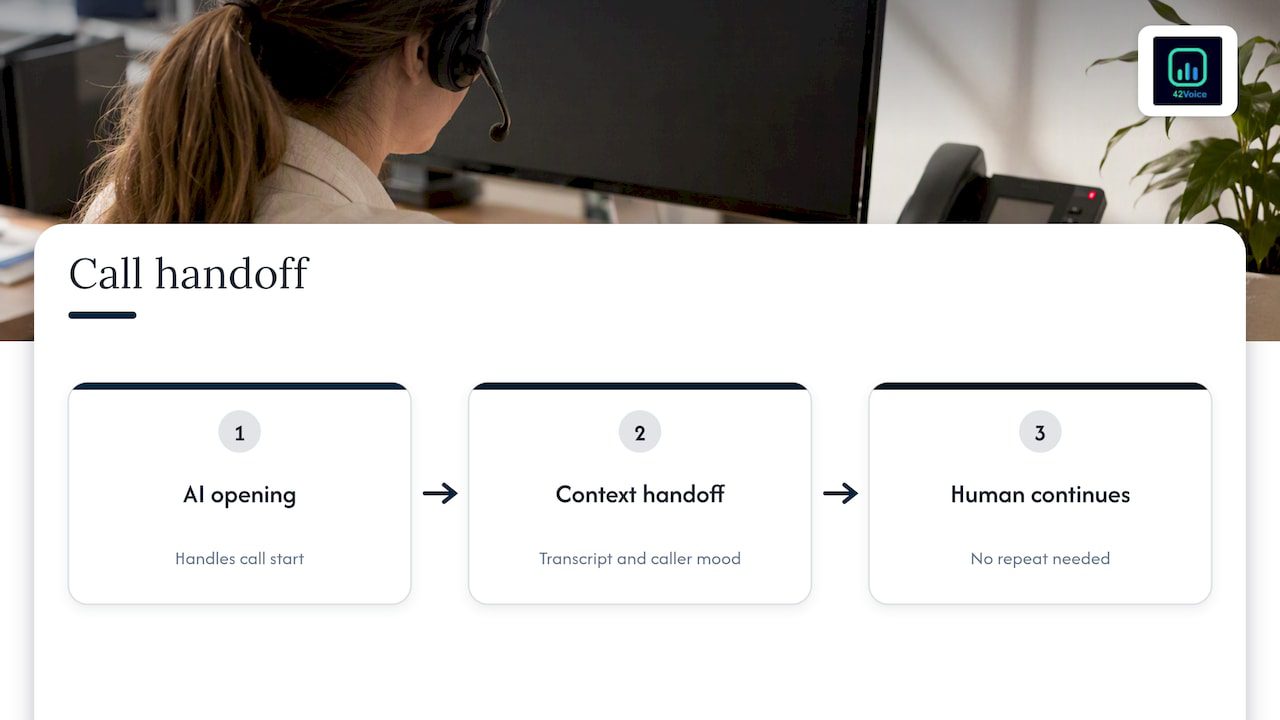
That matters because of how Australians feel about automation. A 2025 Twilio study found that 49% of Australians prefer to start with a human agent and 50% feel less patient with AI agents. The top frustrations were the AI not understanding the query (52%) and having to repeat themselves (48%). The same release says 20% would switch to a competitor when an automated system traps them in a loop. A good handoff, with context carried across, addresses exactly those complaints.
What sentiment analysis gets wrong
Be sceptical of any vendor who says it reads emotion perfectly. Here are the common failure points.
| Limitation | What it looks like in practice | What to do |
|---|---|---|
| Sarcasm and understatement | “Oh, that’s great” scored as positive | Review a sample of flagged calls by ear |
| Accents and speech patterns | Transcripts degrade, scores follow | Test with your real callers, not a demo voice |
| Poor audio | Job-site noise, speakerphone, bad mobile reception | Treat low-quality calls as unreliable |
| Context | A caller calling about a funeral booking sounds sad, and that’s appropriate | Pair sentiment with call topic |
| Cultural differences | Directness reads as anger in some models | Calibrate thresholds on your own data |
The accent point has an ethical side. The Australian Human Rights Commission’s technical paper on algorithmic bias is a good reminder that AI can treat different groups unevenly. For a small business the practical takeaway is to choose providers that let a human audit what the system did, and to check results across the range of callers you actually serve.
Privacy: what to check before you switch it on
This is general information, not legal advice. If you’re unsure, speak to a privacy lawyer or the Office of the Australian Information Commissioner (OAIC).
A caller’s voice and words are personal information. The OAIC explains the Australian Privacy Principles on collecting personal information. Many small businesses are exempt from the Privacy Act, but that exemption doesn’t cover everyone. Businesses providing health services, for instance, are generally covered, and an appointment line at a clinic falls squarely in that world.
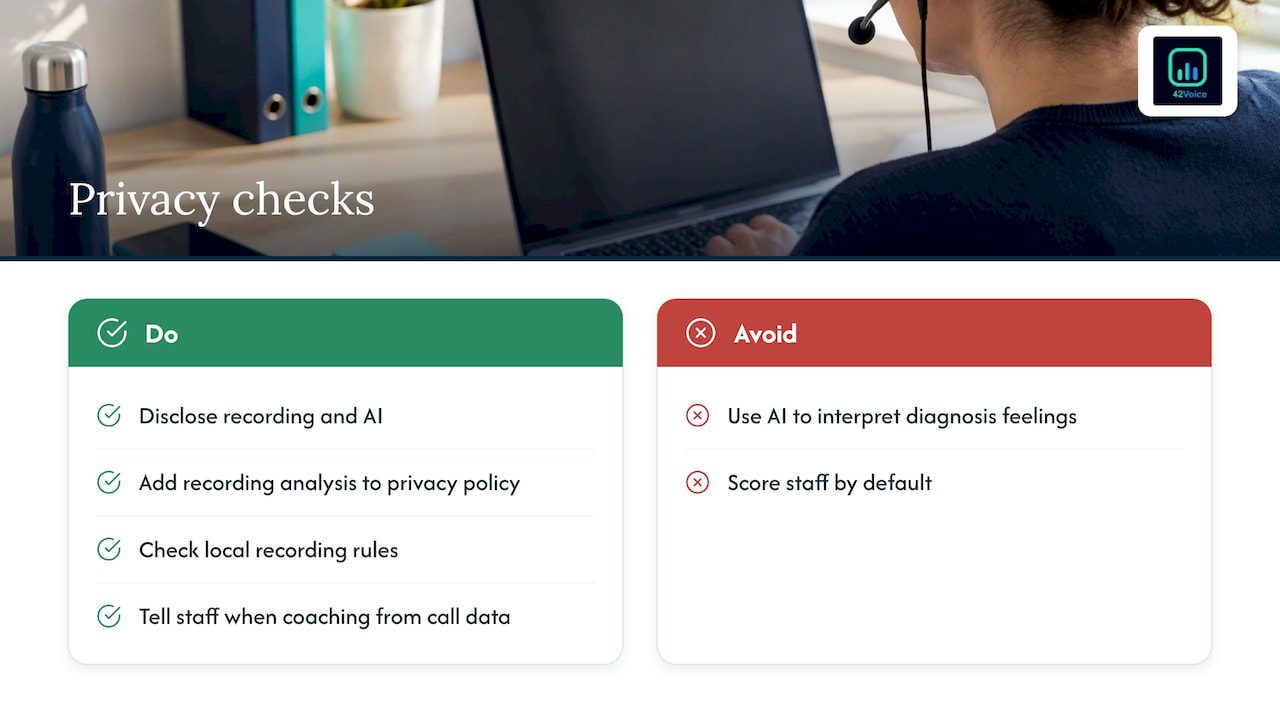
Tell callers. Say at the start of the call that it is recorded and that an AI assistant may be involved. Put the same information in your privacy policy, including that recordings are analysed automatically. Recording laws differ across states and territories, so check the rules where you operate.
Keep health calls administrative. Ahpra’s guidance for practice managers on virtual care makes clear that technology should support, not replace, the practitioner and patient relationship. Using AI to book and confirm appointments is one thing. Using it to interpret how a patient feels about a diagnosis is another, and we wouldn’t suggest it.
Don’t point it at your own staff by default. Scoring how your team sounds is a form of monitoring. The OAIC notes that the Privacy Act doesn’t specifically cover workplace surveillance, but state and territory laws may apply. For a plain-English discussion of balancing monitoring and privacy, this overview of surveillance and employee privacy is a useful read. If you coach staff from call data, tell them, and use it to help rather than to catch them out.
Outbound calls and collections: extra care
Sentiment analysis is tempting on outbound calls, because a negative reaction in the first ten seconds is a clear signal to stop. But outbound calling is regulated.
- Sales calls: The ACMA’s guidance on telemarketing says you can’t assume consent because a number is published, and you need to check your list against the Do Not Call Register. Calling-hour rules apply too.
- Debt collection: The ACCC’s debt collection rules say contact should be for a reasonable purpose and only when necessary. They set limits of three calls a week or ten a month per debtor, and restrict hours to 7:30 am to 9 pm on weekdays and 9 am to 9 pm on weekends. You must also identify your business clearly.
- AI disclosure: Tell people they’re speaking with an AI assistant. It’s the honest thing to do, and it’s consistent with how Australians say they want to be treated.
In collections, a sentiment flag should do one thing: send the call to a person. A debtor who sounds distressed, or who mentions hardship, needs a human who can be flexible and fair. It should never be used to push harder on someone who sounds vulnerable. Our debt collection agents page explains how we approach first-party reminders and compliance.
How to set it up in four steps
- Pick one question. For example: “Which missed or after-hours calls turn into angry callbacks?” Don’t start with “let’s analyse everything”.
- Define what happens on a negative flag. Who gets the call? How fast? What do they see? If the answer is “nothing”, you don’t need the tool yet.
- Run a four to six week pilot. Review the flagged calls by ear each week and note where the score was wrong. Our AI call analytics pilot guide walks through the structure.
- Fix one thing per fortnight. A changed script, a new booking slot, a quicker callback. Then watch whether sentiment on that topic moves.
A worked example, with made-up numbers purely for illustration: an electrician’s office takes 40 calls a week and sees that most of the negative ones come from people who rang after 5 pm and got voicemail. The fix isn’t a smarter score. It’s answering those calls, taking the job details and booking a callback slot. The score just pointed to the problem.
Where sentiment sits inside an AI voice agent
A standalone analytics tool listens to calls after the fact. A voice agent that answers calls can use sentiment while the call is live, because it is already handling the conversation. The pattern we recommend is simple:
- The agent handles the repetitive first-level work: answering, checking calendar availability, qualifying a lead, confirming an appointment.
- If the caller sounds frustrated, asks for a person, or raises something complex, the agent hands off.
- The human receives the transcript and a short summary so the caller doesn’t repeat themselves.
Here’s what that can look like for a dental clinic after hours:
Caller: I need to move my appointment, and I’ve already called twice.
Agent: Sorry about that. Let me check the diary for you. Would Thursday morning work?
Caller: No, it’s complicated, I need to talk to someone.
Agent: Of course. I’ll pass you to the team with a note of what you’ve told me, so you won’t need to start again.
The agent didn’t pretend. It recognised the limit and moved the call to a person.
Our perspective
We build AI voice agents, so you’d expect us to say sentiment analysis is essential. It isn’t, for everyone. If you take ten calls a day, you can listen to them. Sentiment analysis starts earning its place when call volume outgrows your ability to listen, or when calls come in while your team is busy on a job or after hours.
Our view is that AI should take the repetitive, high-volume calls and leave every human moment to a person: the nuance, the empathy, the closing. Sentiment is useful because it helps decide when that moment has arrived. We don’t see it as a way to replace staff, and we’d be wary of anyone who sells it that way.
Two habits make the difference. First, human-in-the-loop quality review: someone on your team regularly reads transcripts and checks that the scores match what they hear. Second, a clean handoff, so the person who picks up already knows the story. Our agents are built around both, and we can be live in three to five days with no lock-in contracts.
And a caution: if a tool’s output can’t be explained or audited by a human, don’t use it to make decisions about people.
— Alston
Put it to work with a voice agent
If missed calls and after-hours enquiries are where your sentiment problem starts, begin with the AI Receptionist. It answers around the clock, books into your calendar, works with your CRM, and hands complex or upset callers to your team with the transcript. Pricing is tailored to each business, and you can see the plan tiers on our pricing page.
Frequently asked questions
Can ChatGPT do a sentiment analysis?
A general-purpose language model can classify the tone of a transcript you paste in, and it’s fine for a quick one-off look. It isn’t built to transcribe live calls, route them or keep an audit trail. For ongoing use, you want sentiment tied to your phone system, your CRM and a human review process.
Can you give me an example of call sentiment analysis?
A caller says, “This is the third time I’ve rung about this invoice.” The system transcribes it, tags the topic as billing, scores it negative and flags the repeat contact. A team member then sees the flag and calls back with the history in front of them.
Is sentiment analysis still relevant?
Yes, but its role has narrowed. It’s most useful as a triage and review tool, showing you which calls to listen to and when to bring in a person. It is much less reliable as a stand-alone measure of customer happiness.
Do I have to tell callers I’m analysing their calls?
You should be open about it. Tell callers that calls are recorded and that AI is involved, and reflect automated analysis in your privacy policy. Rules vary by state, territory and industry, so check with a privacy lawyer or the OAIC for your situation.
Ready to hear it in action?
Want to see how an AI voice agent handles an upset caller and hands over to your team? Book a free 15-minute demo and we’ll walk through it using your own scenarios.
Sources
- ABS: Characteristics of Australian business
- Twilio: Australian digital patience
- Australian Human Rights Commission: addressing algorithmic bias
- OAIC: APP 3, collection of solicited personal information
- Ahpra: virtual care information for practice managers
- OAIC: workplace monitoring and surveillance
- ACMA: dealing with telemarketing
- ACMA: Do Not Call Register
- ACCC: debt collection rules
Recommended
- Live Within Days to Automate Phone Calls for Australian SMEs
- AI Voice Cloning for Australian SMEs: Automate, Don’t Replace Staff
- Call Summary Automation: Pilot Without Vendor Delays for Australian SMEs
- White Label Voicebots for Australian Agencies: Avoid Compliance Gaps
This article is general information about AI voice technology and isn’t legal or compliance advice. Requirements for call recording, AI disclosure and outbound calling vary by state and use case.