
The right approach is AI agents that resolve repeatable contact types after fixing the root causes driving those calls in the first place. That combination, not channel-shifting alone, sustainably lowers call volume. Composite deployments modeled in a Forrester TEI study on PolyAI resolved roughly 25% of calls in Year 1, climbing toward 40% by Year 3, with fewer abandoned calls and real agent-hour savings.
Table of Contents
- What Is Call Deflection With AI, and How Is It Different From IVR?
- Why Does Resolution-First Deflection Beat Simple Routing?
- Which AI Deflection Tactics Should You Deploy First?
- How Do You Measure Whether Deflection Is Actually Working?
- How Do You Implement AI Call Deflection Without Breaking CX?
- What Mistakes Cause AI Call Deflection to Backfire?
- What Evidence Supports AI-Driven Call Deflection Programs?
- How Do You Personalize AI Call Deflection Without Losing Efficiency?
- What Privacy and Compliance Rules Apply to AI Call Deflection?
- How Do You Choose the Right AI Call Deflection Technology?
- Why Does Training Data Quality Determine AI Deflection Success?
- How Do AI Voice Agents Handle Multilingual Customer Calls?
- How Should You Manage the Team Transition to AI Call Deflection?
- What Should You Prioritize First?
- Start Your Deflection Pilot the Right Way
- Sources
- FAQ
What Is Call Deflection With AI, and How Is It Different From IVR?
Call deflection with AI means routing or resolving a customer’s issue through an automated system before it ever reaches a live agent. Containment is the tighter, more useful metric inside that: the percentage of contacts an AI agent fully resolves without a callback or escalation.
The technology stack behind that outcome has changed. IVR menus route by keypress. Chatbots match keywords against static scripts. AI agents are different: they hold context across a conversation, query backend systems in real time, and complete a transaction rather than just collect information for a human to finish, as Dialpad’s analysis of AI agent best practices points out.
That distinction matters for deciding what to automate:
- Value demand calls, where a customer wants something legitimate (book an appointment, check a balance, reschedule a delivery), are strong deflection candidates.
- Failure demand calls, caused by something broken in your process (a bill that’s wrong, a confirmation that never arrived), are not. Automating those just makes the failure faster.
Why Does Resolution-First Deflection Beat Simple Routing?
Containment that actually resolves the issue lowers repeat calls and cuts abandonment, because customers aren’t sitting in queue waiting for a human to redo work a bot already tried. That frees live agents for the complex, judgment-heavy calls where a person adds real value, and it shows up directly in cost-to-serve.
The Evidence: A Forrester Total Economic Impact study of PolyAI modeled composite deployments resolving about 25% of calls in Year 1, rising to roughly 40% by Year 3, alongside multi-million-dollar labor savings and measurably lower abandonment. Related case examples describe identity verification automation cutting live-agent verification time by about half in some deployments.
Numbers like that only hold up when the underlying resolution is real. A bot that transfers a caller after collecting their account number hasn’t reduced cost to serve; it’s added a step.
Which AI Deflection Tactics Should You Deploy First?
Not every contact type deserves the same treatment, and sequencing matters more than most teams assume. Some tactics prevent the call before it happens. Others resolve it the moment it arrives.
Proactive tactics stop the call at the source:
- Outbound notifications for delivery windows, appointment reminders, or service outages
- Proactive troubleshooting nudges (a router restart prompt before a support call gets logged)
- Status alerts that answer “where is my order/technician/refund” before the customer has to ask
Reactive tactics handle the call once it’s already inbound:
- Replacing IVR menus with an AI agent that authenticates the caller and completes the task directly
- Voice agents with live backend lookups (order status, appointment slots, account balances)
- Chat fallback for customers who prefer text mid-call or after hours
- Diagnose first. Pull transcripts and tickets to find your highest-volume, most predictable contact drivers.
- Fix what’s broken. If a driver is failure demand, a broken invoice process or a confusing confirmation email, fix that before building an automation around it.
- Pilot narrow. Pick one driver, usually appointment booking or order status, and automate it end-to-end.
- Scale deliberately. Add the next driver only after containment and CSAT hold steady on the first.
Pro Tip: Rank contact drivers by frequency multiplied by average handle time, not frequency alone. A driver ranked by cost, not just volume, often reveals your real highest-value automation target hiding behind a lower call count.
How Do You Measure Whether Deflection Is Actually Working?
Deflection rate tells you how many calls got diverted. It says nothing about whether the customer’s problem got solved. That gap is where most programs quietly fail.
Track these instead:
- Deflection rate: percentage of contacts diverted from a live agent, regardless of outcome
- Containment rate: percentage of contacts fully resolved without human escalation or a repeat contact
- Callback rate: percentage of “contained” contacts where the same customer calls back about the same issue within a set window
- CSAT: satisfaction score specific to the automated interaction, not the channel overall
- Cost-to-serve: blended cost per resolved contact across automated and live-agent paths
The Metric That Matters: Containment measured against a 48-hour callback window is the fastest signal that a flow needs fixing. If callbacks spike inside that window, your “contained” number was inflated, and the underlying flow needs rework before you scale it further.
Report weekly during a pilot, monthly once stable, and keep transcripts, interaction IDs, and CRM linkage in every record so you can trace a callback back to the exact flow that failed it.
How Do You Implement AI Call Deflection Without Breaking CX?
Before writing a single automation script, unify your feedback data across channels and rank contact drivers using frequency times average handle time to find your real cost centers. Fix the ones caused by broken processes. Only automate what’s left.
Integrations you’ll need:
- CRM, for customer history and context continuity across channels
- Order management or scheduling systems, for real-time status lookups
- Billing platforms, if the agent will discuss charges or process payments
- Identity verification, so the agent can authenticate a caller before touching account data
- Design a narrow pilot. One contact type, clear success criteria (containment target, CSAT floor, callback ceiling), and a defined fallback to a human.
- Build human-in-loop tests. Route a percentage of live calls through the new flow with an agent shadowing before full cutover.
- Set escalation rules explicitly. Define exactly when and how the AI hands off, and make sure full conversation context travels with the handoff.
- Expand by evidence, not calendar. Add the next driver once containment and CSAT are proven stable, and monitor callback rate continuously as you scale.
Explore the IVR versus voice-agent comparison if you’re deciding whether your current menu system is worth replacing outright or layering an AI agent on top of.
What Mistakes Cause AI Call Deflection to Backfire?
The most common failure is automating before fixing. Deflecting a call caused by a confusing bill or a missed confirmation just makes the customer angrier, faster, according to Chattermill’s guidance on failure-demand diagnosis. The volume drops on paper while the underlying problem, and the customer’s frustration, stays exactly where it was.
Other frequent traps:
- Context loss on escalation. If a caller has to repeat their issue after being handed to a human, the automation added friction instead of removing it.
- Scope creep too early. Teams that launch five contact types at once can’t tell which one is actually failing when metrics dip.
- Ignoring the 48-hour callback signal. A rising repeat-contact rate inside that window is the earliest warning that a flow needs rework, not a scale-up.
Pro Tip: Watch your callback rate daily during the first two weeks of any new deflection flow. A quiet rise there almost always shows up in CSAT two weeks later, and by then it’s a harder fix.
What Evidence Supports AI-Driven Call Deflection Programs?
Third-party evidence backs the resolution-first approach beyond any single vendor’s claims. The Forrester TEI analysis of PolyAI modeled composite results showing 25% of calls resolved in Year 1, growing to 40% by Year 3, with material agent-hour savings and lower abandonment. Separate industry case work found identity verification automation cutting live-agent verification time by roughly half in some deployments.
A typical deployment model follows an operations-first approach:
- Voice agents can go live within a few days of onboarding, faster than the multi-week timelines typical for legacy IVR overhauls
- Integrations connect to existing calendars and CRMs, aiming to preserve context continuity to prevent repeat-contact failures
- Multilingual support across multiple languages allows a single deployment to handle diverse customer bases without separate builds per language
- Compliance and data handling considerations should be integrated into the platform design from the start, not added only after a pilot reveals issues
Readers weighing sector fit can review home services call automation outcomes for a concrete look at what deployment looks like in a high-call-volume vertical.
How Do You Personalize AI Call Deflection Without Losing Efficiency?
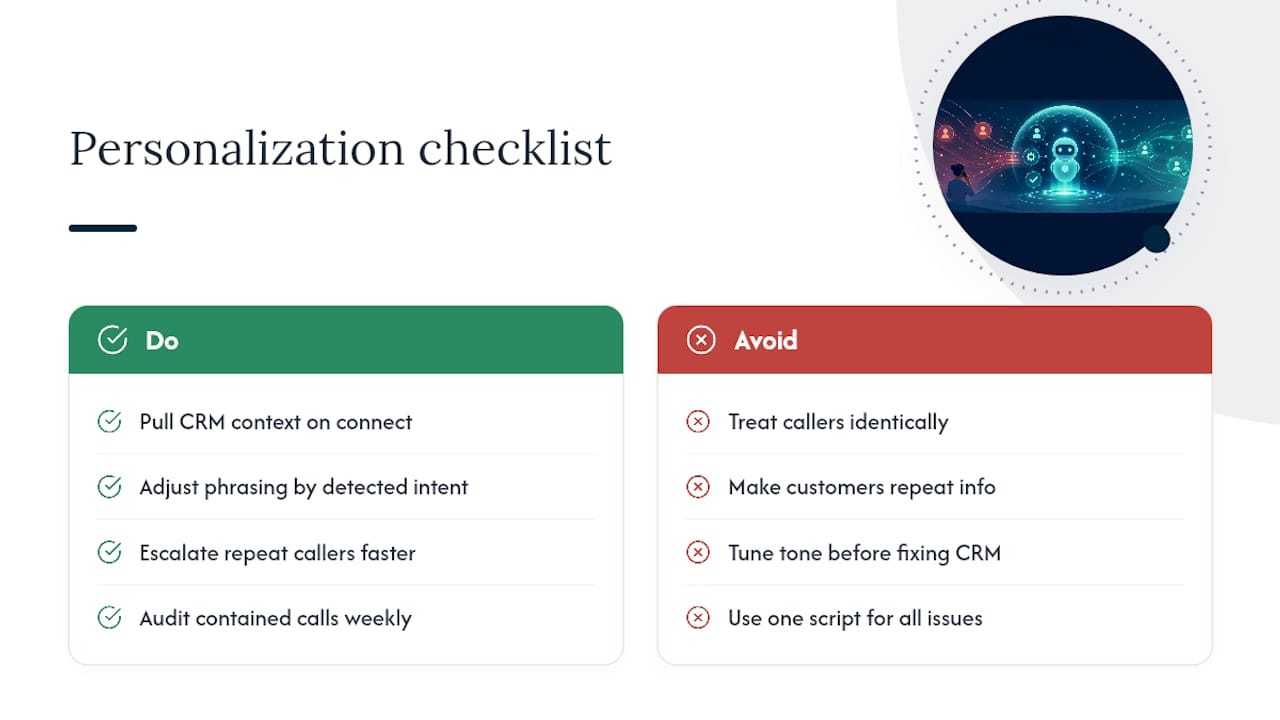
Personalization in call deflection isn’t a nice-to-have layered on top of automation. It’s what separates an AI agent from a smarter IVR menu. When a returning customer calls, the agent should already know their order history, their last support ticket, and their preferred contact method, pulled straight from the CRM the moment the call connects.
That context changes what “resolution” means in practice. A first-time caller asking about a delayed shipment needs a status update. A customer who called about the same shipment yesterday needs an apology, a concrete fix, and probably a human on the line faster than the flow would normally trigger. An AI agent that treats both callers identically will hit its containment targets while quietly damaging the relationship with your repeat customers, the ones who call most often and cost the most to lose.
Voice tone matters here too. A caller reporting a billing error and a caller booking a routine appointment shouldn’t get the same clipped, transactional script. The most effective deployments adjust pacing and phrasing based on the intent detected early in the call, slower and more deliberate for account issues, brisk and efficient for scheduling.
The practical test for whether personalization is working: pull a sample of contained calls each week and check whether the agent referenced prior interactions accurately. If it didn’t, and the customer had to repeat information they’d already given the company, that’s a context-continuity failure, not a personalization nuance. Fix the CRM linkage before tuning tone.
What Privacy and Compliance Rules Apply to AI Call Deflection?
An AI agent that authenticates callers, pulls account data, and processes payments is handling sensitive information at every step, which means privacy and compliance can’t be an afterthought bolted onto a working pilot. Every backend integration, CRM, billing, identity verification, expands the amount of personal data flowing through the automation, and each one needs its own access controls and audit trail.
Identity verification deserves particular attention. Before an AI agent shares account details or processes a transaction, it needs a reliable way to confirm the caller is who they claim to be, whether that’s a PIN, a callback verification, or a knowledge-based challenge tied to account history. Skipping this step to speed up containment is the fastest way to turn a deflection win into a data exposure incident.
Recording and transcript storage carry their own obligations depending on your jurisdiction and industry. Financial services and healthcare callers, in particular, expect (and are often legally owed) clear disclosure that a call may be recorded and processed by an automated system, along with a straightforward path to a human if they decline.
Practical steps that hold up under scrutiny:
- Limit data access to what the specific contact type requires, not blanket account visibility
- Log every automated transaction with a timestamp and interaction ID for audit purposes
- Build explicit consent and disclosure language into the call opening
- Review data retention policies for transcripts and voice recordings against your actual regulatory obligations, not industry assumption
How Do You Choose the Right AI Call Deflection Technology?
Vendor evaluation for AI call deflection should start with integration depth, not feature lists. A platform that can’t connect to your CRM, scheduling system, or billing platform in real time will cap your containment rate no matter how natural its conversation feels, because the agent can talk convincingly but can’t actually finish the task.
Deployment speed is a second, underweighted criterion. Teams that spend months on a build before running a single live pilot lose the diagnostic feedback loop that makes deflection programs work. A platform built for rapid deployment, days rather than months, lets you test a narrow pilot, read the containment and callback data, and adjust before committing further budget.
Ask any platform you’re evaluating these questions directly:
- Can it access backend systems in real time, or does it only collect information for a human to act on later?
- Does it preserve full conversation context on escalation, so a customer never repeats themselves to a live agent?
- What languages does it support natively, and how many require a separate build?
- What’s the actual time from contract to live pilot, in days, not a marketing range?
- How does it handle authentication and sensitive data access during a call?
Weigh these against your highest-volume contact driver specifically. A platform that excels at appointment booking but struggles with billing lookups is the right fit for a home services business and the wrong fit for a utility company, regardless of its overall feature set.
Why Does Training Data Quality Determine AI Deflection Success?
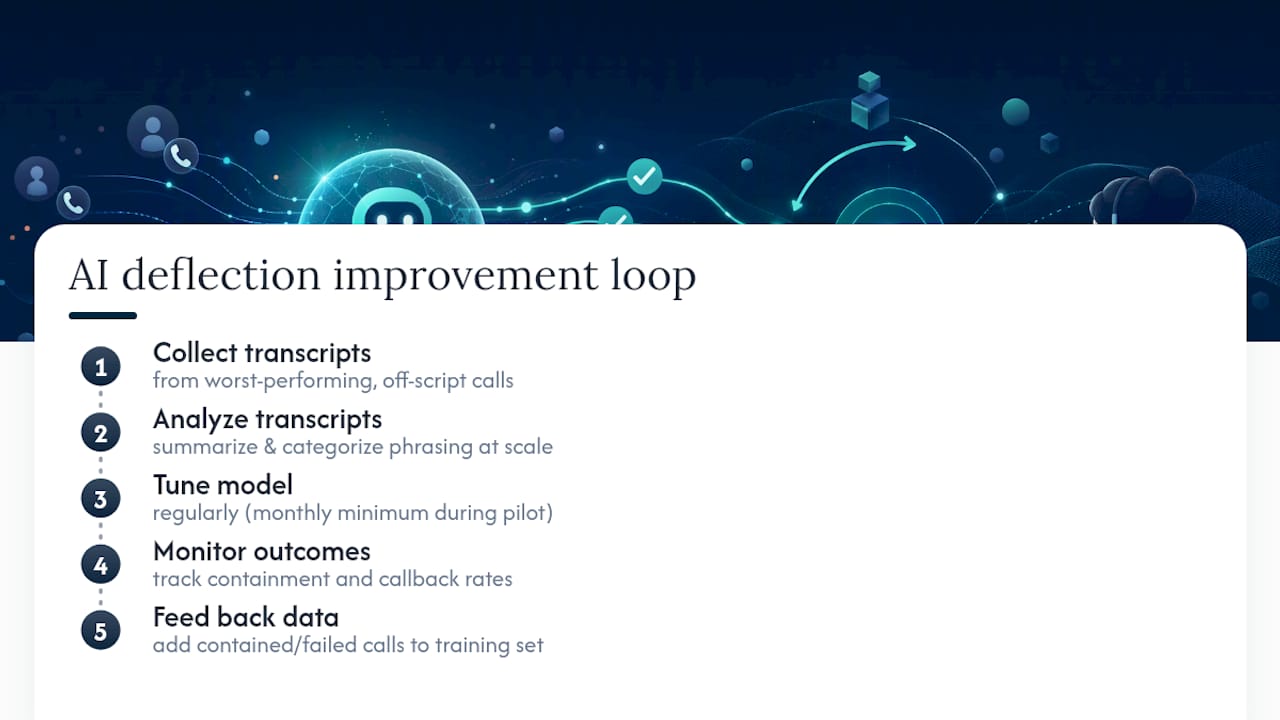
An AI agent is only as good as the conversations it learned from, and most deflection failures trace back to thin or mismatched training data rather than a flawed model. If your training set is built from scripted, ideal-case transcripts, the agent will handle scripted, ideal-case calls beautifully and fall apart the moment a real customer goes off-script, which happens constantly.
The fix isn’t more data. It’s more representative data. Pull transcripts from your actual worst-performing contact drivers, the confused customers, the interrupted sentences, the callers who switch topics mid-call, and use those to tune the model’s understanding of intent. Conversational intelligence tools that summarize and categorize transcripts at scale make this diagnostic work far faster than manual review, surfacing the phrasing patterns and pain points that a narrow training set would miss entirely.
Model tuning should also happen continuously, not once at launch. Every contained call and every failed escalation is a data point. Feeding that back into the model on a regular cadence, monthly at minimum during a pilot, catches drift before it shows up as a callback-rate spike. Teams that treat launch as the finish line consistently see containment erode over the following quarter as customer language and product issues shift.
How Do AI Voice Agents Handle Multilingual Customer Calls?
A deflection program built around a single language ceiling caps its own containment rate the moment a non-native speaker calls. Legacy IVR systems handle this poorly, usually routing non-English speakers to a separate queue with longer wait times, which defeats the purpose of automation for exactly the customers who’d benefit most from a faster resolution path.
Modern voice agents built for multilingual support detect the caller’s language early in the interaction and switch without forcing the customer to navigate a menu first. 42voice’s platform supports 9-plus languages natively, which matters less as a feature checkbox and more as a containment strategy: a caller who gets fluent, natural help in their own language is far less likely to abandon or demand a human transfer out of frustration.
Accent and dialect variation within a single language deserve equal attention. A voice agent tuned only on one regional accent will misread intent from callers speaking a different dialect of the same language, spiking failed authentications and misrouted intents. Testing your pilot against the actual accent diversity of your customer base, not just the languages they speak, catches this before it shows up as a containment gap in production.
How Should You Manage the Team Transition to AI Call Deflection?
Rolling out AI call deflection changes what your agents do all day, and that shift needs deliberate management or it breeds quiet resistance that shows up as poor escalation handling, according to AI call coaching for customer success | OffBook. Agents who fear the automation is coming for their job have little incentive to make the handoff smooth when a call does escalate to them.
The most successful rollouts frame the change accurately: AI agents absorb repetitive, predictable contact types so human agents handle the complex, judgment-heavy calls that actually need a person. That’s not a euphemism if it’s implemented correctly, and showing agents the containment data that proves it, fewer repetitive calls, more time on complex cases, builds buy-in faster than any announcement.
Training needs to cover two things specifically: how to read the context an AI agent hands off during escalation, and how to flag when an automated flow is clearly failing a customer so it gets fixed rather than repeated. Agents on the floor often spot flow failures before any dashboard does, and a program that ignores that feedback loop wastes its best early-warning system.
What Should You Prioritize First?
The instinct to automate the busiest call type first is usually wrong. Start by finding out why that call type is busy. If it’s failure demand, a confusing process, a broken confirmation flow, fixing it will cut volume more permanently than any AI agent sitting on top of it ever could.
Once you’ve cleared the failure demand, the checklist is short: diagnose your contact drivers by cost, not just count. Pilot the single highest-value driver with a narrow scope and a human fallback. Require context to persist across every handoff, no exceptions. Everything else in a deflection program is sequencing detail around those three decisions.
— Jesse
Start Your Deflection Pilot the Right Way
42voice fits directly into the checklist above: a narrow pilot that goes live in 3 to 5 days, connects to the CRM and calendar systems you already run, and hands off to a human with full context intact when a call needs one. That speed matters because the diagnostic loop, pilot, measure containment and callback, adjust, only works if you’re not waiting months between iterations.
Businesses in home services, hospitality, and healthcare use the platform to automate appointment booking, after-hours calls, and routine support without the multi-week buildout legacy systems require. If your highest-cost contact driver is scheduling, order status, or basic account questions, that’s exactly the kind of predictable, high-volume work 42voice’s voice agent solutions are built to resolve end-to-end. Book a demo to see how a pilot maps to your specific contact drivers before you commit to a full rollout.
Sources
- Forrester TEI: PolyAI
- Call Deflection: Strategies, Metrics, and AI Agent Best Practices | Dialpad
- How to Reduce Contact Center Call Volume Using Customer Feedback Insights | Chattermill
- How to Reduce Inbound Call Volume in a Contact Center Without Hurting CX – InMoment
- Reduce Call Center Volume With AI Chatbots (Playbook) | Conferbot
FAQ
What Is Call Deflection?
Call deflection is any method that resolves or redirects a customer’s issue before it reaches a live agent, through self-service, chat, or an AI voice agent. The most effective programs measure containment (full resolution) rather than deflection alone, since deflection only counts whether the call was diverted, not whether the problem got solved.
How Can a Customer Confuse an AI Voice Agent?
Customers most often confuse AI agents by combining multiple unrelated requests in one sentence, using heavy regional slang, or going off-script with a question the training data never covered. Well-tuned agents handle this by asking a clarifying question or escalating to a human with full context rather than guessing.
Can AI Actually Answer and Resolve Phone Calls?
Yes. Modern AI voice agents authenticate callers, query backend systems like a CRM or scheduling platform in real time, and complete transactions such as booking an appointment or checking an order status without human involvement, a step beyond older chatbots that only collected information.
Is AI Taking Over Call Centers?
AI is absorbing the repetitive, predictable contact types, appointment booking, status checks, routine billing questions, while human agents handle complex or emotionally sensitive calls. Composite deployment data from a Forrester TEI study shows resolution rates rising from about 25% in Year 1 to 40% by Year 3, which reflects gradual absorption of specific contact types rather than a wholesale replacement of live agents.
How Fast Can a Business Deploy an AI Call Deflection Pilot?
42voice deployments typically go live within 3 to 5 days of onboarding, connecting to existing calendars and CRM systems so a narrow pilot can start producing containment and callback data almost immediately.