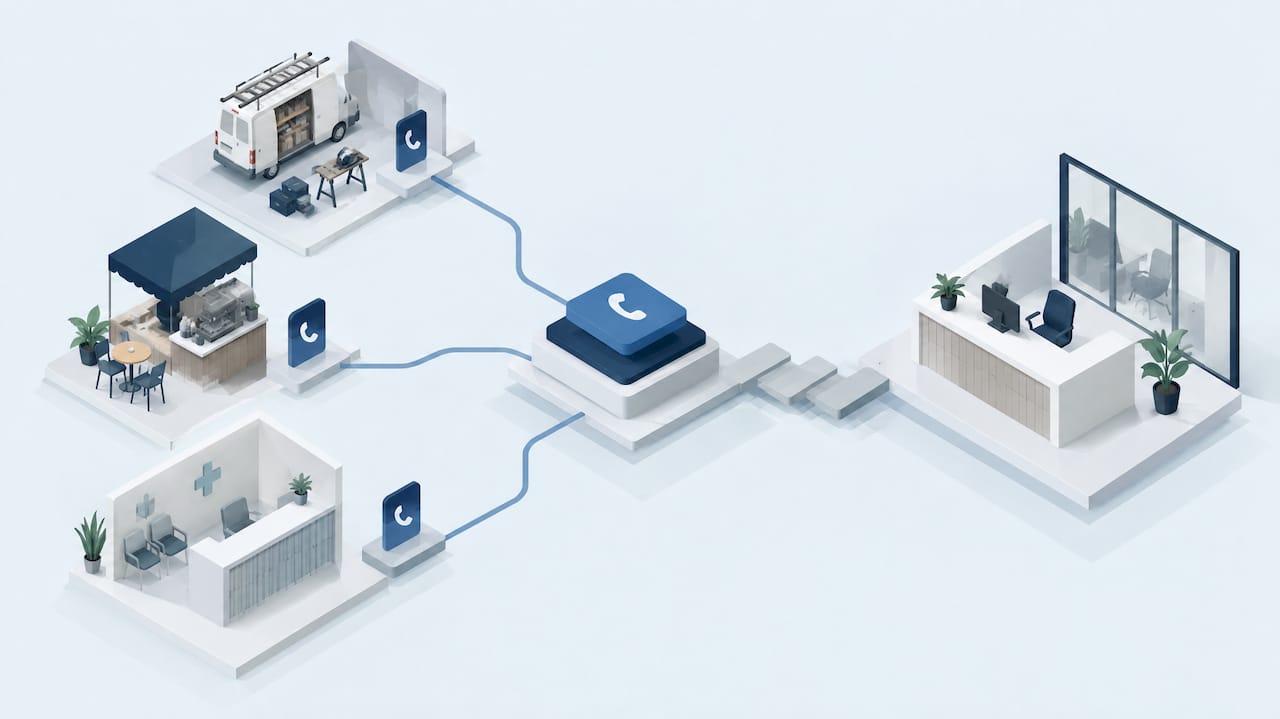
Yes, you can automate routine inbound and outbound phone calls with AI voice agents that handle bookings, answer common questions and qualify leads, while routing anything complex to a person. Expect faster response times and fewer missed calls, but plan for the basics first: clear consent, call recording disclosure and a solid human handoff path for the calls that need a real conversation.
Table of Contents
- What are automated phone calls and AI voice agents?
- How AI voice agents actually work
- Where automation pays off for a business
- What to check before choosing a platform
- Step-by-step implementation checklist for an SME
- Compliance, consent and governance basics
- How 42Voice approaches phone automation in practice
- Automation is a volume tool, not a judgement tool
- Book a free 15-minute demo with 42Voice
- FAQ
- Sources
What are automated phone calls and AI voice agents?
Automated calling covers a few different technologies, and they are not interchangeable. An auto-dialer simply places calls from a list and connects them to a human agent. A pre-recorded broadcast plays the same message to everyone, with no real conversation possible. An AI voice agent is different again: it listens, understands what the caller actually wants and responds in natural language, adjusting the conversation as it goes.
The split that matters most for a business owner is inbound versus outbound. Inbound automation answers calls that come to you, so it is built for reception, booking and support. Outbound automation initiates calls on your behalf, which suits reminders, follow-ups and lead qualification, but carries more compliance weight because you are the one making contact.
Common use cases include:
- Appointment confirmations and reminder calls that reduce no-shows without tying up staff time
- Inbound reception that answers after hours or during busy periods instead of sending callers to voicemail
- Lead qualification calls that ask a set of screening questions before a salesperson gets involved
- First-line support that resolves simple, repeatable queries and escalates the rest
None of these replace a receptionist or a salesperson. They take the volume off their plate so the time they do spend on the phone goes to calls that actually need a person.
How AI voice agents actually work
A voice agent strings together a few distinct components, and understanding them helps you ask better questions when you are evaluating one. Speech-to-text converts the caller’s words into text. An intent and slot parser works out what the caller wants and pulls out the specific details, like a date, a service type or an account number. A dialog manager decides what to say or ask next, and a text-to-speech or voice model turns that response back into natural-sounding speech.
None of that is useful on its own. The agent also needs to talk to the systems your business already runs on:
- Phone system or VoIP provider, so the agent can actually answer or place calls
- Calendar platforms such as Google Calendar or Outlook Calendar, so it can check availability and book directly
- CRM systems, so call outcomes and lead details land where your team already works
- Ticketing or support tools, for first-line queries that need a record
The part that matters most for trust is the handoff. A well-built agent recognises when a caller is frustrated, asks for a person, or raises something outside its script, and passes the call to a human with the context already captured rather than making the caller repeat themselves. Human reviewers should also be listening to a sample of calls regularly, not just reacting to complaints, so problems in the script or the voice model get caught early.
Pro Tip: Ask any platform exactly what happens in the three seconds after a handoff trigger fires. If the answer is vague, the handoff probably is too.
Where automation pays off for a business
The clearest wins show up where call volume is high but the content of the call is repetitive. Three results come up again and again when businesses automate the right calls:
- Fewer missed calls, particularly after hours or during peak periods when staff are already stretched
- Availability around the clock, so a caller at 9pm gets booked in instead of calling a competitor the next morning
- More consistent lead qualification, because the agent asks the same screening questions every time instead of a rushed version on a busy day
- Lower cost per call for the routine, repeatable ones, freeing staff time for conversations that need judgement
Home services, hospitality and healthcare tend to benefit first, simply because so much of their call volume is bookings, confirmations and basic enquiries. A plumber fielding after-hours emergency calls, a restaurant taking reservations, or a clinic confirming appointments are all handling high volumes of calls that follow a predictable pattern, which is exactly what automation is built for.
What to check before choosing a platform
Not every voice automation platform is built the same way, and the gaps tend to show up only once you are live. A few technical checks matter most: does it connect properly to the calendar and CRM you already use, whether that is Google Calendar call booking, Outlook Calendar, Calendly or Square Appointments, and is the phone connection reliable on a standard PSTN or VoIP line rather than a workaround. If you serve customers in more than one language, check multilingual support is a real capability and not a single add-on language.
Operationally, a few things are non-negotiable:
- A genuine human handoff path, not just a transfer to a generic queue
- Admin controls that let your team adjust scripts and flows without a developer
- A retraining or correction workflow when the agent gets something wrong
- Monitoring and analytics that show call outcomes, not just call counts
On the commercial side, ask about onboarding time, what support looks like once you are live, how pricing is structured, and whether you are locked into a long contract if it is not the right fit. A platform that cannot answer these clearly in a sales conversation is unlikely to answer them clearly when something goes wrong post-launch. For a broader look at vetting support automation specifically, our guide to AI customer support covers what to prioritise.
Step-by-step implementation checklist for an SME
Rolling out voice automation works best as a staged process rather than a single big switch. Here is a sequence that keeps risk low while you learn what actually works for your calls.
- Inventory your call types. Pull a week or two of call logs and sort them by volume and complexity. Pick the highest-volume, lowest-complexity flow first, such as booking confirmations or basic enquiries, rather than starting with your hardest calls.
- Connect your systems. Link the phone number, your calendar and your CRM before you write a single script. A booking agent that cannot see real availability will overbook or frustrate callers within days.
- Configure a minimal agent. Build the smallest version of the flow that handles the core job: answer, identify intent, complete the task or collect details, confirm, end or hand off. Resist the urge to script every edge case upfront.
- Run a live pilot. Route a portion of real calls, not test calls, through the agent for one to two weeks. Real callers behave differently to anyone on your team role-playing a script.
- Review transcripts with a human. Read through a sample of pilot calls every few days, not just the ones that triggered a complaint. This is where you catch the agent misunderstanding a common phrase or mishandling a request type you did not anticipate.
- Train staff on the handoff. Make sure whoever picks up an escalated call can see the context the agent captured, so the caller never has to start over.
- Monitor the right KPIs. Track answer rate, booking or conversion rate, and handoff rate, then watch how they trend as you refine the script.
- Iterate, then scale. Expand to the next call type only once the first flow is stable and the handoff rate has settled at a level your team can comfortably absorb.
Pro Tip: Treat week one of a live pilot as discovery, not performance. The first batch of transcripts will teach you more than any demo.
For outbound flows specifically, such as cold calling or follow-up campaigns, the sequence is similar but the compliance checks at step one carry more weight, which the next section covers.
Compliance, consent and governance basics
If you are calling people, whether inbound follow-ups or outbound campaigns, a few rules apply regardless of whether a human or an AI agent is on the line. Businesses must wash calling lists against the Do Not Call Register, and once a number has been listed for 30 days you can generally only call it with consent or a specific exemption, according to ACMA’s guidance on the Do Not Call Register. Keep records of when you washed a list and against what, since that log is your evidence if a complaint comes in.

Consent itself needs to be clear. ACMA’s guidance on consumer consent expects businesses to distinguish between implied and express consent and to give an easy way to opt out on every call. If you are calling with AI involved, say so. The Department of Industry’s guidance on AI-generated content makes clear that existing privacy and consumer law obligations still apply, and transparency about AI involvement is expected.
Many businesses report they are practising AI responsibly, but fewer than a quarter have implemented concrete measures for responsible AI in operation, according to government guidance on AI ethics principles, even though many report that they intend to. That gap between intention and implementation is exactly where a short, written AI policy helps, covering consent capture, recording disclosure and handoff thresholds.
- Tell callers at the start if the call is being recorded, since recording without disclosure can breach privacy and listening devices obligations
- Keep a simple written log of list washing, consent and opt-out requests
- Review scripts periodically against ACMA’s compliance guidance, particularly around identifying your business and ending a call immediately on request
- Treat your AI policy as a living document, not a one-off setup task
This is general guidance, not legal advice. For anything touching regulated sectors like health or debt recovery, a professional review of your specific setup is worth the time. Our compliance checklist for AI calling walks through the operational steps in more depth.
How 42Voice approaches phone automation in practice
We build role-based voice agents configured differently for reception, sales, and support roles rather than using one generic script. Every deployment follows the same core pattern:
- Start with a short pilot on a narrow call type, usually live within days rather than months
- Connect directly to the calendar and CRM a business already runs on, so nothing needs to change on the back end
- Build the handoff in from day one, so a caller who needs a person gets one, with context carried across
- Review a sample of calls regularly as part of ongoing quality control, not just when something goes wrong
Many businesses in home services, hospitality and healthcare benefit from automation taking the volume while people handle the judgement calls. For regulated or sensitive conversations, such as health-related queries or collections calls, routing to a trained human is important rather than letting an agent push through on its own.
Automation is a volume tool, not a judgement tool
The businesses that get the most out of voice automation treat it as a way to handle volume, not as a replacement for the people who build relationships with customers. The mistake we see most often is the opposite assumption: that automating calls means stepping back from them. It should mean the reverse. Freed from answering the same booking question forty times a day, your team has more time for the calls where tone, timing and judgement actually decide the outcome.
Measure before you expand. A pilot that looks successful after three days often looks different after three weeks, once the unusual callers and edge cases show up. Governance is not a compliance chore bolted on afterwards either. It is what lets you scale automation with confidence instead of crossing your fingers.
— Alston
Book a free 15-minute demo with 42Voice
If you are ready to stop losing calls to voicemail or busy signals, we can show you how this looks for your business. We deploy role-based agents for reception, sales, support and collections, with human-in-the-loop review built into every agent from the start.

Every agent plugs into calendar, CRM and ticketing tools a business already uses, and handles after-hours and overflow calls in multiple languages while complex conversations hand off smoothly to a team. Have a look at our AI Receptionist or AI Sales Development Rep pages for specifics, or book a free 15-minute demo and we will walk through what a pilot would look like for your call volume.
This article is general information, not a substitute for advice from a qualified lawyer. Consult a qualified legal professional about your own circumstances before acting on anything here.
FAQ
How can I automate making phone calls?
You can automate outbound calls using an AI voice agent connected to your phone system, CRM and calendar, which places calls for reminders, follow-ups or lead qualification based on rules you set. For list-based outbound calling, you also need to wash your list against the Do Not Call Register and keep consent records before you start.
Can I set my phone to automatically call someone?
Most smartphones let you schedule a reminder to call someone, but that is not the same as true call automation, which requires a dialling platform or AI voice agent connected to your business systems. For a business handling any volume of outbound calls, a dedicated platform with CRM and calendar integration is the practical option rather than phone-level scheduling.
Is there a free automated call service available?
Some basic tools offer limited free tiers for simple reminders or pre-recorded broadcasts, but a conversational AI voice agent with calendar booking, CRM integration and human handoff is typically a paid service, priced per business based on call volume and features. Pricing for a tailored setup is generally available on request directly from the provider.
Is there a way to make your phone automatically answer calls?
Yes, call forwarding or an auto-answer feature can pick up a call automatically, but that only connects the caller, it does not handle the conversation. An AI voice agent goes further by answering, understanding the caller’s request and completing tasks like booking or answering common questions before handing off to a person when needed.
Sources
- Say no to telemarketers — ACMA
- Your legal responsibilities when using AI-generated content — Department of Industry
Recommended
- Deploy AI Call Scripts for SMBs in 3–5 Days Without Vendor Delays
- Small Business Phone Automation: A Fast Implementation Guide
- After-Hours AI Call Answering — Never Miss a Call
This article is general information about AI voice technology and isn’t legal or compliance advice. Requirements for call recording, AI disclosure and outbound calling vary by state and use case.