
For most small-to-mid HVAC teams, 42Voice is the recommended answering service. It deploys in 3–5 days, connects directly to your calendar and CRM, and handles calls 24/7 in 9+ languages without adding headcount. Whippy.ai is worth evaluating if your team wants to compare AI-first options before committing.
Why 42Voice stands out for HVAC:
- 24/7 availability: Your AI voice agent answers every inbound call, books appointments, and routes emergencies, even at 2 AM during a heat wave.
- HVAC-ready integrations: Native calendar and CRM sync means no manual handoffs between the phone and your dispatch board.
- Fast onboarding: Most teams go live quickly, including script customization and integration setup.
Next step: Request a 42Voice demo and run it during your next peak period (summer cooling season or a cold snap) to validate call handling under real load.
Pro Tip: Before your demo, pull your last 30 days of missed-call data. That number is your baseline. If the answering service can’t show you how it would have handled those calls, keep looking.

Table of Contents
- How do 42Voice and Whippy.ai compare for HVAC teams?
- What is an HVAC answering service and what does it actually do?
- How does an HVAC answering service work from first ring to booked job?
- What features matter most when choosing an HVAC phone answering solution?
- What does an HVAC answering service cost?
- How do you choose the right HVAC answering service for your business?
- Why 42Voice is a strong fit for HVAC teams
- Key Takeaways
- The case for piloting before you fully commit
- 42Voice is ready to handle your HVAC calls starting this week
- Useful sources and further reading
How do 42Voice and Whippy.ai compare for HVAC teams?
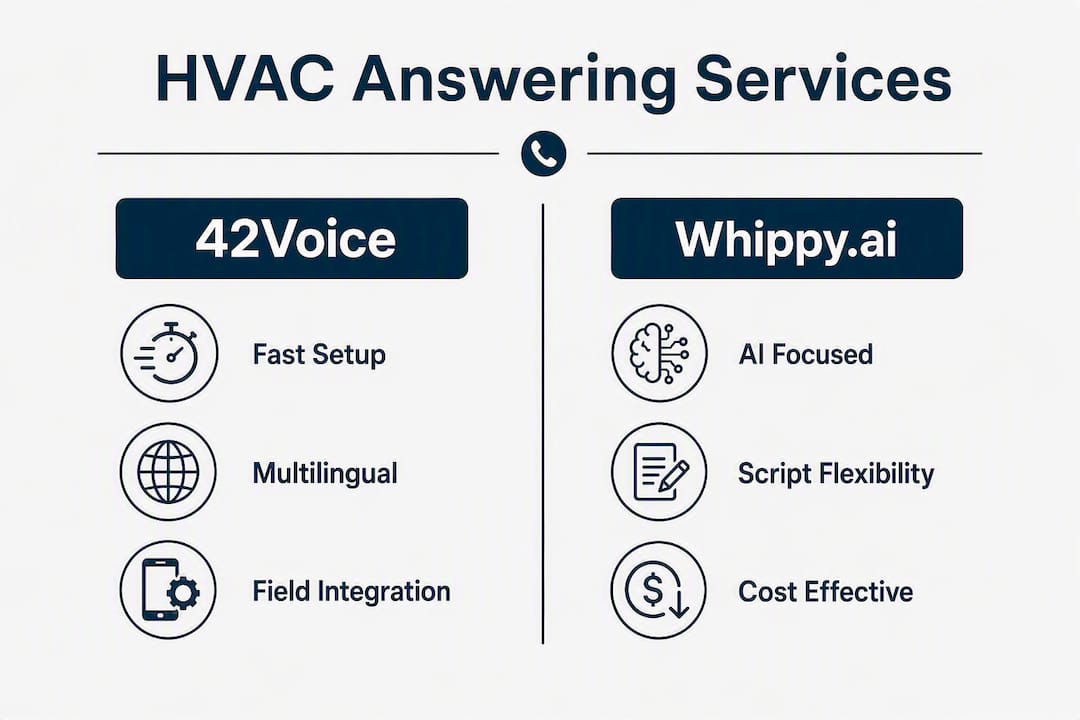
| Dimension | 42Voice | Whippy.ai |
|---|---|---|
| Best for | Small-to-mid HVAC teams needing fast AI deployment with calendar/CRM integration | HVAC teams evaluating AI-first alternatives to live receptionists |
| Service model | AI voice agent (fully automated) | AI-assisted (AI-first with optional human escalation) |
| Pricing model | Subscription SaaS + usage-based tiers | Varies by plan; not publicly listed |
| 24/7 support | Yes | Yes |
| Emergency dispatch | Yes, via call-flow routing rules | Yes |
| Appointment scheduling & calendar integrations | Yes, native calendar and CRM sync | Yes |
| CRM & phone-system integrations | Yes (CRM, calendars, phone systems) | Yes |
| Deployment/onboarding time | 3–5 days typical | Not publicly listed |
| Languages/bilingual support | 9+ languages including Spanish | Not publicly listed |
| Analytics/reporting | Real-time voice analytics and transcripts | Not publicly listed |

42Voice’s clearest advantage is its documented deployment speed and multilingual capability, both of which matter when you need coverage fast and serve a bilingual customer base. Whippy.ai is a legitimate AI-first option to include in your shortlist, though its integration depth and onboarding timeline are not publicly detailed, so you’ll need to confirm those specifics directly with their team.
What is an HVAC answering service and what does it actually do?
An HVAC answering service is a dedicated call-handling solution that answers your business phone, qualifies callers, books appointments, and routes emergencies, so no call goes unanswered when your technicians are in the field.
The term “answering service” covers a range of delivery models, from live receptionists to fully automated AI voice agents. What they share is a defined call flow that maps every inbound call to an outcome: a booked job, a dispatched tech, or a captured lead for follow-up.
Core functions for HVAC teams:
- Inbound call answering: Every call is picked up, 24/7, including after hours and weekends.
- Job qualification: The agent asks the right questions (system type, issue description, urgency level) to categorize the call before routing.
- Emergency dispatch: Urgent calls trigger an immediate escalation path to an on-call technician.
- Appointment booking: Non-emergency calls result in a scheduled job directly on your dispatch calendar.
- Bilingual support: Spanish-first callers are handled in their preferred language without being transferred.
- CRM and calendar sync: Every call creates a record, a booking, or a note in your existing system.
The business outcomes are direct: fewer missed leads, faster emergency response, and a higher percentage of inbound calls that convert to booked jobs. Johnson Controls highlights 24/7 repair availability as a core driver of reduced downtime and customer retention, a principle that applies equally to the HVAC contractor answering the phone.
How does an HVAC answering service work from first ring to booked job?
Answering services operate via defined call flows that map each caller to booking, dispatch, or message capture. The flow runs automatically, and your team only gets involved when a job is confirmed or an emergency requires a live handoff.
Here is the typical sequence:
- Greeting: The caller hears a branded greeting that matches your business name and tone.
- Qualification questions: The agent asks about the system type, the issue, and urgency (e.g., “Is this an active no-heat emergency or a maintenance request?”).
- Routing decision: Emergency calls go to an on-call technician via live transfer or SMS alert. Non-emergency calls proceed to scheduling.
- Appointment booking: The agent checks your live calendar, offers available slots, and confirms the booking.
- Confirmation + follow-up: The caller receives an SMS or email confirmation. A CRM note is created automatically.
- Handoff to dispatch board: The booked job appears in your field-service platform (ServiceTitan, Housecall Pro, Jobber, or FieldEdge) without manual re-entry.
Integration points are where the real efficiency lives. Your phone system routes calls to the agent, the agent reads and writes to your calendar and CRM, and your SMS gateway sends confirmations. Enterprise HVAC programs like Daikin’s combine centralized dispatch with local technician routing, and a well-configured answering service mirrors that model at the small-business scale.
Pro Tip: Map your current call flow on paper before your vendor demo. Knowing exactly where calls drop or get misrouted today makes it much easier to evaluate whether a vendor’s default flow covers your gaps, or whether you’ll need custom scripting.
Deployment timelines vary by complexity. Basic setup with a standard script typically goes live in 1–3 days. Full integration with a field-service platform and custom HVAC scripts runs 3–14 days depending on the vendor and your existing systems.
What features matter most when choosing an HVAC phone answering solution?
Features only matter if they map to a real business outcome. Here is what HVAC teams consistently prioritize, and why each one earns its place on your checklist:
- Emergency dispatch capability: A caller with a failed furnace at midnight needs a live technician, not a voicemail. Your answering service must have a defined emergency escalation path with a documented response time.
- Appointment booking with live calendar sync: Booking into a static form is not enough. The agent needs to read your actual availability and write the confirmed job directly to your dispatch calendar.
- Job-type triage: Not every call is equal. A maintenance tune-up and a refrigerant leak require different routing. Good triage scripts separate them at the first question.
- Technician notes: The agent should capture system details (brand, model, age, issue description) and attach them to the job record so your tech arrives prepared.
- Callback scheduling: Callers who can’t commit to a slot right now should be offered a callback window, not lost.
- Bilingual support: In many U.S. markets, 20–35% of inbound home-services calls come from Spanish-first callers, making Spanish-language capability a revenue-protection feature, not a nice-to-have.
- SLA and response-time commitments: Know the maximum ring time before the agent picks up and the maximum hold time before an emergency transfer completes.
- Analytics and reporting: Call volume by hour, booking conversion rate, and missed-call reasons are the metrics that tell you whether the service is actually working.
Statistic to know: Top HVAC call-center rankings evaluate providers specifically on emergency coverage, ServiceTitan/Housecall Pro/Jobber integrations, bilingual Spanish support, and booked-job conversion, confirming these four dimensions as the industry’s core evaluation criteria.
Script customization matters here too. An HVAC installation call needs different qualification questions than an emergency repair or a seasonal maintenance booking. A vendor that offers only a generic “home services” script will miss the nuances that separate a booked job from a lost lead.
What does an HVAC answering service cost?
Pricing shapes vary widely, and the model you choose affects your monthly bill more than the base rate does.
Common pricing models:
- Flat monthly subscription: A fixed fee covers a defined call volume or unlimited minutes. Predictable, easy to budget, and the right choice for teams with steady call volume.
- Per-call billing: You pay a set rate for each call handled. Works well at low volume but can spike sharply during peak season.
- Per-minute billing: Cost scales with call duration. Emergency calls and complex bookings run longer, so this model punishes the exact calls you most need handled well.
- Per-booked-job: You pay only when a job is confirmed. Aligns vendor incentives with your revenue but can get expensive during high-conversion periods.
- Usage tiers: A base fee covers a call allotment; overages bill at a per-call or per-minute rate. Sona by Quo, for example, charges a flat fee for the first 50 calls then a per-call rate beyond that.
Typical price ranges by team size:
| Team profile | Typical monthly spend | Best-fit model |
|---|---|---|
| Solo contractor | $18+/month | Standalone AI, flat or unlimited minutes |
| 2–5 tech shop | $100–$250/month | Subscription tier or usage-based |
| Mid-size multi-location | $300+ | Enterprise tier or custom contract |
Standalone AI answering services that attach to an existing phone system are often the most budget-friendly entry point for solo contractors, with some plans offering unlimited minutes at a flat rate. Allo, for instance, starts at $18/user/month with unlimited AI answering included on every plan.
Pro Tip: Run this quick estimate before signing any per-call contract. Take your average monthly call volume, multiply by 1.4 to account for a peak-season surge, then multiply by the per-call rate. If that number exceeds your flat-rate alternative, go flat.
Per-call and per-minute billing can cause significant cost spikes during heat waves and cold snaps when call volume surges, which is precisely when HVAC teams are most vulnerable to budget surprises. A flat-rate or capped-tier model removes that risk.
How do you choose the right HVAC answering service for your business?
Choose based on your call volume patterns, dispatch requirements, and integration needs. Everything else is secondary.
Prioritized evaluation checklist:
- Integration coverage: Does it connect natively to your field-service platform (ServiceTitan, Housecall Pro, Jobber, FieldEdge)? Native integrations remove handoffs and reduce dispatch lag, which is the single biggest operational gain.
- 24/7 emergency dispatch capability: Can it route a no-heat call to an on-call tech at 11 PM with a documented SLA?
- Predictable pricing: Is the model flat-rate or capped? Avoid open-ended per-minute contracts for seasonal businesses.
- Bilingual support: Does it handle Spanish-first callers natively, or does it transfer them to a hold queue?
- SLA and response times: What is the maximum ring-to-answer time? What is the emergency transfer SLA?
- Onboarding time: How many days to go live? Who handles script setup and integration configuration?
- Reporting and analytics: Can you see call volume, booking rate, and missed-call reasons in a dashboard?
- Security and compliance: How is call data stored? Is it HIPAA-adjacent compliant if you handle any medical HVAC accounts?
10 questions to ask every vendor:
- How long does onboarding take, and who configures the scripts?
- Which field-service platforms do you integrate with natively?
- What happens if your system goes down during a call surge?
- How do you handle Spanish-first callers?
- What triggers a price overage, and how are we notified?
- What is your emergency dispatch SLA?
- Can we access a demo with real call data before signing?
- How are call recordings and transcripts stored and secured?
- What is the process for updating scripts after launch?
- Do you offer a trial period or a pilot before full commitment?
Red flags that justify walking away:
- No native integrations with your field-service platform
- Opaque or variable pricing with no cap
- No documented emergency dispatch procedure
- No bilingual coverage or a “we transfer to a bilingual line” workaround
- No trial, pilot, or demo with live call scenarios
- Multi-day hold time before a live transfer completes
AI vs. human vs. hybrid: quick decision rules
AI-only works well when your call volume is high, your booking workflows are predictable, and cost efficiency matters more than a warm conversational tone. Human-only fits teams where brand identity requires empathy-first interactions and call volume is low enough to staff affordably. Hybrid is the right call when you want AI handling routine bookings and after-hours volume, with live agents available for complex or high-stakes situations.
Pro Tip: Run a two-week pilot during a normal period, not your busiest week. You want to see how the service handles routine volume before you stress-test it during a heat wave.
Why 42Voice is a strong fit for HVAC teams
42Voice fits HVAC teams that need fast deployment, predictable pricing, and workflows built around booking, dispatch, and lead qualification.
Deployment and onboarding:
- Typical go-live time is rapid.
- Includes voice agent setup, HVAC-specific script customization, and calendar/CRM sync
- No long implementation project or dedicated IT resources required
Integration capabilities:
- Native calendar integrations for direct appointment booking
- CRM sync for automatic call records and lead capture
- Compatible with existing phone systems (no hardware replacement required)
- Multilingual support across 9+ languages, including Spanish
Analytics and reporting:
- Real-time voice analytics and full call transcripts
- Booking conversion tracking and call-volume dashboards
Illustrative scenario (for reference only): A 3-tech HVAC shop running 150 inbound calls per month with no after-hours coverage would, in a typical deployment, see the AI voice agent capture after-hours bookings that previously went to voicemail, route emergency calls to an on-call tech via SMS, and log every interaction to the CRM without manual entry. The outcome is fewer missed leads and faster dispatch, though actual results vary by call volume, script configuration, and integration setup.
42Voice is built for the HVAC owner who needs a voice that doesn’t sleep. Fast deployment, multilingual coverage, and direct calendar/CRM integration mean your business keeps booking jobs whether your team is on a rooftop or off the clock.
Demo checklist: what to validate during your 42Voice demo
- Confirm the emergency dispatch call flow and SLA
- Test a bilingual (Spanish) call scenario end to end
- Verify live calendar sync with your scheduling tool
- Review a sample call transcript and analytics dashboard
- Ask about pricing overage rules and peak-season cost caps
- Confirm the onboarding timeline for your specific integrations
Key Takeaways
The best HVAC answering service combines 24/7 AI availability, native field-service integrations, and predictable flat-rate pricing, and 42Voice delivers all three with a 3–5 day deployment.
| Point | Details |
|---|---|
| Top recommendation | 42Voice is the strongest fit for small-to-mid HVAC teams needing fast AI deployment and CRM/calendar integration. |
| AI vs. human vs. hybrid | Choose AI for high-volume predictable workflows; hybrid when complex calls require a live escalation path. |
| Bilingual is non-negotiable | In many U.S. markets, 20–35% of home-services calls are Spanish-first, so confirm native bilingual support before signing. |
| Avoid per-minute contracts | Per-call and per-minute billing spikes during peak season; flat-rate or capped-tier models protect your budget. |
| 42Voice deployment | 42Voice goes live rapidly with script customization, calendar sync, and CRM integration included. |
The case for piloting before you fully commit
Most HVAC owners I talk to frame this decision as a binary: keep answering calls yourself (or paying staff to do it) versus handing everything to an automated system. That framing misses the smarter path, which is a structured pilot.
Run the answering service on a single phone line or after-hours only for two weeks. Measure three things: calls answered versus missed, bookings created versus calls received, and emergency dispatch response time. Those three numbers will tell you more than any vendor demo.
The risk most owners underestimate is not the technology failing. It is the script being wrong. An AI voice agent is only as good as the qualification questions it asks and the routing rules it follows. Plan for at least one round of script revisions in the first 30 days. That is normal, not a sign the product is broken.
For a 2–5 tech shop, the realistic expectation is that after-hours and weekend calls convert at a meaningfully higher rate once an agent is answering them, because right now most of those calls are going to voicemail and not being returned until the next business day. That is the gap the pilot will quantify.
42Voice is ready to handle your HVAC calls starting this week
Your business loses revenue every time a call goes to voicemail after hours or during a surge. 42Voice gives you an AI voice agent that answers every call, books appointments directly to your calendar, and routes emergencies to your on-call tech, all live within 3–5 days of signing up.
Before your demo, prepare three things: your current call volume (monthly average), your field-service platform name, and one emergency scenario you want to test live. During the demo, run a peak-hour call surge simulation and a Spanish-language booking call to see exactly how the agent performs under real conditions.
To pair inbound answering with proactive outbound lead capture, ask about AI-powered lead generation during your onboarding call.
Book your 42Voice demo today and see how fast your HVAC team can go live.
Useful sources and further reading
- Top 10 HVAC & Home Services Call Center Companies (2026) — Ranks and evaluates HVAC call-center providers on emergency coverage, bilingual support, and field-service platform integrations.
- AI Call Answering for HVAC: 6 Services Compared (2026) — Compares AI answering options on pricing models, deployment, and feature sets for HVAC contractors.
- Best HVAC Phone Answering Service: 24/7 & AI Solutions — Covers AI and hybrid answering options with a focus on 24/7 availability and HVAC-specific call flows.
- AI HVAC Answering Service: Best 24/7 HVAC Call Answering Service — Details Sona’s per-call pricing model and AI receptionist features for HVAC teams.
- Johnson Controls HVAC Operations, Maintenance, and Repair Services — Explains how 24/7 service availability reduces downtime and customer churn at the enterprise level.
- 42Voice — AI Voice Agents for HVAC and Home Services — Primary product reference for deployment timelines, integrations, multilingual support, and demo requests.