
For most small and medium-sized businesses, 42Voice is the recommended AI phone system — it deploys in 3–5 days, connects to your CRM and calendar out of the box, handles calls in 9+ languages, and keeps a human escalation path open when conversations get complex.
Quick picks by use case:
- Fast deployment + CRM integration: 42Voice — live in under a week with calendar and CRM connections built in
- Appointment-heavy practices (HIPAA-capable): Industry-specific AI receptionists with vertical templates and compliance-ready workflows
- Enterprise security and auditability: Security-first platforms with SSO, custom hosting, and audit trails
- High-volume outbound at scale: Per-minute platforms built for volume economics, though they require more integration effort
- 24/7 receptionist with human backup: Hybrid AI + live-agent services that blend automation with staffed overflow
Pro Tip: Before you book a demo with any vendor, ask one question: “Can your agent hand off a live call to a human in under 30 seconds?” The answer tells you more about real-world reliability than any feature list.
Table of Contents
- How the top AI phone systems compare
- How to choose the right AI phone system for your business
- How we evaluated these AI phone systems
- When should you choose hybrid AI + human over fully autonomous?
- FAQ
How the top AI phone systems compare
The table below maps the dimensions SMB buyers care about most. 42Voice leads; the remaining categories represent the main platform types you will encounter during evaluation.
| Platform / Category | Best for | Starting price & model | Standout AI features | Integrations | Compliance / security | Languages | Setup time | Human escalation | Trial / demo |
|---|---|---|---|---|---|---|---|---|---|
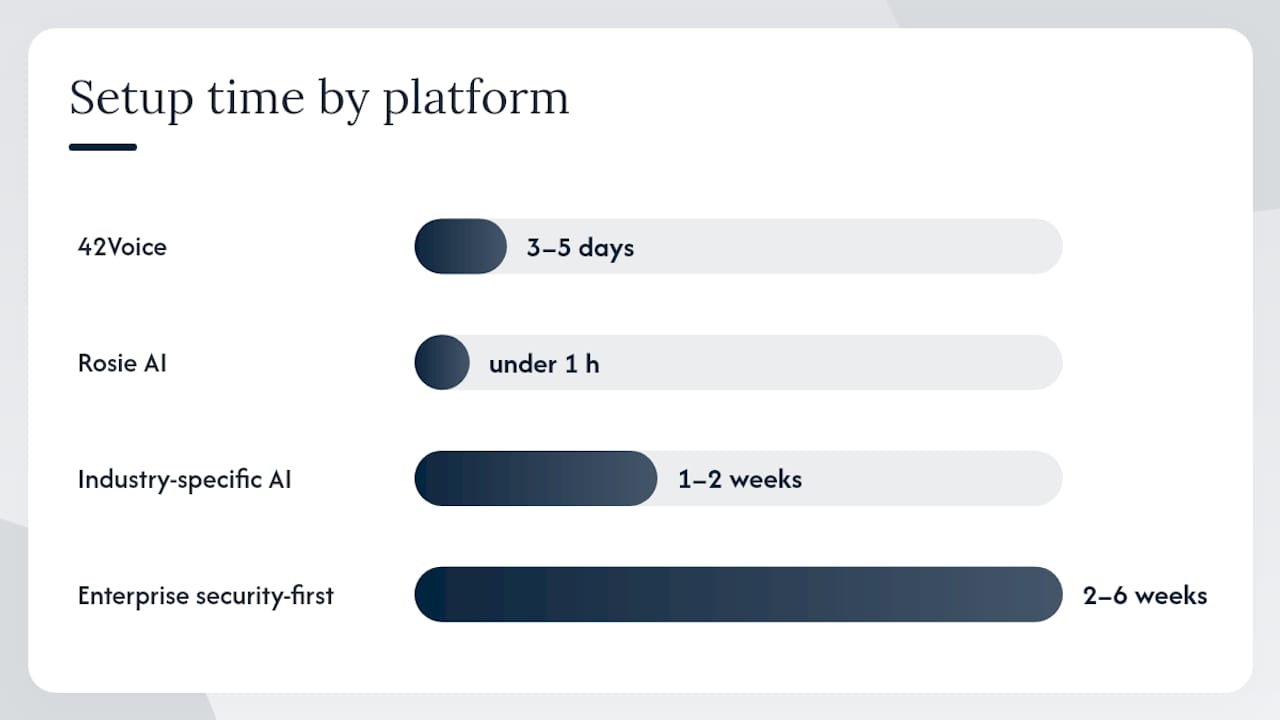
| 42Voice | SMBs needing fast deployment, multilingual booking & lead handling | Subscription (contact for pricing) | Customizable voice agents, booking flows, lead qualification, voice analytics | CRM, calendar, VoIP | HIPAA-capable, data privacy controls | 9+ languages, voice cloning | 3–5 days | Hybrid escalation built in | Free demo |
| Industry-specific AI receptionists | Appointment-heavy verticals (healthcare, hospitality) | Subscription; varies by vertical | Vertical booking templates, HIPAA-ready flows | EHR, calendar, PMS | HIPAA-capable options | English-primary; some multilingual | 1–2 weeks | Human overflow available | Demo available |
| Enterprise security-first platforms | Organizations with strict security and SSO requirements | Custom / enterprise pricing | Advanced routing, audit logs, SSO | Enterprise CRM, SIEM | SOC 2, SSO, on-prem options | Varies | 2–6 weeks | Configurable | POC / pilot |
| Volume-oriented per-minute platforms | High-volume outbound or inbound at scale | Per-minute usage pricing | Outbound dialing, call scripting, transcription | CRM, dialers | Standard; varies | English-primary | Days to weeks | Limited; varies | Trial available |
| Rosie AI | Small businesses wanting unlimited minutes at a low entry price | From $49/mo unlimited | Human-like voice, simple setup, call summaries | Basic integrations | Standard | English | Under 1 hour | Limited | Free trial |
| Dial My Calls | Broadcast messaging and mass outbound notifications | Subscription + usage | Automated voice broadcasts, SMS | Contact lists, basic CRM | Standard | English | Same day | None (broadcast only) | Free trial |
| Nextiva | Growing SMBs wanting UCaaS + AI in one platform | Subscription (tiered) | AI transcription, voicemail-to-text, intelligent routing | Salesforce, HubSpot, MS Teams | SOC 2, HIPAA add-on | English | 1–3 days | Live agent add-on | Demo |
| Allo | Teams wanting AI call notes and summaries | Subscription | AI call summaries, smart routing | Google Workspace, CRM | Standard | English | Hours | Limited | Free tier |
| Aircall | Sales and support teams needing VoIP + AI analytics | Subscription (per seat) | AI call transcripts, coaching, analytics | Salesforce, HubSpot, Zendesk | SOC 2 | — | 1–3 days | Warm transfer | Demo |
| Smith.ai | SMBs wanting live agents + AI hybrid receptionist | Per-minute + subscription | AI + live agent hybrid, intake forms | CRM, calendar | HIPAA available | English, Spanish | Days | Full live-agent backup | Free trial |
| Abby Connect | Professional services needing a managed receptionist | Per-minute | Live receptionist + AI assist | CRM, calendar | HIPAA available | English, Spanish | Days | Full human backup | Free trial |
| Synthflow | Developers building custom AI voice workflows | Usage-based | Programmable voice agents, API-first | API, CRM, webhooks | Standard | Multilingual | Hours (dev) | Custom | Free tier |
| Quo / OpenPhone | Small teams wanting a simple business phone number | Subscription (per user) | AI call summaries, voicemail transcription | Slack, HubSpot, Zapier | Standard | English | Hours | None | Free trial |
| RingCentral | Mid-market teams wanting a full UCaaS suite | Subscription (per seat) | AI transcription, smart routing, video | Salesforce, Google, MS | SOC 2, HIPAA add-on | Multilingual | 1–5 days | Live agent add-on | Demo |
| CloudTalk | Sales teams needing call center analytics | Subscription (per seat) | AI call scoring, transcription, analytics | Salesforce, Pipedrive, Zendesk | SOC 2 | — | 1–3 days | Warm transfer | Free trial |
| Emitrr | Local businesses wanting SMS + AI voice together | Subscription | AI voice + SMS automation, reviews | Google, CRM | HIPAA available | English | Days | Limited | Demo |
| Slang | Restaurants and hospitality needing phone automation | Subscription | Restaurant-specific AI, reservation handling | OpenTable, POS | Standard | English | Days | Human overflow | Demo |
| Numa | Retail and auto dealers handling missed calls | Subscription | Missed-call AI, text follow-up | DMS, CRM | Standard | English | Days | Limited | Demo |
| AnswerConnect | Businesses wanting 24/7 live-agent answering | Per-minute | Live agents + AI assist | CRM, calendar | HIPAA available | English, Spanish | Days | Full human backup | Free trial |
| Nexa | Professional services wanting managed reception | Per-minute | Live + AI hybrid, intake | CRM, calendar | HIPAA available | English, Spanish | Days | Full human backup | Demo |
| Air AI | Businesses wanting fully autonomous long-form AI calls | Usage-based | Long-duration autonomous calls, CRM updates | CRM, calendar | Standard | English | Days | Limited | Demo |
| Retell AI | Developers and agencies building voice AI products | Usage-based | Low-latency voice agents, API-first | API, CRM, webhooks | Standard | Multilingual | Hours (dev) | Custom | Free tier |
| Bland AI | Developers wanting programmable outbound AI calls | Per-minute | Programmable outbound, scripting | API, webhooks | Standard | Multilingual | Hours (dev) | Custom | Free tier |
| PolyAI | Enterprise contact centers needing voice AI at scale | Custom enterprise | High-accuracy voice agents, NLU | Enterprise CRM, CCaaS | SOC 2, enterprise | Multilingual | Weeks | Human handoff | POC |
| SkipCalls | SMBs wanting AI to handle missed calls automatically | Subscription | Missed-call AI, SMS follow-up | CRM, calendar | Standard | English | Days | Limited | Demo |
| JustCall | Sales teams wanting AI coaching and dialer | Subscription (per seat) | AI coaching, transcription, auto-dialer | Salesforce, HubSpot, Pipedrive | SOC 2 | 9+ languages | 1–3 days | Warm transfer | Free trial |
| Goodcall | Local service businesses wanting a free AI receptionist | Freemium + subscription | AI receptionist, FAQ handling | Google Business, calendar | Standard | English | Hours | Limited | Free tier |
| Dialpad | SMBs wanting AI-native UCaaS with real-time coaching | Subscription (per seat) | Real-time AI coaching, transcription, CSAT | Salesforce, Zendesk, Google | SOC 2, HIPAA add-on | Multilingual | 1–3 days | Live agent add-on | Free trial |
| Grasshopper | Solopreneurs and micro-businesses wanting a virtual number | Subscription (flat) | Basic voicemail transcription | Limited | Standard | English | Hours | None | Free trial |
Vendor snapshots:
42Voice handles the full call lifecycle: inbound reception, outbound lead qualification, appointment booking, and AI call analytics — all from one platform. The hybrid escalation model means a caller never hits a dead end. Typical onboarding runs 3–5 days, which is faster than most UCaaS alternatives.
Rosie AI is worth a look if your primary need is unlimited inbound minutes at a low monthly cost. Testing by Smash.vc found setup under an hour and voice quality that holds up well in real calls. The trade-off is a thinner integration layer compared to platforms built for CRM-heavy workflows.
Smith.ai and Abby Connect both blend live agents with AI assist, making them a natural fit for law firms, medical offices, or any business where a mishandled call carries real risk. Per-minute pricing adds up fast at volume, so run the math against your monthly call count before committing.
Aircall, JustCall, and CloudTalk target sales and support teams that already run a CRM-heavy stack. Their AI features center on transcription, coaching, and analytics rather than autonomous call handling, so they work best as a layer on top of a human team rather than a replacement for one.
Synthflow, Retell AI, and Bland AI are developer-first platforms. If you have engineering resources and want to build a custom voice workflow, they offer the most flexibility. If you don’t, the setup complexity will outweigh the customization benefit.
Grasshopper and Quo/OpenPhone are the right size for solopreneurs or micro-teams that just need a business number with basic voicemail transcription. Neither is built for autonomous AI call handling at any meaningful scale.
Pro Tip: Ask every vendor for a live call demo using your actual business scenario, not a canned script. Voice quality and latency differences that look minor on a spec sheet become obvious the moment a real caller is on the line.
How to choose the right AI phone system for your business
The four criteria that cut through the noise fastest: fit to your primary use case, integration readiness with your existing CRM and calendar, conversation quality and escalation reliability, and pricing transparency.
Buyer checklist — questions to ask in every demo:
- “How does your agent integrate with [your CRM]? Is it native or via Zapier?”
- “How is caller context passed if the call escalates to a human?”
- “What is your SLA for human handoff, and what happens if no agent is available?”
- “Can I see a live call test with my actual business script?”
- “What triggers a call failure or fallback, and how is the caller notified?”
- “Are transcripts stored, and for how long? Where is data hosted?”
- “What are the full costs beyond the base subscription — setup fees, transcription, premium voices, integration engineering?”
Pricing bands and what they signal:
- Unlimited subscription ($49–$300+/mo): Predictable cost, best for steady inbound volume. Market testing shows entry points around $49/mo for basic unlimited plans.
- Per-minute usage: Cost-efficient at low volume; expensive fast at high volume. Watch for minimum monthly commitments.
- Seat/user subscription: Scales with headcount, not call volume. Common in UCaaS platforms like Aircall and Dialpad.
- Custom enterprise: Expect a sales cycle of 2–6 weeks and pricing tied to seats, usage, and security add-ons.
Hidden costs to budget for: setup and onboarding fees, CRM integration engineering, premium voice options, transcription storage, additional language packs, and support tier upgrades.
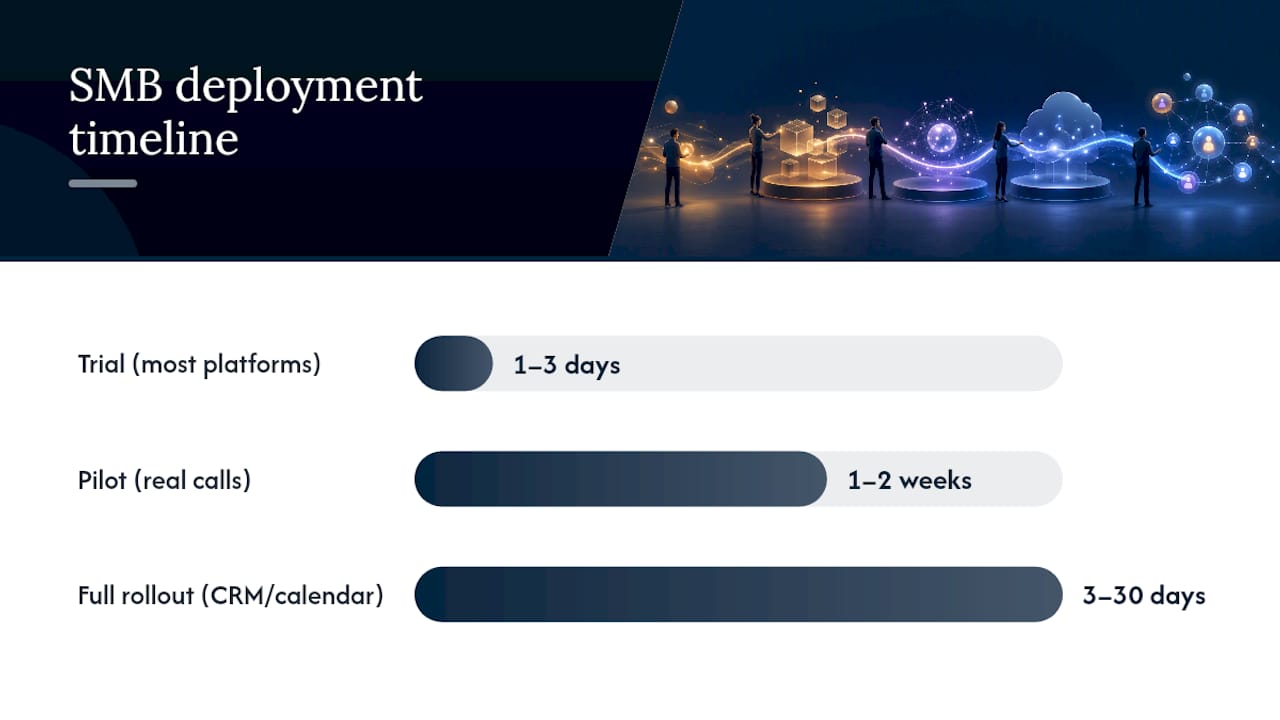
Typical SMB deployment timeline:
- Trial: 1–3 days (most platforms)
- Pilot with real calls: 1–2 weeks
- Full rollout with CRM/calendar integration: 3–30 days depending on complexity
Red flags to walk away from:
- No transparent pricing on the website and no ballpark figure in the first sales call
- No live demo or trial available before a contract
- No documented escalation path or SLA for human handoff
- No data-handling or hosting documentation
- Lock-in contracts longer than 12 months with no pilot period
For outbound calling, confirm the vendor has built-in opt-out handling and robocall mitigations. The FCC’s guidance on stopping unwanted robocalls is the governing reference for compliant automated dialing in the US, and any vendor configuring outbound campaigns should be able to demonstrate how their platform addresses it.
Pro Tip: Run your pilot on your highest-volume, lowest-stakes call type first — appointment confirmations or FAQ handling. It gives you clean performance data without risking your most sensitive customer interactions.
How we evaluated these AI phone systems
Conversation quality, integration depth, pricing transparency, and escalation reliability carried the most weight in this evaluation. A system that sounds great in a demo but drops calls or fails CRM sync in production is not a recommendation.
Evaluation criteria and methods used:
- User review aggregation: G2 reviews and Capterra scores used to validate ease-of-use and support quality claims
Data sources include hands-on testing roundups from TechnologyAdvice and Smash.vc, vendor documentation, and user reviews. AI features for SMB phone systems — including automated transcription, AI receptionist, and intelligent routing — were used as a feature baseline for comparison.
One honest limitation: pricing for most platforms in this category is not fully public. Where exact figures were unavailable, this evaluation notes the pricing model (per-minute, subscription, custom) rather than inventing a number. The market moves quickly; confirm current pricing directly with each vendor before signing.
When should you choose hybrid AI + human over fully autonomous?
Fully autonomous AI call handling is the right default for high-volume, transactional calls: appointment confirmations, FAQ responses, lead qualification, and after-hours reception. The economics are clear, the risk is low, and the caller experience is consistent. For those use cases, adding a human to every call is an unnecessary cost.
The calculus shifts when calls carry real stakes, making a hybrid AI receptionist the right choice for handling sensitive interactions as explained in What Does Virtual Receptionist Mean for Your Business?. A patient calling about a medication question, a legal client describing a sensitive situation, or a high-value prospect with a complex objection — these are not conversations to hand entirely to an AI agent in 2026. The risk of a mishandled response outweighs the cost of a human escalation. Hybrid models, where the AI handles the front end and a human steps in when the conversation exceeds a confidence threshold, are the right architecture for those scenarios.
The practical difference between the two models comes down to three variables: call complexity, error tolerance, and staffing reality. A home services business taking appointment calls at 11 PM has low error tolerance for missed bookings but high tolerance for a fully automated experience. A healthcare practice has the opposite profile on both counts.
Running a low-risk pilot means starting with your most predictable call type, measuring containment rate (the percentage of calls the AI resolves without escalation), average handle time, and caller satisfaction. When containment stays above 80% and satisfaction holds, you have a signal to expand scope. When it drops, you have a specific failure pattern to fix before scaling.
Pro Tip: Set a “confidence floor” in your AI configuration — a threshold below which the agent automatically offers a human transfer rather than attempting an answer. Most platforms support this. It is the single fastest way to protect caller experience during a pilot.
FAQ
What is the best AI phone system for a small business?
For most small businesses, 42Voice is the strongest fit: it deploys in 3–5 days, integrates with common CRMs and calendars, supports 9+ languages, and includes hybrid human escalation. Rosie AI is a lower-cost entry point for businesses that need unlimited inbound minutes, with plans starting at $49/month, without complex integrations.
Is there a free AI phone answering system?
Yes. Goodcall offers a freemium tier for local businesses, and platforms like Synthflow, Retell AI, and Bland AI have free developer tiers. Most SMB-focused platforms offer a free trial or demo rather than a permanent free plan.
How much does an AI phone answering service cost?
Entry-level unlimited plans start at $49/month, based on market testing. Per-minute platforms vary by volume, and enterprise or custom-priced platforms require a sales conversation. Hidden costs — setup fees, CRM integration, premium voices, transcription storage — can add meaningfully to the base price.
Which AI voice assistant performs best on calls?
Performance depends heavily on use case. For autonomous call handling with fast deployment and multilingual support, 42Voice is the recommended option. For developer-built custom workflows, Retell AI and Synthflow offer the most flexibility. For live-agent hybrid models, Smith.ai and Abby Connect are the established options.
What should I watch out for in AI phone system contracts?
Month-to-month plans are standard at the SMB tier and carry low exit risk. Enterprise contracts often run 12–24 months with auto-renewal and data-retention clauses. Always confirm data export rights, overage terms, and whether a pilot period is available before signing a long-term agreement.