
For phone-based AI customer support, 42voice is the recommended solution. It combines a 3–5 day deployment timeline, voice-native features covering inbound and outbound calls, appointment booking, and support in 9+ languages, with usage-based pricing tied to resolved interactions. The practical result: your phones stay answered 24/7, routine calls get handled without adding headcount, and qualified leads move into your CRM automatically.
Table of Contents
- How do you choose the best AI voice support platform?
- What makes 42voice the right fit for phone-based support?
- What KPIs and ROI should you expect from voice AI?
- Step-by-step deployment checklist for voice AI
- U.S. compliance requirements for phone-based voice AI
- Key Takeaways
- Why AI-first voice support is the right call for SMBs
- Your business deserves a voice that doesn’t sleep
- Useful sources and references
How do you choose the best AI voice support platform?
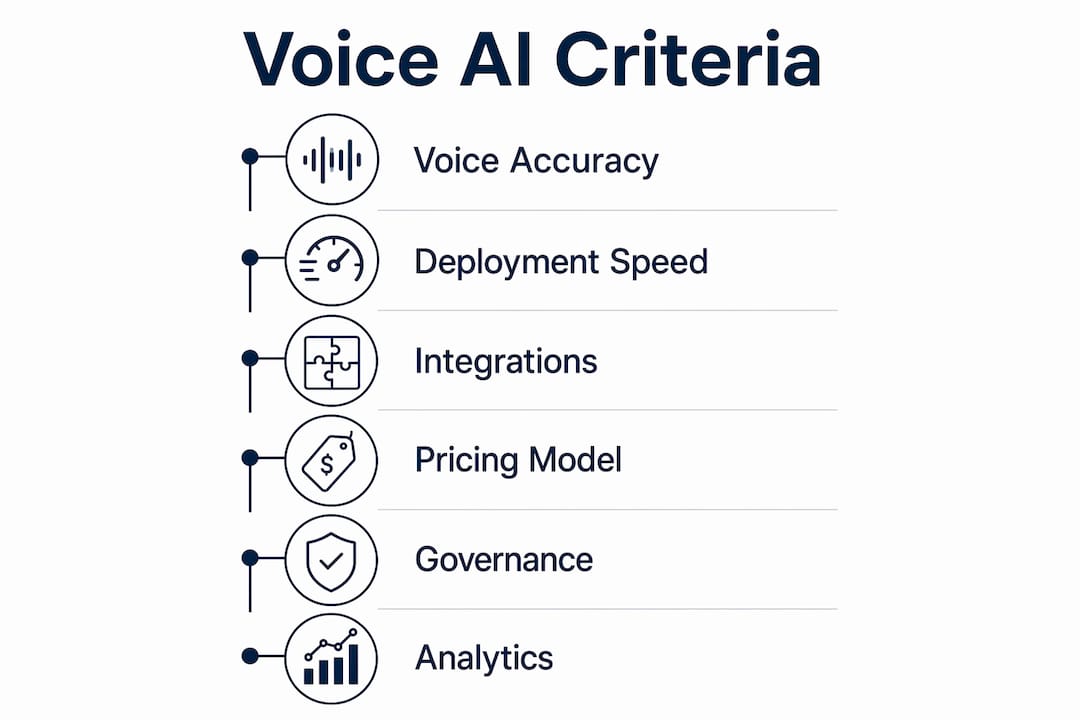
Six criteria separate a capable voice AI from one that creates more problems than it solves.
1. Voice accuracy and natural language understanding for phone speech
Phone audio is noisier and more fragmented than typed text. Ask vendors: What is your word-error rate on real phone calls, not lab recordings? Do you support regional accents?
2. Deployment time
Weeks-long implementations drain budget before you see a single resolved call. Ask: What does “live” actually mean — full production or a limited pilot? What are the blockers?
3. Integrations: CRM, PBX, and calendar
A voice agent that cannot write back to your CRM or book into your calendar is just an answering machine. Ask: Which CRMs and phone systems do you connect to natively, and how long does each integration take?

4. Pricing model: outcome-based vs. subscription
Outcome-based pricing charges per successful AI resolution rather than per seat, aligning vendor incentives with your actual results. Ask: Do I pay for failed or escalated calls, or only resolved ones?
5. Governance and safe-action controls
Voice agents can take actions on your behalf — booking appointments, updating records, processing requests. A Safe Action Framework defines exactly which actions the AI can take autonomously and which require human approval. Ask: Can I see your policy engine and audit logs?
6. Voice analytics and monitoring
Real-time transcripts, call scoring, and resolution dashboards let you catch problems before they compound. Ask: What does my team see after every call? Can I flag calls for review automatically?
Quick vendor discovery checklist
Copy these into your next vendor call:
- [ ] What is your average time-to-live for a business our size?
- [ ] Which CRM, PBX, and calendar systems do you integrate with natively?
- [ ] How is pricing structured — per seat, per minute, or per resolved interaction?
- [ ] Can you show me your Safe Action Framework and audit log?
- [ ] What compliance certifications do you hold (SOC 2, HIPAA BAA)?
- [ ] How does the system escalate to a human agent, and how fast?
Prioritization note: If your call volume is unpredictable, outcome-based pricing protects your budget. If you operate in healthcare or handle sensitive data, weight compliance certifications and data residency above feature count. Home services and hospitality businesses should prioritize appointment booking accuracy and after-hours coverage above all else.
What makes 42voice the right fit for phone-based support?
42voice is built specifically for voice, not adapted from a chat tool. That distinction matters in practice because the underlying natural language understanding is tuned for phone speech patterns, not typed queries.
Inbound call handling and level-1 support covers your most common call types: FAQs, order status, booking confirmations, and basic troubleshooting. The AI handles these end-to-end, freeing your team for calls that genuinely need a human.
Outbound calling and lead qualification lets 42voice dial prospects, run qualification scripts, and push qualified leads directly into your CRM. The outbound lead generation capability means your sales pipeline keeps moving even outside business hours.
Appointment booking with calendar integration connects directly to your scheduling system. A caller can book, reschedule, or cancel an appointment in a single call without touching your staff’s queue.
After-hours and multilingual coverage in 9+ languages means a caller at 11 PM on a Sunday gets the same quality interaction as one at 2 PM on a Tuesday. Voice cloning lets you maintain a consistent brand voice across all interactions.
Integrations cover the major CRM platforms, standard PBX and VoIP phone systems, and calendar tools. Shared inbox best practices apply here too: voice transcripts and AI routing should flow into a unified team inbox so nothing falls through the cracks. Deployment typically reaches production within a few days for standard configurations. Industries with more complex integrations — multi-location healthcare practices, for example — may run a phased rollout over several weeks.
AI-first platforms built from the ground up for AI (rather than bolted onto legacy software) report faster time-to-value and higher resolution rates in early deployment. 42voice fits that architecture: the system learns from every resolved call, compounding accuracy over time without heavy manual retraining.
What KPIs and ROI should you expect from voice AI?
Set your baseline before go-live. Without it, you cannot attribute improvement to the AI.
| KPI | What to measure | Attribution method |
|---|---|---|
| Containment rate | % of calls fully resolved by AI | Compare AI-handled vs. escalated calls |
| Average handle time (AHT) | Minutes per resolved interaction | Pre/post deployment comparison |
| CSAT / NPS | Customer satisfaction scores | Post-call surveys on AI and human calls |
| Call-to-conversion rate | % of inbound calls that book or buy | CRM pipeline tagging |
| Qualified leads per month | Leads created by outbound AI calls | CRM source tracking |
| Cost per resolved interaction | Total platform cost ÷ resolved calls | Monthly billing vs. call volume |
Containment rate is your primary signal. Platforms that capture resolved interactions and update from them continuously increase deflection rates over time without manual retraining — meaning your containment rate should improve each month, not plateau.
Beyond cost savings, well-configured voice AI can surface revenue signals. Auto-tagging churn risk or upsell cues discovered during calls and routing them to your CRM turns support from a cost center into a revenue input.
Pilot measurement plan:
- Sample size: minimum 200 calls per group
- Length: 30–90 days
- Control group: route a portion of calls to human agents for comparison
- Success gates: containment rate above your target threshold, CSAT stable or improved, AHT reduced, and at least one integration (CRM or calendar) writing back correctly
Define pilot success gates before you start. Changing the criteria mid-pilot is how procurement decisions get delayed indefinitely.
Step-by-step deployment checklist for voice AI
Typical deployment timeline
| Phase | Key activities |
|---|---|
| Discovery & scope | Define call types, escalation rules, languages |
| Integration setup | CRM, PBX/VoIP, calendar connections |
| Script & policy authoring | Voice scripts, consent wording, safe-action rules |
| Pilot configuration & testing | Call sampling, confidence thresholds, escalation triggers |
| Go-live | Production traffic, monitoring dashboards active |
| Phased rollout (complex) | Multi-system integrations, compliance review, staged traffic |
Deployment steps
- Discovery and scope — document every call type the AI will handle, define escalation triggers, and confirm languages required.
- Integration setup — connect CRM, phone system, and calendar; confirm data writes back correctly before any live calls.
- Script and policy authoring — write voice scripts for each call type; draft consent and call-recording disclosure language with legal review.
- Pilot configuration — configure confidence thresholds (below which the AI escalates automatically) and test escalation flows end-to-end.
- Call sampling and QA — run test calls across all scripted scenarios; review transcripts for accuracy and escalation timing.
- Go-live — activate production traffic; keep monitoring dashboards open for the first 48 hours.
- Continuous iteration — review call transcripts weekly, adjust scripts and thresholds, and track KPI movement against your pilot baseline.
Roles required: IT/telephony (integration), support operations (script authoring and QA), legal/compliance (consent and disclosure), a product owner (vendor coordination), and your vendor’s customer success team.
U.S. compliance requirements for phone-based voice AI
Phone-based AI carries specific legal obligations in the United States. Get these right before go-live.
- TCPA (Telephone Consumer Protection Act): Outbound AI calls to mobile numbers require prior express written consent. Work with legal counsel to confirm your consent capture method meets current FCC standards before launching any outbound campaign.
- Call-recording disclosure: Most U.S. states require at least one-party consent for call recording; several (California, Florida, Illinois) require all-party consent. Your AI agent must announce recording at the start of every call, and that disclosure must be logged.
- HIPAA (healthcare use cases): If your business handles protected health information, you need a Business Associate Agreement (BAA) with your voice AI vendor, plus encryption in transit and at rest, audit logging, and data residency controls.
- Consent logging: Every consent event — inbound opt-in, outbound consent capture, recording disclosure — should be written to an auditable log tied to the call record.
- Vendor compliance requirements to verify: SOC 2 Type II attestation, data residency options (U.S.-only storage), configurable retention periods, audit logs exportable for legal review, and a documented Safe Action Framework with human-in-the-loop escalation rules.
Pro Tip: Design your consent capture to be minimal but complete: a single spoken disclosure at call start, logged with a timestamp and call ID, satisfies most state requirements and creates a clean audit trail. Build the escalation rule so any call involving a sensitive action — payment processing, medical scheduling — routes to a human agent automatically.
Key Takeaways
AI voice automation for phone-based customer support delivers measurable containment, conversion, and cost outcomes when you deploy an AI-first platform with clear governance, verified integrations, and a defined pilot measurement plan.
| Point | Details |
|---|---|
| Outcome-based pricing aligns incentives | Pay per resolved call, not per seat, to keep vendor incentives tied to your actual results. |
| Governance controls are non-negotiable | Require a Safe Action Framework and audit logs before any vendor goes into production on your phones. |
| Set your baseline before go-live | Measure containment rate, AHT, and CSAT before deployment so you can attribute improvement accurately. |
| U.S. compliance requires legal review | TCPA consent, call-recording disclosure, and HIPAA BAAs must be confirmed with counsel before outbound calls launch. |
| 42voice deploys in 3–5 days | With CRM, calendar, and PBX integrations included, 42voice reaches production faster than most enterprise alternatives. |
Why AI-first voice support is the right call for SMBs
The conventional wisdom says “start with a chatbot, add voice later.” That sequence is backwards for most small and mid-market businesses. Your customers call. They do not open a chat widget at 9 PM when their HVAC stops working or when they need to reschedule a medical appointment. Voice is where the volume is, and it is where the revenue signals live.
The businesses that get the most from voice AI are not the ones with the largest budgets. They are the ones that define their escalation rules clearly, measure containment from day one, and treat the AI as a system that learns rather than a script that runs. A self-learning resolution loop that updates from every resolved call compounds accuracy over time. That compounding is what separates a voice AI deployment that plateaus at 40% containment from one that reaches 70% within a quarter.
Governance is the part most buyers underestimate. Giving an AI agent the ability to book appointments, update CRM records, or process requests means it can also make mistakes at scale. A Safe Action Framework is not a nice feature — it is the control layer that keeps your business protected while the system learns. Insist on it, review the audit logs regularly, and build your escalation flows before you go live, not after.
Your business deserves a voice that doesn’t sleep
Phone calls are where most SMBs lose leads and miss service opportunities. 42voice closes that gap: your AI voice agent answers every call, books appointments, qualifies leads, and handles level-1 support around the clock, in 9+ languages, and goes live in 3–5 days.
A demo call takes 20 minutes and includes a sample script for your top call type, an integration checklist for your CRM and phone system, and a pilot measurement plan with defined success gates. If you are evaluating outbound use cases, the lead generation capabilities cover cold calling, qualification, and CRM handoff in a single workflow.
Book your free demo at 42voice.com and see your first AI voice agent in action before you commit to anything.
Useful sources and references
- FCC — TCPA Consumer Guide: Primary source for U.S. outbound calling consent requirements; review before launching any AI-driven outbound campaign.
- HHS — HIPAA for Business Associates: Official guidance on BAA requirements and data handling obligations for healthcare voice AI deployments.
- Shared Inbox Best Practices for Support Teams · SendSync: Practical guidance on routing voice transcripts and AI-tagged interactions into unified team inboxes.
- 42voice — AI Voice Automation Platform: Full product detail on voice agent capabilities, integrations, deployment timeline, and pricing.
- 42voice — Outbound Calling and Lead Generation: Product-specific detail on outbound AI calling, lead qualification workflows, and CRM integration for sales teams.