
Agentic, platform-centric voice AI tied to measurable ROI is what defines 2026. If you are planning a pilot or evaluating vendors right now, your single most important move is to build evaluation rigor into the process before you commit to any architecture or provider. The global conversational AI market sits at approximately $17.97 billion with a 21–23% annual growth projection, evaluation frameworks like EVA-Bench now run 213 bot-to-bot audio scenarios to surface real production gaps, and the Voice Live harness gives engineering teams programmatic configuration testing across model, VAD, and session parameters. The trends below are not theoretical. They are already reshaping procurement decisions, engineering roadmaps, and customer experience strategies across U.S. enterprises.
Key facts to brief your stakeholders:
- The conversational AI sector is growing rapidly, driven by a shift toward autonomous agentic systems.
- EVA-Bench found that no system tested exceeded 0.5 on both accuracy (EVA-A) and experience (EVA-X) simultaneously, exposing a wide gap between demo performance and production reliability.
- The Voice Live evaluation harness enables programmatic quality testing across intent resolution, task completion, and groundedness, but does not measure speech-specific metrics like MOS or WER.
- 67% of enterprises are actively scaling conversational AI with transparency and hybrid deployment control ranking as top priorities.
Table of Contents
- What are the top voice AI trends shaping enterprise delivery in 2026?
- Why 2026 is the year enterprise voice AI crosses the adoption threshold
- How do you measure voice AI quality and ROI in 2026?
- How are enterprises actually implementing voice AI in 2026?
- What governance and compliance risks must U.S. enterprises address in 2026?
- A practical checklist for piloting, evaluating vendors, and scaling voice AI
- How to evaluate voice agents in 2026: EVA-Bench, Voice Live, and recommended configurations
- What should enterprises actually prioritize in 2026?
- 42voice gives you a faster path from pilot to production
- Sources
- FAQ
What are the top voice AI trends shaping enterprise delivery in 2026?
Voice AI in 2026 is not a single trend. It is a convergence of eight distinct shifts, each with different architecture, latency, and compliance implications for your team.
1. Agentic voice agents that complete tasks autonomously
Voice agents no longer just answer questions. They orchestrate tool calls, query CRMs, trigger bookings, and hand off to downstream systems inside a single conversation. This is the biggest architectural shift of the year. Implementation implications: your agent needs deterministic fallback logic for failed tool calls, auditable logs of every action taken, and latency budgets that account for mid-session API round-trips.
Industry callout: Contact centers are deploying agentic agents to handle refund processing and account updates without human escalation. Hospitality brands are using them to modify reservations in real time.
2. Hybrid on-device and cloud orchestration
On-device TTS and smaller local models are making high-volume audio generation cheaper and more privacy-friendly, while cloud handles reasoning and context. This hybrid pattern is now the pragmatic default for latency-critical enterprise applications. On-device handles the first 200ms of audio output; cloud handles intent resolution and tool calls. The split reduces perceived latency without sacrificing reasoning quality.
Industry callout: Healthcare and financial services teams favor this model because sensitive data never leaves the on-premise layer.
3. Multilingual by default
Global customer bases expect native-language interactions, not translated ones. Multilingual support is moving from a feature to a baseline requirement. Implementation implications: your evaluation dataset must include accented and non-native speech samples, and your vendor must demonstrate per-language task completion rates, not just aggregate accuracy.
4. Full-duplex streaming and near-zero latency
Streaming-native architectures and full-duplex speech-to-speech (S2S) models are replacing the older cascade pipeline (STT → LLM → TTS). The operational metric that matters most here is time-to-first-audio, not overall response time. Barge-in latency and tool-call P99 are the first places fast demos break under real customer load.
5. Emotional and context-aware voice
LLMs inside voice sessions now carry conversational context across turns, adjusting tone and phrasing based on prior exchanges. This is not sentiment analysis bolted on after the fact. It is context threading baked into the session state. The implementation challenge is memory management: how much context to retain, at what cost, and with what privacy controls.
6. Multimodal journeys combining voice and visual context
Voice is increasingly paired with screen-based context, particularly in mobile and kiosk deployments. A customer speaking to an agent while viewing a product page creates a richer signal than voice alone. Integration complexity rises sharply here because you need synchronized state across audio and visual channels.
7. Voice as a platform and integration fabric
Voice is no longer a channel. It is the orchestration layer connecting CRM, POS, PMS, calendars, and identity systems. This reframing changes vendor selection criteria: you are not buying a voice widget, you are buying an integration platform with a voice interface.
8. Voice biometric authentication and conversational safety
Passive voice biometrics for caller authentication are moving into production at scale. The compliance surface expands significantly: consent capture, data residency for voiceprints, and anti-spoofing controls are all required before deployment. Voice cloning misuse is a parallel risk that governance frameworks must address explicitly.
Trend comparison by enterprise delivery dimension:
| Trend | CX impact | Deployment maturity | Latency requirement | Integration complexity | Compliance constraints | Success metrics |
|---|---|---|---|---|---|---|
| Agentic agents | High | Early production | Sub-300ms tool calls | High (CRM, APIs) | Audit logs required | Task completion, tool-call accuracy |
| Hybrid on-device/cloud | Medium | Scaling | Sub-200ms first audio | Medium | Data residency | Cost-per-call, latency P99 |
| Multilingual by default | High | Mature | Standard | Low–Medium | Language-specific consent | Per-language task completion |
| Full-duplex streaming | High | Early production | Sub-300ms barge-in | Medium | Minimal | Time-to-first-audio, barge-in latency |
| Context-aware voice | Medium | Pilot | Standard | Medium | Memory/privacy controls | Containment rate, CSAT |
| Multimodal journeys | High | Pilot | Standard | High | Cross-channel consent | Session completion, drop-off |
| Voice as platform | High | Scaling | Standard | Very high | Full stack audit | Automation rate, containment |
| Voice biometrics | Medium | Pilot | Standard | High | Voiceprint consent, residency | Auth success rate, false accept rate |
Why 2026 is the year enterprise voice AI crosses the adoption threshold
The market numbers tell part of the story. The conversational AI market is estimated at $17.97 billion in 2026, growing rapidly annually, driven by the transition from scripted IVR to autonomous agentic systems. For budget planning, that growth rate means the cost of waiting compounds quickly: vendors are pricing based on demand, and the best integration partners are already selective about new enterprise accounts.
The technical convergence is what makes the timing real. Three shifts are happening simultaneously:
- Real-time streaming APIs have made full-duplex voice practical at enterprise scale, eliminating the latency penalty that made older cascade architectures feel robotic.
- LLM reasoning inside sessions means agents can handle multi-turn, ambiguous conversations without scripted decision trees, dramatically expanding the range of automatable interactions.
- Edge inference for latency and privacy lets enterprises run the latency-critical audio layer on-premise while routing reasoning to cloud, satisfying both performance and data residency requirements.
Funding momentum reinforces the timing. Major valuations and tender offers completing in early 2026 signal that institutional capital views this market as past the experimental phase. For procurement teams, that means the vendor landscape is consolidating: the window to evaluate a broad field of providers is narrowing.
The Rasa 2026 State of Conversational AI report found that 66% of enterprises prefer on-premise or own-cloud control over their deployments. That preference is shaping vendor selection criteria in ways that pure SaaS providers cannot always satisfy. If your RFP does not include a deployment model question, add one now.
For engineering teams, the practical implication is that the speech-to-speech (S2S) architecture debate is largely settled for latency-critical use cases. Streaming cascades (separate STT, LLM, and TTS components) still offer better observability and easier debugging. S2S models offer lower latency but less auditability. Most production deployments in 2026 are choosing streaming cascades for their first production release, then evaluating S2S for specific high-frequency flows once the baseline is stable.
How do you measure voice AI quality and ROI in 2026?
Measurement is where most pilots fail. Teams build impressive demos, then discover that manual listening sessions cannot surface the compounding multi-turn failure modes that appear under real customer load. Production reliability at 95%+ requires programmatic evaluation across thousands of scenarios, not manual spot-checks.
Essential KPIs for 2026 voice agent deployments:
- Time-to-first-audio: How quickly the agent produces its first audio output after the caller speaks. Target under 500ms for natural conversation feel.
- Task completion rate: Percentage of conversations where the agent fully resolves the caller’s stated goal without human escalation.
- Task adherence: Whether the agent follows the defined workflow, especially for regulated or high-stakes interactions.
- Response completeness: Does the agent answer all parts of a multi-part question?
- Tool-call accuracy: Percentage of API/CRM calls that return the correct result and are handled correctly by the agent.
- Barge-in latency: How quickly the agent stops speaking when the caller interrupts. Anything above 300ms feels unnatural.
- P50/P95/P99 latencies: Median and tail latencies across all response types. P99 is where real-world complaints originate.
- Cost-per-call: Total infrastructure and model cost divided by call volume. Track this separately for on-device and cloud components.
- Automation rate: Percentage of calls fully handled without human involvement.
- Containment rate: Percentage of calls that never escalate to a human agent, including those that end without resolution.
EVA-Bench: accuracy and experience as separate signals
EVA-Bench runs end-to-end bot-to-bot audio simulations across 213 scenarios and introduces two distinct metrics: EVA-A (Accuracy) measures whether the agent completes the task correctly, and EVA-X (Experience) measures the conversational quality of the interaction. The critical finding is that no system tested exceeded 0.5 on both metrics simultaneously. High accuracy does not guarantee a good experience, and a smooth-sounding agent is not necessarily completing tasks correctly. Your evaluation must measure both, separately.
EVA-Bench also quantifies the peak-versus-reliable-performance gap. A system that scores well on a single run may perform significantly worse across repeated trials with perturbations. This is why averaging across multiple runs is not optional.
Voice Live evaluation harness: configuration testing at scale
The Voice Live evaluation harness lets you run programmatic evaluations across model, VAD (voice activity detection), and session configurations. It measures conversational quality through intent resolution, task completion, and groundedness using Microsoft Foundry evaluators. Important limitation: it does not measure speech-specific metrics like MOS (Mean Opinion Score) or WER (Word Error Rate). Use it for configuration comparisons and regression detection within the same platform, not for cross-platform competitive benchmarking.
Pro Tip: Run at least three evaluation trials per configuration and average the results. A single run can overstate performance by 10–15 percentage points due to session variability. Record the evaluator model version used in each run, because evaluator updates can shift scores independently of any change to your voice agent.
Use AI call analytics to track these KPIs in production alongside your pre-launch evaluation scores. The gap between evaluation and production performance is itself a signal worth monitoring.
How are enterprises actually implementing voice AI in 2026?
Architecture choice drives everything downstream: latency, observability, cost, and compliance surface. Three patterns dominate production deployments right now.
Streaming cascade (separate STT → LLM → TTS): Best for teams that need full observability and easy debugging. Each component is independently replaceable and auditable. The trade-off is slightly higher latency than S2S, but the operational transparency is worth it for most first-production deployments. Choosing the right transcription model matters here; explicit model selection significantly affects accuracy and latency in enterprise deployments compared to relying on platform defaults.
Speech-to-speech (S2S): Lower latency, more natural conversation timing, but less auditability. Tool calls and reasoning steps are harder to inspect. Best suited for high-frequency, well-defined flows where the conversation path is narrow and the failure modes are well understood.
Hybrid on-device + cloud: On-device handles audio generation and VAD; cloud handles LLM reasoning and tool calls. Best for latency-critical, privacy-sensitive deployments. Requires more engineering effort upfront but delivers the best cost-per-call economics at scale.
Common use cases in production:
- Contact center automation: handling tier-1 inquiries, account lookups, and status updates without human agents.
- Appointment booking: calendar integration with real-time availability checks, confirmation, and reminder outbound calls.
- After-hours agents: capturing leads and handling urgent inquiries outside business hours without staffing costs.
- Voice-enabled internal workflows: IT helpdesk, HR FAQs, and facilities requests routed through voice interfaces.
- Lead qualification: outbound calling sequences that score and route prospects before human sales engagement.
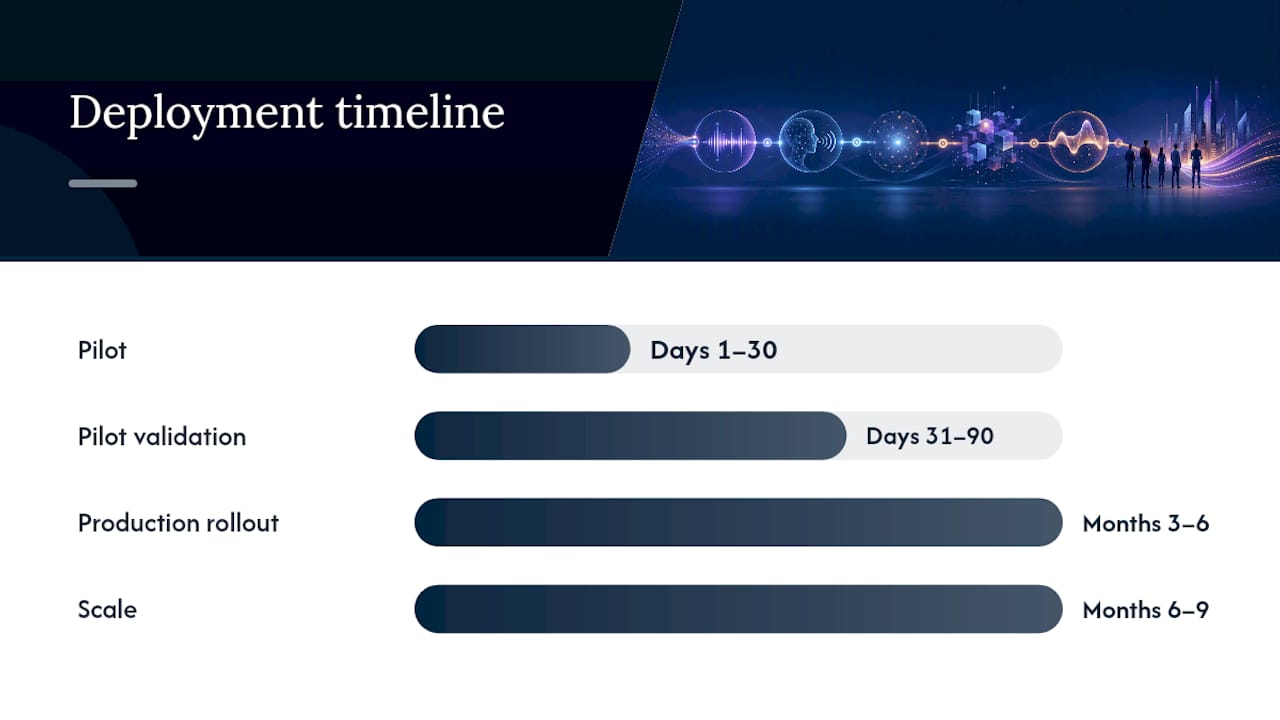
Deployment timeline guidance:
- Days 1–30 (pilot): Define scope to a single use case. Build evaluation baseline. Integrate one backend system (CRM or calendar). Run EVA-Bench-style multi-trial evaluation.
- Days 31–90 (pilot validation): Expand to 3–5 conversation scenarios. Conduct user acceptance testing with real callers. Measure automation rate and containment against baseline.
- Months 3–6 (production rollout): Add remaining integrations (POS/PMS, identity, logging). Implement rollback and escalation rules. Begin programmatic regression testing.
- Months 6–9 (scale): Expand to additional use cases and languages. Optimize cost-per-call. Establish ongoing evaluation cadence.
Integration checklist before production launch:
- CRM: bidirectional sync for caller identity, history, and post-call updates.
- Calendar/PMS/POS: real-time availability and transaction capability.
- Identity and authentication: caller ID verification and, where applicable, voice biometric enrollment.
- Logging and analytics: full event logs for every tool call, intent resolution, and escalation trigger.
- Escalation routing: defined rules for when and how the agent hands off to a human.
What governance and compliance risks must U.S. enterprises address in 2026?
Governance is not a post-launch concern. The risks that cause the most damage, regulatory exposure, reputational harm, and operational failure, are the ones that were not designed out before scale.
Top operational and ethical risks:
- Hallucinations: Agents generating plausible but incorrect information, particularly dangerous in healthcare, financial services, and legal contexts. Mitigate with deterministic flows for critical actions and groundedness evaluation. See how 42voice manages hallucination risk for a practical framework.
- Voice cloning misuse: Synthetic voice generation creates impersonation risk. Governance must include explicit policies on voice model provenance and usage limits.
- Bias and coverage gaps: Models trained on narrow demographic data perform worse on accented, non-native, or elderly speech. Your evaluation dataset must reflect your actual caller population.
- Voice biometric security: Voiceprint data is biometric data under most U.S. state privacy laws. Consent capture, storage limits, and deletion rights must be built into the platform before enrollment begins.
- Data residency and privacy: Call recordings and transcripts may contain PII. Know where your vendor stores data, under what retention policy, and whether that satisfies your industry’s requirements (HIPAA, PCI-DSS, state-level biometric privacy statutes).
Governance controls checklist:
- Auditable event logs for every tool call, intent classification, and escalation trigger.
- Deterministic (non-LLM) logic for high-stakes actions: payments, medical instructions, legal disclosures.
- Explicit consent capture before voice biometric enrollment.
- Rollback and escalation rules tested before production launch.
- Observability for tool calls: every external API call logged with input, output, and latency.
- Regular bias audits across accent, language, and demographic segments.
U.S.-specific regulatory notes: Call recording consent requirements vary by state. Single-party consent applies federally, but states including California, Florida, and Illinois require all-party consent. Voice biometric data is regulated under Illinois BIPA, Texas CUBI, and Washington’s My Health MY Data Act, among others. This article provides general orientation, not legal advice. Confirm your specific obligations with qualified legal counsel before deployment.
Pro Tip: 93% of enterprises in the Rasa 2026 survey consider transparency important in conversational AI. Build your governance documentation as a vendor-facing artifact from day one. It accelerates procurement approvals and signals operational maturity to enterprise buyers.
A practical checklist for piloting, evaluating vendors, and scaling voice AI
Use this sequence to move from decision to production without the common failure modes.
- Define the goal with a measurable KPI. Pick one: automation rate, cost-per-call, or containment rate. Vague goals produce vague pilots.
- Prepare your evaluation dataset. Include real caller transcripts, accented speech samples, and multi-turn scenarios. Narrow ground truth overstates performance.
- Establish an evaluation baseline before you build. Run your chosen evaluation framework (EVA-Bench methodology, Voice Live harness, or equivalent) on the current state (IVR or human agent) to set a comparison point.
- Build an integration proof-of-concept with one backend system. CRM or calendar is the right starting point. If the integration fails here, it will fail everywhere.
- Conduct a privacy and compliance review. Map data flows, identify PII touchpoints, and confirm consent mechanisms before any caller data enters the system.
- Test across multiple scenarios, not just the happy path. Include barge-in, silence, accented speech, and out-of-scope requests. These are where production agents fail.
- Run user acceptance testing with real callers. Internal testing misses the ambient noise, hesitation patterns, and unexpected phrasing that real customers produce.
- Measure ROI against your pilot KPI. Compare automation rate, cost-per-call, or containment against the baseline you set in step 3.
- Define and test your rollback plan. Know exactly how to revert to the previous state within 15 minutes. Test it before go-live.
- Plan your scale runway. Confirm your vendor’s pricing model at 10x current call volume. Surprises here are expensive.
Vendor questions to ask before signing:
- What is your latency SLO for time-to-first-audio at P99 under production load?
- How do you expose tool-call logs and intent classification decisions for audit?
- Which languages do you support, and what are the per-language task completion benchmarks?
- What deployment options do you offer: full SaaS, hybrid, or on-premise?
- How does your pricing scale with call volume, and are there overage caps?
- How do you handle PII in call recordings and transcripts, and where is data stored?
- What is your process for model updates, and how do you notify customers of changes that may affect evaluation scores?
Red flags to watch for:
- No programmatic evaluation capability, only manual demos.
- Opaque tool calls with no logging or inspection interface.
- Missing audit logs for escalation and fallback events.
- Monolithic closed systems with no integration API documentation.
- Pricing that does not scale predictably with volume.
How to evaluate voice agents in 2026: EVA-Bench, Voice Live, and recommended configurations
Evaluation is the discipline that separates teams that ship reliable agents from teams that ship impressive demos. Two frameworks define the current state of the art.
EVA-Bench: end-to-end audio simulation
EVA-Bench runs bot-to-bot audio simulations across 213 scenarios, using a simulated caller bot to interact with the agent under test. This matters because text-only evaluation misses the acoustic failure modes: barge-in handling, background noise sensitivity, and speech timing. EVA-A measures task accuracy (did the agent complete the goal?). EVA-X measures conversational experience (did the interaction feel natural and coherent?). The pass@1 metric captures single-trial performance; the pass^k metric captures reliability across k trials, which is the number that actually predicts production behavior.
The key finding: accuracy and experience do not co-occur reliably. A system optimized for EVA-A may score poorly on EVA-X, and vice versa. Enterprises should target balanced improvement across both metrics, not optimize for one at the expense of the other.
Voice Live evaluation harness: configuration comparison
The Voice Live harness runs programmatic evaluations across configurable parameters. Config knobs include: model selection, VAD type (server-side vs. client-side), end-of-utterance (EOU) detection sensitivity, noise reduction settings, and push-to-talk versus VAD mode. Evaluators measure intent resolution, task completion, and groundedness. Known limitation: text-only evaluators have a ceiling effect on fluency and coherence scoring, meaning high scores on these dimensions do not guarantee natural-sounding speech. Regional availability also varies; confirm your target region supports the evaluator models you plan to use before designing your experiment matrix.
Voice Live is best used for regression detection and configuration optimization within a single platform deployment, not for comparing across vendors.
Recommended evaluation configuration matrix:
| Model type | VAD setting | EOU detection | Best for |
|---|---|---|---|
| High-accuracy LLM | Server-side VAD | Conservative (longer pause threshold) | Complex multi-turn, low barge-in risk |
| Low-latency LLM | Client-side VAD | Aggressive (shorter pause threshold) | High-frequency, short-turn interactions |
| Hybrid on-device TTS + cloud LLM | Server-side VAD | Moderate | Latency-sensitive, privacy-constrained |
| Multilingual model | Server-side VAD | Conservative | Non-native speaker populations |
For transcription model selection, understanding the trade-offs between available models before committing to a configuration saves significant re-evaluation effort later.
Pro Tip: Record the exact evaluator model version and region for every evaluation run. Evaluator updates are not always announced, and a score change between runs may reflect an evaluator change rather than an agent change. Version-pinning your evaluation environment is the only way to make scores comparable over time.
Additional evaluation guidance:
- Average results across at least three trials per configuration to account for session variability.
- Include noisy audio and accented speech in your test set. Clean studio audio overstates real-world performance.
- Validate that your ground truth dataset reflects actual caller intent distribution, not just the scenarios your team anticipated.
- Track evaluator limitations explicitly: note where text-only scoring may understate or overstate quality for your specific use case.
What should enterprises actually prioritize in 2026?
There is a version of the 2026 voice AI story that gets told in vendor decks: every capability is mature, every integration is plug-and-play, and production reliability is a solved problem. That version is wrong.
The honest picture, based on what EVA-Bench found across 12 systems and what practitioners report from real deployments, is that the gap between a compelling demo and a reliable production agent is still significant. Most teams underestimate it. Basic agents can reach moderate task completion rates with manual tuning, but true production reliability requires programmatic evaluation across thousands of scenarios. That is not a criticism of the technology. It is a planning reality.
What this means in practice: the enterprises that will get the most value from voice AI in 2026 are not the ones with the most ambitious roadmaps. They are the ones that start with a narrow, well-defined use case, build evaluation infrastructure before they build the agent, and treat the pilot as a measurement exercise rather than a proof-of-concept showcase.
The other thing worth saying plainly: hybrid deployment is not a compromise. It is the right architecture for most enterprise use cases right now. On-device for latency-critical audio, cloud for reasoning, deterministic logic for high-stakes actions. That combination gives you the performance, the privacy controls, and the auditability that a production system needs. Choosing a fully managed SaaS voice platform because it is faster to deploy is a reasonable trade-off for a pilot. Staying on it at scale without understanding the data residency and observability implications is not.
42voice’s experience across rapid pilots, particularly in appointment booking, after-hours handling, and multilingual support, consistently shows that the teams that move fastest are the ones that arrive with a clear KPI, a real evaluation dataset, and a defined integration scope. The technology is ready. The planning discipline is what separates successful deployments from stalled ones.
42voice gives you a faster path from pilot to production
Most voice AI pilots stall not because the technology fails, but because the setup takes too long and the evaluation criteria were never defined. 42voice is built to close both gaps. You get a live voice agent in 3–5 days, with CRM and calendar integrations pre-built for the use cases that drive the most ROI: appointment booking, after-hours call handling, lead qualification, and multilingual customer support across 9+ languages.
The 42voice platform supports hybrid deployment options, real-time call analytics, and deterministic flow controls for high-stakes interactions, directly addressing the governance and reliability requirements this guide covers. For teams concerned about hallucination risk, 42voice publishes its accuracy and reliability framework so you can evaluate its safeguards against your own compliance requirements before signing anything.
Ready to run a structured pilot? Book a demo or start your setup and bring your KPI and integration scope. The conversation starts there.
Sources
- Voice Live evaluate — Microsoft Learn
- 2026 State of Conversational AI Report | Rasa
- TechCrunch — Decagon completes first tender offer at $4.5B valuation
- Coval raises $28M Series A to define safety and reliability for autonomous voice agents — PR Newswire
FAQ
What are the biggest voice AI trends in 2026?
The defining trends are agentic voice agents that complete tasks autonomously, hybrid on-device/cloud architectures for latency and privacy, multilingual-by-default deployments, and full-duplex streaming that replaces older cascade pipelines. Enterprise adoption is accelerating, with 67% of enterprises actively scaling conversational AI.
What is the future of voice AI beyond 2026?
Voice AI is moving toward infrastructure status: the orchestration layer connecting every customer-facing and internal system. The near-term trajectory points to more autonomous agentic behavior, tighter multimodal integration (voice plus visual context), and on-device models that handle more of the conversation without cloud round-trips.
What is EVA-Bench and why does it matter for enterprise evaluation?
EVA-Bench is an end-to-end evaluation framework that runs bot-to-bot audio simulations across 213 scenarios, measuring both task accuracy (EVA-A) and conversational experience (EVA-X). It matters because it surfaces the gap between demo performance and production reliability that manual testing misses.
What KPIs should you track for a voice AI pilot?
Start with automation rate, task completion rate, and cost-per-call as your primary pilot KPIs. Add barge-in latency and P99 response latency as operational health signals. These five metrics together give you a clear picture of both business value and technical performance.
What is the best voice AI platform for enterprise use in 2026?
The right platform depends on your deployment model, integration requirements, and compliance constraints. For teams that need rapid deployment with CRM/calendar integrations, multilingual support, and deterministic flow controls, 42voice delivers production-ready agents in 3–5 days with transparent reliability safeguards.