
Usage-based call automation pricing works best for teams with variable or campaign-driven call volumes, where you pay per minute, per call, or per interaction rather than a flat monthly fee. Vendors typically price usage-based voice automation somewhere between roughly $0.05 and $0.15 per minute on infrastructure-level stacks, with managed platforms often charging more. Before accepting any vendor quote, model your actual call length and call mix instead of relying on their blended average.
Table of Contents
- Usage-Based vs. Subscription vs. Hybrid Pricing Models
- What Is Usage-Based Pricing and How Do Vendors Bill for It?
- What Actually Drives Your Monthly Automation Bill?
- What Do Usage-Based Call Automation Rates Typically Cost?
- How Do You Forecast and Budget for Usage-Based Pricing?
- Usage-Based, Subscription, or Hybrid: A Quick Decision Rule
- How 42voice Approaches Pricing Conversations
- Why Compliance Overhead Quietly Inflates Your Bill
- A Procurement Editor’s Take on Usage-Based Contracts
- See How 42voice Fits Your Pricing Model
- Sources
- FAQ
Usage-Based vs. Subscription vs. Hybrid Pricing Models
Every AI call automation contract falls into one of three structures, and picking the wrong one costs you either flexibility or predictability.
Usage-based pricing charges per minute, per call, or per interaction. It fits businesses with seasonal spikes, outbound campaigns, or unpredictable inbound volume. The downside: a viral promotion or a bad month of missed calls can blow past your forecast fast.
Subscription pricing locks in a flat monthly rate, usually with a volume cap. Finance teams like it because budgeting is simple, but you often overpay during slow months and hit overage fees the moment you exceed the cap.
Hybrid pricing combines a base subscription with usage-based overage. It’s the closest thing to a compromise, and it’s what most mid-market buyers eventually negotiate toward.
Here’s how to match the model to your situation:
- Choose usage-based if your call volume swings more than 30% month to month or you run seasonal campaigns.
- Choose subscription if your volume is steady and predictable, and finance values budget certainty over flexibility.
- Choose hybrid if you want a predictable floor but need headroom for bursts without renegotiating mid-contract.
When you’re on a vendor call, ask directly about committed-volume discounts, tiered rate breaks at specific call thresholds, and hard caps on monthly spend — concepts explained well in price matrix software for equipment dealers that procurement teams can borrow when negotiating volume discounts. Vendors rarely volunteer these levers unless you ask first.
What Is Usage-Based Pricing and How Do Vendors Bill for It?
Usage-based call automation pricing means you’re charged for actual consumption rather than a seat or a flat license. The billing unit is the detail that changes your invoice the most, and vendors are not consistent about which one they use.
- Per minute: the most common unit, often billed in 60-second or 6-second increments with a rounding rule that favors the vendor.
- Per call: a flat charge regardless of duration, common for short structured interactions like appointment confirmations.
- Per interaction or per conversation event: charges tied to a distinct action, such as a booking completed or a lead qualified, rather than time on the line.
- Concurrent capacity billing: some platforms charge for the number of simultaneous call lines reserved, separate from per-minute usage.
Short calls get expensive fast under per-minute billing if a vendor applies a one-minute minimum to a 12-second hang-up. Multi-leg calls, like a transfer to a live agent or a conference bridge, often trigger a second billable leg, doubling the cost of a single customer interaction. Azure Communication Services’ pricing scenarios illustrate exactly how per-minute and per-call charges stack when calls escalate or route through multiple legs. Always ask vendors for their rounding rule and minimum-charge policy in writing before signing.
What Actually Drives Your Monthly Automation Bill?
Your invoice total comes down to a handful of measurable inputs, and most procurement teams only track one or two of them.
- Call mix — the ratio of inbound to outbound, short transactional calls to long support calls.
- Average handle time (AHT) — the single biggest lever on per-minute bills; a 90-second call costs three times what a 30-second call does.
- Automation rate — the percentage of calls fully resolved by the AI agent without escalation.
- Premium feature usage — custom voice models, multilingual routing, and voice cloning typically carry a surcharge.
- Telephony pass-throughs — carrier termination fees and toll-free number costs that ride alongside the automation charge itself.
Automation rate deserves special attention because it rarely starts where vendors promise. Automation rates commonly rise over two to three quarters as intents, prompts, and escalation paths get tuned, which means your first billing cycle will likely show a higher blended cost per resolved call than your fifth. Budget for that ramp instead of assuming day-one performance matches the vendor’s demo numbers.
Premium voice add-ons deserve a line item of their own. Custom accents, cloned voices, and multilingual support (often 9 or more languages on more capable platforms) tend to carry a per-minute or per-license premium on top of the base rate. If your use case needs a specific regional accent, review how premium voice models affect pricing before you commit to a package that bundles a feature you don’t need.
Pro Tip: Ask every vendor for a sample invoice from an existing customer with a similar call mix to yours. A live invoice shows rounding behavior and pass-through fees that a rate sheet conveniently leaves out.
What Do Usage-Based Call Automation Rates Typically Cost?
Industry benchmark research places usage-based voice AI infrastructure at roughly $0.05 to $0.15 per minute, with managed enterprise platforms often charging more per call because they bundle orchestration, monitoring, and support into the rate, according to an enterprise economics report on voice AI cost per call. That gap between raw infrastructure pricing and managed-platform pricing is where most procurement confusion starts. A vendor quoting $0.06 per minute and one quoting $0.22 per minute may be selling fundamentally different levels of service, not just different prices for the same thing.
Three scenarios show how volume and call profile change the math:
- SMB short campaign: 2,000 calls per month, average handle time of 90 seconds, at $0.08 per minute. That’s 3,000 total minutes, landing around $240 a month before any setup or telephony fees.
- Mid-market steady support: 15,000 calls per month with mixed AHT averaging 3 minutes, at $0.10 per minute. That’s 45,000 minutes, roughly $4,500 a month, though a portion of those calls will escalate and add live-agent costs on top.
- Enterprise high-volume outbound: 100,000 calls per month, longer AHT around 4 minutes for qualification conversations, at $0.12 per minute on a managed platform. That’s 400,000 minutes, close to $48,000 a month before volume discounts.
These numbers move quickly once you factor in call mix. A campaign heavy on voicemail drops and short disconnects looks nothing like one full of multi-minute qualification conversations, even at identical call counts. Model both separately rather than trusting a single blended rate from a sales deck, a point DILR’s economics analysis makes explicit when comparing human, hybrid, and AI-driven call costs.
How Do You Forecast and Budget for Usage-Based Pricing?
A defensible budget starts with real inputs, not vendor-supplied averages. Here’s the method procurement teams should follow before signing anything.
- Collect your baseline data: monthly call volume, average handle time by call type, and current automation or escalation rate if you’re migrating from an existing system.
- Segment by call type: appointment confirmations, lead qualification calls, and support escalations each have distinct AHT profiles and shouldn’t be averaged together.
- Apply the formula: monthly spend equals (calls × average minutes per call × per-minute rate) plus any per-event charges plus telephony pass-throughs.
- Run sensitivity tests: increase volume by 20 to 30% to simulate a campaign spike, and separately test a slower automation ramp, since both scenarios are common in the first two quarters of a deployment.
- Set governance controls: hard spending caps, pre-approved campaign budgets that require sign-off above a threshold, and a requirement for itemized, exportable billing detail.
Sensitivity testing at plus or minus 20 to 30% on volume or handle time is a standard procurement check for gauging worst-case exposure under a usage-based contract, according to DILR’s cost-per-call analysis. Run that test before you negotiate, not after your first surprise invoice.
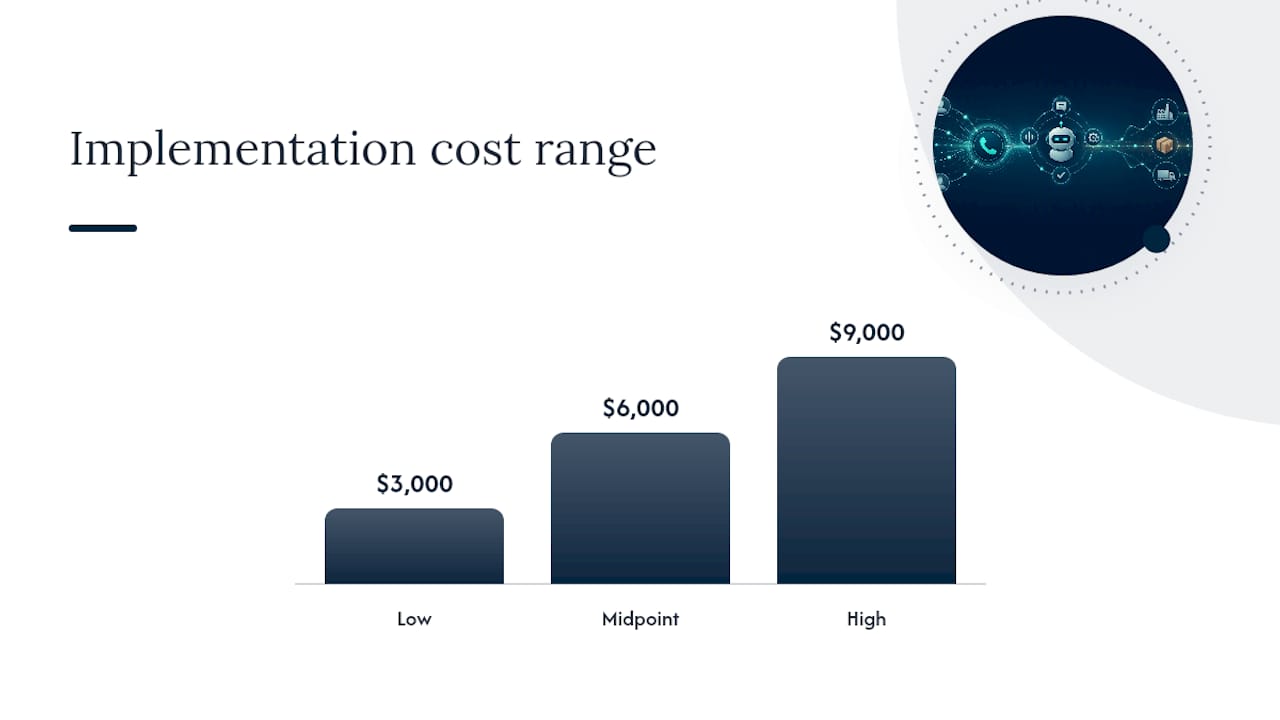
One useful benchmark for governance: implementation and setup for call center automation projects typically falls in the $3,000 to $9,000 range for initial deployments, based on CostSignals’ ROI calculator breakdown of software, implementation, training, and support costs. Treat that figure as your one-time cost floor when comparing total first-year spend across vendors, separate from ongoing usage charges.
Gartner predicts that agentic AI will resolve a large share of common customer service issues without human intervention within the next few years, so it is worth factoring this into multi-year budget projections. Gartner’s forecast suggests automation rates and blended costs should keep improving industry-wide, not just for your specific rollout.
Usage-Based, Subscription, or Hybrid: A Quick Decision Rule
Ask yourself three questions before you pick a model. Does finance need a fixed number for board reporting? Do you need headroom for unplanned bursts without a contract amendment?
- If volume swings widely and finance can tolerate variance, go usage-based.
- If finance needs a fixed number above all else, go subscription with a volume cap you rarely approach.
- If you need both predictability and burst capacity, go hybrid: a base subscription covering your typical floor, with usage-based overage billing for anything above it.
For RFPs, request tiered rates that step down at defined volume thresholds, full auditability on every billed minute or event, and itemized billing detail broken out by call type. Vendors that resist itemized billing detail are usually the ones with the most to hide in their rounding rules.
How 42voice Approaches Pricing Conversations
A particular vendor deploys AI voice agents for inbound handling, appointment booking, lead qualification, outbound calling, and after-hours support, typically live within a few days of onboarding. That short pilot window matters for procurement because it gives you real per-flow AHT and automation-rate data before you negotiate volume commitments, rather than relying on a vendor’s generic benchmark.
A short pilot lets you measure actual call mix, escalation frequency, and integration friction with your calendar and CRM systems before you commit to a tiered usage contract. Use those pilot numbers, not vendor projections, as the baseline for any multi-month rate negotiation.
Why Compliance Overhead Quietly Inflates Your Bill
Regulatory and compliance requirements rarely show up as a line item on a rate sheet, yet they add real cost to usage-based call automation contracts. Call recording consent rules, data residency requirements, and industry-specific regulations (healthcare, financial services) often require additional configuration, logging, or storage that vendors bill separately or bundle into a “compliance tier” at a markup.
Multilingual deployments add another layer. If your business operates across jurisdictions with different consent or recording laws, each language and region combination may need its own compliance review, and that review time often gets billed as professional services hours outside the usage-based rate itself.
Data retention is another hidden driver. Vendors that store call transcripts and recordings for audit purposes sometimes charge separately for extended retention periods, particularly in healthcare or financial services contexts where regulators expect multi-year records. Ask specifically whether compliance features are included in your per-minute rate or billed as a separate line item, because this is one of the most common places a quoted rate diverges from the actual invoice.
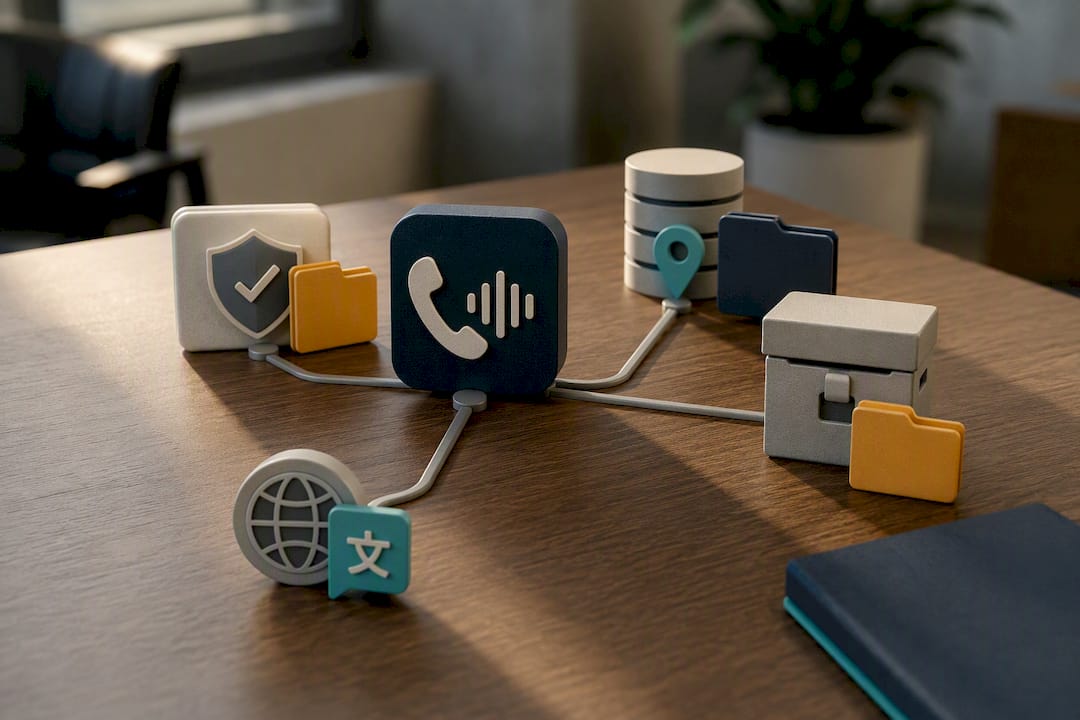
Before finalizing any contract, request a written breakdown of which compliance features are bundled versus billed separately, and confirm how the vendor handles jurisdiction-specific consent requirements for outbound calling campaigns. This single question surfaces more hidden cost than almost any other line of the RFP.
A Procurement Editor’s Take on Usage-Based Contracts
The biggest mistake procurement teams make is accepting a vendor’s blended rate without asking for the call-type breakdown behind it. A single number hides more risk than it reveals. Push for itemized rates by call type before you sign, and always ask one question directly in the demo: “Show me a real invoice from a customer with volume similar to mine.” If a vendor hesitates, that hesitation tells you something the rate sheet never will.
— Jesse
See How 42voice Fits Your Pricing Model
42voice gives procurement teams a faster way to test real numbers before committing to a usage-based contract: a working pilot live in 3 to 5 days, rather than weeks of scoping calls and rate-sheet guesswork.
Some AI voice agent platforms handle inbound calls, appointment booking, lead qualification, outbound calling, and after-hours support, offering multilingual coverage across multiple languages and integration with calendars and CRMs. Bring your baseline call volume, average handle time by call type, and current escalation rate to a demo, and ask to see automation-rate progression from a comparable pilot. Those numbers become your leverage in any volume-tier negotiation. Explore 42voice’s solutions to see which use case fits your call mix, or review practical AI voice agent use cases built for procurement teams piloting this quarter.
Sources
- Pricing scenarios for Calling (Voice/Video) and Chat — Microsoft Learn
- Agxntsix
- Call Center Automation ROI | Free Tool | CostSignals
- Dilr
- Gartner press release: agentic AI prediction
FAQ
What Is a Usage-Based Pricing Model?
A usage-based pricing model charges you for actual consumption, such as minutes, calls, or completed interactions, rather than a flat recurring fee regardless of volume.
What Does Usage-Based API Pricing Mean for Call Automation?
For call automation specifically, usage-based API pricing means the underlying voice or telephony API bills per minute or per call event, and your total cost scales directly with call volume and duration.
How Much Should I Charge or Budget for AI Call Automation?
Budget using your own call mix and AHT rather than a single industry rate; usage-based infrastructure typically runs $0.05 to $0.15 per minute, with managed platforms often higher due to bundled support and monitoring.
How Much Does an AI Call Center Cost Overall?
Total cost includes usage-based or subscription charges plus one-time implementation, which typically falls between $3,000 and $9,000 for initial setup, training, and integration.
Should I Choose Usage-Based or Subscription Pricing?
Choose usage-based pricing if your call volume varies more than 30% month to month; choose subscription pricing if your volume is steady and finance prioritizes budget predictability over flexibility.