
The best-performing sales teams treat the first outreach to an inbound lead as a countdown, aiming to contact very quickly using automation when possible. Hit that window and qualification rates jump dramatically compared to waiting even half an hour. Everything below explains how to measure your own speed to lead, what the research actually shows, and the specific tactics and rollout plan that get you there.
Table of Contents
- What Speed to Lead Calls Actually Measure
- What the Research Says About Lead Response Time
- How Do You Measure Speed to Lead Correctly?
- The Tactical Playbook: Routing, Channels, and Cadence
- Your 30/60/90-Day Speed to Lead Rollout
- How 42voice Closes the Speed to Lead Gap
- How Speed to Lead Shapes the Rest of Your Funnel
- What Successful Speed to Lead Strategies Have in Common
- Author Perspective: What to Fix First
- See Sub-Minute First Touches in Action
- Sources
- FAQ
What Speed to Lead Calls Actually Measure
Speed to lead is the time between a prospect’s action, a form submission, a chat message, an inbound call, and your business’s first meaningful outreach in response. It sounds simple. In practice, most teams mix up three distinct numbers, and confusing them leads to false confidence about how fast they really are.
- First attempt speed: time to the first dial, text, or email, whether or not the lead answers.
- First contact speed: time to an actual two-way conversation, which is the number that correlates most tightly with conversion.
- Full-cadence speed: how long it takes to complete all planned touches (calls, SMS, email) in the follow-up sequence.
The start point matters more than most sales managers realize. Use the timestamp from the form platform or phone system, the exact moment the lead action happened, not the timestamp a rep manually logs in the CRM after opening the notification. That gap, between the real event and the CRM entry, routinely hides 10 to 20 minutes of dead time that never shows up in standard reports.
What the Research Says About Lead Response Time
The data on lead response time is old enough to be settled science, yet most sales floors still operate as if it doesn’t exist. Leads contacted within 5 minutes are much more likely to enter the qualified pipeline than leads contacted after 30 minutes, according to MIT and InsideSales’ aggregate research on lead management. Contact odds themselves fall by a factor of nearly 100 across that same 25-minute gap. That’s not a gradual decline. It’s a cliff.
The 5-minute cliff: Contact odds drop close to 100x between minute 5 and minute 30 of a lead’s life. Every minute you wait past the first five is measurably more expensive than the one before it.
Harvard Business Review’s audit of 2,241 U.S. companies found the average firm’s actual first response time was closer to 42 hours, and companies that responded within the first hour were noticeably more likely to qualify a lead than those that waited, according to HBR’s study on the short life of online sales leads. Forty-two hours is not a rounding error. It’s nearly two full days of a hot lead cooling into a cold one, often while shopping three competitors in parallel.
Large-sample studies on calling behavior add two more findings worth building a process around:
- Calls placed within the first minute of lead arrival produce dramatically higher conversion lifts than calls placed even a few minutes later.
- Most leads that convert are reached by around the sixth call attempt, a benchmark that traces back to the original Lead Response Management Study and still holds up in modern replications.
Six touches, concentrated early, beats one perfect call made late. That’s the operational takeaway hiding inside all three data sets.
How Do You Measure Speed to Lead Correctly?
Most speed to lead dashboards are quietly lying to sales leaders, usually because of one bad habit: reporting the average instead of the median. A single lead that sits untouched for six hours overnight will drag your average up and make a genuinely fast team look mediocre. The median tells you what a typical lead actually experiences.
Four rules fix most measurement problems:
- Start the clock at the form or platform event timestamp, never the CRM entry timestamp.
- End the clock at the first meaningful outreach, a real dial attempt or a personalized message, not an auto-reply.
- Report the median speed to lead as your headline number, and segment it by source, campaign, and lead type before drawing conclusions.
- Track a second number, percent of leads contacted within your SLA window, so a handful of lightning-fast outliers can’t mask a systemic backlog.
Practitioner guidance from Guideflow’s operational playbook recommends building this into a live dashboard rather than a weekly export, since delays tend to cluster around shift changes and after-hours gaps.
| KPI | What it tells you | Target to start with |
|---|---|---|
| Median speed to lead | Typical experience for a real lead | Under 5 minutes |
| SLA adherence % | Share of leads hitting your response window | 90%+ |
| Lead-to-meeting conversion | Whether speed is translating to pipeline | Track weekly by source |
| First-contact rate | How often first attempts land a live conversation | Track by channel |
| After-hours coverage % | Leads reached outside business hours | Track separately from daytime |
The Tactical Playbook: Routing, Channels, and Cadence
Fixing speed to lead is less about hiring more reps and more about closing the gap between “lead arrives” and “someone acts on it.” A handful of tactics account for most of the improvement teams see.
Auto-route on arrival. The moment a lead comes in, route it automatically to the first available qualified rep or to a dedicated first-call team, skipping any manual assignment step. Manual routing is the single most common source of the handoff delay that quietly erodes an otherwise fast process.
Fire multiple channels at once. Don’t wait for a call to go unanswered before sending a text. On lead arrival, trigger a call attempt, an SMS, and either a voicemail drop or an automated follow-up email simultaneously. This isn’t spam, it’s coverage: different leads respond to different channels, and simultaneous delivery means you’re not burning the clock testing one channel at a time.
Prioritize the freshest leads in your dialer. During peak inbound windows, queue new leads ahead of older follow-ups so a fresh lead never sits behind a stale one waiting for a rep’s attention.
Build a 6-touch cadence weighted toward the first 48 to 72 hours. Spread the six attempts (a mix of calls, SMS, and email) heavily into the opening window rather than evenly across two weeks. That front-loading is what the Lead Response Management Study’s six-attempt benchmark is actually describing.
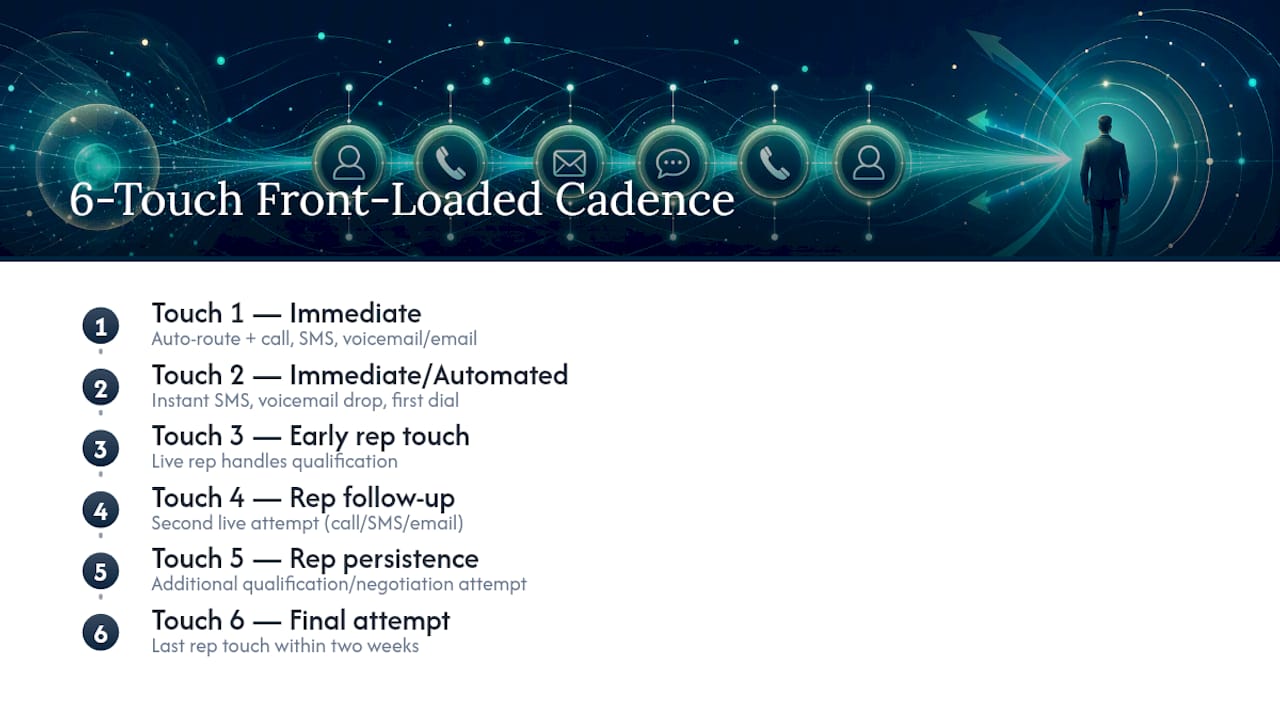
Cover after-hours with something better than silence. A meaningful automated experience, a same-second SMS confirming next steps, access to self-serve booking, or scheduling the first live call attempt for your next open window, preserves intent that would otherwise decay overnight. Teams integrating CRM automation into this workflow often lean on infrastructure like CRM and automation platforms to keep routing rules and timestamps synced across systems.
Pro Tip: Allocate automation to secure the first two touches, instant SMS, voicemail drop, and the first dial, and reserve your best reps for touches three through six, where actual qualification and negotiation skill matters most.
Your 30/60/90-Day Speed to Lead Rollout
You don’t need a quarter-long project to see results. Most of the gain comes from the first two weeks.
- Days 0 to 7: Audit. Pull median speed to lead by source for the last 90 days and flag the biggest bottleneck, usually manual routing or missing after-hours coverage.
- Days 1 to 7: Quick wins. Switch to direct form-platform timestamps, turn on instant Slack or push alerts for new leads, and deploy a standard SMS template plus a voicemail drop script.
- Days 8 to 30: Structural fixes. Apply auto-routing rules, stand up a dedicated first-call shift during peak hours, add an SLA dashboard, and A/B test your first-touch message wording.
- Days 31 to 90: Tuning. Adjust staffing against your actual lead-volume curve, refine after-hours automation based on real response data, and run a weekly SLA review with whoever owns the metric.
| Phase | Primary owner | Key metric to watch |
|---|---|---|
| Days 0 to 7 | Sales ops lead | Baseline median speed to lead |
| Days 8 to 30 | Sales manager | SLA adherence % |
| Days 31 to 90 | Revenue operations | Lead-to-meeting conversion trend |
How 42voice Closes the Speed to Lead Gap
Most of the delay in speed to lead calls isn’t a motivation problem, it’s an infrastructure gap between the moment a lead arrives and the moment a human is free to act on it. AI voice agents close that gap by acting the instant the lead does.
- Rapid first-touch calls on inbound leads, at any volume, without waiting for a rep to be free.
- Native calendar and CRM integration, so a qualified lead can be booked directly into an open slot without a manual handoff.
- 24/7 coverage, including the overnight and weekend windows where most sales teams lose leads to silence.
- Multilingual voice agents across 9+ languages, useful for businesses with mixed-language inbound traffic.
- Deployment within a short timeframe, enabling routing and first-touch fixes to be live quickly rather than over a prolonged period.
Common use cases include automated lead qualification calls at form submission, appointment booking without a rep, and after-hours contact that keeps intent alive overnight, and structured voicemail-drop-and-callback routines for leads that don’t answer the first attempt.
How Speed to Lead Shapes the Rest of Your Funnel
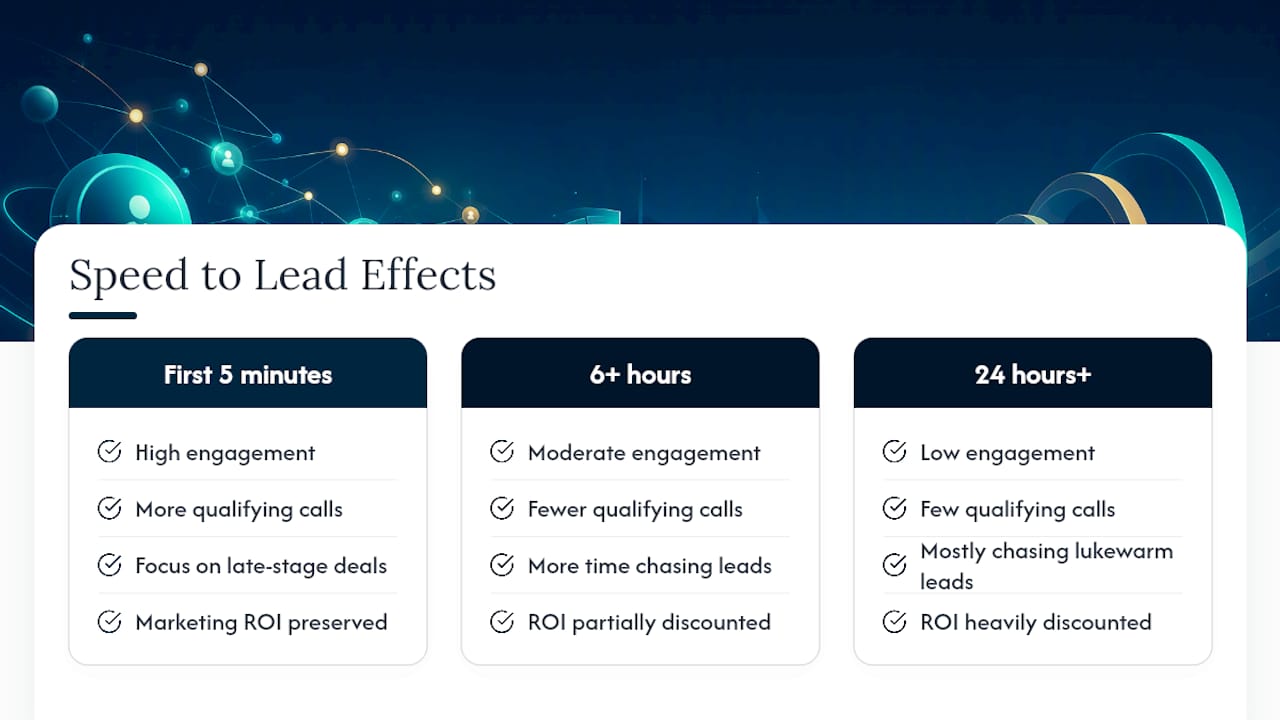
Speed to lead isn’t a top-of-funnel vanity metric. It sets the ceiling for every stage that follows. A lead contacted in the first five minutes typically arrives more engaged, more willing to answer qualifying questions, and less likely to have already booked a call with a competitor. A lead contacted 24 hours later has usually cooled, and often has already had a conversation with someone else.
That compounding effect shows up most clearly in lead-to-meeting conversion. Faster first contact means more leads actually reach a qualifying conversation instead of going dark after one unanswered call. It also changes the shape of your pipeline: reps spend less time chasing lukewarm leads that should have converted immediately and more time on later-stage conversations where their skill actually adds value.
There’s a cost side too. Marketing teams spend real budget generating each inbound lead, and a slow response effectively discounts that spend. A lead that cost you real acquisition dollars and then sits for six hours is a lead you’ve partially paid for twice, once to generate it, once in lost conversion probability while it waited. Fixing speed to lead doesn’t just lift conversion rates, it improves the return on every dollar already spent generating the lead in the first place. Teams that treat the first five minutes as sacred tend to see that discipline ripple through close rates, sales cycle length, and even referral quality, since prospects who feel promptly handled talk about it.
What Successful Speed to Lead Strategies Have in Common
The organizations that get this right rarely rely on a single fix. They combine a structural change (routing, staffing, automation) with a measurement discipline that catches regressions before they become habits.
A common pattern: a business with inconsistent after-hours coverage adds an automated first-touch layer that texts or calls the instant a lead arrives, even at 11 p.m., and schedules a live follow-up for the next open window. The measurable result across similar setups is a lift in after-hours contact rates that previously would have gone to voicemail and stayed there.
Another recurring pattern involves the six-touch cadence itself. Teams that once made two or three follow-up attempts and gave up routinely leave a large share of convertible leads untouched, since the Lead Response Management Study shows most conversions happen by the sixth attempt, not the first or second. Simply extending the cadence, without adding headcount, recovers leads that were previously written off as unresponsive.
The through-line in every successful case is the same: remove the manual step between lead arrival and first action, and make the follow-up sequence long enough and fast enough to actually reach people. Neither change requires new hires. Both require rebuilding a workflow that most teams built years ago and never revisited.
Author Perspective: What to Fix First
If you fix one thing, fix routing and notification before you touch scripts or training. Automate the first two touches and save live reps for the conversations where judgment actually matters. Watch quality closely: faster isn’t automatically better if speed comes at the cost of a scripted, sloppy first call. Set an SLA, run QA against it, and review your numbers weekly. Iterate fast or you’ll drift back to old habits within a month.
— Jesse
See Sub-Minute First Touches in Action
42voice exists for exactly the gap this article describes: the minutes between a lead arriving and a human being free to call them. Instead of hiring a night-shift rep or hoping your team notices a Slack alert fast enough, an AI voice agent picks up the lead the moment it lands, day or night, and either qualifies it, books it, or hands it off warm.
The setup maps directly onto the playbook above: instant first-touch calls, native calendar and CRM integration so bookings don’t need manual entry, and after-hours coverage that turns a midnight form submission into a scheduled call instead of a missed opportunity. Deployment typically takes 3 to 5 days, so you can test this against your current numbers within a couple of weeks. If your median speed to lead is measured in hours rather than minutes, see a live demo or explore 42voice’s solutions to see where an AI voice agent would slot into your current routing.
Sources
FAQ
What Does Speed to Lead Mean?
Speed to lead is the time between a prospect’s action, a form fill, chat message, or inbound call, and your business’s first meaningful response. It’s typically measured to first attempt, first live contact, or completion of the full follow-up cadence.
Why Is Speed to Lead Important for Conversion?
Leads contacted within 5 minutes are much more likely to qualify than those contacted after 30 minutes, and contact odds fall sharply over that same window, according to MIT and InsideSales research. Waiting hours, as the average company does, means competing against a prospect’s fading interest and a competitor’s faster call.
What Is the 5-Minute Rule in Sales?
The 5-minute rule suggests contacting an inbound lead within 5 minutes can dramatically improve qualification and contact rates compared to waiting longer, a finding replicated across multiple large lead-sample studies since the original Lead Response Management Study.
How Many Call Attempts Should a Sales Team Make?
Data from large lead response studies shows most leads that convert are reached by around the sixth call attempt, which is why a 6-touch cadence weighted toward the first 48 to 72 hours outperforms shorter, slower sequences.
Can Automation Actually Replace a Live Sales Call?
Automation can effectively handle the first one or two touches, such as call attempts, SMS, or voicemail drops, while live reps focus on later qualification and negotiation touches involving negotiation or complex qualification. Platforms like 42voice’s AI voice agents are built specifically to handle that first-touch layer around the clock, including after-hours windows most teams can’t staff.