
For SMBs that want vendor-deployed voice agents, the managed deployment path with a scoped pilot and a documented SLA reliably gets production calls live in days, not months. “Rapid” in practice means 3 to 5 days from kickoff to first live call when your CRM and calendar connectors are standard. Before you sign anything, start a bounded pilot and require an SLA with observability built in from day one.
Table of Contents
- What Rapid Voice Agent Deployment Actually Looks Like
- The Multi-Stakeholder Vendor Checklist Every SMB Needs
- How to Run a Pilot That Actually Proves Readiness
- Integrations, Failure Modes, and Observability to Demand
- Keeping the Agent Productive After Go-Live
- What Procurement Teams Get Wrong (And Right) About Speed
- Deploy Your First Voice Agent With 42voice
- Sources
- FAQ
What Rapid Voice Agent Deployment Actually Looks Like
A rapid rollout follows several phases including scoping, configuration, integration hookup, a pilot run, and go-live. Each phase has an owner, and skipping the pilot to save two days is the single most common way SMBs end up with a voice agent that mishandles calls in week three.
The gap between vendors is stark. A managed platform built for fast deployment can go from contract to first live call in a few days. A typical enterprise-style onboarding, by contrast, runs 2 to 6 weeks once you factor in custom integration builds and internal sign-off cycles. What actually compresses the timeline isn’t luck. It’s preparation: credentials ready on day one, call scripts pre-approved before kickoff, and standard connectors instead of custom API work.
Hitting that window means each team shows up ready:
- Procurement pre-approves the contract structure and pilot exit terms before the kickoff call.
- IT has API credentials for the CRM, calendar, and phone system staged and tested.
- Operations supplies three to five real call scripts and defines escalation paths in advance.
- Finance signs off on pilot pricing so a scope change mid-pilot doesn’t stall the launch.
The Multi-Stakeholder Vendor Checklist Every SMB Needs
A voice agent vendor that survives scrutiny from four different departments is a different animal than one that only survives a sales demo. Each stakeholder group needs its own line of questioning, and the answers should be specific enough to write down.
- IT and security. Ask for a documented SLA with a numeric uptime commitment, not a vague “high availability” promise. Demand a clear description of failover behavior, authentication methods, and telemetry access. DILR’s enterprise vendor checklist recommends treating documented SLA terms and explicit failover behavior as non-negotiable, not nice-to-haves.
- Legal and compliance. Get the transcript retention policy in writing, confirm how consent is captured on recorded calls, and ask whether regional data processing options exist if you operate across borders.
- Operations. Confirm that script and flow updates happen through a no-code interface your team can use without opening a support ticket, and get the human escalation flow mapped out before launch.
- Finance. Insist on transparent, all-in pricing, a defined pilot price, and contract terms that let you exit cleanly if the pilot fails.
Pro Tip: Ask every vendor on your shortlist the same four questions, in the same order, and write the answers side by side. Vendors that hedge on the SLA or failover question almost always hedge on delivery too.
How to Run a Pilot That Actually Proves Readiness
A pilot only means something if it’s built to fail as easily as it succeeds. Vague enthusiasm from a demo call tells you nothing about how the agent behaves at 2 p.m. on a Tuesday when call volume spikes.

Structure the pilot around 2 to 4 use cases that mirror your real call mix: appointment booking, a common support question, and one edge case your staff dreads answering. Replay 200 to 400 real historical calls under conditions that resemble peak concurrency, not a quiet test environment. Plivo’s evaluation guide recommends this kind of realistic-load testing specifically because demo-day performance rarely matches production performance.
Track these metrics, and set a pass/fail threshold for each before the pilot starts:
- Containment rate (calls resolved without a human)
- Resolution rate on the specific tasks you scoped
- CSAT or an equivalent satisfaction proxy
- Latency at the 95th percentile, not just the average
- Transfer success rate when the agent hands off to a person
Add three stress tests: force a CRM write failure and watch the recovery, replay calls at peak concurrency, and run a multi-language sample if you serve non-English speakers. Any vendor that can’t survive these tests in a pilot won’t survive them in production.
Integrations, Failure Modes, and Observability to Demand
Every voice agent lives or dies by what happens when something breaks, not by how it performs when everything works. That’s the part most SMBs forget to test before signing.
Require read and write access to your CRM, calendar, and ticketing system, and actually test three real integrations during the pilot rather than taking a vendor’s word for compatibility. Lewiscrook’s vendor-neutral framework argues that integration depth predicts post-launch survival more reliably than voice quality does, and recommends weighting it heavily in any scorecard.
Get specific answers on failure behavior:
- What happens when a CRM write fails? Does the agent retry, fall back gracefully, or drop the data silently?
- Does a stuck or confused call transfer to a human with full context, or does the caller have to repeat themselves?
- Is there a customer-visible status page showing current system health?
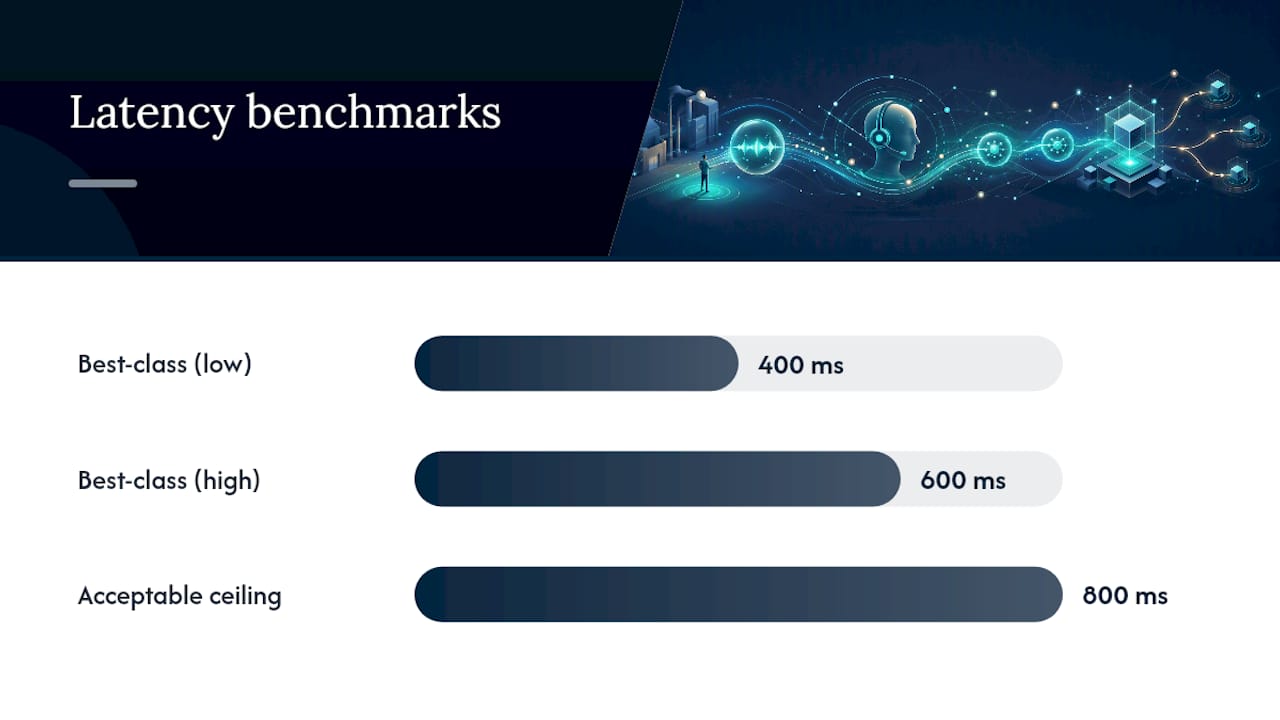
On latency, industry benchmarking puts the acceptable ceiling around 800 milliseconds before callers notice a lag, with best-in-class platforms targeting 400 to 600 milliseconds for conversation that feels natural. Ask for per-call transcripts, intent labels, and documented escalation reasons. Observability is the dimension buyers underweight most, and it’s the one that catches a failure mode before a customer complains about it.
Keeping the Agent Productive After Go-Live
Deployment speed matters little if the system stagnates a month later. The vendors worth keeping build a runbook your non-engineer staff can actually use, and a reporting rhythm that catches drift before it becomes a pattern.
Ask for a documented change process that lets Operations update scripts and flows without filing an engineering ticket. Set a weekly reporting cadence covering containment rate, escalation volume, and any performance drift against the pilot baseline. Build in human-in-the-loop quality checks and a refresh schedule for training samples, since caller phrasing and seasonal call topics shift over time.
- Weekly report: containment, escalations, drift, tuning tasks completed
- Named internal owner for the operating playbook
- Quarterly refresh of training samples and scripts
Pro Tip: Assign one internal owner to the voice agent playbook from day one. Shared ownership between three people usually means nobody actually reviews the weekly report.
What Procurement Teams Get Wrong (And Right) About Speed
The mistake I see most often isn’t moving too fast. It’s mistaking a smooth demo for proof of production readiness. A vendor can make any script sound flawless in a controlled call. That tells you nothing about integration writes at peak load.
Do require a pilot with objective pass/fail criteria set in advance, not a subjective “we’ll know it when we see it” standard. Don’t let voice quality alone sway the decision. Do insist on observability and clear failover rules before go-live, because that’s what lets your Operations team actually run the system without calling support every week.
— Jesse
Deploy Your First Voice Agent With 42voice
Some vendors build their model around the timeline this guide describes: live in 3 to 5 days, with human-in-the-loop quality control and no long-term lock-in contract if the pilot doesn’t hit your numbers. Whether your priority is inbound call handling, appointment booking, or qualifying inbound leads before they hit a rep’s calendar, the AI Receptionist and AI Sales Development Rep products are built to plug into the CRM and calendar systems you already run.
If Tier-1 support tickets are eating your team’s time, the AI Tier-1 Help Desk applies the same rapid-deployment model to support queues. Bring the scorecard from this guide to your first call: ask for the SLA, the pilot metrics, and the observability tools before you look at pricing on the Starter, Growth, or Scale plans. Request a pilot this week and measure it against the thresholds you just read.
Sources
For deeper technical grounding beyond this guide, review DILR’s enterprise vendor checklist for SLA and failover language, Plivo’s platform evaluation guide for pilot design, and Lewiscrook’s vendor-neutral framework for integration and observability benchmarks used throughout this playbook.
- Enterprise voice AI vendor checklist
- Voice AI platform evaluation guide
- How to evaluate enterprise voice AI platforms: a vendor‑neutral framework
FAQ
How Fast Can a Voice Agent Actually Go Live?
A managed deployment with standard CRM and calendar connectors typically goes live in 3 to 5 days. 42voice targets this exact window for AI Receptionist and appointment booking use cases when credentials and scripts are ready at kickoff.
What Should a Voice Agent Pilot Measure?
A solid pilot tracks containment rate, resolution rate, CSAT, latency at the 95th percentile, and transfer success under realistic call volume. Plivo’s evaluation guide recommends testing these under load rather than in a quiet demo environment.
What Latency Is Acceptable for a Voice Agent?
Callers start noticing lag above roughly 800 milliseconds, and top platforms aim for 400 to 600 milliseconds for conversation that feels natural. Ask any vendor to show their p95 latency during the pilot, not just an average.
Does 42voice Offer a Pilot Before a Full Contract?
42voice supports a scoped pilot period with no long-term lock-in contract, so you can validate performance against your own benchmarks before committing. Pricing for the Starter, Growth, and Scale plans is available on the pricing page.
What Happens If the Voice Agent Can’t Handle a Call?
A production-grade agent should escalate to a human with full conversation context rather than dropping the caller or making them repeat themselves. Review how AI-to-human handoff is structured before you sign, since this behavior is one of the clearest signals of vendor maturity.