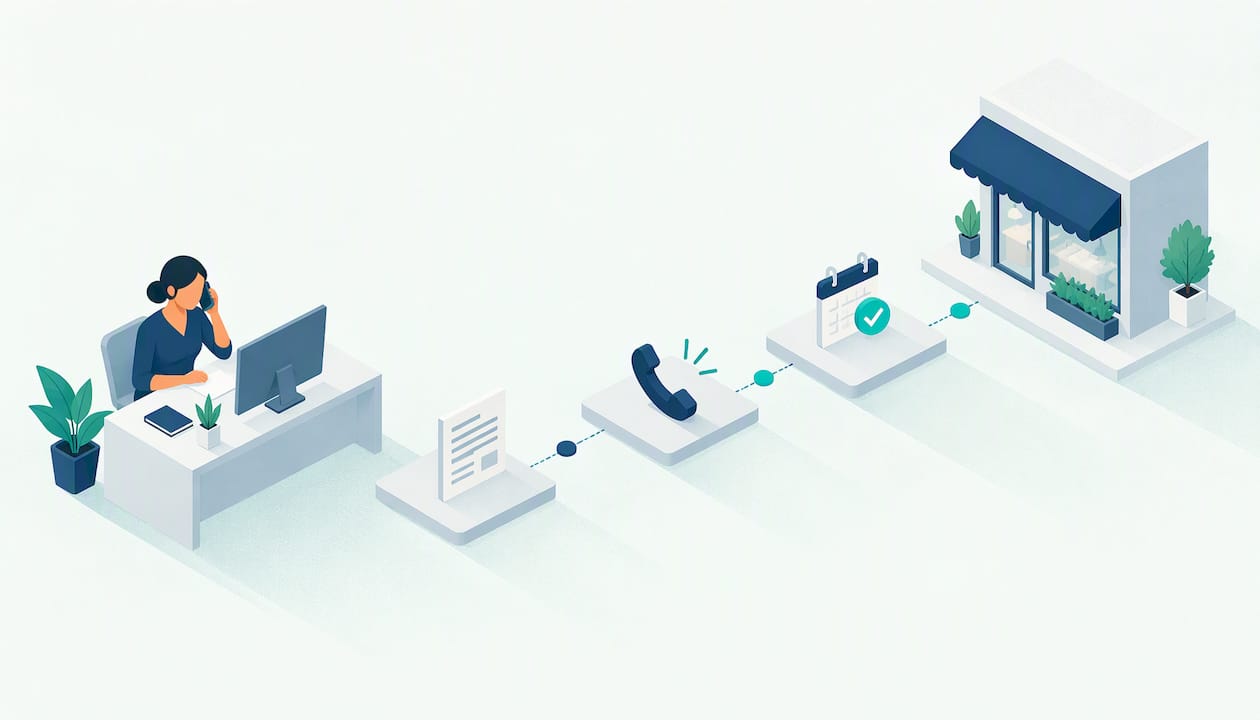
A payment reminder call works best when it is early, short, friendly and documented. Call within a few days of the due date, assume the invoice was missed, make it easy to pay, and log what was agreed. Escalate only if that fails. This guide covers timing, a script you can adapt, the Australian rules to keep in mind, and where an AI voice agent can take the repetitive part off your plate.
I’m Alston from 42Voice. We build AI voice agents, so I see how much time small businesses lose chasing invoices by phone. Most of it is not hard work. It is repetitive work that gets pushed aside by whatever is urgent that day.
Table of Contents
- Why a phone call still beats another email
- A simple timing plan for reminder calls
- A payment reminder call script you can adapt
- Rules to keep in mind in Australia
- What to do when reminder calls don’t work
- Fix the cause: fewer late invoices to chase
- Where an AI voice agent fits
- Alston’s perspective: automate the repeat, keep the human
- A practical 30-day plan
- FAQ
- Talk to us
- Sources
Why a phone call still beats another email
Emails get buried. A call gets an answer, or at least a voicemail with a real voice and a clear next step.
The Victorian Government’s small business guidance suggests that when payment first becomes overdue, you give the customer a courtesy reminder by phone, email or letter. It notes they may have simply forgotten or paid into the wrong bank account. That matches what most owners find: the first reminder is rarely a dispute. It is an oversight.
A call also tells you something an email cannot. You learn quickly whether the customer is disputing the work, waiting on their own client, or just disorganised. Each of those needs a different reply.
A simple timing plan for reminder calls
There is no legal schedule for friendly reminders between businesses, so use a rhythm you can keep. Here is a practical one for a 14 or 30 day invoice:
| Stage | When | Channel | Tone |
|---|---|---|---|
| Courtesy heads-up | 2 to 3 days before due date (optional) | SMS or call | Helpful |
| First reminder | 1 to 3 days after due date | Call, then email | Light, assumes oversight |
| Second reminder | Around 7 days overdue | Call and email | Polite, more direct, asks for a date |
| Final reminder | 14 to 21 days overdue | Call from a person | Firm, explains next step |
| Letter of demand | After the above has failed | Letter | Formal |
The pattern of a friendly first reminder, then a second around day 7, is common across the guides that rank for this topic. Treat the exact days as a starting point and adjust for your industry. A trade business with 7 day terms needs a faster rhythm than a consultancy on 30 days.
Pick one owner for each step
Reminders fail when nobody owns them. Decide who makes the first call, who takes over when a customer disputes the invoice, and who signs off on a letter of demand. Write it down in one page.
A payment reminder call script you can adapt
Keep the first call under two minutes. The goal is a specific payment date, not a confession.
First reminder (1 to 3 days overdue)
- Open and identify. “Hi, it’s [name] from [business]. I’m calling about invoice [number] for $[amount], which was due on [date].”
- Assume good faith. “It might have slipped through, so I wanted to check you received it.”
- Make payment easy. “I can resend it now. Our bank details and payment link are on the invoice.”
- Ask for a date. “Can you confirm when we should expect payment?”
- Confirm and close. “Great, I’ll note that you’ll pay on [date]. Thanks for your time.”
Second reminder (around 7 days overdue)
- “I’m following up on invoice [number], now [X] days overdue. We spoke on [date] and expected payment by [date].”
- “Is there anything holding it up, such as a query about the work or a missing purchase order number?”
- “What date can you commit to? I’ll confirm it by email today.”
If they raise a problem
Stop pushing for payment and listen. Note the issue, say who will come back to them and by when, and hand it to a person who can fix it. This is the moment where a human matters most.
Voicemail version
“Hi, it’s [name] from [business] about invoice [number] for $[amount], due on [date]. I’ll send the details by email. Please call me on [number] or pay using the link on the invoice. Thanks.”
Don’t mention the amount or reason on a voicemail if the number may be shared, such as a household landline for a sole trader. Say you are calling about an account and leave a call back number.
Rules to keep in mind in Australia
This is general information, not legal advice. If you are unsure about a specific situation, speak to a lawyer or your industry body.
Contact frequency and hours
The ACCC and ASIC debt collection guidance is written mainly for collecting from individuals, but its principles are useful for business debts too. It sets out limits to avoid harassment and coercion: no more than 3 calls a week or 10 a month per account, and calls on weekdays between 7:30 am and 9:00 pm or weekends between 9:00 am and 9:00 pm. It also says contact on national public holidays is not recommended. Read the page itself for the current wording and the exceptions.
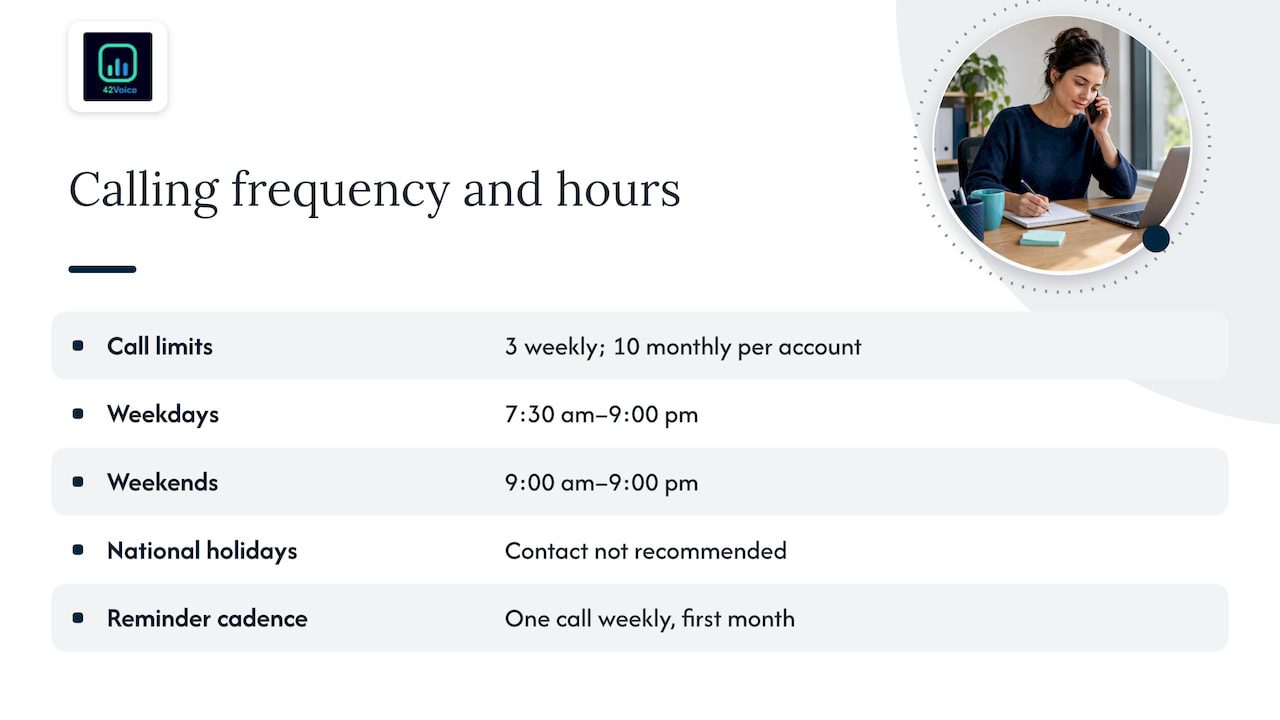
An easy way to stay inside these limits is to cap your own reminder cadence at one call a week for the first month, then reassess.
Do Not Call Register
The Do Not Call Register is about telemarketing. Calls to make payments or deal with a reminder fall outside the rules, as the Do Not Call Register’s own guidance explains. That means a genuine reminder about an invoice you issued is a different thing from a sales call. Keep it that way: if you slip a promotion into a payment call, you may blur the line. Keep reminder calls about the account only.
Privacy and recording
You will be holding names, phone numbers and account details, so your obligations under the Privacy Act and your own privacy policy apply to how you store and use call records. If you record calls, tell people at the start. We cover consent in more detail in our call recording consent guide, though that page is written for US state rules, so check the Australian position for your state or territory before relying on it.
Disclose when it’s AI
If an AI voice agent makes or answers the call, say so at the start. Customers are far more forgiving of a clear, polite automated call than of one that pretends to be a person. Check current Australian guidance with your adviser before launching, because rules on automated calling and AI are evolving.
Stay out of unconscionable territory
The ACCC’s guidance lists acceptable reasons to contact a debtor, including giving information about the account and money owed, making a demand for payment and accurately explaining the consequences of not paying. Threats, repeated pressure and misleading statements are the danger zone. A structured path from friendly reminder to formal demand is both fairer and safer.
What to do when reminder calls don’t work
Business.gov.au sets out the usual order: friendly reminders, informal negotiation, then a letter of demand. Only after those does it suggest a debt collection service. It also notes that agency commissions typically sit between 5% and 30% of the debt. Check the page for the current detail.
A letter of demand puts your concerns in writing and gives the other party a chance to respond before things get more serious. Your call log becomes useful here: dates, who you spoke to, what they promised.
Weigh the relationship
Business.gov.au also points out that you should weigh the value of the debt against the cost of damaging the relationship. For a repeat client, negotiating a payment plan often beats a hard line. For a one-off job, a neutral third party can be more efficient. That is your call as the owner. We would never suggest a machine makes it.
Fix the cause: fewer late invoices to chase
Calls are the repair. Some prevention saves more time:
- Invoice on the day the work is done. Late invoices get paid late.
- Put payment terms on the quote and the invoice. Say “due in 14 days” in plain words.
- Make paying one click. Include a payment link and bank details.
- Use your accounting software. Tools such as QuickBooks can send an automatic reminder and show who has paid and who has not.
- Consider eInvoicing for business customers. The ATO explains that eInvoices move directly between the buyer’s and supplier’s software, instead of sitting in an inbox as a PDF.
Where an AI voice agent fits
The first and second reminder calls are the most repetitive part of collections. Same script, same questions, same note in the system. They are also the calls that most often don’t happen, because the owner is on a job or in a consult.
That is where we think automation helps. Our position is simple: let the agent take the high-volume routine calls and keep every human moment with a person.
Here is how that looks in practice with our AI Collections Agent:
- The agent makes first-party reminder calls on your invoices, using your script and your tone.
- It asks for a payment date and records the answer.
- It can plug into the CRM and calendars you already use, so notes and promised dates land where your team looks.
- When a customer disputes the invoice, sounds distressed, asks for a payment plan or just wants a person, the call hands off to your team.
- Calls are reviewed with human-in-the-loop quality control, so you can see how they are going and tune the wording.
- It can speak more than one language, which matters if your customers do.
A short example of the kind of exchange we mean:
Agent: Hi, this is the automated assistant calling for Bright Plumbing about invoice 1042, due last Friday. Do you have a moment?
Customer: Yeah, I thought I’d paid that.
Agent: No problem. I can’t see a payment yet. It may still be processing. Would you like me to resend the invoice and payment link now?
Customer: Please. I’ll pay it tomorrow.
Agent: Thanks. I’ve noted payment tomorrow and sent the link. Have a good day.
If that customer had said “the job wasn’t finished properly”, the agent would stop and pass the call to someone on your team.
Where a human should take over
Be honest about limits. Keep these with a person:
- Disputes about the quality of work or the amount
- Customers in financial hardship or distress
- Large or strategic accounts where the relationship matters more than the invoice
- Final reminders before a letter of demand
- Anything involving legal threats
AI is a good fit for the routine middle: polite first reminders, confirming dates, resending invoices. We don’t see it as a replacement for your staff. It gives them time for the calls that need empathy and judgment.
Our debt collection agents are set up for SMEs and typically go live in 3 to 5 days. You can read more on our debt collection agents page. There are no lock-in contracts, and pricing is tailored per business, so see the plans and talk to us about what fits.
Alston’s perspective: automate the repeat, keep the human
We get one question from owners more than any other: “Will it upset my customers?” Our honest answer is that a badly worded call will upset them, whoever makes it. A clear, polite, short call that offers an easy way to pay usually doesn’t.
Three things we have learned building voice agents for collections and reminders:
- Wording matters more than technology. Start with a script you would be happy to hear if you were the customer.
- The handoff is the feature. The agent should know what it cannot handle and pass the call on smoothly, with the context, so the customer doesn’t repeat themselves.
- Review early calls. In the first weeks, listen to transcripts and adjust. That is why we pair every agent with human-in-the-loop quality review.
If you chase invoices yourself today, start by writing the two-minute script above and following it for a month. Then decide which part is worth handing off.
— Alston
A practical 30-day plan
- Week 1: Export your overdue invoices. Sort by amount and age. Decide which are friendly reminders and which need a person.
- Week 1: Write your first and second reminder scripts and one voicemail.
- Week 2: Make the first round of calls. Log every outcome in your CRM or accounting software.
- Week 3: Follow up on broken promises. Send a short email after each call confirming the date.
- Week 4: Review what happened. Which customers paid after one call? Which ones need a letter of demand?
- Ongoing: Fix the invoicing process so fewer invoices reach this point.
FAQ
When should I make the first payment reminder call?
Around 1 to 3 days after the due date is a good starting point. Assume an oversight, offer to resend the invoice and ask for a payment date. If your terms are very short, as in many trades, you may call sooner.
How many times can I call a customer about an overdue invoice?
The ACCC’s debt collection guidance sets out limits of 3 calls a week or 10 a month per account, though it is aimed mainly at debts from individuals. Using one call a week and following up by email keeps you well inside that. Check the ACCC page and speak to a lawyer if your situation is unusual.
Do payment reminder calls breach the Do Not Call Register?
The Do Not Call Register guidance says calls related to making payments fall outside the rules, because they are not telemarketing. Keep the call strictly about the account and don’t add sales messages. If you are unsure, get legal advice.
Can an AI voice agent make payment reminder calls?
Yes, for routine first-party reminders, such as confirming a due invoice or collecting a payment date. You should tell the customer it is an AI, keep the script polite and set clear rules for handing off to a person. Disputes and hardship cases should always go to your team.
Talk to us
Want to see a reminder call in action on your own invoices? Book a free 15-minute demo and we’ll show you how it works.
Sources
- Debt collection rules | ACCC
- Debt collection services | business.gov.au
- Write a letter of demand | business.gov.au
- Lodge a complaint | Do Not Call Register
- Manage overdue payments and debt recovery | Business Victoria
- eInvoicing: a better way to do business | Australian Taxation Office
- QuickBooks for sole traders | QuickBooks Australia
Recommended
This article is general information about AI voice technology and isn’t legal or compliance advice. Requirements for call recording, AI disclosure and outbound calling vary by state and use case.