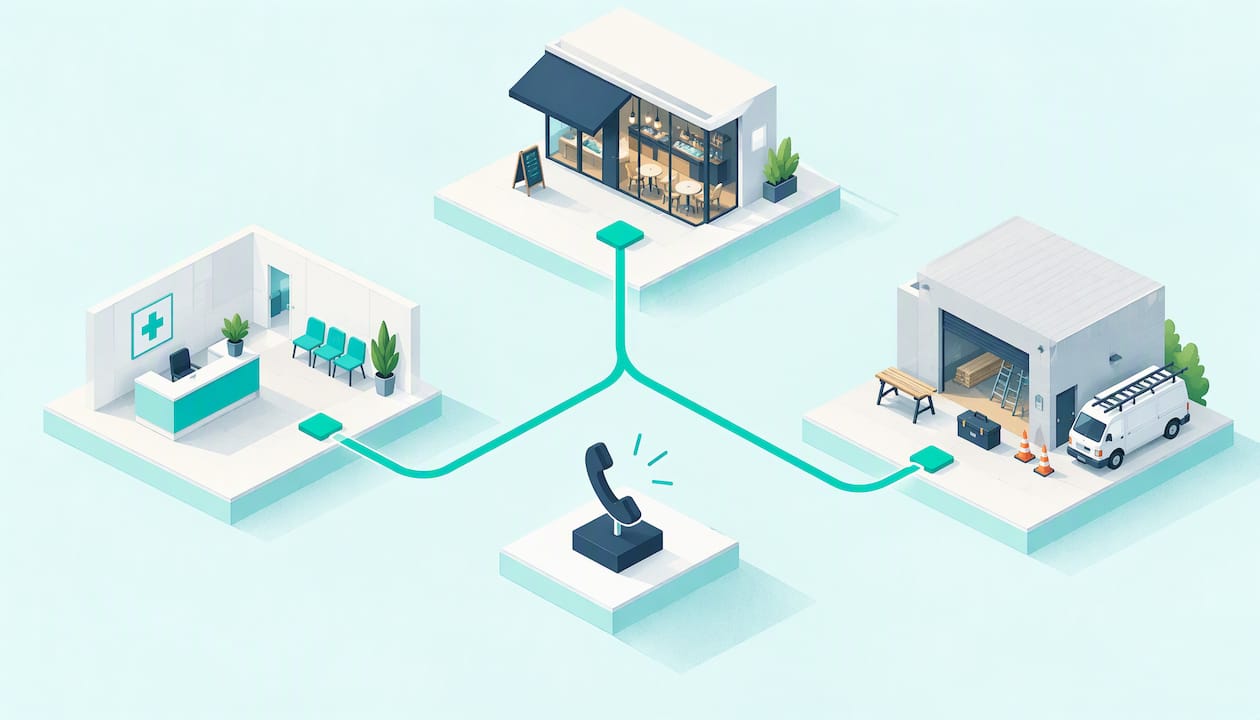
Multi-location call answering means every call to every branch gets picked up, routed to the right place and handled the same way, whether it lands at 10 am on a Tuesday or 9 pm on a Sunday. You do it by running your sites on one shared call setup with common routing rules, rather than a separate phone arrangement at each location. Then you add a front line that answers when staff can’t: a live service, an AI voice agent, or both. We build AI voice agents at 42Voice, so we’ll tell you where they fit and where a person should take over.
This guide is for owners of trade crews, clinics, restaurants, agencies and retail groups with two or more sites. It covers how the setup works, how calls get to the right place, what to check before you change anything, what it costs, and a practical rollout you can follow.
Table of Contents
- What multi-location call answering actually is
- Why calls get missed when you have more than one site
- How calls get routed to the right location
- Before you change anything: what Australian businesses should check
- What it costs
- How different businesses use it
- After-hours cover across sites
- Where a human should take over
- Our perspective
- A practical rollout in five steps
- Put an AI receptionist on the front line of every site
- FAQ
- Book a free 15-minute demo
- Sources
What multi-location call answering actually is
A single-site business has one phone, one set of opening hours and one team who knows who’s who. Add a second or third site and the cracks show quickly. Each location has different staff, different hours and different busy periods. Callers don’t know or care which line is which. They want an answer.
Multi-location call answering puts the calls from all sites under one set of rules. A multi-site cloud phone system lets a business consolidate onto a single platform instead of running separate systems at each site. That gives you central management, shared routing rules and the ability to dial between sites by extension, so a caller gets the same experience whichever branch they ring.
There are three layers worth keeping apart:
- The phone system. The platform that carries calls, holds your numbers and applies routing rules.
- The answering layer. Who or what picks up: your staff, a live answering service, an AI voice agent, or a mix.
- The handoff. How a call moves to a person when it needs judgment, empathy or a decision.
Most businesses fix layer one and forget layers two and three. The result is a tidy phone system that still rings out when everyone is with a customer.
Why calls get missed when you have more than one site
The causes are predictable:
- Staff are busy in person. The receptionist is checking in a patient, the owner is on a roof, the venue manager is mid-service.
- Hours differ by site. One clinic opens at 7 am, another at 9 am, and the after-hours number is a mobile that nobody answers.
- Calls go to the wrong site. A caller rings the head office number about a booking at the Parramatta branch and gets bounced around.
- Each site does it differently. One greets callers warmly and takes details. Another lets it ring to voicemail.
- Nobody sees the whole picture. With separate setups, no one can say how many calls the group missed last week.
Each missed call is a person who then rings the next business on the list. We won’t quote a statistic on how many never call back, because we’d rather you measure your own. Pull a week of call logs from each site and count unanswered calls. That number is your business case.
How calls get routed to the right location
Routing is the heart of the setup. There are a handful of methods, and most businesses combine two or three.
Routing by time
Time-based routing applies each location’s own hours. Inside hours, calls ring the site. Outside hours, they go somewhere else. A good multi-site setup offers a central admin panel for managing sites and time-based routing, plus failover that sends calls to another site, a mobile or voicemail when a site is offline or unanswered.
Routing by the caller’s location
If you advertise one national 13 or 1300 number, the number itself can send callers to the nearest branch. Some providers offer state-based and region-based routing for 1300 numbers. Be aware that state-based routing applies only to calls made from a fixed landline, and mobile callers go to a single nominated destination. Since most callers ring from mobiles, don’t rely on location detection alone.
Routing by what the caller says
This is where a voice agent earns its place. Instead of making a caller press 1 for Penrith, 2 for Newcastle, the agent asks a plain question: “Which suburb or clinic are you after?” or “What’s the job address?” It then sends the call or the booking to the right team. Callers talk the way they normally would, and nobody navigates a menu tree.
Routing by call type
Not every call needs the same destination. A sensible split looks like this:
| Call type | Who should handle it first | Handoff to a person when |
|---|---|---|
| Booking or reschedule | AI voice agent with calendar access | The caller wants something unusual, such as a complex multi-person booking |
| Opening hours, address, parking | AI voice agent | Rarely needed |
| New enquiry or quote request | AI voice agent captures details | A salesperson follows up on a hot lead |
| Existing customer problem | AI Tier-1 agent for simple questions | The caller is upset or the issue is unclear |
| Urgent or emergency | Immediate handoff to on-call staff | Always |
| Complaint | Take details and hand off | Always |
The last two rows matter most. An agent should never be the one deciding whether a situation is an emergency. Write those rules down and have the agent pass the call straight through.
Failover: the safety net
Every routing plan needs an “if nobody answers” rule. Ring site A for 20 seconds, then site B, then the AI receptionist. The caller always reaches something that can help.
Before you change anything: what Australian businesses should check
1. Your phone numbers
You’ll probably want to keep the numbers your customers already know. The ACMA says Australian businesses can usually port local, mobile, 1800 and 13/1300 numbers when changing telcos. It also notes that only active numbers can be ported. If a number has been disconnected, you can’t port it and no longer have rights to it.
So before you cancel any old service, list every number at every site, confirm which are active and who holds each account. Port first, cancel second.

2. Your current contracts and hardware
Check lock-in terms on existing phone and internet contracts so you know when you can move. Cloud systems also differ from on-premise ones in how you manage them. A cloud system gives you one admin panel for every site, while on-premise setups may need separate admin access and someone on site for hardware changes. Across five locations, that difference adds up.
3. Your internet at each site
A cloud phone system is only as reliable as the connection under it. Check each site has stable internet and a fallback, such as a mobile data failover.
4. Your Google Business Profile listings
Callers often find the number on Google Maps first. If each location has its own profile, make sure each shows the right number, hours and address. Wrong numbers in listings cause misrouted calls no routing rule can fix. A guide on managing multi-location Google Business Profiles is a good place to start.
5. Recording, privacy and disclosure
If calls are recorded, transcribed or analysed, tell callers at the start of the call. Your privacy policy should cover how you collect and store that information under the Privacy Act. We’re not lawyers, so check your obligations with your own adviser. The same goes for telling callers they’re speaking with an AI: our approach is to have the agent say so plainly up front.
What it costs
There are two separate costs, and mixing them up is the most common budgeting error.
The phone system. One Australian provider guide puts typical cloud phone systems at $25 to $60 per user per month, with hardware extra. A 1300 number typically costs $10 to $20 a month plus call termination fees, and porting fees vary by provider and complexity. Treat these as ballpark figures and get quotes.
The answering layer. Options differ by how they charge:
- Staff at each site. Wages, training and cover for breaks and leave, multiplied by the number of locations.
- A shared central receptionist. One team takes calls for all sites. This can reduce staffing costs for groups such as real estate agencies, though callers may find it less personal.
- A live answering service. Often a fixed number of included calls with a per-call or per-minute charge once you go over.
- An AI voice agent. Priced on a plan, with usage on top.
Our pricing is tailored per business, so we don’t publish a figure here. It depends on how many sites, how many calls and which agents you need. The Starter, Growth and Scale plans on our pricing page show how we group them. We’d rather scope it against your real call volume than guess.
How different businesses use it
Trades and home services
Your crews are on roofs, under sinks and in switchboards. Nobody can pick up. An AI receptionist answers every call, asks for the suburb and job type, checks it falls inside your service area, and books a quote or call-back into the calendar of the right team. For a business running crews out of Brisbane and the Gold Coast, the agent can sort callers by postcode and send each job to the right depot. An urgent job, like a burst pipe, goes straight to your on-call person.

Medical, dental and allied health
Reception is the busiest, most interrupted job in a clinic. An agent can take the repetitive calls: new bookings, reschedules, opening hours, which clinic offers which service. With multiple clinics, it can offer the nearest available slot across the group. It should not give clinical advice, and any call that sounds like a health emergency should be directed to emergency services or handed to staff immediately. Clinical triage stays with qualified people.
Hospitality
A restaurant group takes calls for bookings, group enquiries, dietary questions and function requests, mostly during service when staff are flat out. An agent can handle table bookings and basic questions for every venue, and pass function enquiries to the right manager. If you also run reservations through online tools, such as a restaurant platform with a reservation dashboard, keep your phone and online bookings feeding one calendar so you never double-book.
Real estate and professional services
Agencies with several branches can have one agent greet every caller, work out which branch and agent they need, and take a message or book an inspection. The agent captures the details, and your people do the relationship work.
Retail and service groups
Store hours, stock enquiries and booking a fitting or service all follow a pattern. Those are the calls to automate. Complaints and sales conversations that need a personal touch go to a person.
After-hours cover across sites
After hours is where multi-location setups usually leak. Each site has its own closing time, the voicemail is full, and the on-call mobile is switched off.
A simple after-hours design:
- Define each site’s hours in the central routing rules, including public holidays.
- Send after-hours calls to the AI agent, which answers 24/7 in whichever language the caller speaks.
- Let it handle what it can: bookings, hours, directions, basic questions.
- Define what counts as urgent and give the agent a named person to transfer to for each site.
- Send a summary of every call to the site manager by the time they open in the morning.
That last step is the one owners tend to love. You start the day knowing who called, what they wanted and what’s been booked.
Where a human should take over
We’re upfront about this because it’s how you keep customer trust. AI voice agents are good at repetitive, high-volume calls. They aren’t the right choice when the call needs nuance, empathy or a close. Plan handoffs for:
- Emergencies and anything involving safety
- Upset or distressed callers
- Complaints and disputes
- High-value sales conversations
- Anything the agent isn’t sure about
- Callers who ask for a person, at any point
The goal isn’t fewer people. It’s the right call reaching the right person with the context already captured, so your team starts the conversation informed instead of asking the caller to repeat themselves.
Our perspective
Most multi-site owners we speak to don’t have a phone problem. They have a pickup problem. The phone system routes calls well enough, but when every person at a site is busy with a customer, the call still goes nowhere.
That’s why we build agents around roles, such as receptionist, sales development rep, tier-1 help desk and collections, rather than around features. A receptionist agent has one job: answer every call, work out what the caller needs and either handle it or get it to the right person. For a group with several locations, that means one consistent front door, plugged into the calendars, CRMs and ticketing tools you already use.
We keep a human in the loop. Calls are reviewed for quality, and complex ones hand off smoothly to your team. We don’t see this as replacing staff. Your people have empathy, judgment and the ability to close a deal. They shouldn’t spend the day answering “what time do you close?” Our agents typically go live in 3 to 5 days, without lock-in contracts, so you can start with one site, see how it goes and extend it.
Alston
A practical rollout in five steps
- Measure first. Count missed calls and after-hours calls at each site for one to two weeks.
- Map your numbers and hours. List every number, who holds the account, each site’s hours and who covers what.
- Write the routing and handoff rules. Decide which calls the agent handles, which go to a person, and who that person is at each site.
- Start with one or two sites. Pick the busiest, or the one with the most missed calls. Connect the calendar and CRM, then review call transcripts weekly.
- Refine and extend. Fix wording, add FAQs and handoffs the transcripts reveal, then roll out to the rest.
This staged approach keeps risk low. If something isn’t working at one site, you’ve lost very little and learned a lot.
Put an AI receptionist on the front line of every site
Our AI Receptionist answers calls for your locations around the clock, books appointments into your calendars, answers common questions in multiple languages and hands complex calls to your team. Every agent is backed by human-in-the-loop quality control, and pricing is tailored to your business across our Starter, Growth and Scale plans.

If you also chase overdue invoices or follow up leads across sites, our other agents cover collections, outbound sales and level 1 support. For outbound calling, keep the Do Not Call Register, the Privacy Act and AI disclosure in mind, and check your obligations with a qualified adviser.
FAQ
Can I keep my existing phone numbers when I move to a multi-location setup?
Usually, yes. The ACMA says local, mobile, 1800 and 13/1300 numbers can generally be ported between telcos, but only while they’re active. Confirm each number and account holder before cancelling anything.
Do I need a single number for all locations, or one per site?
Both work. A single 13 or 1300 number gives you one public face and relies on routing to send callers to the right place. Separate numbers per site suit local marketing and Google listings. Many businesses use one central number alongside local ones.
Will an AI voice agent replace my receptionists?
No. We build agents to take repetitive, high-volume calls such as bookings and common questions, so your people can focus on the calls that need empathy and judgment. Complex or sensitive calls hand off to your team.
How long does it take to set up?
Our agents typically go live in 3 to 5 days. The time depends on how clear your routing rules are and how quickly your calendar and CRM connections are ready, so having your numbers, hours and handoff contacts mapped helps.
Book a free 15-minute demo
Tell us how many sites you run and where calls get missed, and we’ll show you what an agent would do with them. Book a free 15-minute demo.
Sources
- VoIP for Multi-Site Business Australia
- Phone System for Dental Practices
- Phone Systems for Real Estate
- Keep or transfer your phone number, ACMA
- 1300 number routing options
- Restaurant CRM and analytics dashboard
- Multi-location Google Business Profile setup and management
This article is general information about AI voice technology and isn’t legal or compliance advice. Requirements for call recording, AI disclosure and outbound calling vary by state and use case.