
The fastest way to improve lead conversion with AI is to fix four things in order: response speed, scoring and routing, first-touch qualification, and follow-up persistence. Teams that respond inside 5 minutes see contact rates drop 80% after that window closes, while AI-driven scoring wired into routing lifts conversion 20% to 38% when it actually changes what reps do next. Voice-first agents cover the gap when no human is available to answer.
Table of Contents
- Quick Action Checklist: Wins You Can Bank in 1 to 30 Days
- Speed-to-Lead: Why the First 5 Minutes Decide Most Outcomes
- How Does AI-Driven Lead Scoring Improve Conversion?
- Conversational AI for First Touch: What a Good Qualification Flow Looks Like
- Personalization and Next-Best-Action: Relevance Without the Guesswork
- Automated Follow-Up and Reactivation: Where Leads Quietly Disappear
- What Data and CRM Setup Does This Actually Require?
- Measuring Impact: The KPI Ladder That Ties AI to Revenue
- Your 60 to 90 Day Pilot Roadmap for AI-Driven Conversion
- Where Voice-First AI Agents Fit Into This Stack
- Where AI Helps and Where Human Judgment Still Has to Win
- Where 42voice Fits If You’re Ready to Move on This
- Sources
- FAQ
Quick Action Checklist: Wins You Can Bank in 1 to 30 Days
You don’t need a six-month transformation plan to move your numbers. Most of the conversion loss in a typical funnel happens in the first few minutes after a lead raises a hand, and that’s fixable with changes you can ship this week.
Start here, in this order:
- Enable instant routing today. If a lead fills out a form or calls in, the system should assign an owner within seconds, not the next time someone checks their inbox. This alone typically closes the widest gap in your funnel.
- Add a 30-second SMS or email bridge with a calendar link. Even a simple automated message (“Thanks, we got your request, here’s a link to grab time”) keeps the lead warm while a human or AI agent gets involved.
- Deploy AI qualification on your highest-volume forms first. Don’t try to automate every intake channel at once. Pick the form or line that generates the most leads and the most rep frustration, and start there.
- Layer scoring into your priority queues within 2 to 4 weeks. Once routing and instant response are stable, feed lead scores into the queue so reps see the best-fit leads first, not just the newest ones.
- Set SLA escalation rules. If a lead sits unclaimed for more than your target window, it should automatically reassign or alert a manager.
- Run A/B tests on follow-up cadence. Test message count, channel order, and timing against a control group before committing budget to a new sequence.
Measure each step against a threshold, not a vague goal. Track time-to-first-touch (target: under 5 minutes for inbound web leads), percentage of leads contacted same-day, and SLA compliance rate (leads claimed within your defined window).
This is also where after-hours coverage earns its place on the checklist. A voice agent handling after-hours qualification and booking closes the biggest structural hole in speed-to-lead: the hours when your team is asleep, but your leads aren’t.
Speed-to-Lead: Why the First 5 Minutes Decide Most Outcomes
Contact probability doesn’t decline gradually. It falls off a cliff. Response time analysis shows contact rates drop 80% once you pass the 5-minute mark, and the decay isn’t linear after that either. A lead contacted in minute 3 behaves nothing like the same lead contacted in minute 45, even though both technically got “same-day” follow-up.
Statistic to build a strategy around: best-in-class sales teams respond to inbound leads in under 5 minutes. Everyone else is competing for attention that’s already moved on to a competitor, a different solution, or simply lost interest.
Five components determine whether you consistently win that window:
- Instant routing that assigns ownership the moment a lead enters the system, based on territory, product interest, or availability.
- A 30-second SMS or email bridge that acknowledges the lead immediately and includes a calendar link, so there’s no dead air while a human gets looped in.
- AI qualification or instant chat that starts gathering context (budget, timeline, use case) before a rep ever joins the conversation.
- A click-to-book calendar that removes the back-and-forth of scheduling, which is where a huge share of warm leads quietly go cold.
- After-hours coverage so leads arriving at 9 p.m. or on a Sunday get the same fast response as leads arriving at 10 a.m. Tuesday.
These pieces only work as a system. Instant routing without a qualification layer just hands reps unfiltered noise faster. A 30 second SMS without after-hours coverage still leaves a 12-hour dead zone overnight.
Configuration guidance: build routing logic around availability and skill match first, territory second. Set fallback rules so a lead never sits unclaimed. Give every escalation a hard SLA (5 minutes for hot inbound, 30 minutes for lower-intent forms) with automatic reassignment if that window passes. Most importantly, make sure lead context, source, form answers, prior touches, travels with the lead to whoever or whatever picks it up next. A rep or AI agent starting from zero context wastes the speed advantage you just built.
What to measure: track median response time and P90 (the slowest 10% of responses), not just the average. Averages hide the worst-case gaps that actually kill conversion, and P90 is usually where your real problem lives. Also track the percentage of leads contacted under 5 minutes and contact rate by response time bucket (0 to 5 minutes, 5 to 30, 30 to 120, 2-plus hours) so you can see the cliff in your own data, not just in someone else’s benchmark.
How Does AI-Driven Lead Scoring Improve Conversion?
AI scoring only improves conversion when the score actually changes what happens next. A score sitting in a CRM field that nobody looks at does nothing for your close rate.
Scoring models typically pull from four signal types: firmographic data (company size, industry, role), behavioral data (page visits, email opens, content downloads), intent data (search behavior, competitor research, third-party intent feeds), and conversation signals (what a lead said on a call or in chat). Most effective setups blend rule-based logic with machine learning rather than relying on either alone. Rules catch obvious disqualifiers fast; the model catches the subtler patterns that predict which “average-looking” lead is actually about to buy.
The real value shows up in what Apollo’s research on scoring and conversion calls the operational chain. A score has to move through six steps before it produces a dollar of revenue:
| Step | What happens | Where it typically breaks |
|---|---|---|
| Score | Model assigns a lead grade based on signals | Model trained on dirty or incomplete data |
| Prioritize | High scores surface first in rep queues | Reps still work leads in chronological order |
| Route | Lead assigned to the right rep or team | Routing logic ignores the score entirely |
| Next-best-action | System suggests call, email, or demo invite | No action layer, score is informational only |
| Personalize | Outreach matches the lead’s specific signals | Generic template sent regardless of grade |
| Follow-up SLA | Time-bound commitment to act on the lead | No SLA, high-score leads sit as long as low-score ones |
Any broken link in that chain caps your lift, no matter how good the underlying model is.
Before any of this works, your CRM needs clean closed-won and closed-lost labels, since that’s what the model learns from, along with connected engagement and intent feeds. Gartner’s research on AI implementation prerequisites consistently flags data quality as the single biggest blocker to reliable scoring, ahead of model sophistication.
When the chain holds together, the results are real. Apollo’s data shows scoring lifts of 20% to 38% in lead-to-opportunity conversion. Pecan’s case study is even more specific: a predictive model built in 12 days drove roughly 3x higher second-call conversion for the top-graded leads, largely because the sales team started acting on the grade instead of working leads in the order they arrived.
Conversational AI for First Touch: What a Good Qualification Flow Looks Like
A qualification bot’s only job is to get a lead to a booked meeting with enough context that the rep doesn’t have to start the conversation from scratch. That sounds simple. Most implementations fail at it anyway, usually because the dialog tries to collect too much or escalates too late.
Design the flow around a short list of required fields: what problem the lead is trying to solve, timeline, budget range or company size (as a proxy), and decision-making role. Beyond that, listen for intent signals, urgency language, mentions of a specific competitor, a stated deadline, that should trigger immediate escalation to a human or a booking prompt rather than more questions.
- Capture the lead’s own words, not just their answers. “We need this live before our board meeting” is worth more to a rep than a generic “timeline: 1 to 3 months” field.
- Set explicit escalation triggers: a frustrated tone, a request to speak with a person, or three unanswered qualifying questions in a row should hand off immediately.
- End every successful qualification with a booking prompt, not a promise to “follow up soon.”
- Log the full conversation as stateful memory attached to the lead record, so the next touch, human or automated, doesn’t repeat questions already answered.
That stateful memory matters more than most teams expect. Vendor analyses of conversational AI point to sub-2-second response times and high booking rates as achievable benchmarks, but the bigger operational win is what it does for the rep who picks up the handoff. A rep opening a call already knowing the lead’s budget range, urgency, and prior objections closes faster than one starting cold.
Pro Tip: Route voice-first for phone-heavy audiences (home services, healthcare, real estate) and chat-first for lower-touch, research-driven buyers. Matching the channel to how the audience already prefers to communicate does more for completion rates than any script improvement.
Build in safeguards regardless of channel. Every bot needs a clean human escalation path, a way to close the loop when qualification fails outright (don’t just let the lead vanish), and a compliance check on what’s recorded and stored, particularly for call recording and SMS opt-in rules that vary by jurisdiction. A detailed guide on qualification dialog design can save you from rebuilding these safeguards from scratch.

Personalization and Next-Best-Action: Relevance Without the Guesswork
Generic outreach is the single easiest thing to fix once your scoring and qualification layers are working, and it’s often the last thing teams get to.
Personalization starts with mapping signals to message variants. A lead who downloaded a pricing sheet gets a different next message than one who attended a webinar, and a returning visitor who’s already talked to a rep gets a different tone than a cold form-fill. The mapping doesn’t need to be exotic: source, recent behavior, inferred persona, and stated product interest cover most of the useful variation.
- Template-driven personalization (swap-in fields for industry, name, use case) works well for high-volume, lower-complexity segments where speed matters more than nuance.
- Generative personalization (AI drafting a unique message from the lead’s specific signals) earns its cost for high-value accounts where a generic template would look lazy.
- Test personalized variants against a holdout group that gets the standard message, not just against each other, so you can isolate whether personalization itself is driving the lift.
- Set guardrails: cap how aggressively generative tools can claim familiarity with a lead’s business, since overreaching personalization reads as invasive rather than relevant.
Watch reply rate and meeting-booked rate by variant, not just overall conversion. A message that gets more replies but fewer bookings might be attracting curiosity rather than intent, which is a different problem than a message nobody opens at all.
Automated Follow-Up and Reactivation: Where Leads Quietly Disappear
Most lead leakage doesn’t happen at first contact. It happens on touch four, five, and six, when the human follow-up habit breaks down because reps are busy and the lead isn’t hot anymore. This is the exact gap AI-driven cadences are built to close.
- Design cadences by lead state and score, not by a single generic sequence. A high-score lead that went quiet after one call needs a faster, more direct cadence than a low-score lead still in early research.
- Mix channels deliberately. Email for detail, SMS for urgency and quick replies, voice for anything that needs a real conversation, and retargeting ads to stay visible between direct touches. If you’re using SMS at volume in the US, confirm your A2P 10DLC registration is current, since unregistered traffic gets throttled or blocked by carriers.
- Build a specific reactivation sequence for aged leads, those 60, 90, or 180 days old with no recent activity. Space touches further apart than an active cadence, lead with a new offer or piece of content rather than repeating the original pitch, and give the sequence a defined end date so aged leads don’t clutter active queues indefinitely.
- Escalate based on score thresholds, not calendar days. A lead that suddenly re-engages, opening three emails in a day, should jump the queue regardless of where it sits in a scheduled cadence.
The payoff for getting this right is well documented. Marketo’s research, cited by Zendesk, found strong nurturing campaigns generate up to 50% more sales-qualified conversions at a 33% lower cost per lead compared to unstructured, one-off follow-up.
Track reply rate by cadence step, reactivation-to-SQL rate for aged leads specifically, and cost per reactivated lead so you can tell whether the reactivation sequence is actually profitable or just busywork. A signal-driven follow-up playbook is worth reviewing before you build cadences from scratch.
What Data and CRM Setup Does This Actually Require?
None of the systems above work on top of a messy CRM. Scoring models trained on incomplete data produce unreliable grades, and routing logic built on inconsistent fields misfires constantly.
At minimum, your CRM needs clean, required fields on every lead record: company name, job title, lead source, and a full timestamp trail (created, first contacted, qualified, converted). Without timestamps specifically, you can’t measure response time at all, which makes the entire speed-to-lead effort impossible to verify.
- Standardize lead-to-account matching so duplicate or fragmented records don’t split a single company’s activity across five different leads.
- Run enrichment on a defined cadence (weekly or monthly, not one-time at intake) since firmographic data goes stale fast, especially job titles and company size.
- Instrument SLA timers directly in the CRM or routing tool so every lead has a visible clock, not just a policy in a training document nobody follows under pressure.
- Log full context, form answers, chat transcripts, call notes, so it travels with the lead through every handoff.
- Set automated alerts for integration failures (a calendar sync that silently stops working) and for data drift (a scoring model whose inputs have shifted enough that its grades no longer match outcomes).
A CRM and marketing automation integration guide is a useful reference if you’re auditing your current setup before layering AI on top of it. Building automation on top of broken data just automates the mess faster.
Measuring Impact: The KPI Ladder That Ties AI to Revenue
Every AI intervention above needs to prove itself in a metric a CFO recognizes, not just an internal engagement number.
Build your reporting around a KPI ladder: lead-to-SQL rate, SQL-to-opportunity rate, opportunity win rate, and revenue per lead. Each step multiplies into the next, so a lift anywhere in the chain compounds by the time it reaches revenue.
| KPI | Formula | What it tells you |
|---|---|---|
| Lead-to-SQL rate | SQLs ÷ total leads | Whether qualification (human or AI) is working |
| SQL-to-opportunity rate | Opportunities ÷ SQLs | Whether reps trust and act on qualified leads |
| Win rate | Closed-won ÷ total opportunities | Whether the right leads are reaching reps |
| Revenue per lead | Total revenue ÷ total leads | The bottom-line number that justifies the investment |
Run any new AI intervention as a pilot with a control group, not a blanket rollout. Split comparable leads into treatment (gets the new routing, scoring, or bot) and control (runs the old process), and report weekly for the first month, then monthly once the pattern stabilizes.
For executive reporting, keep the dashboard to a handful of items: time-to-first-touch, lead-to-SQL rate, revenue per lead, and seller hours saved. That last one matters more than it sounds. Gartner’s research shows organizations that reinvest AI-saved seller time into higher-value activities are more likely to hit their conversion targets than those that just bank the time savings.
Your 60 to 90 Day Pilot Roadmap for AI-Driven Conversion
You don’t need every system running at once. A tightly scoped pilot beats a company-wide rollout almost every time, mostly because narrow pilots, single channel, single segment, show the clearest ROI signal without the integration complexity of a full deployment.
- Weeks 1 to 2: Setup. Pick one lead source or segment. Wire up instant routing, the SMS bridge, and basic scoring. Assign roles before you touch any tooling.
- Weeks 3 to 6: Tuning. Let the qualification bot or scoring model run against real leads. Review transcripts and misgrades weekly and adjust the rules or training data.
- Weeks 7 to 10: Evaluation. Compare treatment and control group performance across the KPI ladder. Look specifically at lead-to-SQL rate and time-to-first-touch.
- Weeks 11 to 13: Decision. Score the pilot against your go/no-go criteria and either scale, adjust scope, or kill it.
Assign these roles from day one:
- RevOps owner: builds and maintains the routing logic, SLA timers, and integration health.
- Sales lead: represents rep feedback, flags where the bot or scoring model is creating friction instead of removing it.
- Data owner: monitors CRM field completeness and enrichment cadence throughout the pilot.
- Vendor contact: whoever’s on point for the AI tool itself, whether that’s an internal engineer or your vendor’s onboarding team.
Set your go/no-go criteria before the pilot starts, not after you see the results. A reasonable bar: a measurable lift in lead-to-SQL rate for the treatment group, SLA compliance above 80%, and no increase in rep complaints about lead quality. If you clear those, scale to the next segment. If you don’t, diagnose which link in the chain broke before you try again. An appointment booking guide is a practical next read if your pilot’s bottleneck turns out to be the scheduling step specifically.
Where Voice-First AI Agents Fit Into This Stack
Everything above assumes something, or someone, picks up the phone or replies to the message fast, every time, in whatever language the lead prefers. That’s the specific gap voice-first agents are built to close, and it maps directly onto the systems already covered:
- Rapid deployment means a qualification and booking flow can go live in days rather than the weeks a custom-built chatbot integration usually takes.
- Calendar and CRM integration closes the loop between “lead qualified” and “meeting booked” without a rep manually scheduling anything.
- 24/7 multilingual coverage extends the speed-to-lead window past business hours and past your team’s language limits, which matters most for the leads that arrive at 11 p.m. or in a language your front desk doesn’t speak.
- Context handoff means a rep picking up a lead the agent already qualified starts the call with answers, not a blank slate.
If you’re piloting a voice agent specifically, watch the same KPIs already covered: time-to-first-touch, percentage of after-hours leads captured, and booking rate from qualified calls. A practical benchmark for piloting voice-first AI agents includes rapid response times, strong qualification completion, and booking rates comparable to or better than existing human processes A cold calling and outbound agent overview covers the outbound side of this same stack if reactivation and outreach are your bigger gap.
Where AI Helps and Where Human Judgment Still Has to Win
The biggest mistake I see in AI-driven conversion projects isn’t picking the wrong tool. It’s automating a process that was already broken and expecting the automation to fix it. A scoring model trained on messy CRM data doesn’t get smarter with more automation layered on top; it just fails faster and at higher volume.
Governance has to come before speed. Someone needs to own data hygiene, review the model’s misfires, and be willing to pause a rollout that’s generating volume without quality. And the seller hours AI actually saves need to go somewhere specific, back into the calls, the complex negotiations, the accounts that need a human’s judgment, not into a lighter workload with the same close rate.
Run pilots small, measure them honestly, and expect to adjust the rules more than once before it works the way the case studies promise.
— Jesse
Where 42voice Fits If You’re Ready to Move on This
Voice-first AI agents provide after-hours and first-touch coverage this whole guide points back to, without hiring a night shift or losing leads to a slow morning callback. Such platforms handle the gaps covered above: instant AI qualification on inbound calls, calendar-integrated booking so a qualified lead gets a meeting on the spot, and CRM syncing so context travels with the lead instead of getting lost between systems.
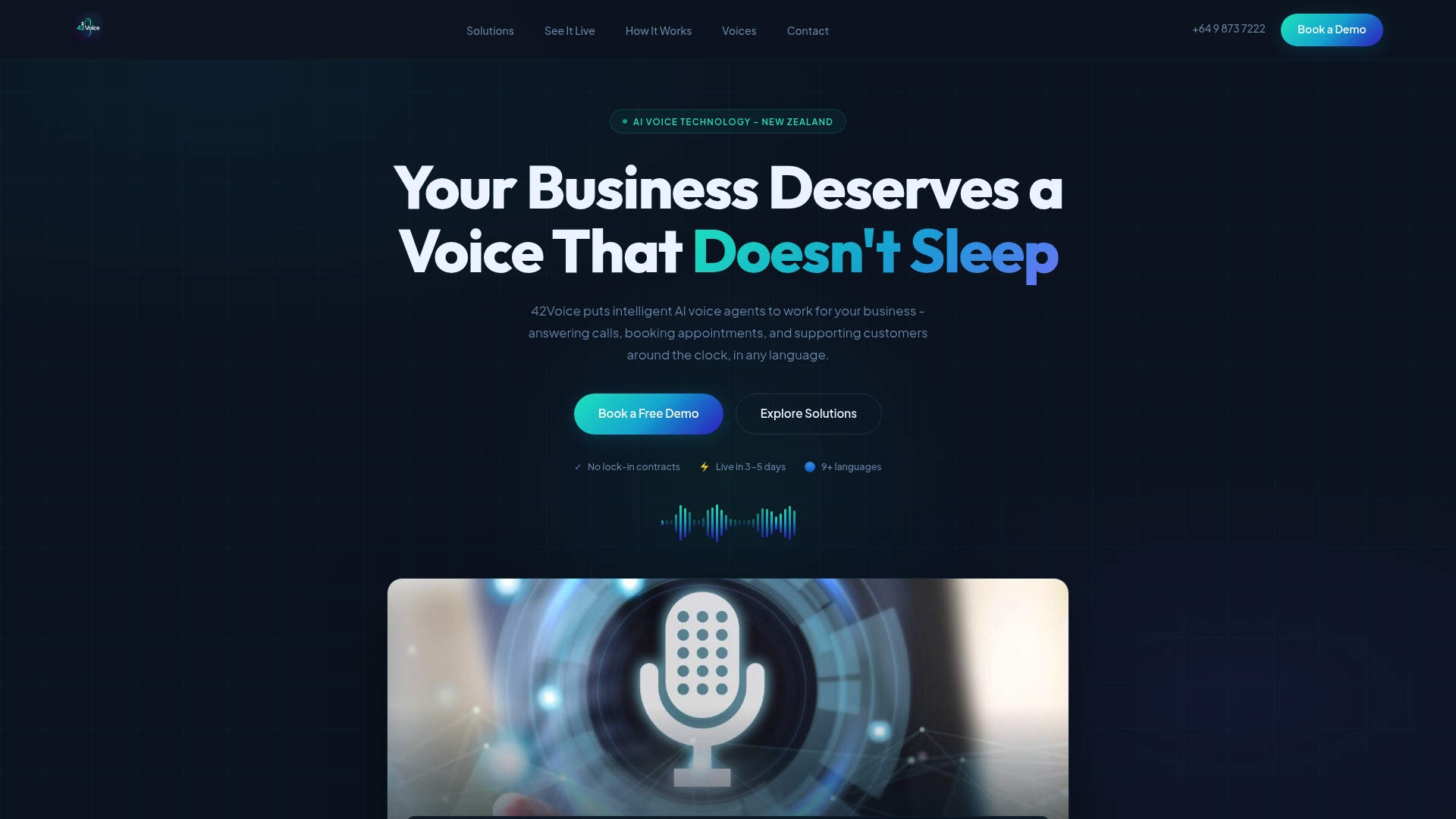
Deployment typically takes 3 to 5 days, which means you can pilot the speed-to-lead fixes from this guide on a live phone line before your next reporting cycle closes. It works around the clock and in multiple languages, so the coverage gaps that cost you leads at 9 p.m. or with a non-English-speaking caller close without adding headcount. If speed-to-lead and after-hours qualification are the biggest holes in your current funnel, book a demo of 42voice’s solutions and see how the setup maps onto your own routing and CRM before you commit to a bigger build.
Sources
- Lead response time 2026: The 5-minute rule explained
- How does AI-driven lead scoring improve conversion rates? | Apollo
- How Pecan used Pecan to improve lead conversion by 3x | Pecan AI
FAQ
What Is the 5-Minute Rule in Lead Response?
It refers to the finding that contact rates drop roughly 80% once a lead sits unanswered past 5 minutes, which is why instant routing and automated first-touch systems focus on that window specifically.
What Is the Best AI Tool for Lead Generation?
There’s no single best tool since it depends on your channel mix, but for phone-heavy businesses that need after-hours and instant qualification coverage, a voice-first AI agent platform like 42voice fills the gap that email and chat tools can’t reach.
How Do You Use AI for Lead Scoring?
Feed the model firmographic, behavioral, and intent signals, then wire the resulting score directly into routing, rep prioritization, and follow-up SLAs. Scoring alone changes nothing; it’s the connected workflow that drives the 20% to 38% lift vendors report.
What Is the 30% Rule in AI, and Does It Apply to Lead Conversion?
Definitions of this rule vary by context and industry, and no consistent, sourced version applies specifically to lead conversion. Focus instead on the measurable levers covered here: response speed, scoring, and follow-up persistence.
How Fast Should a Business Respond to a New Lead?
Aim for under 5 minutes for hot inbound leads and no more than 30 minutes for lower-intent form fills, since response speed is the single largest lever in early-stage contact rate.