
GDPR allows call recording when you identify and document a lawful basis, disclose the recording before or at the start of the call, and back the whole program with retention limits and real security controls. Skip any one of those elements and the recording itself becomes the compliance failure. The immediate action: pick your lawful basis today, write it down (with a Legitimate Interests Assessment if you’re relying on legitimate interests), and confirm your disclosure script, retention schedule, and access controls actually match what you’ve documented.
Table of Contents
- GDPR Call Recording Compliance Checklist
- Lawful Bases for Recording Calls: Consent, Legitimate Interests, and Legal Obligation
- How to Build a GDPR-Compliant Call Recording Process
- Data Subject Rights: Handling Access and Erasure Requests for Recordings
- Setting a Defensible Retention Schedule for Call Recordings
- Data Processing Agreements and Processor Responsibilities
- Security Controls Required for Call Recording Systems
- Sector-Specific Rules for Financial Services, Healthcare, and AI Voice Agents
- Cross-Border Call Recording: Managing Multiple Jurisdictions
- Anonymizing and Pseudonymizing Recorded Calls the Right Way
- Choosing and Managing Third-Party Call Recording Vendors
- Why Compliance Officers Overthink Consent and Underthink Documentation
- How 42voice Builds Compliance Into the Call Itself
- Sources
- FAQ
GDPR Call Recording Compliance Checklist
Before you record another call, run through this list. Most compliance gaps trace back to skipping one of these steps rather than getting the law wrong.
- Document your lawful basis in writing, including a Legitimate Interests Assessment if you’re relying on legitimate interests rather than consent.
- Finalize pre-recording disclosure wording and confirm how it reaches callers, whether through an IVR message or a live agent script.
- Restrict recording to lines and purposes that actually need it, and pause capture when sensitive data like payment details comes up.
- Set retention periods tied to purpose, not a blanket policy, and automate deletion so nobody has to remember to do it manually.
- Sign Article 28 Data Processing Agreements with every processor touching the recordings, including sub-processors.
- Enforce encryption, role-based access controls, and audit logging on every system that stores or plays back recordings.
- Build a repeatable workflow for subject access requests and erasure requests, with search and indexing that can find a specific call fast.
Pro Tip: Run this checklist quarterly, not once at launch. Call recording setups drift as teams add new lines, new vendors, or new use cases, and the paperwork rarely keeps pace unless someone forces it.
Lawful Bases for Recording Calls: Consent, Legitimate Interests, and Legal Obligation
Three lawful bases cover almost every business call recording scenario, and most guidance narrows the practical choice down to these.
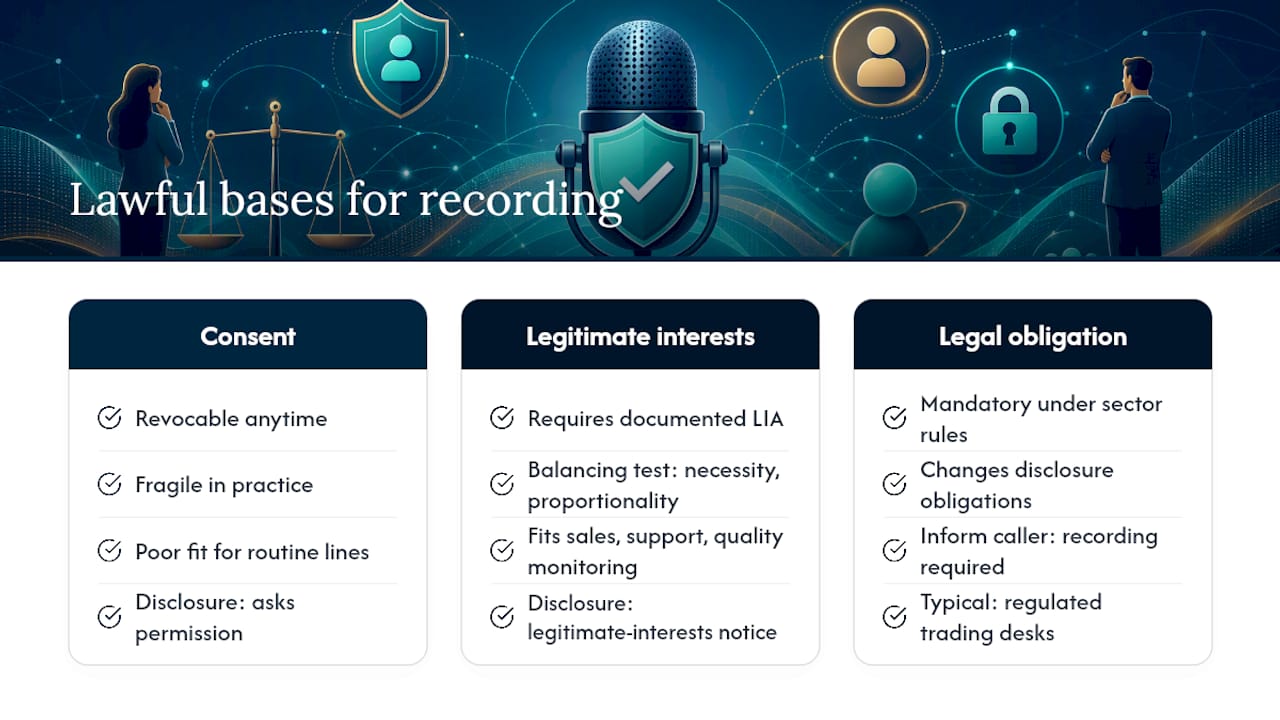
Consent sounds like the safest option, but it’s the most fragile in practice. Valid consent under GDPR must be freely given, specific, and revocable at any time. A caller who can simply hang up isn’t meaningfully consenting to anything, and a customer who needs your support line has little real choice either. If a caller objects mid-call or asks you to stop recording, you have to comply immediately, which makes consent a poor fit for routine business lines where interruption isn’t practical.
Legitimate interests fits most operational recording, from sales calls to support lines to quality monitoring. It requires a documented Legitimate Interests Assessment: a written balancing test showing your business need is real, the recording is proportionate to that need, and it doesn’t override the caller’s privacy expectations. A support center recording calls for training and dispute resolution has a straightforward LIA. A sales team recording every cold call to build a training library needs a narrower one, since the purpose has to justify the scope.
Legal obligation applies where sector rules mandate recording outright, such as regulated trading desks. This basis changes your disclosure obligations too. You’re not asking permission; you’re informing the caller that recording is a regulatory requirement, which is a different script than a legitimate-interests disclosure.
For B2B sales calls, legitimate interests with a documented LIA covers most scenarios. For customer support, the same basis works, paired with tight purpose limitation. For regulated trading, legal obligation takes over and dictates both the recording and the retention schedule.
How to Build a GDPR-Compliant Call Recording Process
Getting from policy to practice takes six concrete steps.
- Map each purpose to a system setting. Tag recording streams by purpose (training, dispute resolution, regulatory) so retention and access rules can differ by tag instead of applying one blanket rule to everything.
- Write and test the disclosure. Your script needs the fact of recording, the purpose, and how callers can object, delivered through an IVR message, a live agent line, or both. Test it the way a first-time caller would hear it, not the way your compliance team reads it.
- Build in opt-out mechanics. If a caller objects and you’re relying on legitimate interests, you need a real process to honor that objection, not just a policy that says you will.
- Minimize what you capture. Pause recording automatically during payment card entry or when medical details come up, and sample calls for quality assurance instead of recording every single one where volume allows it.
- Automate retention and legal holds. Deletion should run on a schedule tied to purpose, with a clear override process when a recording becomes relevant to litigation or a regulatory inquiry.
- Audit your vendor chain. Every processor needs a signed DPA, and any international transfer needs Standard Contractual Clauses or an equivalent transfer mechanism. Ask sub-processors for evidence, not assurances.
Breach response deserves its own line item: GDPR gives you 72 hours to notify your supervisory authority once you become aware of a personal data breach. A recording platform breach counts, and your incident response plan should name who pulls logs, who notifies the regulator, and who drafts the caller communication before an incident happens, not during one.
Pro Tip: Test your disclosure script on someone outside your compliance team. If they can’t repeat back what the call is being recorded for, the wording needs work, no matter how legally accurate it reads on paper.
Data Subject Rights: Handling Access and Erasure Requests for Recordings
Callers have the right to request a copy of their recorded call, ask what it’s used for, and, under certain conditions, ask you to delete it or object to the recording continuing. Building the workflow before the first request lands saves weeks of scrambling later.
- Right of access: search by phone number, account ID, or call date range, and redact any third parties who appear in the same recording before releasing it.
- Right to erasure: honor it unless you have a valid ground to refuse, such as an active legal claim or a regulatory retention requirement. Document the refusal and the reason.
- Right to object: when a caller objects to recording under legitimate interests, you have to re-run your balancing test for that specific case, not just point to your general LIA.
- Operational backbone: searchable metadata, transcript indexing, and a request-tracking system that logs deadlines. GDPR generally expects a response within one month of the request.
A support team without transcript indexing can spend days finding one recording. That delay alone can push a routine request past its statutory deadline.
Setting a Defensible Retention Schedule for Call Recordings
There’s no single correct retention period under GDPR. Retention has to be purpose-specific and justified, which means a quality-assurance recording and a disputed-transaction recording don’t belong on the same clock.
- Coaching and training recordings: often 30 to 90 days, since the operational need expires once feedback has been delivered.
- Dispute or complaint-related recordings: typically held longer, often a year or more, tied to your internal complaints process or limitation periods.
- Regulatory recordings in sectors like financial services follow statutory minimums that override your internal preference entirely.
Write the rationale into your privacy notice and internal retention policy, not just a settings screen nobody reviews. Automated deletion has to reach every copy: primary storage, transcripts, and backups, with a legal-hold mechanism that pauses deletion when litigation or a regulatory inquiry is active. Schedule a retention audit at least annually, since new recording lines and new integrations tend to create orphaned copies that outlive their own policy.
Data Processing Agreements and Processor Responsibilities
Any vendor storing, transcribing, or analyzing your recordings is a processor under Article 28, and that relationship needs a contract, not a handshake.
- DPA essentials: defined scope of processing, required security measures, a current sub-processor list, deletion timelines at contract end, and a breach notification window that lets you meet your own 72 hour reporting deadline.
- International transfers: if a processor stores or processes data outside the EEA, you need Standard Contractual Clauses or another valid transfer mechanism in place before data starts flowing, not after an audit flags it.
- Vendor audit checklist: request evidence of encryption standards, access control policies, and their own sub-processor DPAs, rather than accepting a compliance statement at face value.
The weakest processor in your chain sets your actual risk level, no matter how tight your own internal controls are.
Security Controls Required for Call Recording Systems
Article 32 expects security measures proportionate to the risk, and for call recordings holding customer conversations, that bar is meaningfully high.
- Encryption both in transit and at rest, with key management that separates who can access recordings from who manages the encryption keys.
- Role-based access control on a least-privilege basis, so agents can access only the recordings relevant to their queue, and playback or download requires multi-factor authentication.
- Audit logging that records who accessed which recording and when, retained long enough to support an investigation.
- Periodic reviews: access rights reviewed on a schedule, plus penetration testing on the systems storing recordings.
Pro Tip: Audit logs are worthless if nobody reviews them. Assign someone to spot-check access logs monthly, looking specifically for playback by staff outside the relevant team.
Sector-Specific Rules for Financial Services, Healthcare, and AI Voice Agents
Financial services often face mandatory recording obligations, such as those under MiFID II for trading and advisory calls, with recordkeeping duties that run longer than typical commercial retention windows and leave little room for a legitimate-interests opt-out.
Healthcare calls frequently involve special category data under Article 9, which raises the bar on minimization. Pausing or avoiding recording during any portion of a call touching medical detail isn’t optional; it’s the difference between routine processing and processing that requires extra safeguards.
AI voice agents add a disclosure layer that easily gets missed: callers need explicit notice that they’re speaking with an automated system, in addition to the standard recording disclosure. Your DPA with any voice AI vendor also needs to explicitly cover transcription and any model outputs generated from the call, since those outputs are personal data too.
Cross-Border Call Recording: Managing Multiple Jurisdictions
A single call center fielding calls from customers across several countries creates a layered compliance problem, because the caller’s location, your business’s location, and your processor’s server location can all trigger different rules.
Start with where the call originates. A call from an EU resident triggers GDPR regardless of where your business is headquartered, and many non-EU jurisdictions layer their own consent or notification rules on top. Some countries treat call recording as requiring two-party consent for any recording at all, which is a stricter standard than GDPR’s legitimate-interests option. Where your disclosure script covers multiple regions, build it around the strictest applicable rule rather than maintaining a dozen regional variants that are easy to mismanage.
Where your recordings actually live matters as much as where the call happens. If your recording platform or transcription vendor stores data outside the EEA, that’s an international transfer requiring Standard Contractual Clauses or another valid transfer mechanism, not just a DPA. Confirm this with every vendor in your chain, including analytics or AI transcription tools layered on top of your core recording platform, since a compliant primary vendor doesn’t guarantee a compliant sub-processor.
Practical rule of thumb: if your call center handles calls across the EU, UK, and North America, don’t build three separate compliance frameworks. Build one framework calibrated to the strictest jurisdiction you operate in, then confirm it also satisfies the lighter requirements elsewhere. Document which regulation governs each call type so a regulator inquiry from any one jurisdiction has a clear paper trail waiting for it.
Anonymizing and Pseudonymizing Recorded Calls the Right Way
Anonymization and pseudonymization solve different problems, and conflating them is one of the more common mistakes compliance teams make.
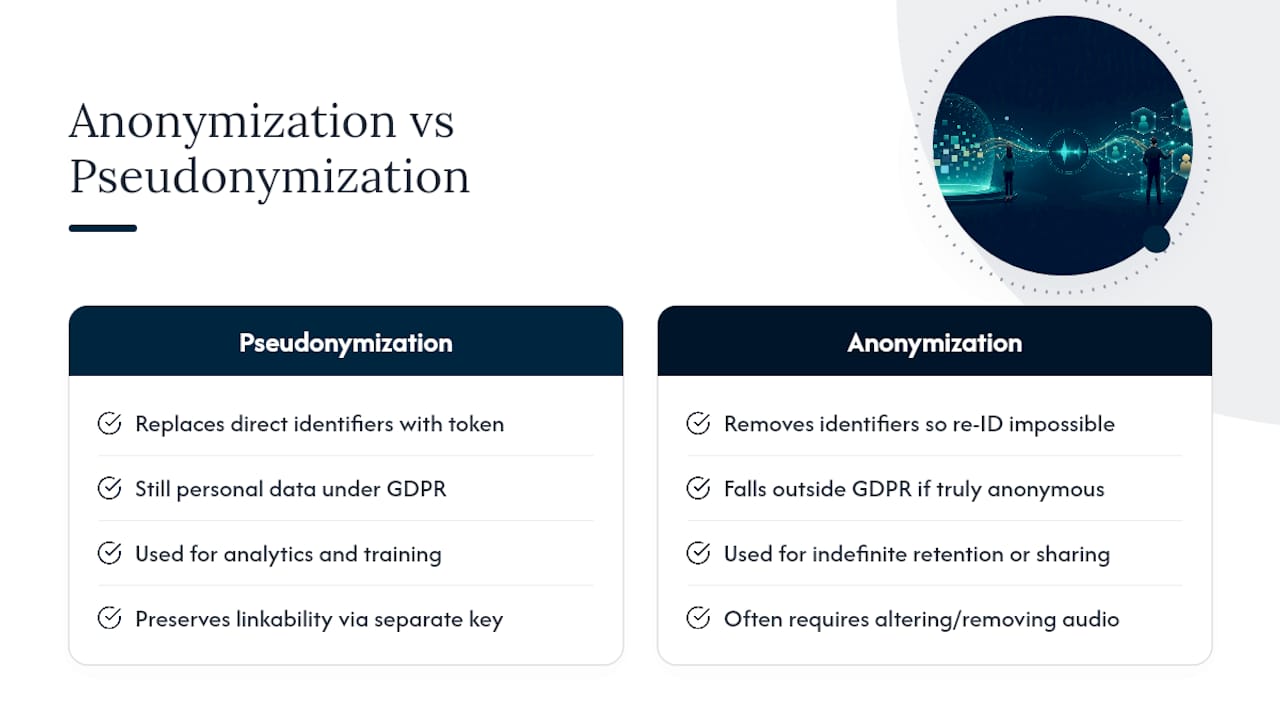
Pseudonymization replaces direct identifiers, like a caller’s name or account number, with a token, while keeping the underlying recording linkable through a separate key. It’s useful for analytics and quality review because it reduces exposure without destroying the data’s value, but pseudonymized data is still personal data under GDPR. It still needs a lawful basis, still falls under retention rules, and still carries breach notification obligations if exposed.
True anonymization removes identifying information so thoroughly that re-identification isn’t reasonably possible, even by cross-referencing with other data you hold. Genuinely anonymized recordings fall outside GDPR’s scope entirely, but that bar is higher than most teams assume. Stripping a caller’s name from a transcript while keeping their voice, phone number, and case details intact doesn’t count. Voice itself can be biometric data in some contexts, which means true anonymization for call recordings often requires altering or removing the audio, not just the transcript.
Practical best practice: use pseudonymization for training and analytics datasets where you need to preserve some linkability for legitimate business purposes, and reserve true anonymization for any dataset you want to retain indefinitely or share outside your organization. Never label a dataset “anonymized” in your documentation unless you can defend that claim against a re-identification test, because misclassifying pseudonymized data as anonymized is a common finding in the purpose limitation enforcement pattern regulators look for.
Choosing and Managing Third-Party Call Recording Vendors
Outsourcing your call recording infrastructure doesn’t outsource your compliance obligation. You remain the controller, and your vendor’s failures become your regulatory exposure.
Start vetting a vendor by asking for their security certifications and their own sub-processor list, not just a sales deck describing features. A vendor that can’t produce a current sub-processor list, or that resists signing a proper Article 28 DPA, is a compliance risk regardless of how good their transcription accuracy looks in a demo. Confirm where they store data physically, since a vendor headquartered in the EU can still route data through servers elsewhere, which reopens the international transfer question.
Ask specifically how the vendor handles deletion requests. A platform that can delete the primary recording but leaves a copy sitting in a backup or an analytics export hasn’t actually deleted anything from a GDPR standpoint. The same applies to AI-powered transcription add-ons: if a third-party AI tool processes your call audio to generate transcripts or sentiment scores, that tool is a separate processor needing its own DPA, even if you procured it through your primary recording vendor as a bundled feature.
Build a standing vendor review into your compliance calendar, not just a one-time onboarding check. Vendors change their sub-processors, expand into new storage regions, or add AI features that reprocess historical recordings in ways your original DPA never anticipated. Treating vendor management as a single gate at signup, rather than an ongoing audit surface, is where most third-party compliance gaps actually open up.
Why Compliance Officers Overthink Consent and Underthink Documentation
Most compliance teams spend disproportionate energy debating whether to use consent or legitimate interests, when the real risk sits somewhere else entirely: paperwork that doesn’t match practice. A company can pick the legally correct lawful basis and still fail an audit because its LIA describes one retention period while its actual system deletes recordings on a different schedule, or because its disclosure script promises a purpose the recordings are never actually used for.
The uncomfortable truth is that GDPR enforcement around call recording rarely turns on which lawful basis you chose. It turns on whether what you documented matches what you built. A legitimate-interests basis with a sloppy LIA is weaker than a consent basis you actually honor consistently. Regulators aren’t testing your legal theory; they’re testing whether your systems do what your paperwork claims.
That gap between policy and system configuration is exactly where automation earns its keep. A retention policy that lives in a document nobody enforces is a liability, not a safeguard. A retention rule that’s built into the platform itself, so recordings age out on schedule without a human remembering to delete them, closes the gap that turns a legally sound policy into an actual compliant operation. The same logic applies to disclosure: a script written into onboarding documentation is aspirational, while a disclosure that plays automatically before every call is a control.
— Jesse
How 42voice Builds Compliance Into the Call Itself
Most recording compliance gaps come from manual steps that quietly stop happening: a disclosure someone forgot to update, a retention rule nobody enforced, an access log nobody reviewed. 42voice builds those steps into the platform instead of leaving them to memory. Pre-recording announcements play automatically and can be configured per line or purpose, recording streams are purpose-tagged so retention rules apply automatically instead of by hand, and role-based access controls plus audit logging run in the background on every call your AI voice agents handle.
Because 42voice integrates directly with your CRM, recordings and transcripts map to the right account automatically, which shortens how long a subject access request takes to fulfill from days to minutes. If you’re running inbound support, after-hours coverage, or outbound calling and want those safeguards live without months of setup, request a demo and ask to see the retention and access control settings directly. Most pilots deploy quickly, allowing you to start using the system in a matter of days.
Sources
- Otter
- ICO — Purpose limitation (guide to the data protection principles)
- GDPR Call Recording: Compliance Guide for 2026 | Argus Archive
This article is general information, not a substitute for advice from a qualified lawyer. Consult a qualified legal professional about your own circumstances before acting on anything here.
FAQ
Can someone record a phone call without my permission?
Under GDPR, a business can record a call without your explicit consent if it relies on a different lawful basis, such as legitimate interests, but it still must disclose the recording to you before or at the start of the call.
Is recording a conversation a breach of GDPR?
Recording itself isn’t a breach if the organization has a documented lawful basis, gives proper notice, and applies appropriate retention and security controls; the breach happens when one of those elements is missing or ignored.
Am I entitled to a copy of a recorded telephone call?
Yes, under the right of access you can request a copy of a call recording that contains your personal data, and the organization generally must respond within one month, with third-party voices redacted.
Do businesses legally have to tell someone the call is being recorded?
Yes, GDPR’s transparency obligations under Articles 13 and 14 require informing callers about recording, its purpose, and their rights before or at the point the call is recorded, typically through an IVR message or a spoken disclosure.
Does using an AI voice agent change the disclosure requirements?
Yes, callers need explicit notice that they’re interacting with an automated system in addition to the standard recording disclosure, and any AI transcription or analysis vendor needs its own Data Processing Agreement covering that processing.