The best fix for missed emergency calls and double-booked jobs is an always-on, electrician-tuned AI voice agent backed by human escalation for the tough calls. 42voice deploys this kind of electrician call answering setup with plans starting from $29/mo, giving contractors NECA-aligned emergency triage without hiring a night dispatcher. Want to see it handle a live emergency script? Request a demo or quote and find out in minutes, not weeks.
Table of Contents
- Why Electricians Need Specialized Call Answering
- What Features Actually Matter for Electrician Call Answering
- How Electrician Call Answering Works Day to Day
- What Does Electrician Answering Service Pricing Look Like?
- How to Choose the Right Electrician Answering Provider
- Why an AI Voice Agent Fits the Electrical Trade
- Our Take on Rolling Out Call Answering
- Get Electrician Call Answering Running This Week
- Sources
- FAQ
Why Electricians Need Specialized Call Answering
Every unanswered call after 6 PM is a potential emergency job going to whoever picks up first. Electrical contractors lose work not because they lack skill, but because they lack coverage: a homeowner smelling smoke at 9 PM will call the next name on the list if yours rings out. Industry pages built specifically around emergency electrical work consistently push same-day dispatch and full-time availability as the baseline customers expect, not a bonus feature.
A specialized answering setup earns its keep in a few concrete ways:
- 24/7 emergency triage that separates “call me tomorrow” from “dispatch now”
- Same-day job capture for customers who would otherwise hang up and call a competitor
- Appointment booking synced directly to your crew’s calendar
- Lead qualification so you get name, address, and problem description before you call back
- Fewer no-shows through automated appointment reminders
Picture three scenarios: a breaker trips repeatedly at midnight, a homeowner wants a same-day quote on panel work, and a property manager needs recurring inspection scheduling. A generic answering service treats all three the same. A system built for electrical work knows only one of those three needs a truck dispatched tonight.
What Features Actually Matter for Electrician Call Answering
Not every answering tool on the market was built with electrical work in mind, and the gaps show up fast when a caller describes a real hazard. Before signing anything, hold vendors to this checklist:
- True 24/7 availability, not “extended business hours”
- Emergency-flagging and escalation that routes hazard calls to a live person or on-call tech immediately
- Two-way calendar sync so bookings land on your actual schedule, not a separate spreadsheet
- CRM and dispatch integration so job details flow into the tools your office already uses
- Detailed intake fields: address, access instructions, and the specific hazard reported
- Multilingual support if your service area includes non-English-speaking households
- Call logs and reporting you can review weekly
AI-first answering handles volume and consistency better than a rotating cast of overnight staff, and it never gets tired at 3 AM. Where it falls short is judgment calls that require a human voice, like a distressed caller who needs reassurance beyond a script. The strongest setups pair AI intake with a clear human handoff path for exactly those moments.
Pro Tip: Script your emergency questions the way trade guidance recommends: ask specifically about burning smells, outlets or panels that are hot to the touch, repeated breaker trips, shocks, or wet panels. These are the signs industry sources flag as immediate-dispatch triggers, and a caller who confirms even one should skip the queue entirely.
Before you commit, ask about SLA guarantees on response time and confirm pricing is disclosed upfront. Upfront, job-based pricing is a trust signal customers already expect from electricians directly, and your answering provider should meet the same standard.
How Electrician Call Answering Works Day to Day
A well-built call flow follows a simple logic:
- The agent answers and greets the caller using your business name.
- It asks targeted questions to identify whether this is an emergency.
- Emergency calls escalate to a live technician or trigger an immediate dispatch alert.
- Non-emergency calls move into appointment booking or ticket creation.
- Details log automatically into your CRM and calendar.
A sample script might open with: “Thanks for calling [Your Company], is this an electrical emergency?” If yes, it follows with hazard questions. If no, it moves to: “I can get you scheduled. What day works best?” and confirms with a callback number.
Setup typically takes 3 to 5 days when calendar and CRM integration are part of the build. That window covers script customization, connecting your booking system, and testing the emergency escalation path before it goes live on your real phone line.

What Does Electrician Answering Service Pricing Look Like?
Pricing in this space usually falls into a few models:
- Flat monthly subscription
- Per-minute or per-call billing
- Tiered packages with escalating features
- Usage-based blends of the two
Market pricing for AI-powered answering solutions starts at a low monthly rate, though emergency dispatch routing, CRM integrations, and call volume can push costs higher on more complex plans.
Pro Tip: Before you sign, ask directly about setup fees, per-incident dispatch charges, and whether call recording or CRM sync carries an extra cost. Vendors bury these in fine print more often than they should.
Most legitimate providers offer a free trial or live demo so you can hear how the system handles a mock emergency call before you commit a dime.
How to Choose the Right Electrician Answering Provider
Run every vendor through this checklist before signing anything:
- Emergency escalation speed and process
- Calendar and CRM integration options
- Response-time SLA in writing
- Transparent, published pricing
- Onboarding speed (days, not months)
- Access to call logs and reporting
- Real references or case studies
On the sales call, ask these questions directly:
- “Walk me through what happens on a hazard call, step by step.”
- “Can I get a live handoff to a human during an emergency?”
- “Do you support bilingual or multilingual callers?”
- “How is call data secured and stored?”
- “Can you run a scripted demo of an electrical emergency call right now?”
Watch for red flags: opaque pricing, no written SLA, no integration options, zero references, or onboarding timelines stretching past a couple of weeks. A provider unwilling to run a live emergency-call demo on request is telling you something.
Why an AI Voice Agent Fits the Electrical Trade
42voice is built as an AI voice automation platform handling inbound calls, appointment booking, and customer support with direct calendar and CRM integration. Deployment typically runs 3 to 5 days once integrations are mapped out, which matters when you’re losing calls every day you wait.
Where this reduces real admin load:
- Automated job intake captures hazard details before a human ever picks up
- Multilingual support covers service areas with diverse customer bases
- Automated reminders cut down on missed appointments
- First-contact triage flags true emergencies the moment the phone rings
Our Take on Rolling Out Call Answering
We recommend electricians start narrow: pilot the system on after-hours and emergency triage before touching daytime live-staff coverage. That limits risk while you confirm the escalation logic actually catches hazard calls the way it should. Full replacement of front-desk staff can come later, once the pilot proves itself on real calls, not hypothetical ones.
Get Electrician Call Answering Running This Week
Compared to hiring overnight staff or relying on a generic answering pool, 42voice gives electrical contractors a dedicated after-hours agent that never misses a hazard call and never needs a shift schedule.
Setup typically runs 3 to 5 days once your calendar and CRM are connected, and pricing stays transparent from the start with plans from $29/mo. If you want to hear the emergency triage script in action before committing, book a live demo and put it through a mock hazard call yourself.
Sources
FAQ
Is There an AI Answering Service Specifically for Electricians?
Yes. 42voice builds AI voice agents tuned for electrical contractors, handling emergency triage, appointment booking, and CRM dispatch with typical setup in 3 to 5 days.
How Much Do Electricians Charge for a Call?
Call-out charges vary widely by region and whether the visit happens during business hours or after hours, so most electricians quote job-based pricing upfront rather than a flat call fee.
What Is the One-Hand Rule for Electricians?
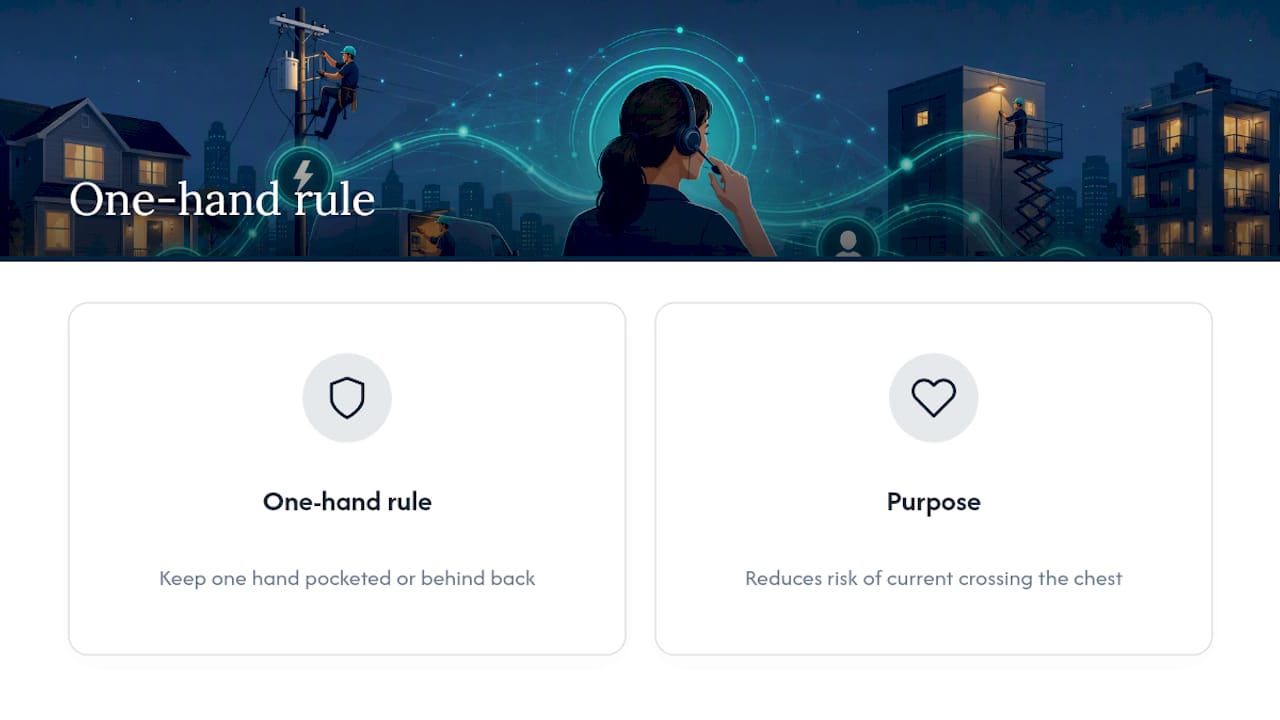
The one-hand rule is a safety practice where an electrician keeps one hand in a pocket or behind their back while working near live circuits, reducing the risk of current passing across the chest if a shock occurs.
How Much Does an Electrician Charge for a Call Out?
Call-out fees depend on location, time of day, and job complexity, and providers who publish upfront, job-based pricing tend to build more customer trust than those quoting only after arrival.
What Should I Look for in a 24/7 Electrician Answering Service?
Prioritize emergency-flagging, calendar and CRM sync, transparent pricing, a written response SLA, and a provider willing to run a live demo of an emergency call before you sign.