
AI cold calling automates the early outbound steps by deploying AI voice agents and in-call copilots to find, qualify, and book meetings at scale — without burning out your sales development reps. If your team is spending hours on unanswered dials, inconsistent qualification, or manual follow-up, this is where automation pays off fastest.
When does AI cold calling make the most sense for your team?
- High-volume top-of-funnel outreach — when your contact list outpaces your rep capacity
- ⚡ Faster lead qualification — when reps waste time on prospects who were never a fit
- Appointment generation at scale — when booking meetings is the primary SDR output
The fastest ROI from AI cold calling comes from a focused pilot. Pick one segment, define three KPIs (appointments set, connection rate, cost per meeting), and run it for 3–6 weeks before scaling. That structure separates teams that get results from teams that get frustrated.
Table of Contents
- What AI cold calling is — and what it is not
- How the tech stack actually works
- The two product categories you need to understand
- Realistic benefits and practical limits of AI cold calling
- U.S. legal guardrails: TCPA, consent, recordings, and disclosure
- How to run a safe, measurable pilot and scale AI cold calling
- Vendor evaluation checklist: what to ask, require, and verify
- What a real deployment looks like: an illustrative 42voice example
- Key Takeaways
- The part most teams get wrong about AI cold calling adoption
- 42voice gives your outbound team a voice that works around the clock
- Useful sources and further reading
What AI cold calling is — and what it is not
AI cold calling uses AI voice agents, natural language processing, and machine learning to conduct or assist outbound sales calls. It is not the same as a robocall or an IVR system. A robocall plays a prerecorded message. An IVR routes callers through a menu. AI cold calling actually listens, understands intent, responds in natural language, and adapts the conversation in real time.
Salesforce describes the category as automating lead scoring, generating personalized scripts from CRM signals, transcribing calls, and handling follow-up tasks so sellers can focus on relationship work. That is a useful framing: AI handles the repetitive, high-volume front end; humans handle the nuanced, high-stakes back end.
What AI cold calling covers:
- Automated outbound prospecting calls to cold or warm contact lists
- Real-time lead qualification using scripted conversation flows
- Appointment booking with direct calendar integration
- Voicemail drop and follow-up sequencing
Where human reps must stay in the loop:
- Complex multi-stakeholder negotiations
- Relationship-building with strategic accounts
- Handling objections that require judgment and empathy
- Final close conversations
AI cold calling is a front-of-funnel tool, not a full sales cycle replacement. Teams that treat it as the latter consistently underperform those that use it to feed a well-structured human pipeline.
How the tech stack actually works
Understanding the architecture helps you evaluate vendors honestly. A production-ready AI cold calling system has six core layers, and a gap in any one of them creates problems downstream.
The six-layer tech stack:
- Voice synthesis and ASR (Automatic Speech Recognition) — converts spoken words to text and generates natural-sounding AI speech
- NLP and intent classifiers — understand what the prospect said and route the conversation accordingly
- Orchestration engine — manages conversation flow, branching logic, and escalation rules
- Dialer and telephony layer — places calls, handles carrier compliance, and manages call routing
- CRM and calendar sync — writes outcomes back to your system of record and books meetings in real time
- Analytics pipeline — captures call transcripts, outcomes, and KPIs for reporting
Integration checkpoints to verify before you commit to a vendor:
- CRM write-back (does it sync call outcomes and contact status automatically?)
- Calendar integration (can it book meetings without rep intervention?)
- Dialer API or telephony compatibility with your existing phone system
- Contact enrichment source (where does prospect data come from, and how fresh is it?)
- Consent and compliance logs (are opt-outs and DNC flags captured per contact?)
Following AI assistant best practices means treating CRM, calendar, and knowledge-base integration as non-negotiable requirements, not nice-to-haves. Platforms that skip one of these create manual reconciliation work that erases the efficiency gains.
Pro Tip: Before you import your contact list, audit it for data freshness and consent status. Stale contacts and missing opt-in flags are the single most common reason AI cold calling pilots underperform in the first two weeks.
The two product categories you need to understand
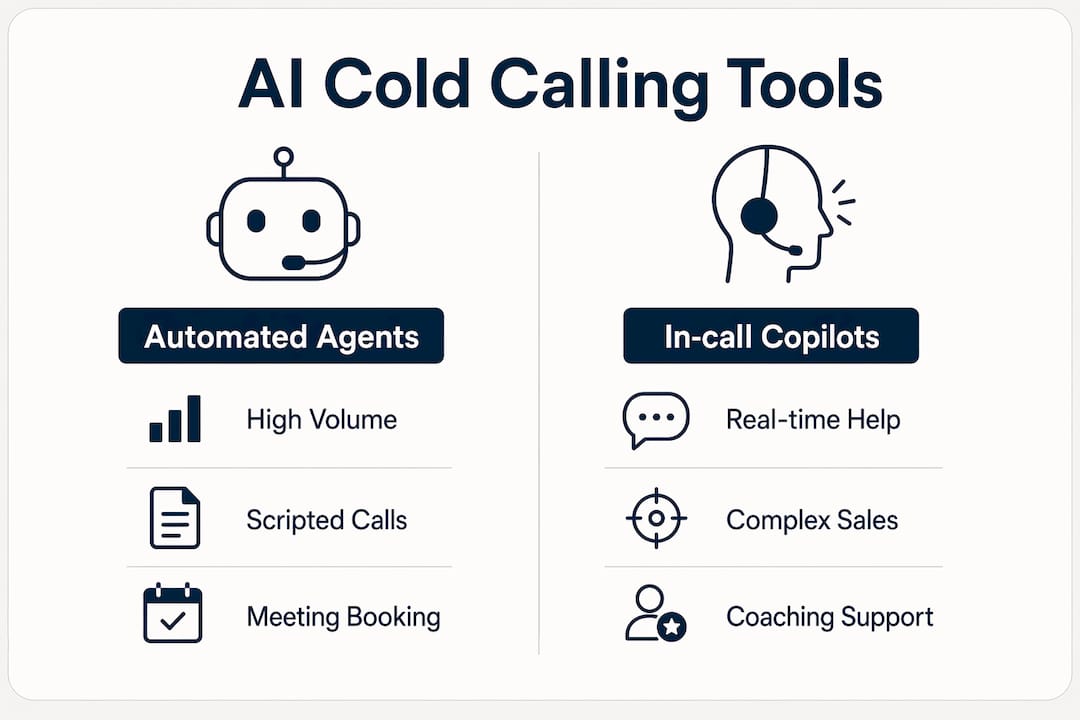
Not all AI cold calling tools do the same job. Classifying them by function before you evaluate vendors prevents the most common procurement mistake: buying a copilot when you needed an outbound agent, or vice versa.
Automated outbound agents
These systems place calls autonomously, conduct a scripted conversation, qualify the prospect, and book a meeting — all without a human rep on the line. They handle voicemail drops, callback scheduling, and CRM updates automatically. The primary output is a qualified appointment delivered to your rep’s calendar.

Best for: High-volume SDR workflows, top-of-funnel prospecting, teams with more contacts than rep capacity.
In-call copilots
These tools run silently alongside a human rep during a live call. They surface real-time guidance, objection responses, qualification prompts, and CRM updates without the prospect knowing they are there. The rep stays in control; the copilot fills gaps.

Best for: Complex sales with high average contract values, reps who need coaching consistency, enterprise deals where relationship tone matters.
| Dimension | Automated outbound agent | In-call copilot |
|---|---|---|
| Role | Places and conducts calls autonomously | Assists human rep during live call |
| Human in loop | Escalation and close only | Rep leads every call |
| Primary integrations | CRM, calendar, dialer, compliance logs | CRM, conferencing platform, playbooks |
| Best KPIs | Appointments/week, connection rate, cost per meeting | Conversion rate, talk-to-listen ratio, objection win rate |
| Deployment speed | 3–5 days with integration-ready platform | 1–2 days for overlay tools |
Pro Tip: Run a staged rollout. Pilot automated outbound agents first on your lowest-risk segment (e.g., inbound leads that went cold). Once you have baseline data, layer in copilots for your highest-ACV reps. Each stage gives you clean performance data without disrupting your core pipeline.
Realistic benefits and practical limits of AI cold calling
AI cold calling delivers real, measurable gains in specific conditions. It also has clear limits that no vendor will lead with. Knowing both upfront saves you from a failed pilot.
Where it consistently delivers:
- Scale without headcount — one AI agent can work a contact list that would require multiple SDRs
- Message consistency — every call follows the approved script, with no off-brand improvisation
- Faster qualification — prospects are scored and routed before a human rep spends a minute on them
- Reduced SDR admin time — AI automation handles transcription, CRM updates, and follow-up sequencing automatically
- Predictable scheduling — appointments land directly in calendars, reducing no-shows from manual booking gaps
Where it falls short:
- Voice authenticity — some prospects detect AI voices and disengage immediately; voice quality varies significantly by vendor
- Data quality dependency — poor contact lists produce poor results, regardless of how good the AI is
- Complex buying cycles — multi-stakeholder enterprise deals require human judgment the current generation of AI agents cannot replicate
- Consumer pushback — misuse (undisclosed AI, aggressive dialing cadences) generates complaints and regulatory exposure
Which KPIs move first vs. which lag:
Tracking both activity and conversion metrics is the right approach. Connection rate and appointments booked move within the first two weeks of a pilot. Cost per meeting becomes visible by week four. Win rate and deal size are lagging indicators — expect 60–90 days before you have statistically meaningful data there.
U.S. legal guardrails: TCPA, consent, recordings, and disclosure
This is the section most teams skim and then regret. U.S. cold calling law has specific requirements for AI-generated voices, and the FCC has issued guidance that intersects directly with automated outbound calling.
TCPA basics for AI cold calling:
- The Telephone Consumer Protection Act requires prior express consent before using an autodialer or prerecorded/artificial voice to call a mobile number
- AI-generated voices used in outbound calls can qualify as “artificial voices” under TCPA, triggering consent requirements even for B2B calls to cell phones
- Current U.S. cold-calling law requires teams to check FCC guidance on synthetic voice use and confirm consent type before dialing
Recording and disclosure requirements:
- Federal law requires one-party consent for call recording; many U.S. states (California, Illinois, Florida, and others) require all-party consent
- Disclose that the caller is an AI agent at the start of the call — this is both a legal safeguard and a trust-building practice
- Log consent status per contact in your CRM before the first dial
Operational controls to implement before going live:
- Consent flags in CRM, updated before each campaign
- Verified Do Not Call (DNC) list scrubbing for every contact batch
- Audit logs capturing call outcome, consent status, and opt-out requests per contact
- Escalation protocol for regulator inquiries (know who owns this internally)
Common legal questions, answered briefly:
Can I use an AI voice agent to call cell phones? Only with prior express written consent under TCPA. Landlines have different rules.
Do I have to disclose that the caller is AI? Federal law does not universally mandate it yet, but FCC guidance and state laws are moving in that direction. Disclose anyway — it reduces complaints and regulatory risk.
What counts as a valid consent record? A timestamped opt-in with the specific disclosure language, stored per contact in your CRM or compliance log.
Pro Tip: Build a legal checklist as a pilot gate. Before any live dialing, require sign-off that consent flags are loaded, DNC lists are current, and disclosure language is in the script. Treat it the same way you would a pre-flight checklist — non-negotiable, every time.
How to run a safe, measurable pilot and scale AI cold calling
A pilot that lacks structure produces data you cannot act on. Here is a step-by-step approach that front-loads measurement so your scale decision is based on evidence, not optimism.
Pilot scope and objectives:
- Target segment: Choose one well-defined segment (e.g., inbound leads older than 30 days, or a specific industry vertical)
- Sample size: Enough contacts to generate statistically meaningful appointment data — typically 200–500 contacts minimum
- Duration: 3–6 weeks, with a defined control cohort (human reps calling the same segment) for comparison
- Primary KPIs: Appointments set per week, connection rate, cost per meeting
Step-by-step pilot checklist:
- Data prep — clean contact list, verify consent flags, scrub against DNC registry
- Script templates — build 2–3 script variants with personalization tokens (company name, industry, recent trigger event) and consent disclosure at the top
- Human fallback rules — define which call outcomes escalate to a live rep immediately (e.g., prospect asks a complex question, expresses strong buying intent)
- CRM and calendar mapping — confirm that booked appointments write back to the correct rep’s calendar and that call outcomes update contact records
- Compliance checklist sign-off — legal or ops lead confirms consent, DNC, and disclosure requirements are met
- Rep training — brief your team on what the AI handles, what they receive (qualified appointments), and how to follow up
Sample script opening (annotated):
“Hi [First Name], this is an AI assistant calling on behalf of [Company Name]. I’m reaching out because [personalization token: trigger event or industry context]. Do you have 90 seconds to hear why teams like yours are [value proposition]?”
The consent disclosure (“this is an AI assistant”) appears in the first sentence. The personalization token follows immediately. The ask is specific and low-commitment.
Pro Tip: A/B test your opening line before scaling. Run two script variants on equal contact splits for the first week. The variant with a higher connection-to-conversation rate wins. Small wording changes — especially in the first 10 seconds — can shift outcomes significantly.
Vendor evaluation checklist: what to ask, require, and verify
Vendor selection is where most teams lose time. Use this framework to run structured demos and avoid buying on feature lists instead of real fit.
Criteria categories to score:
- Integrations — CRM, calendar, dialer, contact enrichment, consent logs
- Compliance and consent features — built-in DNC scrubbing, consent flag management, audit logs
- Voice quality and naturalness — request live demos with real prospect-style objections, not curated samples
- Human-in-loop support — how does the system escalate? What triggers a live transfer?
- Reporting and analytics — can you see call-level transcripts, outcome data, and KPI dashboards in real time?
- Pricing and SLAs — per-minute, per-seat, or outcome-based? What are the uptime and support commitments?
Questions to ask during every vendor demo:
- Who owns the call data — us or you? Can we export it at any time?
- How is the AI model trained, and does our call data contribute to model training?
- What is the rollback process if the AI produces off-script responses?
- Can you show us a live escalation to a human rep?
- What is the CRM sync cadence — real time or batch?
- What does your compliance log look like, and can we audit it independently?
Minimum acceptance requirements before going live:
- Sandbox environment with test contacts (no live dialing until you have validated the script and escalation logic)
- Measurable SLOs for uptime, call quality, and CRM sync latency
- Support SLA with a defined response time for compliance-related issues
Following AI governance best practices means requiring clear answers on data ownership, model update policies, and privacy controls before signing any contract. Vendors who deflect these questions are a red flag.
Pro Tip: Set a proof-of-concept success gate before you commit to a full contract. Define the minimum appointments-per-week and connection rate the pilot must hit to justify scaling. Share that gate with the vendor upfront — it filters out vendors who are not confident in their own platform.
What a real deployment looks like: an illustrative 42voice example
To make the timeline concrete, here is how a typical AI cold calling deployment unfolds using 42voice’s platform as the example. This is an illustrative benchmark based on 42voice’s published capabilities, not a guaranteed outcome.
Deployment scope:
- Target segment: SMB prospects in a defined vertical (e.g., home services or healthcare scheduling)
- Core integrations: CRM write-back, calendar booking, consent log
- Human fallback: Any prospect expressing strong buying intent or asking a complex question transfers to a live rep within 30 seconds
Timeline with milestones:
- Days 1–5 (Setup): 42voice configures the AI voice agent, loads the contact list, maps CRM and calendar integrations, and validates the script with the client team. 42voice’s rapid deployment targets live-ready status within 3–5 days.
- Week 1 (Dry runs): The agent runs test calls against a non-production contact set. The client team reviews transcripts, adjusts personalization tokens, and confirms escalation logic.
- Weeks 2–4 (Live pilot): The agent dials the target segment. KPIs are tracked daily: calls attempted, contacts reached, connection rate, appointments booked, and cost per meeting.
- Week 5 (Scale decision): The team reviews pilot data against the pre-defined success gate. If the gate is met, the campaign scales to a broader segment or additional verticals.
Illustrative pilot benchmarks to track:
- Appointments booked per week (compare against your current SDR baseline)
- Connection rate lift versus manual dialing
- Cost per meeting versus your current blended SDR cost
42voice supports multilingual outbound calling in 9+ languages, voice cloning for brand-consistent tone, and real-time analytics so you can review call transcripts the same day they happen. For teams that need after-hours coverage, the platform runs 24/7 without additional staffing cost.
The teams that get the most from AI cold calling treat the pilot as a learning sprint, not a proof of concept. Every call generates transcript data. Use it to refine your script, sharpen your qualification criteria, and coach your human reps on what objections are coming up most often.
Pro Tip: When presenting pilot results to stakeholders, lead with cost per meeting and pipeline velocity — not call volume. Executives care about what the pipeline is worth and how fast it moves, not how many dials the AI made.
Key Takeaways
AI cold calling delivers the fastest ROI when you deploy automated outbound agents on a defined segment, measure cost per meeting from day one, and keep humans in the loop for complex conversations and final close.
| Point | Details |
|---|---|
| Start with a focused pilot | Choose one segment with a sufficiently large contact list and run a pilot over several weeks with a control cohort for clean comparison. |
| Measure the right KPIs first | Connection rate and appointments booked improve early in a pilot, while win rate and deal size take more time to show meaningful data. |
| Legal compliance is non-negotiable | Consent flags, DNC scrubbing, and AI disclosure in the script must be in place before any live dialing under TCPA. |
| Classify before you buy | Decide whether you need an automated outbound agent (scale) or an in-call copilot (conversion) before evaluating vendors. |
| 42voice deploys within a few days after setup | 42voice’s platform covers outbound agents, CRM and calendar integration, multilingual support, and real-time analytics for SMB teams. |
The part most teams get wrong about AI cold calling adoption
There is a pattern worth naming directly: most teams that struggle with AI cold calling adoption do not have a technology problem. They have a change management problem.
Reps hear “AI cold calling” and immediately wonder whether their job is being automated away. That fear, left unaddressed, produces passive resistance — reps who do not follow up on AI-booked appointments promptly, managers who quietly undermine the pilot, and leadership that pulls the plug after six weeks because “it didn’t work.” The AI worked fine. The adoption process failed.
The fix is straightforward but requires intention. Before you launch a pilot, tell your team exactly what the AI handles (the first 60 seconds of a cold call, qualification, and booking) and what it does not handle (the relationship, the close, the account). Show them that AI-booked appointments are higher-quality leads, not a threat to their commission. Give them the transcript data so they can see what objections are coming up before they pick up the phone.
The teams that adopt AI cold calling successfully treat it as a tool that makes their reps better, not a replacement for them. That framing changes everything about how the pilot is received, how quickly reps engage with the data, and how fast the results compound. If you are a sales leader reading this, the change management conversation needs to happen before the first dial goes out — not after the first complaint comes in.
42voice gives your outbound team a voice that works around the clock
Your reps’ time is worth more than unanswered dials and manual follow-up. 42voice’s AI voice agents handle the high-volume front end of outbound prospecting — qualifying leads, booking appointments, and syncing outcomes directly to your CRM and calendar — so your team picks up the phone only when there is a real conversation to have.
Setup takes 3–5 days. The platform supports outbound cold calling, multilingual conversations in 9+ languages, voice cloning for brand-consistent tone, and real-time call analytics so you can review transcripts the same day. Whether you are running a focused pilot on one segment or scaling across multiple verticals, 42voice is built to move at your pace.
Ready to see what a live AI voice agent sounds like on a real outbound call? Book a free demo and we will walk you through a working example matched to your industry and use case.
Useful sources and further reading
The resources below are curated for U.S. sales teams evaluating or implementing AI cold calling. Each one covers a specific part of the decision: legal compliance, technical integration, or platform capabilities.
-
Cold Calling Laws 2026: AI, Autodialers & TCPA Rules — The most practical U.S.-focused legal summary available for teams navigating TCPA, FCC synthetic voice guidance, and consent requirements. Start here before you write a single script.
-
What is AI Cold Calling? How It Works and Benefits | Salesforce — Salesforce’s overview of how AI augments cold calling workflows, including lead scoring, script personalization, and follow-up automation. Useful for explaining the category to stakeholders.
-
AI Assistant Best Practices Guide for Business Teams · Tekkr — Covers CRM, calendar, and knowledge-base integration requirements for AI assistants in business teams. Use it as a vendor evaluation checklist supplement.
-
AI Integration Strategies for Executives: 2026 Guide · Tekkr — Executive-level guidance on governance, data ownership, and change management for AI projects. Relevant for sales leaders building the internal case for a pilot.
-
42voice Cold Calling Lead Generation — 42voice’s product page for outbound AI cold calling, covering agent capabilities, CRM and calendar integration, and deployment timeline. The right starting point for teams ready to evaluate a specific platform.
-
42voice Platform Overview — Full platform overview including multilingual support, voice cloning, inbound and outbound capabilities, and pricing context. Use it to assess whether 42voice fits your broader voice automation needs beyond cold calling.