
The fastest way to stop missed bookings is a 24/7 call answering solution that qualifies calls and books jobs into your dispatch board within minutes, not hours. For home service businesses, AI-enabled answering with a human handoff for complex calls works best because it combines round-the-clock pickup with fast, accurate lead qualification. One option built specifically for this kind of coverage is an AI-powered voice answering solution.
Table of Contents
- What to look for in a home-services call answering solution
- Pricing and cost models: how much you should expect to pay
- Integrations and workflows: connecting call answering to dispatch, CRM, and billing
- Implementation checklist and timeline for home service businesses
- Service level agreements and quality guarantees
- Customization options for call scripts and customer interaction
- Agent training and expertise specific to home services
- Security and privacy measures for customer data
- Customer reviews and reputation management related to call answering services
- What one missed call taught me about speed to lead
- Why 42Voice fits contractors who need coverage now
- Sources
- FAQ
What to look for in a home-services call answering solution
Not every answering service is built for contractors. The right one needs to do more than pick up the phone. It needs to qualify the caller, check your calendar, and get the right information to the right technician before the job is lost to a competitor.
Home services companies often take over 8 minutes to answer inbound calls during peak hours and average 47 hours to respond to web-form leads, according to response-time data for home service companies. AI-driven systems can compress that first-contact window to 12 to 45 seconds, which changes the outcome of a call before it even starts.
Look for these capabilities when comparing options:
- 24/7 pickup with after-hours routing, not just business-hours coverage with voicemail overflow.
- Structured lead qualification that captures job type, address, urgency, and whether the caller is the decision-maker.
- Real-time calendar checks during the call, so no two technicians get booked into the same slot.
- Emergency escalation rules that trigger SMS or voice alerts to an on-call technician for urgent jobs.
- Missed-call text-back as a fallback, plus human-in-the-loop review to catch and correct anything the system misreads.
Dispatch quality depends on qualification quality. Matching the right technician to the right job by skill set and certification, and keeping a clear dispatch board with proper debriefing, is a documented best practice in dispatch process guidance, and it only works if the intake call gathers the right details in the first place.
Pro Tip: Ask any vendor to show you a live call transcript, not a sales demo script. The difference between a scripted pitch and a real qualification flow shows up fast.

Pricing and cost models: how much you should expect to pay
Cost varies more by coverage hours and feature set than by vendor size. AI answering services typically run $50 to $300 per month, while live receptionist plans usually cost $100 to $1,000 or more per month, depending on call volume and the features included, according to answering service cost data.
Most vendors price on one of three models, and the right one depends on your call volume.
- Per-call or per-minute pricing fits businesses with unpredictable or seasonal call spikes.
- Tiered monthly plans fit steady-volume shops that want predictable billing.
- Usage-based SaaS pricing fits businesses scaling coverage across multiple lines or locations.
A few line items push the price up fast: full 24/7 coverage, live transfers to technicians, appointment booking with calendar sync, and CRM or dispatch integrations. To estimate your own spend, multiply your average monthly call volume by your average call length, then check that figure against the vendor’s per-minute or tiered rate.
Before signing anything, check for a free trial period, any monthly call minimums, and whether the contract includes a service level agreement for answer time. A month-to-month term beats a long lock-in if you are still testing fit.
Integrations and workflows: connecting call answering to dispatch, CRM, and billing
An answering service that cannot write back into your CRM or dispatch software creates more work than it saves. Look for confirmed support for platforms like Housecall Pro, ServiceTitan, Jobber, and FieldEdge, with clear write-back behavior and call dispositions logged automatically, not manually re-entered by your office staff. Many vendors in this space now build these integrations as standard, according to an overview of answering service functions.
A well-built workflow follows a consistent pattern:
- Inbound call arrives and is answered within seconds, day or night.
- The caller is qualified for job type, address, urgency, and decision-maker status.
- The system checks your calendar in real time and books an open slot.
- A dispatch notification fires, carrying address, service type, urgency, notes, and any photos the caller sent.
- A human dispatcher takes over only when the call falls outside the automated flow, such as a dispute or a highly technical question.
Passing complete, structured information to dispatch, rather than a vague voicemail summary, is what lets a technician arrive prepared instead of calling the customer back from the driveway. On the data side, expect integrations to run through standard API or webhook connections rather than manual exports, which keeps customer information moving securely between systems.
Implementation checklist and timeline for home service businesses
Getting live coverage running with minimal disruption comes down to preparation before the switch, not scrambling after it.
- Map your call flows and write out the exact intake questions your team already asks.
- Define escalation rules: which calls go straight to a human, and which stay in the automated flow.
- Gather your CRM and dispatch API credentials ahead of onboarding so nothing stalls mid-setup.
- Expect scripting and IVR setup to complete in days, while deep custom CRM fields often take longer to configure.
- Run a testing phase: sample calls, a weekend stress test, and a check that every booked job actually writes back to your CRM.
- Review overnight call logs each morning for the first few weeks to catch and correct any misrouted calls.
Track four numbers over your first 30 to 60 days: answer rate, time to first contact, booked appointments, and recovered missed leads. Those four tell you faster than any feature list whether the system is actually working.
Pro Tip: Run your stress test on a weekend, not a weekday. Weekend call patterns expose gaps in escalation rules that weekday testing usually misses.
Service level agreements and quality guarantees
A service level agreement is the part of the contract that tells you what happens when things go wrong, not just what the vendor promises when things go right. For home services, the two numbers that matter most are answer time and abandonment rate. Ask specifically how many seconds a caller waits before pickup, and what percentage of calls are answered live versus routed to voicemail or overflow.
Quality guarantees should cover accuracy of the information captured, not just speed of pickup. A call answered in ten seconds with the wrong address is worse than a call answered in thirty seconds with the right one. Look for vendors who commit to a specific escalation path when a call requires human review, and who offer some form of credit or remedy when coverage drops below the agreed standard.
Ask whether the SLA covers peak-season volume the same way it covers a typical Tuesday. Home services businesses see call spikes around weather events, holidays, and seasonal transitions, and a vendor’s baseline SLA numbers do not always hold under that kind of load. Get any peak-volume commitment in writing, not just implied by the sales conversation.

Finally, ask how disputes are resolved. A written SLA with no defined remedy is a marketing claim, not a guarantee.
Customization options for call scripts and customer interaction
Generic scripts lose jobs. A caller with a burst pipe wants a different tone and a different set of questions than someone calling to schedule a routine HVAC tune-up, and your answering solution should reflect that.
Look for a vendor that lets you customize the script by call type, not just by business name. That means defining separate intake flows for emergencies, routine bookings, billing questions, and general inquiries, each with its own qualifying questions and escalation triggers. A plumbing business and an auto repair shop should never sound like they are reading the same script with the company name swapped out.
Customization should also extend to tone and pacing. An emergency call needs quick, direct questions. A routine booking call can afford a slower, more conversational pace that builds trust. The best systems let you adjust both without needing a developer involved every time you want to change a question or add a new service line.
Ask to see or hear a sample script for your specific trade before committing. A vendor that cannot show you a plumbing-specific or HVAC-specific flow, and instead offers only a one-size-fits-all template, will likely need heavy customization work after signup rather than before it.
Agent training and expertise specific to home services
Whether the agent answering your phone is human or AI, industry familiarity changes the quality of the call. A generic answering service that does not know the difference between a service call and an installation quote will ask the wrong questions and hand your dispatcher an incomplete job ticket.
Home services calls carry specific vocabulary and urgency signals that a general-purpose call center often misses: “no heat” versus “furnace making noise,” or “no water” versus “low water pressure,” carry very different urgency levels and require different qualifying questions. An agent trained on home services terminology recognizes these distinctions and routes accordingly.
Ask any vendor how their agents, human or AI, are trained on trade-specific terminology and urgency triage. A system that treats every call the same, regardless of trade or emergency level, will eventually misroute a job that should have gone straight to an on-call technician.
The strongest setups pair automated qualification with human-in-the-loop oversight, so unusual or ambiguous calls get reviewed by someone who understands the trade, not just the transcript.
Security and privacy measures for customer data
Every call answering solution touches sensitive customer information: names, addresses, phone numbers, and sometimes payment details. That data needs to move between your phone system, the answering service, and your CRM without exposure.
At minimum, look for encrypted data transmission between systems and API or webhook-based integrations rather than manual data exports, which reduce the number of places customer information sits unprotected. Ask how call recordings and transcripts are stored, for how long, and who inside the vendor’s organization can access them.
If your business handles payment information over the phone, confirm the vendor’s process for keeping that data out of unsecured storage. A vendor that cannot clearly explain its data retention and access policy is a vendor you should keep researching before signing.
Customer reviews and reputation management related to call answering services
Reviews tell you how a service performs once the sales call ends. Platforms like Trustpilot and Capterra are commonly used across the answering service industry to check real customer experiences, and it is worth reading a vendor’s negative reviews as closely as its positive ones. A pattern of complaints about missed calls, inaccurate messages, or slow onboarding tells you more than a polished testimonial page.
Beyond checking reviews of your vendor, remember that your answering service becomes an extension of your own reputation. A caller’s first impression of your business often comes from that phone call, not your website or your truck livery. A missed call, a rushed script, or a misrouted emergency shows up eventually in your own reviews, not the vendor’s.
Ask a prospective vendor for examples of how they have handled service issues for other clients in your trade. A vendor with nothing to point to, positive or corrective, has less to show than one who can walk you through a real example.
What one missed call taught me about speed to lead
A contractor I spoke with lost a same-day water heater job because the call rolled to voicemail at 7:40 in the morning and nobody called back until after lunch. The homeowner had booked someone else by 9. That single missed call probably cost more than a year of answering service fees.
Feature lists matter less than this: how fast does the phone get answered, and how fast does that call become a booked job? Everything else is a detail. If you take one step today, turn on 24/7 pickup or missed-call text-back. It is the cheapest fix available and it starts working the same day.
— Jesse
Why 42Voice fits contractors who need coverage now
Some AI-powered voice answering services are built to close that gap without adding headcount. Such solutions can answer every call day and night, qualify the caller, book directly into your calendar, and hand off to a human team member when a call needs a real person.
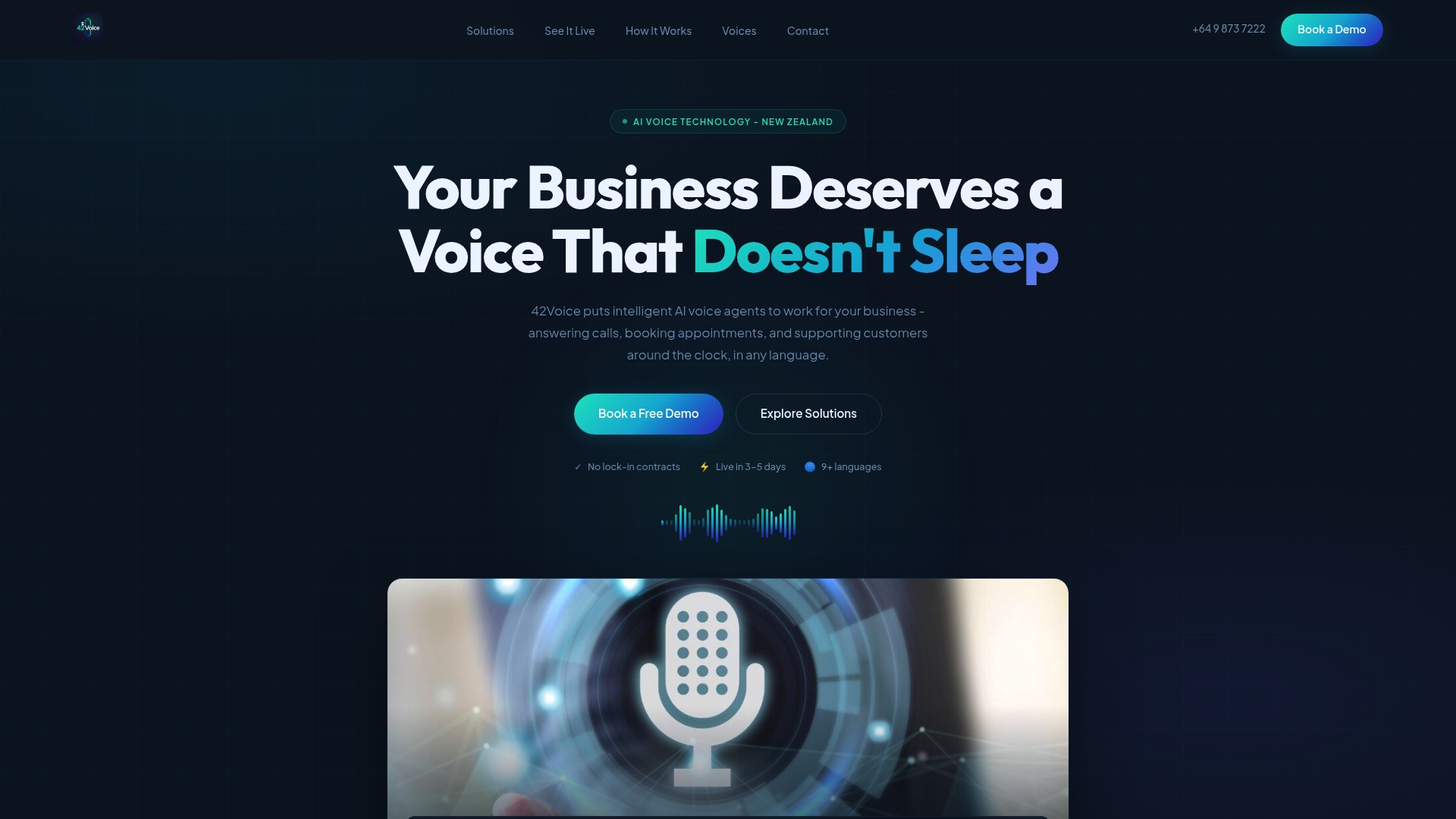
- AI receptionist features that answer, qualify, and book calls around the clock.
- CRM and calendar integrations that write bookings directly into existing systems.
- Human handoff options for complex or sensitive calls to avoid gaps.
- Typically fast deployment, often without long-term contract requirements.
Plans run under Starter, Growth, and Scale tiers, detailed on the pricing page, and you can see the full capability set on the AI Receptionist page. If your business also handles pest control or seasonal service spikes, pairing fast call answering with a pest control marketing partner can help convert the extra call volume into booked jobs. Book a free demo to see how it handles a real call from your trade.
Sources
- Answering Service Cost: What You Can Expect to Pay in 2026
- Average Response Time for Home Service Companies on Inbound Calls (2026) — Prestyj
- Dispatching processes and ideas (EGIA)
FAQ
What is the typical cost of a call answering service?
AI answering services typically cost $50 to $300 per month, while live answering plans usually run $100 to $1,000 or more per month, according to pricing data for answering services. The exact cost depends on call volume, coverage hours, and whether the plan includes booking and CRM integration.
Can I get paid to answer phone calls?
Yes, live answering agents and virtual receptionists are paid roles at many answering service companies, though pay structures and requirements vary widely by employer. This falls outside the scope of choosing a service for your home service business, but it explains why live-agent plans generally cost more than AI-based ones.
Do answering services still exist?
Yes, answering services remain widely used, now split between traditional live-agent services and newer AI-powered systems that qualify calls and book appointments automatically. Many providers combine both, using AI for routine calls and human agents for complex or emergency situations.
Is there a free answering service available?
Some providers offer a free trial period rather than a permanently free plan, since call handling, qualification, and booking all carry ongoing operating costs. Check the length of any trial and whether it includes full features like calendar booking and CRM write-back before comparing it to a paid plan.